


A sub covering a jazz class isn't the problem. A sub covering a competition jazz class three weeks before nationals, with no idea where the piece left off, no counts written down, and 14 dancers who each remember a different chunk of the choreography — that's the problem.
Most studios treat substitute coverage as a scheduling gap to fill. Find someone who can teach, notify the parents, move on. But the real cost isn't the missed hour. It's the invisible drift: choreography taught slightly wrong that has to be un-taught later, progressions that stall, and the slow erosion of parent trust when a $180/month competition team spends a class "reviewing" because nobody knew what came next.
This post is a tactical dance studio substitute teacher workflow — the call tree, the lesson-note format that actually works for movement-based classes, the make-up credit rules that don't blow up your books, and the parent messaging that keeps families calm. One problem, handled properly.
Why substitute coverage quietly wrecks progression
The reason a sub can crush a recreational tap class but destroy a pre-pointe class comes down to one thing: what the sub can reconstruct on the spot.
A recreational class runs on a repeatable structure — warm-up, across-the-floor, combo, cool down. Any competent teacher can improvise it. A progression-based class, though, carries state. Where the barre sequence stopped last week. Which dancers got cleared for turns. The exact 8-count choreographed on Tuesday that needs to connect to what comes Thursday. None of that lives in the room. It lives in your regular teacher's head.
When that teacher is out and there's no external record, the sub does the only rational thing: defaults to safe, generic material. Warm-up, stretch, freestyle, "let's clean what you already know." Feels productive. Actually costs you a week of forward motion.
This happens when a studio has strong teachers but no system for externalizing what those teachers know. The knowledge is trapped. A good sub workflow is really just a way to get it out of one person's head and into a format the next person can use in five minutes.
The four failure points, and where studios lose the most
Substitute situations break down at predictable spots:
Eliminate scheduling headaches and missed payments.
Movioly streamlines booking, confirming, and managing every class with ease.
- Unified class and instructor scheduling
- Automated student notifications
- Integrated payment tracking
No credit card required
| Failure point | What actually goes wrong | Downstream cost |
|---|---|---|
| Finding a sub | Owner texts randomly, waits, texts more, class starts uncovered | Cancelled class, refund/credit obligations, angry parents |
| Briefing the sub | Sub shows up blind, teaches generic content | Progression stalls, choreography drift |
| Choreography continuity | No counts, no video, no notes on the piece | Sections taught wrong, re-teaching next week |
| Parent communication | Parents find out at drop-off, or not at all | Trust erosion, complaints, cancellation risk |
The two nobody plans for are choreography continuity and parent comms. Almost every studio has some answer for finding a sub. Almost none have a lesson-note format built for movement, or a pre-written parent message ready to go out automatically.
The emergency call tree (build this before you need it)
The single most useful thing you can do is stop improvising the "who covers this" decision at 7am. Decide it in advance, in writing.
-
Tier 1 — In-house cross-trained staff. Teachers already on payroll who know your curriculum and your competition pieces. These are your best subs because continuity is highest. List them by which styles and levels they can actually cover, not just "can teach."
-
Tier 2 — On-call sub pool. Freelance teachers you've vetted, background-checked, and oriented once. They don't know your choreography, but they can run a structured class if handed decent notes.
-
Tier 3 — Merge or modify. If nobody's available
combine two same-level classes, convert to a supervised technique or conditioning session, or as a last resort, cancel with a make-up plan already attached.
The thing most studios miss: assign a coverage coordinator, and it should not always be the owner. When the owner is the only person who can trigger the call tree, coverage collapses the moment the owner is traveling, teaching, or asleep. Put a lead instructor or admin in charge of the morning-of scramble with clear authority to offer sub-rate pay.
For competition or exam-prep classes specifically, Tier 1 or a modified Tier 3 is almost always better than a Tier 2 stranger. A random qualified sub who doesn't know the piece will feel like coverage but produce a lost week. Sometimes a combined technique session led by someone who knows your dancers protects progression better than a "real" class taught blind.
When cancelling is actually the right call
Cancelling has a bad reputation, but for a small progression class it's occasionally the smart move. If your only option is a sub who'll teach filler that has to be undone later, you're paying to move backwards. A clean cancellation with a same-week make-up slot preserves the choreography state better than a bad substitute session. Just don't let it become the default — it belongs at Tier 3, not Tier 1.
Lesson-note templates built for choreography, not lectures
Generic sub plans are written for classroom teachers: "cover pages 40–45, assign problems 1–10." Useless for a dance class. Movement notes need a different shape.
-
Where we are right now. "Barre through grand battement, no adagio yet." One line.
-
The choreography state. For competition or recital pieces
which counts are set, which section is next, and a link to the most recent run-through video. A 30-second phone video of the piece as it currently stands is worth more than a page of written counts.
-
Do NOT teach ahead. Explicit instruction. Tell the sub to clean and repeat, not to add new choreography a stranger can't hand off correctly.
-
Dancer-specific flags. "Maya cleared for pirouettes, everyone else spotting only." "Devon has a wrist injury — no floor weight-bearing."
-
The safe fallback block. A pre-approved conditioning and technique sequence the sub can run if the class is chaotic or the notes don't cover something. Gives the sub a floor to stand on.
Keep the state file to four bullet points so maintenance is automatic.
The mistake here is making the note doc too ambitious. Teachers won't maintain a two-page plan after every class. They will update four bullet points. Keep it short enough that maintenance is automatic, or it rots within a month and you're back to blind subs.
For competition teams specifically, keep a running choreography log separate from the weekly notes — counts, formations, and a dated video after each rehearsal. When a sub or returning teacher needs to reconstruct where a piece stands, that dated video sequence is the most reliable source. This is where centralizing everything in one shared place, instead of scattered across texts and personal phones, actually pays off — the sub shouldn't have to chase down which teacher has the latest video.
Substitute day workflow
Here's how a smooth substitute day actually runs from start to finish:
-
Teacher sends absence notification (ideally before 6am)
-
Coverage coordinator receives alert and activates Tier 1 call list
-
Confirmed sub gets access to the class state file and choreography log
-
Parent notification goes out the moment coverage is confirmed
-
Sub runs the session using notes — cleaning current section, no new choreography added
-
Sub submits a brief post-class note (what was covered, any dancer issues)
-
Regular teacher reviews the note before their next session
That last step — the post-class note from the sub — is the one most studios skip. It's how your regular teacher knows what actually happened, not what was planned to happen.
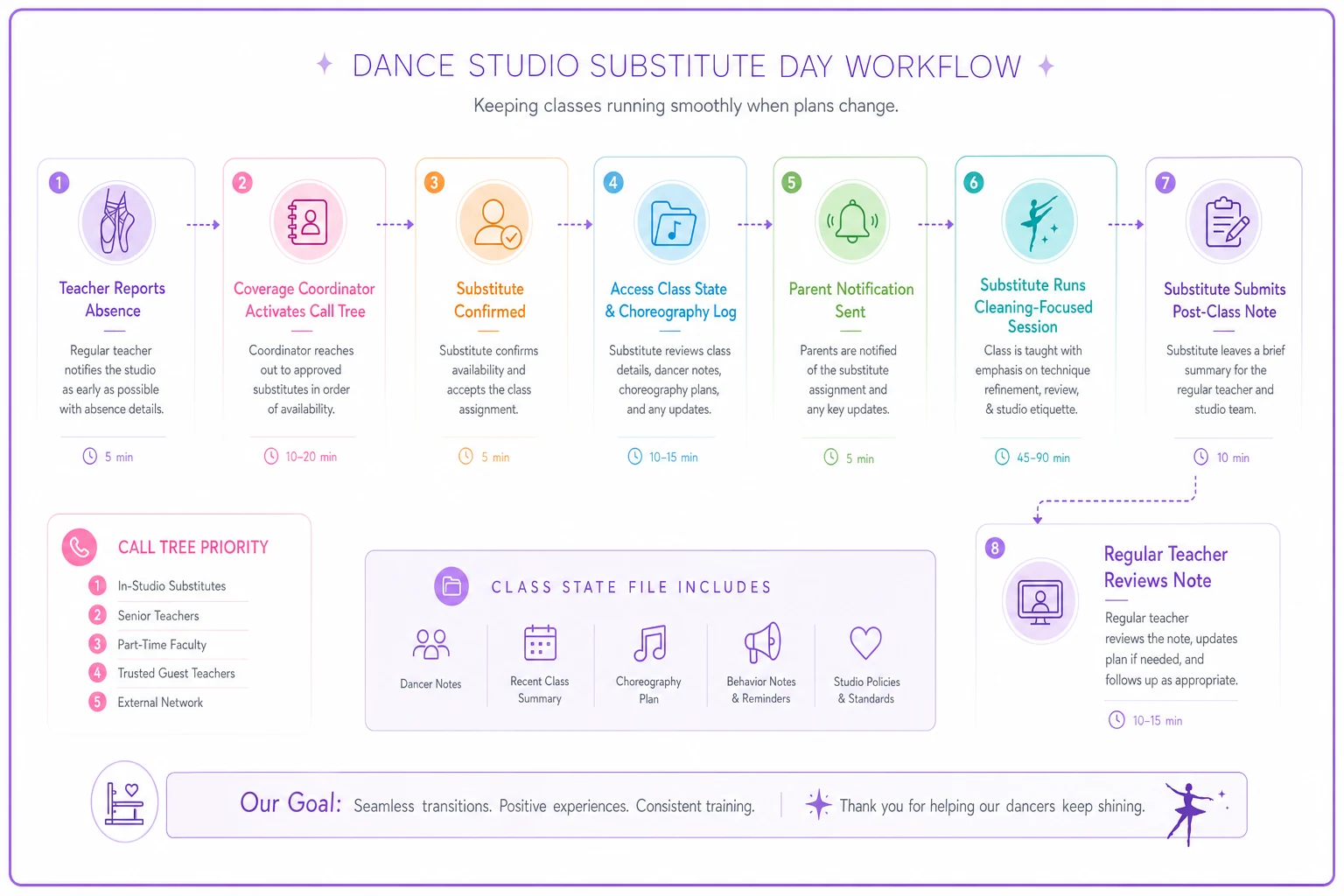
This visual maps the main responsibilities and handoffs so everyone knows who does what on a sub day.
Make-up credit rules that protect your books and progression
The moment you cancel or heavily modify a class, families expect something back. Handle it with a written policy, not case-by-case negotiation, or you'll end up with inconsistent credits and quiet resentment.
-
Studio-cancelled classes get a make-up credit or a drop-in into an equivalent class. This is on you, so honor it cleanly.
-
A substitute-covered class that still ran does NOT get a credit. The class happened. If you credit every sub-covered session, subs become a liability and you'll avoid using them even when you should.
-
Cap make-up credits with an expiration (e.g., use within the current term). Open-ended credits pile up into a liability nobody tracks.
-
For competition teams, prioritize a live make-up rehearsal over a credit. These families care about progression, not a $22 credit. Getting the lost time back matters more than money back.
The distinction between "class ran with a sub" and "class was cancelled" is the whole game. Write it down and communicate it up front so nobody is arguing definitions after the fact. If your credit and refund handling is still manual, the admin drag of processing one-off make-ups is exactly the kind of repetitive work worth systematizing — so it happens consistently instead of depending on who happens to be at the desk.
Parent communication that keeps families calm
Parents don't panic about a substitute. They panic about not knowing. The difference between a non-event and a complaint is whether the message went out before drop-off and sounded like a plan instead of an apology.
> "Heads up — Miss Elena is out today, so Mr. Ray (one of our staff instructors) is covering the 5pm Junior Contemporary class. He has notes on where the group is in the routine, so today's focus will be cleaning the current section. Regular class resumes next week."
That's it. Notice what it does: signals the sub isn't a random stranger, and signals progression is protected ("has notes," "cleaning the current section"). Parents relax when they hear those two things.
Send it as early as possible — the second coverage is confirmed, not when class starts. For competition families, a slightly longer note explaining how the lost time gets made up prevents the "are we falling behind before nationals?" spiral that turns into a phone call you don't have time for.
Real scenario: a small competition-focused studio
A studio with around 210 students and two competition teams kept losing rehearsal ground every time a lead choreographer was out. Over one competition season they had roughly six sub days across the two teams — and nearly every one turned into a "clean what you know" session because subs had nothing to work from. Two of those pieces needed sections re-choreographed before regionals because they'd been taught inconsistently, which cost extra rehearsal weekends nobody had planned for.
They changed three things: a two-tier call tree with a lead instructor (not the owner) running morning coverage, a dated video-log for each competition piece updated after every rehearsal, and a standard parent text that fired the moment a sub was confirmed.
The next season had a similar number of sub days — you can't stop teachers from getting sick — but the outcome was different. Subs walked in with the latest video and a four-bullet state file, ran real cleaning sessions instead of filler, and no piece needed emergency re-choreographing. Parent complaints about sub days dropped to basically none, because families heard about it early and heard the word "notes."
The number of substitutes didn't fall. The lost progress did.
Who should NOT over-engineer this
If you run mostly open-level recreational classes with no competition track, you don't need a choreography video log. A simple call tree and a standard parent message covers you. Building an elaborate note system for classes that don't carry state is wasted effort teachers won't maintain.
The full workflow — living notes, video logs, make-up rules, staged call tree — earns its keep when you have progression-based classes: competition teams, exam prep, pre-pointe, syllabus-based programs. That's where a bad sub day actually costs you weeks. For everything else, keep it light.
Bringing it together
Substitute coverage isn't really about finding someone to stand in the room. It's about whether the knowledge your teachers carry can survive a day without them.
Build the call tree before you need it. Keep the note format short enough that teachers actually update it. Record the choreography as it evolves so nobody has to reconstruct it from memory. Write your make-up rules down so credits stay consistent. Message parents early enough that a sub day is a shrug, not a complaint.
Do that, and the next 7am "I'm out sick" text becomes a routine handoff instead of a lost week of progress.
Do that, and the next 7am "I'm out sick" text becomes a routine handoff instead of a lost week of progress.
Ready to elevate your studio operations?
Join 500+ studios using Movioly to save time, reduce admin workload, and enhance student experiences.