



Most dance studios lose trial students somewhere between day 3 and day 7. Not because the classes aren't good. Not because families don't want to continue. They lose them because the onboarding feels like nothing.
The family shows up for their trial class. Maybe they get a "thanks for visiting" email. Then silence until someone remembers to follow up two weeks later asking if they want to register. By then, the excitement has cooled, the kid has moved on to soccer tryouts, and that potential $2,400 annual enrollment is gone.
The pattern is pretty consistent across studios. The ones converting 65–70% of trials into paid students don't just teach better classes. They orchestrate every touchpoint from the moment someone books a trial through their first paid month.
The psychology behind trial conversions
Parents don't actually decide based on the trial class itself.
They decide based on how the studio makes them feel about their decision to try dance. Class quality matters, obviously, but what really drives conversion is whether parents believe this studio will take care of their child and not make their life harder.
-
Will my kid actually stick with this?
-
Am I going to be that parent who signs up for something their kid quits after three weeks?
-
Is this going to become another weekly battle?
-
How much is this really going to cost once you factor in costumes and competitions?
-
Will they actually teach my child or just stick them in the back row?
The trial class answers maybe one of these questions. Your onboarding sequence needs to handle the rest.
Mapping the critical conversion window
Here's what typically happens at studios that struggle with conversion: Day 1: Trial class happens. Instructor says "great job!" Parent leaves with a brochure. Day 2–6: Nothing. Maybe a generic thank-you email. Day 7: Someone calls to follow up. Parent is at work, doesn't answer. Day 10: Another call attempt. They connect. Parent says they're "still thinking about it." Day 14: Final follow-up email with a registration link. Day 21: Parent signs their kid up for soccer instead.
Eliminate scheduling headaches and missed payments.
Movioly streamlines booking, confirming, and managing every class with ease.
- Unified class and instructor scheduling
- Automated student notifications
- Integrated payment tracking
No credit card required
Now here's what happens at studios converting at 70% or higher:
Hour 2 (post-trial): Personalized text from the instructor — "Emma did amazing in her first ballet class today! She picked up the positions so quickly. Looking forward to seeing her Thursday!"
Day 1 (evening): Email with three things:
-
Specific feedback about what their child did well
-
What they'll learn in the next 3 classes
-
Link to a private video showing basic positions to practice at home
Day 3: Text check-in before the second trial class — "See you at 4pm today! Emma can wear whatever she's comfortable in. We'll be working on jumps — the kids love this one!"
Day 4: Parent gets access to the studio app with trial schedule, instructor bio, and a parent portal showing exactly what skills their child is developing
Day 7: The "investment conversation" email that actually addresses cost concerns:
-
Exact monthly tuition
-
What's included, no hidden fees
-
Payment plan options
-
A simple comparison showing dance costs less than most travel sports
Day 10: Video testimonial from another parent whose child started at the same age, addressing the exact things trial parents worry about
Day 14: Decision email with a limited-time enrollment incentive — waived registration fee if they commit within 48 hours
The second sequence assumes the sale from day one and removes friction at every step. That's the whole difference.
Building your trial-to-paid automation sequence
The most effective trial conversion systems run mostly on automation, with strategic human touchpoints layered in. Here's the framework:
Immediate post-trial (0–2 hours)
Automated: Thank you email with class photo and what to expect next
Human: Instructor sends a personal text about a specific moment from class
Automated: Add to studio CRM, tag as "Active Trial - Day 1"
The momentum phase (Days 2–5)
Day 2 Automated: "How to prepare for class" email with a checklist
Day 3 Human: Front desk texts a reminder 2 hours before class
Day 4 Automated: Parent portal access with progress tracking
Day 5 Automated: "What your dancer is learning" video series begins
The connection phase (Days 6–10)
Day 6 Human: Instructor leaves a voicemail with specific praise
Day 7 Automated: The money conversation email — full cost transparency
Day 8 Automated: Studio culture video, "A day in the life" style
Day 9 Human: Check-in call from the studio manager
Day 10 Automated: Parent testimonial sequence starts
The decision phase (Days 11–14)
Day 11 Automated: "Your child's dance journey" projection email
Day 12 Human: Personal invitation to an upcoming studio event
Day 13 Automated: Limited-time enrollment offer
Day 14 Human: Final personal outreach from owner or director
This looks like a lot written out, but once it's built, roughly 80% runs automatically. The human touches take maybe 10 minutes per trial family.
Here's a simple visual workflow of this automation sequence.
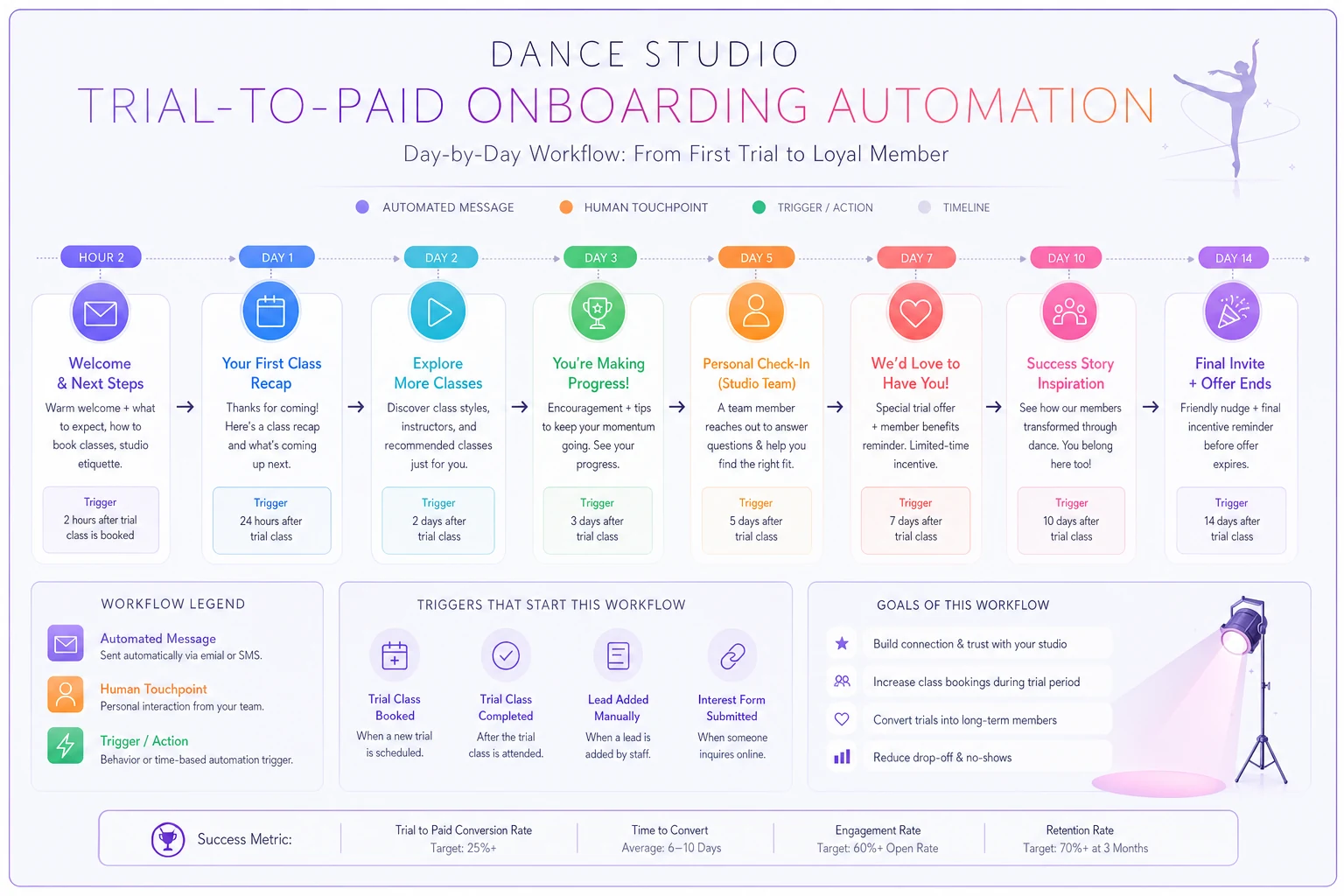
Once it's built, the system triggers the right human touches at the right time while automation handles the routine communications.
The first-month curriculum that locks in retention
Converting the trial is step one. Keeping them past month three is where the real revenue actually lives.
Most studios lose new students in months 2–3 because the honeymoon phase wears off and reality settles in. The kid starts complaining about going. Parents question whether it's worth the hassle. The excitement fades into routine.
Week 1–2: Foundation and confidence
-
Focus entirely on making the student comfortable
-
No corrections unless safety is involved
-
End each class with something they succeeded at
-
Send parents a video of their child doing something correctly
Week 3–4: Integration and belonging
-
Pair the new student with a class buddy
-
Include them in a simple group routine
-
Have them demonstrate one thing for the class
-
Invite parents to observe the last 5 minutes of week 4
Week 5–6: Progress and commitment
-
Introduce the first real challenge appropriate to their level
-
Send parents a progress report with specific achievements
-
Mention an upcoming performance opportunity
-
Start discussing proper dance attire and shoes
Week 7–8: Community and identity
-
Include the family in a studio event — even just a casual pizza night
-
Take an "official" class photo with the new student
-
Share a student spotlight on studio social media
-
Present them with a studio t-shirt or something similar
By week 8, they're not just taking dance classes. They're a dancer at your studio. That mental shift is what actually drives long-term retention.
The conversion killers hiding in your process
The availability trap: Trial family loves the class, wants to register, but the only opening is at an inconvenient time. You lose them to a studio with worse instruction but a better schedule.
The sticker shock moment: They expect $75/month based on your website, then find out about registration fees, costume fees, recital fees, competition fees. The real average lands closer to $200/month. They feel misled.
The communication black hole: Dad brings the child to the trial. Mom handles all extracurriculars. Dad never forwards the follow-up emails. Mom never knows to register. You've been following up with the wrong parent the entire time.
The comparison paralysis: They're trialing at three studios at once. Yours is actually the best fit, but you're the last to follow up and they've already committed somewhere else.
The permission confusion: The child loves it and wants to continue, but needs a grandparent who pays for activities to approve it. You never identified or engaged the actual decision maker.
Each of these is fixable, but you have to know they're happening first.
Testing and optimizing your conversion funnel
The highest-converting studios constantly test their sequences — not massive overhauls, just small adjustments that compound over time.
A/B tests worth running:
Text vs. email for day 1 follow-up Version A: Email within 2 hours Version B: Text within 2 hours (Text typically wins by 15–20% in response rate)
Instructor vs. owner for personal touchpoints Version A: All personal contact from the instructor Version B: Mix of instructor and owner/director (Depends on studio culture, but owner involvement tends to increase perceived value)
Incentive timing Version A: Enrollment discount offered on day 7 Version B: Enrollment discount offered on day 13 (Day 13 usually converts higher — urgency without feeling desperate)
Video content vs. written content Version A: Email with bullet points about the program Version B: Email with a 2-minute video from the instructor (Video wins almost every time)
Single vs. multiple trial classes Version A: One trial class before making a decision Version B: Two-week unlimited trial (Two-week typically converts around 20% higher but requires more tracking)
Test one change at a time and let it run long enough to collect meaningful data.
Track these metrics consistently:
-
Trial booking to show rate
-
Show rate to second class attendance
-
Second class to enrollment
-
Enrollment to 90-day retention
-
Average time from trial to enrollment decision
Studios that implement systematic testing usually see conversion improvements of 20–30% within six months.
When automation helps and when it doesn't
The temptation is to automate everything. Set it and forget it. But some touchpoints need to stay human or conversion rates will drop.
Automate these:
-
Scheduling and reminders
-
Information delivery — what to wear, where to park
-
Progress tracking and reporting
-
Payment processing and receipts
-
General studio updates and newsletters
-
FAQ responses and basic questions
Keep these human:
-
First follow-up after the trial
-
Addressing specific concerns
-
Phone calls — never automate voice
-
Invitations to special events
-
Handling objections
-
The final enrollment ask
The sweet spot is roughly 70% automated, 30% human. That keeps the personal feel while freeing up staff to focus on conversations that actually move the needle.
AI-powered operational platforms handle this balance reasonably well — triggering human tasks at the right moments while managing repetitive communication automatically. The key is making sure automated messages still feel personal. Use the child's name, reference their specific class, mention their instructor. Generic automation is easy to spot and easy to ignore.
Real conversion metrics from actual studios
Here's what typical conversion funnels look like across different studio types:
| Studio Type | Monthly Trial Bookings | Show Rate | Trial to Paid | 90-Day Retention | Annual Value Per Conversion |
|---|---|---|---|---|---|
| Recreational (suburban) | ~45 | 78% | 42% | 81% | $1,850 |
| Competition-focused (suburban) | ~25 | 89% | 67% | 93% | $4,200 |
| Urban boutique | ~60 | 65% | 38% | 72% | $2,400 |
The competition studio converts higher because families arrive already committed to the investment. The urban studio struggles with show rate — more options, less commitment — but makes up for it with higher trial volume.
The hidden revenue in your trial pipeline
Most studios focus on getting more trials. But the math rarely supports that approach.
Say you get 30 trials per month converting at 40%. That's 12 new students. At $150/month average, that's $1,800 in new monthly revenue. Now keep the same 30 trials but increase conversion to 60%. That's 18 new students. $2,700 in new monthly revenue.
That improvement added $900/month without a single additional marketing dollar. Over a year, that's nearly $11,000 in additional revenue from the exact same trial flow.
This is why operational efficiency beats marketing spend almost every time at this stage. You're already paying to get these families in the door. Converting them well is just pure margin.
Building your studio's trial machine
The difference between studios that survive and studios that actually grow isn't instruction quality. It's systems quality.
A properly built trial-to-paid funnel runs quietly in the background, converting families while you focus on teaching. It answers parent questions before they think to ask. It removes friction from registration. It builds emotional investment before asking for financial investment.
Start with the basic sequence. Test one element at a time. Track your numbers. Within 90 days you'll see movement. Within six months, it'll feel obvious that you needed this.
The studios winning right now aren't necessarily the best teachers. They're the ones who've figured out that conversion is a process, not a single moment. They've built something consistent — and consistency is what turns a decent studio into a full one.
Ready to elevate your studio operations?
Join 500+ studios using Movioly to save time, reduce admin workload, and enhance student experiences.