



Most dance studios lose 3-4 weeks of actual instruction during recital season. Not because of the recital itself, but because nobody planned for the ripple effects that start showing up around week 8.
You know the pattern. February rolls around, energy is high, everyone's excited about the June recital. Then somewhere around late March, regular classes start falling apart. Teachers get pulled for extra rehearsals. Students miss technique classes for costume fittings. Parents start asking why their Tuesday ballet class keeps getting cancelled for "recital prep."
By May, half your students are behind on curriculum, recreational families feel neglected, and your instructors are burned out from juggling rehearsals on top of their normal teaching load.
The studios that keep their regular programming intact through recital season don't work harder. They start earlier, protect their instructional time deliberately, and build a rehearsal schedule that actually reflects how dancers learn — not just what fits in the room calendar.
The 12-week breakdown that actually protects class time
Weeks 12-10: Foundation setting (March) This is when you lock in your non-negotiables. Not the fun creative stuff — the operational boundaries that determine whether May will be sustainable or a mess.
Rehearsal windows get established now, not when you "need more time" in week 4. Studios typically need 18-22 total rehearsal hours per routine for recreational groups, 28-35 for competitive. Map those hours across the timeline now. If a routine needs 20 hours and you have 10 weeks, that's 2 hours per week. Simple math that gets ignored constantly.
The delegation matrix starts here too. Assign your choreography leads, your logistics coordinator (not the same person), and your parent communication point person. One studio had their competition team coach handling all recital communications on top of her normal duties. When they shifted parent emails to the front desk coordinator and costume logistics to a part-time admin, she finally had bandwidth to actually coach.
Create your protected class list. These are the classes that cannot be cancelled, moved, or shortened for any recital-related reason — fundamental technique classes, beginner programs, and anything where consistency matters for safety, like acro or aerial work.
A visual of this timeline helps teams align on where rehearsal windows and protected class time fall.
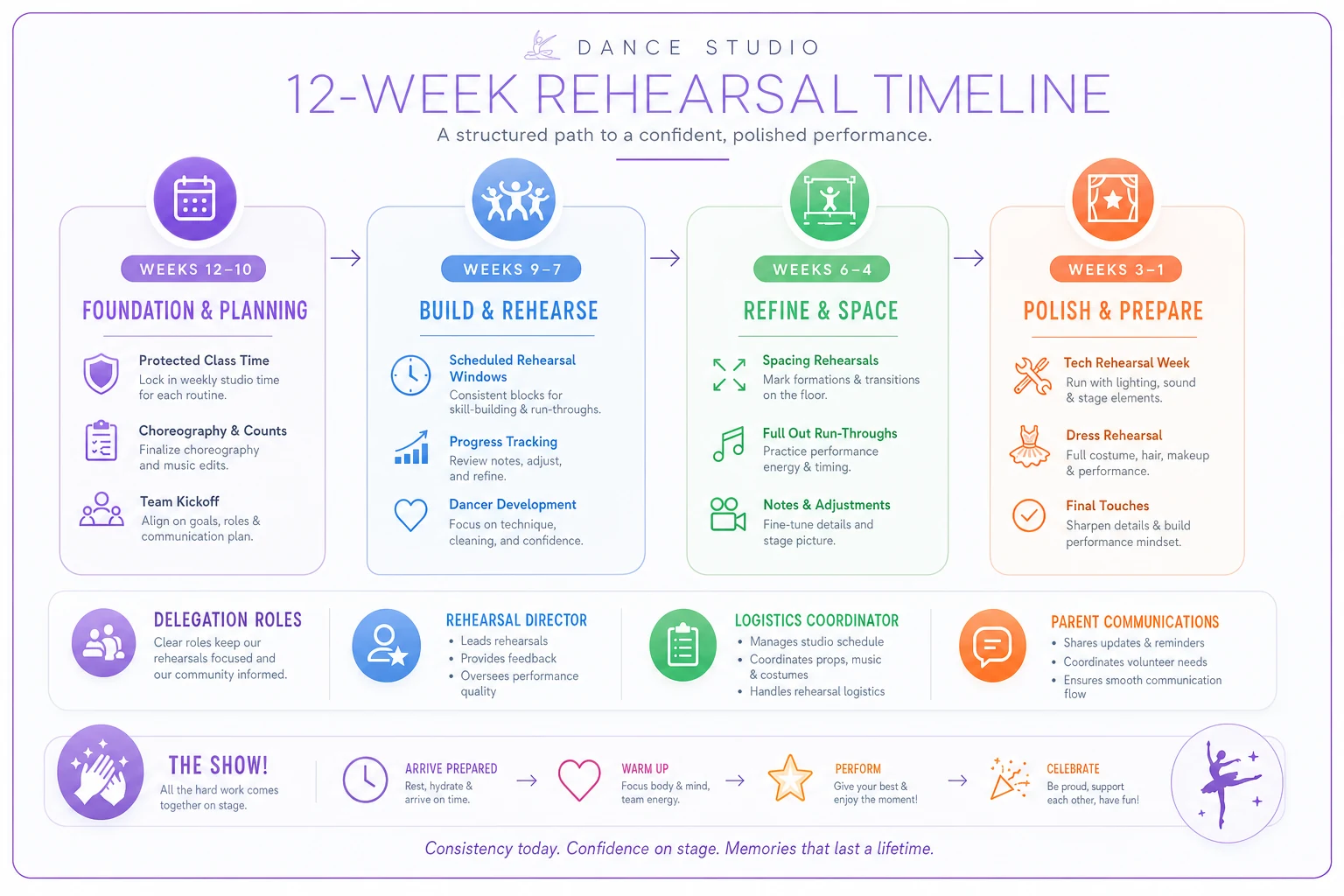
Weeks 9-7: Choreography and initial spacing (Late March - Early April) Choreography happens in designated rehearsal slots only. Not during regular class time. Not as "optional" add-ons that students feel pressured to attend anyway.
Spacing needs roughly 25% of your total rehearsal time. If you've allocated 20 hours, plan 5 of those specifically for formations, entrances, and exits. Most studios try to cram this into the final two weeks and then wonder why the show looks unpolished.
What kills momentum faster than anything: pulling kids out of regular technique class for spacing rehearsals. A studio in Virginia fixed this by scheduling all spacing work on Saturday mornings from 9-12. Three hours, once a week, every group cycled through. Their Tuesday/Thursday technique classes stayed untouched all spring.
Weeks 6-4: The danger zone (April - Early May) This stretch is where regular classes typically start falling apart. Teachers feel behind on choreography. Parents are asking about costumes and tickets. Everyone wants "just one extra rehearsal."
Your delegation matrix earns its keep here. Costume questions go to your logistics coordinator, not your teachers. Ticket and program questions go to front desk. Choreography concerns go to rehearsal directors during designated hours, not pulled aside mid-class.
Block out your dress rehearsal week now — not just the dress rehearsal itself, but the entire week. Studios lose a lot of instructional time during this stretch because they didn't account for tech rehearsals, costume fixes, and the general stress spiral that hits parents in week 5.
One studio started scheduling "technique intensives" that week instead of trying to run normal classes while everyone's focus was already on recital. Shorter, structured sessions on fundamentals. Attendance actually improved because parents saw it as intentional prep rather than filler.
Weeks 3-1: Final preparations (Mid-May - Early June) If you've protected your schedule up to this point, these weeks are about polish, not panic.
Tech rehearsal should happen on a non-class day — Saturday or Sunday, full run-through, no regular classes cancelled to make room. Studios that try to squeeze tech into a weekday evening end up with exhausted dancers and frustrated families who drove across town twice.
Final spacing and dress rehearsal follow the same logic. Yes, dress rehearsal takes a full day. No, you can't also run regular classes that day. Plan for this from week 12 and nobody's blindsided by it.
The delegation matrix that stops teacher burnout
Your instructors shouldn't be handling any of the following:
Eliminate scheduling headaches and missed payments.
Movioly streamlines booking, confirming, and managing every class with ease.
- Unified class and instructor scheduling
- Automated student notifications
- Integrated payment tracking
No credit card required
-
Costume distribution or alterations
-
Ticket sales or seating questions
-
Program ad sales or design
-
Parent emails about rehearsal logistics
-
Quick-change assistance backstage
-
Music editing or technical cues
These tasks eat 15-20 hours per instructor during recital season. Hours that could go toward actual teaching or choreography.
Primary Rehearsal Director Owns all artistic decisions, choreography standards, and rehearsal pacing. Doesn't have to be the studio owner. Often your most experienced instructor who understands both competitive and recreational programs.
Logistics Coordinator Handles costume ordering, sizing, and distribution. Manages volunteer schedules. Coordinates hair and makeup requirements. This role alone saves each instructor around 8 hours during peak weeks.
Parent Communications Lead Sends all recital updates, answers the "what time should we arrive" emails, manages last-minute questions. Usually your front desk lead or a dedicated admin — never your teachers.
Technical Director Music cuts, light cues, backstage flow. Either a hired professional or a technically capable parent volunteer with clear boundaries. Works alongside your rehearsal director but handles all technical execution independently.
Volunteer Coordinator Recruits, schedules, and manages parent volunteers for everything from backstage help to ticket taking. This role prevents the week-of scramble that almost always falls on teachers when nobody planned ahead.
The rehearsal schedule that doesn't sacrifice technique
The standard mistake is scheduling rehearsals by room availability rather than learning capacity.
Dancers under 10 retain choreography better with two 45-minute rehearsals per week than one 90-minute block. Dancers over 14 can handle longer sessions but need technique warm-up built in — otherwise you're running choreography on cold bodies and wondering why retention is poor.
| Age Group | Block Length | Frequency | Notes |
|---|---|---|---|
| Elementary (5-8) | 45 min max | 2x/week | No back-to-back; best on Tue/Thu or Mon/Wed splits |
| Pre-teen (9-12) | 60 min | 2x/week min | Back-to-back OK if styles differ; space sessions 48+ hrs apart |
| Teen/Advanced (13+) | 90 min | Flexible | 20 min warm-up, 60 min choreo, 10 min cool-down and notes |
The conflict minimizer worth trying: build "rehearsal pods" where dancers in multiple numbers work through all their pieces in one block. Instead of driving in Monday for jazz, Wednesday for tap, and Friday for the production number, they come Monday from 4-7pm and knock out all three. Families make one trip. Dancers stay focused. The parking lot stops feeling like a revolving door.
Build "rehearsal pods" where dancers in multiple numbers work through all their pieces in one block.
Families make one trip. Dancers stay focused. The parking lot stops feeling like a revolving door.
Real-world application: How one studio protected 85% of regular classes
Mid-sized studio in Ohio — around 300 students, 22 recital routines. In previous years they'd cancelled or modified somewhere around 40% of regular classes between April and recital week. Parents noticed. Recreational enrollment dropped the following fall.
-
Designated Saturday mornings as rehearsal-only time starting in March
-
Built a delegation matrix with parent volunteers handling all non-teaching tasks
-
Protected all weekday classes at the intermediate level and below
-
Moved dress rehearsal to Memorial Day Monday instead of cramming it into a weeknight
They ended up cancelling only 6 regular classes the entire season — down from 30-plus the year before. Recreational families felt like they actually mattered. Fall enrollment went up around 12% because parents saw the studio could pull off a big production without abandoning the weekly program that brought them there in the first place.
Their biggest takeaway wasn't about finding more time — it was about using the time they'd already allocated more deliberately. When teachers weren't answering costume emails or editing music, they could teach. When rehearsals happened in protected windows, classes stayed consistent.
The tech stack that makes this timeline possible
Running this manually means someone's tracking 22 routines, 300 students, multiple rehearsal spaces, and dozens of volunteers across spreadsheets that stop making sense around week 8.
This is where operational software becomes genuinely useful. Not fancy — just functional. You need:
Rehearsal scheduling that flags conflicts automatically. When you add a Saturday rehearsal, you immediately see which dancers have conflicts with competition team practice or other commitments.
Parent communication that doesn't require instructor involvement. Automated updates when rehearsal times are confirmed. Reminder texts 24 hours before. Costume pickup notifications. None of it requires a teacher to type a single email.
Volunteer management that actually works. Sign-ups, schedules, reminders, and task assignments in one place. No more group texts trying to figure out who's working backstage during which show.
Real-time updates that prevent the week-of scramble. When a rehearsal moves, every affected family finds out immediately. When dress rehearsal runs long, the next group gets notified to arrive later.
The AI automation side of these platforms handles the repetitive communication and scheduling conflicts that tend to eat 20+ hours per week during recital season. Your rehearsal director makes the artistic calls, the software handles the logistics of making sure everyone knows when and where to show up.
Studios using integrated operational platforms typically report saving 15-25 hours per week during recital season — and more importantly, instructors stay focused on teaching because they're not buried in administrative back-and-forth.
Making the timeline work for your specific situation
Small studios (under 150 students): You probably don't need a full delegation matrix, but you absolutely need protected rehearsal windows. Consider condensing to one show instead of two, which creates more focused rehearsal time without spreading everyone thin.
Large studios (500+ students): The delegation matrix becomes critical at this scale. You may need assistant rehearsal directors broken out by age group. Consider staggering recital dates — recreational show in early June, competitive showcase the following weekend.
Competition-heavy studios: Your dancers are used to high-intensity schedules, but they're also the most vulnerable to burnout if you don't protect some downtime. Build in "technique only" weeks where no choreography rehearsal happens at all.
Recreational-focused studios: Your families chose you because of the low-pressure environment. Keep rehearsals light, communications clear, and don't let recital prep overshadow what makes weekly classes worth coming to.
When you tailor the timeline to your studio size and priorities, you protect the things that matter most: consistent instruction, instructor bandwidth, and family satisfaction.
The bottom line on protecting class time during recital season
Recital season doesn't have to mean sacrificing your regular program. The studios that maintain class quality through spring aren't the ones with more hours in the day — they're the ones who decided in March what they weren't willing to compromise.
Your 12-week timeline comes down to one decision: will you plan the recital around your educational program, or let the recital swallow it?
The delegation matrix means your teachers teach. Protected rehearsal windows mean classes stay consistent. A conflict-minimizing schedule means families don't burn out before the curtain opens.
When you protect regular class time through recital season, you're sending a clear message about what your studio actually values. You're not a recital factory that teaches dance on the side. You're a program that happens to produce a great show.
Start the timeline 12 weeks out. Delegate everything except the actual teaching and choreography. Schedule rehearsals based on how dancers learn, not what's left over in the room calendar.
When June arrives, you'll have a strong recital and students who actually progressed in their technique all spring — and that combination is what brings families back in September.
Start the timeline 12 weeks out. Delegate everything except the actual teaching and choreography. Schedule rehearsals based on how dancers learn, not what's left over in the room calendar.
When June arrives, you'll have a strong recital and students who actually progressed in their technique all spring — and that combination is what brings families back in September.
Ready to elevate your studio operations?
Join 500+ studios using Movioly to save time, reduce admin workload, and enhance student experiences.