



Your spring schedule runs smoothly with 18 classes a week. Parents know the routine, instructors have their set days, Studio A handles ballet while Studio B runs hip-hop. Then September hits—you expand to 26 classes to handle waitlists, add a third instructor, and suddenly everything breaks.
Double bookings appear out of nowhere. Your lead instructor texts at 8pm asking if she's teaching the new Tuesday intermediate jazz or if that's Marcus's slot. Parents email confused about whether their kid's contemporary class moved rooms. You spend Sunday nights with three spreadsheets open, trying to puzzle-fit instructors, rooms, and levels like some chaotic Tetris game that never quite resolves.
The weird part? You had fewer problems when you were running fewer classes. Growth was supposed to simplify things.
Why schedules break at exactly 20–25 classes per week
This pattern is predictable once you've watched enough studios hit the same wall. Things run fine at 15–18 weekly classes because everything still fits in your head. You know Sarah teaches Tuesday/Thursday ballet, the competition team gets Studio A on Saturdays, and there's enough buffer that small changes don't cascade.
But somewhere between 20–25 classes, three things collide:
Your instructor matrix hits critical mass. With 2 instructors splitting 15 classes, it's simple—each person has clear domains. Add a third instructor and 8 more classes, and suddenly you're tracking 40+ potential teaching slots, substitute preferences, and certification requirements. One sick day now requires 5 scheduling adjustments instead of 1.
Room utilization pushes past 70%. Below that, you have natural buffers. A class running 10 minutes over doesn't matter much. Once you pack the schedule tighter, those buffers vanish and that 10-minute overrun creates a domino effect through the whole evening.
Student pathways multiply beyond what you can track manually. At 15 classes, most students follow 1 of maybe 3 progression paths. At 25 classes with multiple levels per style, you're suddenly managing 8–10 different pathways, each with its own scheduling conflicts and prerequisites.
Studios assume they have an instructor problem or a space problem. Most of the time, it's a systems problem.
The capacity planning framework studios never think to build
Most studio owners treat scheduling like a creative puzzle to solve each term. But it's really a capacity equation with three variables that interact in pretty predictable ways:
Eliminate scheduling headaches and missed payments.
Movioly streamlines booking, confirming, and managing every class with ease.
- Unified class and instructor scheduling
- Automated student notifications
- Integrated payment tracking
No credit card required
Instructor capacity isn't just hours available—it's hours × expertise × energy distribution. An instructor might have 20 available hours but only 12 high-energy hours suitable for younger kids' classes. Or they're certified for ballet and contemporary but not jazz, creating invisible constraints you don't see until you're desperately trying to cover a Tuesday jazz class.
Room capacity goes beyond simple hourly slots. Each room has a personality: Studio A with mirrors and barres suits ballet but feels wrong for hip-hop. Studio B's sprung floor handles jumps but the ceiling height limits lifts. These constraints multiply as you add classes—what worked at 60% utilization breaks at 85%.
Demand patterns follow predictable curves studios rarely bother mapping. The Tuesday 4–7pm window looks roughly like this:
-
4
00pm: Low demand (kids still in school)
-
4
30pm: Moderate (some early dismissals)
-
5
00pm: Peak begins
-
5
30pm: Maximum demand
-
6
00pm: Still strong
-
6
30pm: Drops sharply (dinner time)
When you understand these three variables, you stop forcing square pegs into round holes and start building schedules that can actually hold up under growth.
Building your instructor load matrix (with real numbers)
Forget the basic availability spreadsheet. You need a load matrix that captures the full picture:
| Instructor | Total Hours | High-Energy Hours | Styles | Level Range | Max Sequential Classes | Preferred Days | Substitute Pool |
|---|---|---|---|---|---|---|---|
| Sarah | 25/week | 15 | Ballet, Contemporary | Beg–Adv | 3 | Tue, Thu, Sat | Emma, Marcus |
| Marcus | 20/week | 20 | Jazz, Hip-Hop, Tap | Beg–Int | 4 | Mon, Wed, Fri | Jordan, Sarah |
| Emma | 15/week | 10 | Ballet, Jazz | Beg only | 2 | Mon, Thu, Sat | Sarah |
| Jordan | 10/week | 10 | Hip-Hop, Breaking | All | 3 | Flexible | Marcus |
Then layer in the load rules that prevent burnout and quality drops:
-
No instructor teaches more than 3 sequential classes without a 30-minute break
-
High-energy classes (ages 3–6) count as 1.5x load
-
Competition team rehearsals count as 2x load due to intensity
-
New instructors cap at 60% load for their first 8 weeks
Include substitute pool preferences in the matrix so coverage decisions are faster when someone calls out.
Sarah might show 25 available hours, but once you factor in that she already teaches 3 preschool ballet classes (4.5 load points) plus 2 competition rehearsals (4 load points), she's actually at 70% capacity despite only teaching 11 clock hours.
This matrix prevents the Thursday scenario where Sarah gets scheduled for 4 consecutive preschool classes and burns out by week 3, leaving you scrambling for substitutes.
The seasonal ramp template that prevents September chaos
Studios operate like every September is a surprise, scrambling to accommodate the post-summer enrollment surge. Build a ramp template that anticipates the patterns instead:
September surge planning (starts in June)
-
Historical data
September enrollment typically jumps 35–45% over summer
-
Instructor prep
Add 2 provisional instructors by August 1st
-
Room optimization
Identify 3–4 underutilized summer slots that can convert to fall classes
-
Communication
Parent survey in July about fall preferences
January plateau management
-
Expect 10–15% new enrollment from "New Year resolution" families
-
Plan 2 trial/beginner series classes
-
Keep 1 float slot for splitting overcrowded classes
March competition season compression
-
Block 6–8 hours of weekend rehearsal space starting February
-
Reduce recreational class offerings by around 15% to free instructor time
-
Prepare parents for modified March/April schedules back in January
Summer transformation
-
Morning slots become viable (camps, intensives)
-
Evening demand drops roughly 50%
-
Weekend classes nearly empty
A typical structure might look like:
-
Fall (Sept–Dec)
28 classes/week across 6 days
-
Winter (Jan–Mar)
26 classes/week, competition prep begins
-
Spring (Apr–May)
24 classes/week, recital preparation
-
Summer (Jun–Aug)
16 regular classes + 4 intensive programs
Each season needs its own capacity model, not just tweaks to the same base schedule.
The implementation checklist that actually prevents chaos
Week 1–2: Data gathering phase
-
Map current utilization rates for every room, every hour slot
-
Document actual (not scheduled) class durations including transition time
-
Track instructor no-shows, late arrivals, and sub requests from the past 6 months
-
List every scheduling complaint or confusion from last term
-
Calculate the real capacity of each room—not maximum, but comfortable capacity
Week 3–4: System design phase
-
Create instructor load matrix with all constraints
-
Design pathway maps showing how students progress through levels
-
Establish buffer rules (minimum time between classes, maximum sequential teaching)
-
Define "schedule break points"—the enrollment numbers that trigger adding classes
-
Build substitute coverage trees showing primary/secondary/emergency coverage
Week 5–6: Schedule creation phase
-
Start with cornerstone classes (longest-running, most popular)
-
Add progression pathways ensuring students can advance without conflicts
-
Layer in new/trial classes in protected slots that won't cause cascading changes
-
Verify every instructor stays within load limits
-
Check room transitions allow proper setup and cleanup time
Week 7–8: Stress testing phase
-
Run "what if" scenarios
instructor sick days, room equipment failures, weather closures
-
Have three staff members independently check for conflicts
-
Create the parent-facing schedule with progression options clearly highlighted
-
Build the substitute schedule showing coverage for every class
-
Document decision rules for common scenarios (class under-enrolled, instructor requests a change, parent complains about timing)
Here's a simple visual workflow of the implementation phases to keep the team aligned.
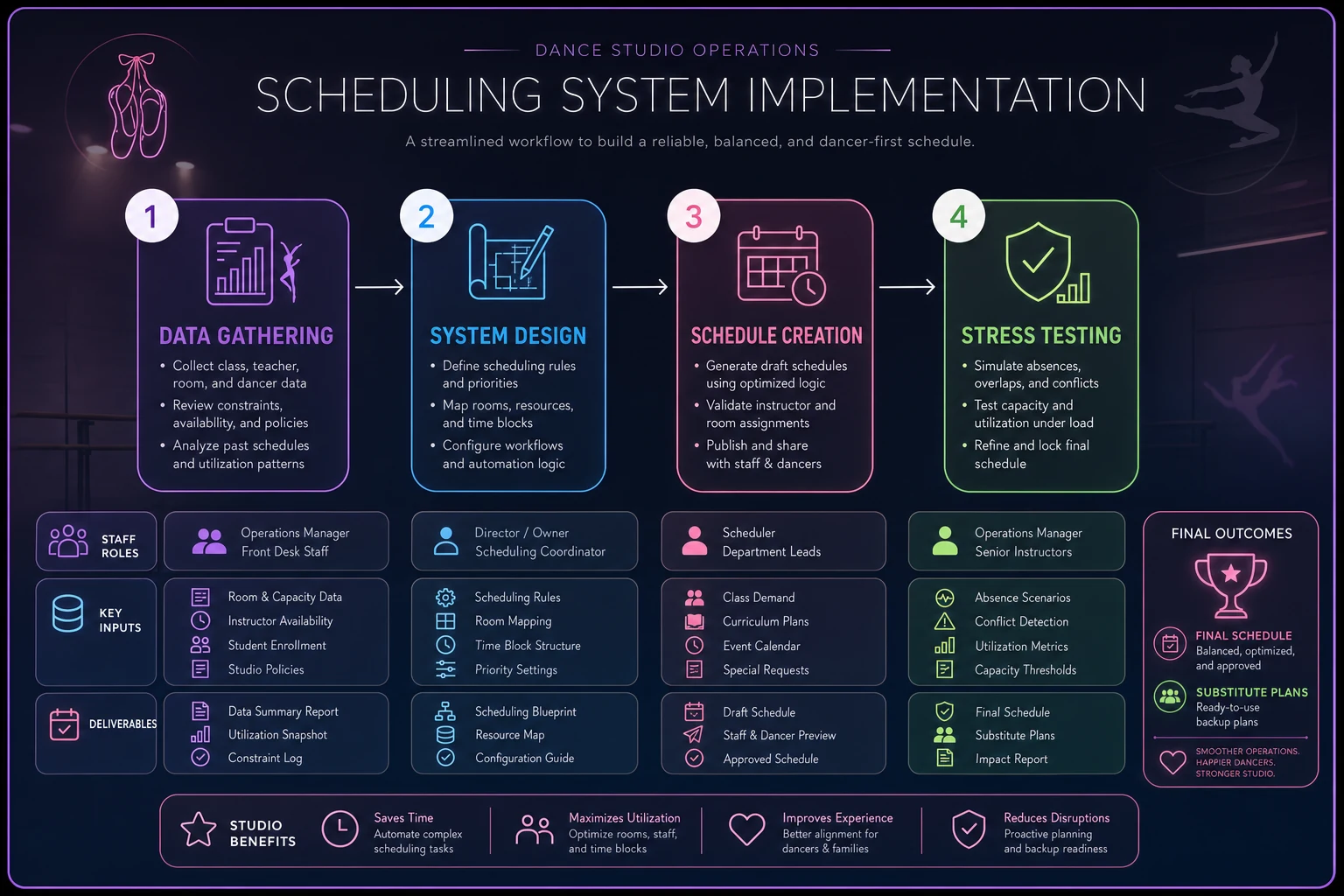
Run the workflow visually with the team during Week 3 to ensure everyone understands the handoffs.
When to abandon democratic scheduling and become a systems dictator
Studios often let scheduling drift into a democracy—instructors request their preferred times, parents lobby for convenient slots, everyone has input. This works until around 20 classes/week. Beyond that, you need benevolent dictatorship guided by systems.
The Thursday 5:30pm slot is a good example. Parents want it. Three instructors prefer it. It's your highest-demand slot. Democratic scheduling would put a beginner class there because the most people asked for it.
Systems thinking says put your intermediate jazz class there. Intermediate students are committed, show up consistently, and their tuition supports the studio's foundation. Beginners get the 4:30pm slot—slightly less convenient but workable, and natural attrition won't gut your primetime revenue.
The decisions aren't complicated once you have principles:
-
Primetime slots (5–6
30pm weekdays) go to proven, profitable programs
-
New or experimental classes get edge times until they earn better placement
-
Instructor preferences matter but don't override operational logic
-
Parent convenience influences scheduling, it doesn't determine it
When someone complains, point to the system: "We schedule based on enrollment history, instructor certification, and pathway progression. Let me show you why this setup actually serves everyone better..."
Scaling past 40 weekly classes: when software becomes mandatory
Studios running 15 classes can survive on spreadsheets and memory. At 25 classes, you need solid systems and real attention to detail. Past 40 weekly classes, human-managed scheduling hits a complexity wall that no amount of organization can fix.
The breaking points become hard to ignore:
Conflict detection grows exponentially. With 40 classes, 5 instructors, and 3 rooms, you're tracking somewhere around 600 potential conflict points weekly. One instructor change can cascade through 15 different adjustments. Miss one conflict and you've got angry parents and confused students.
Pathway tracking becomes impossible. Students follow 15+ possible progression paths across multiple styles and levels. Ensuring a dedicated ballet student can take all required classes without conflicts while also fitting in an optional jazz class means analyzing hundreds of permutations manually.
Change management overwhelms everything. Every week brings 5–10 scheduling adjustments: instructor substitutions, makeup classes, special rehearsals, room maintenance. Tracking who was notified, who confirmed, and what's still pending becomes a full-time job on its own.
This is where AI-powered scheduling platforms shift from nice-to-have to operational necessity. The right platform handles conflict detection automatically, suggests optimal placements based on historical patterns, and manages the communication cascade when changes happen. It tracks instructor loads, monitors room utilization trends, and can even flag which schedule configurations tend to drive higher dropout rates.
More importantly, it frees you from Sunday-night spreadsheet sessions so you can focus on teaching quality and student experience instead of schedule Tetris.
The strategic metrics that show if scaling worked
Adding classes feels like growth, but only specific metrics tell you whether you're scaling successfully or just adding complexity:
Revenue per schedule hour should increase as you scale. If you're running 40 hours of classes weekly generating $16,000/month, you're at $400/hour. Add 10 more hours of classes—revenue should reach at least $20,000/month to hold that efficiency. If it only hits $18,000, those new classes are dragging down profitability.
Instructor utilization vs satisfaction creates a useful ratio. You want instructors at 70–85% utilization (teaching 14–17 hours if available for 20). Below 70%, you're overstaffed. Above 85%, burnout starts creeping in. But also track satisfaction—an instructor at 75% utilization spread across 6 days will be miserable compared to one at 85% teaching consolidated blocks across 3 days.
Cross-enrollment percentage shows schedule efficiency. In a well-designed schedule, 40–60% of students take multiple classes. Below 40% suggests scheduling conflicts are preventing students from expanding their training. Above 60% might mean you're not pulling in enough single-class students to grow the base.
Schedule stability score measures week-to-week consistency. Track what percentage of classes run as originally scheduled without changes. Strong studios tend to hold 85–90% stability. Below 80% usually points to systemic problems—too many conflicts, unreliable instructors, or over-ambitious scheduling.
Dropout correlation with schedule changes reveals hidden problems. If students who experience 2+ schedule changes in a term show significantly higher dropout rates, your change management process is broken. The schedule might look fine on paper but fail in execution.
Studios that scale well watch these metrics monthly and adjust before small problems become enrollment crises.
Conclusion: systems thinking beats heroic effort every time
Your schedule touches every part of studio operations—instructor happiness, parent satisfaction, student progression, and revenue stability. Treating it like a weekly puzzle to solve through sheer effort guarantees you'll hit a ceiling around 20–25 classes where complexity overwhelms human capacity.
The studios that scale past 40, 60, even 80+ weekly classes don't work harder on scheduling. They build systems that handle complexity without requiring constant intervention: instructor load matrices that prevent burnout, seasonal templates that anticipate demand patterns, capacity planning that balances utilization with flexibility.
Start with the instructor load matrix this week. Map the real constraints—not just availability but energy, expertise, and sequential teaching limits. Build the seasonal template next, acknowledging that September's schedule can't look like June's. Then use the implementation checklist to stress-test before committing to a term that locks you into 16 weeks of scheduling chaos.
And let go of the idea that good scheduling means making everyone happy. Good scheduling means creating a system that serves your business goals while respecting operational constraints. Parents might grumble that beginner ballet isn't at the perfect time. Instructors might want different days. But a stable, profitable schedule beats a people-pleasing puzzle that falls apart the moment you add two more classes.
The difference between a 20-class studio drowning in spreadsheets and a 60-class studio running smoothly isn't genius or heroic effort. It's systems thinking, honest capacity planning, and the discipline to follow the framework even when someone insists contemporary dance would really work better on Thursdays.
Build the system once. Adjust seasonally. Let the framework absorb the complexity while you focus on what actually matters—delivering great dance education without spending every Sunday night in operational damage control.
Ready to elevate your studio operations?
Join 500+ studios using Movioly to save time, reduce admin workload, and enhance student experiences.