


Most studio owners think instructor management breaks because of people problems. An instructor calls out last minute. Someone's upset about their schedule. A new teacher isn't ready after training. Pay discussions turn awkward.
What's actually happening in most of these situations: the entire instructor operation runs on memory, relationships, and whatever worked last time. No documented pay structure. Training happens when someone has time. Scheduling gets done in Excel with fifteen revision emails. Review conversations happen... eventually. Substitute coverage depends on who answers their phone.
The studios that survive past year three build actual systems. Not complicated HR departments — just simple operational frameworks that answer every predictable question before it becomes a crisis. Pay formulas everyone understands. Onboarding checklists that produce consistent results. Scheduling rules that feel fair because they are fair.
After watching hundreds of studios either build these systems or slowly collapse from instructor chaos, the pattern is pretty obvious. Studios don't fail from bad instructors. They fail from bad instructor operations.
Why instructor operations break down at exactly 8-12 teachers
Small studios run fine on relationships. You know every instructor personally. Pay discussions happen over coffee. Schedule changes get handled through quick texts. Training means shadowing you for a few classes.
Then you hit eight instructors. Suddenly you can't remember who's certified in what. Schedule requests pile up faster than you can process them. That instructor you hired three months ago still hasn't learned your registration system. Two teachers find out they're making different rates for the same class type and now everyone's upset.
The breakdown happens predictably around 8-12 instructors because that's when human memory and informal systems max out. You literally cannot hold all the details in your head anymore. But most studios don't build systems until they're already drowning at 15+ instructors, trying to retrofit structure onto existing chaos.
What really accelerates the breakdown is turnover. Every time someone leaves, you lose their institutional knowledge. The new person doesn't know why Tuesday's ballet class runs 55 minutes instead of 60. They don't know that certain families only stay if their kid gets Sarah for tap. They don't know your unwritten rule about not scheduling anyone for more than four consecutive classes.
The average studio loses 3-4 instructors per year. Without documented systems, that means retraining the same stuff endlessly, making the same scheduling mistakes repeatedly, having the same pay conversations over and over.
Building a pay structure that scales without drama
Pay remains the most avoided operational topic in dance studios. Most owners set rates based on gut feel, previous jobs, or whatever it takes to get someone to say yes. Then three years later you're paying seventeen different rates with no logical pattern and everyone thinks they're underpaid.
Eliminate scheduling headaches and missed payments.
Movioly streamlines booking, confirming, and managing every class with ease.
- Unified class and instructor scheduling
- Automated student notifications
- Integrated payment tracking
No credit card required
A scalable pay structure starts with classification, not negotiation. Every instructor fits into one of these buckets:
Core classifications:
-
Assistant/Junior
Helps in class, cannot lead independently
-
Instructor
Leads standard classes independently
-
Senior Instructor
Leads advanced classes, helps train others
-
Master Teacher
Sets curriculum, evaluates other instructors
Each classification gets a base rate range, not a fixed number. That gives you flexibility while maintaining structure.
Base hourly rate framework:
| Classification | Experience | Base Range | Typical Classes |
|---|---|---|---|
| Assistant | 0-1 years | $18-22 | Assists only |
| Instructor | 1-3 years | $25-35 | Recreational, beginner |
| Senior | 3-5 years | $35-45 | Intermediate, competition prep |
| Master | 5+ years | $45-65 | Advanced, teacher training |
Base rates are just the foundation. The real pay formula includes multipliers for specific situations:
Pay multipliers (multiply base rate):
-
Competition team classes
1.3x
-
Private lessons (studio-arranged)
1.5x
-
Specialty workshops
1.4x
-
Before 8am or after 8pm
1.2x
-
Emergency substitute coverage
1.5x
-
Recital rehearsals
1.1x
A senior instructor at $40/hour base teaching a competition class would earn $52/hour (40 x 1.3). Same instructor covering an emergency sub would earn $60/hour (40 x 1.5). The math stays transparent and consistent.
Avoiding common pay structure mistakes:
The negotiation trap kills more pay structures than anything else. One instructor negotiates hard, gets a special rate, word spreads, and suddenly your entire structure collapses. Instead, make advancement clear: "You're currently at Instructor level. To move to Senior, you need to complete our advanced training module and maintain classes with 85% retention for six months."
Annual adjustments prevent pay compression. Every January, adjust all base ranges by 3-5%. This keeps new hires from making more than people who've been there for years. Cost of living adjustments aren't raises — they're system maintenance.
The transparency question comes up constantly. Some studios post their pay structure publicly. Others keep it confidential but explain the system during hiring. Both work if you're consistent. What doesn't work: having no system and hoping nobody compares notes.
The 30-day onboarding checklist that prevents six months of problems
New instructor onboarding typically looks like this: watch a few classes, here's the stereo remote, good luck. Then six months later you're dealing with parent complaints, scheduling confusion, and an instructor who still doesn't know half your policies.
Real onboarding happens in phases, with specific checkoffs before moving forward:
Week 1: Observation and orientation
-
[ ] Shadow 3 different instructors teaching same age group
-
[ ] Complete studio tour with operations checklist
-
[ ] Review emergency procedures and incident protocols
-
[ ] Learn registration and attendance systems
-
[ ] Understand parent communication rules
-
[ ] Practice room setup/breakdown routine
-
[ ] Review music and equipment policies
Week 2: Assisted teaching
-
[ ] Co-teach 3 classes with mentor instructor
-
[ ] Handle attendance independently
-
[ ] Lead warm-up sections
-
[ ] Practice transition management
-
[ ] Observe parent pickup/dropoff patterns
-
[ ] Review curriculum expectations for assigned classes
-
[ ] Complete child protection training
Week 3: Supervised solo teaching
-
[ ] Teach 2 classes with mentor observing
-
[ ] Receive structured feedback after each class
-
[ ] Demonstrate emergency procedures
-
[ ] Show proper documentation habits
-
[ ] Handle a mock parent concern scenario
-
[ ] Submit first week's lesson plans
-
[ ] Complete curriculum assessment
Week 4: Independent launch
-
[ ] Teach regular schedule independently
-
[ ] Week 4 check-in meeting with owner/manager
-
[ ] Provide feedback on onboarding process
-
[ ] Confirm understanding of pay structure
-
[ ] Review first month schedule
-
[ ] Sign off on all policies
-
[ ] Set 60-day review date
The accelerated version for experienced instructors might compress this to two weeks, but never skip the checkpoints. An experienced teacher who doesn't know your specific emergency procedures is just as dangerous as a new one.
Documentation requirements from day one:
-
Attendance records (even if digital, they verify)
-
Incident reports (anything beyond normal class activity)
-
Parent communication log (any conversation beyond "great class today")
This seems like overkill until you need to reconstruct what happened in Tuesday's class three months ago when a parent files a complaint. The instructor who documents everything protects themselves and you.
Creating a review system that actually improves teaching quality
Annual reviews don't work for dance instructors. By the time you identify a problem in December, it's been affecting classes since February. Dance instruction is visible enough that issues surface quickly through parent feedback and retention rates — waiting a full year to address anything is just avoidance.
The quarterly touch-point system works better:
Month 1: Self-assessment Instructor completes a simple form:
-
What's working well in my classes?
-
Where do I need support?
-
What resources would help?
-
How are my energy levels?
-
Any parent concerns?
Month 2: Observation
-
Class structure and timing
-
Student engagement levels
-
Safety protocols followed
-
Parent interactions observed
-
Energy and enthusiasm
Month 3: Growth conversation
-
One thing to continue
-
One thing to adjust
-
One skill to develop
-
Resource or training needs
-
Schedule preferences for next quarter
This cycle means you're touching base monthly in some form, but only having a formal sit-down quarterly. It catches problems early and reinforces good practices before they become habits.
The modification ladder for struggling instructors:
-
Provide specific coaching on identified issue
-
Pair with mentor instructor for two weeks
-
Reduce class load temporarily to focus on improvement
-
Move to assistant role while retraining
-
Transition out with dignity and timeline
Most issues resolve at step one or two. Having a clear ladder means instructors know that struggles don't equal immediate termination, which reduces defensive reactions and makes feedback conversations much easier.
Building substitute systems that don't rely on frantic group texts
The typical substitute situation: Tuesday morning, 7am, instructor texts they're sick. You send a group text to twelve instructors. Three don't respond. Two can't do it. One can cover half the class. You end up teaching it yourself while simultaneously trying to run the front desk.
Professional substitute systems work in layers:
Primary pool: Pre-scheduled on-call coverage
Two instructors per week designated as primary subs. They've already blocked the time and get paid a small retainer ($50/week) whether called or not. If called, they get full substitute rate. This guarantees coverage for 90% of situations.
Secondary pool: Qualified available instructors
-
Morning capable (before noon)
-
Afternoon capable (noon-5pm)
-
Evening capable (after 5pm)
-
Weekend available
-
Never available for subs
Coverage requirements by timeline:
| Notice Period | Coverage Requirement | Instructor Responsibility |
|---|---|---|
| 24+ hours | Find own qualified sub | Provide sub with lesson plan |
| 12-24 hours | Find sub or use primary pool | Notify manager and provide plan |
| Less than 12 hours | Manager uses primary pool | Provide any helpful notes |
| Emergency (less than 2 hours) | Manager covers or cancels | Focus on health/emergency |
The substitute teaching guide:
-
Regular instructor's lesson plan (or standard curriculum)
-
Class roster with any special notes
-
Parent communication protocol (what to say about regular instructor)
-
Modified expectations (maintain routine vs. advance curriculum)
Substitutes aren't expected to advance curriculum unless covering for extended periods. Their job is maintaining routine, keeping kids safe and engaged, and preventing regression. This removes pressure and improves coverage willingness.
Substitute pay ethics:
The instructor who finds their own substitute typically pays them directly — the substitute gets full rate, regular instructor keeps the difference. For studio-arranged substitutes, the sub gets the full substitute rate and the regular instructor doesn't get paid for the missed class. This incentivizes finding your own coverage while fairly compensating emergency situations.
Keep the primary pool retainer consistent and small to ensure instructors honor the blocked time without draining your budget.
Substitute systems remove the emergency adrenaline from your day and make coverage predictable instead of panicked.
Scheduling fairness through transparent rules and rotation systems
Schedule conflicts create more instructor drama than pay issues. Someone always feels they got the worst time slots, too many classes, not enough classes, or all the difficult groups. Without transparent rules, every schedule becomes a personal negotiation.
The scheduling fairness matrix:
Start with classifying time slots by desirability:
Prime slots (everyone wants):
-
Weekday 4pm-7pm
-
Saturday 9am-12pm
Standard slots (generally acceptable):
-
Weekday 3pm-4pm, 7pm-8pm
-
Saturday afternoon
Challenge slots (harder to fill):
-
Weekday before 3pm
-
Weekday after 8pm
-
Sunday
Every instructor gets a mix. The instructor with Tuesday/Thursday 4:30pm (prime) also covers Wednesday 10am (challenge). New instructors start with more challenge slots but get first priority when prime slots open up.
Seniority vs. rotation balance:
-
60% of prime slots go to seniority (3+ years)
-
40% rotate quarterly among all qualified instructors
-
Challenge slots offer higher pay multiplier to offset undesirability
-
Schedule requests submitted quarterly, not weekly
The four-week schedule lock:
Schedules lock four weeks in advance. Changes within that window require finding your own substitute. This provides predictability for instructors and families while maintaining some flexibility.
Maximum weekly hours and consecutive class limits:
-
Maximum 25 teaching hours per week (not including breaks)
-
Maximum 4 consecutive classes without 30-minute break
-
Maximum 6 days per week (one full day off required)
-
Maximum 15 competition/performance rehearsal hours per week during recital season
These aren't punishment — they're quality protection. An exhausted instructor teaching their sixth consecutive class is a liability issue waiting to happen.
The schedule request system:
-
Preferred number of hours (range)
-
Availability by day and time
-
Class type preferences
-
Any planned absences next quarter
-
Willingness to take challenge slots for extra pay
Building the schedule becomes a puzzle with clear pieces rather than a political negotiation. When conflicts arise, the fairness matrix gives you a clear resolution path.
Managing the performance season surge without burning out your team
Recital season breaks instructor management systems. Suddenly everyone's working extra rehearsals, stress levels spike, and your most reliable instructors start making mistakes. The studios that navigate performance season without casualties treat it like a separate operational season with different rules.
Rehearsal hour caps and distribution:
No instructor gets more than 10 additional rehearsal hours per week during performance season. Sounds simple, but without this cap, your lead instructors end up with 20 hours of rehearsals on top of regular classes and quality crashes by week three.
Distribute rehearsal load using the 40-30-30 rule:
-
40% to senior instructors (they know the systems)
-
30% to regular instructors (growth opportunity)
-
30% to assistants (lower cost, high energy)
The two-track payment model for performance season:
-
Track 1
Flat fee per dance - Each instructor choreographing gets $200-400 per routine - Payment at completion of choreography - No additional rehearsal pay - Instructor manages their own rehearsal schedule within studio parameters
-
Track 2
Hourly for all rehearsals - Standard hourly rate for all rehearsal time - No choreography fee - Studio controls rehearsal schedule - Better for instructors who want predictable hours
Let instructors choose their track before season starts. Most experienced instructors prefer flat fee because they can optimize their time. Newer instructors generally prefer hourly — more predictable income.
Blocking rehearsal schedules to prevent chaos:
-
Monday
Competition team rehearsals only
-
Wednesday
Recreational group rehearsals
-
Friday
Solo/duet rehearsals
-
Sunday
Full run-throughs
This concentrates stress instead of spreading it across every day. Instructors know their intense days versus regular teaching days, and families can plan around predictable rehearsal blocks.
Building your dance instructor management system into sustainable operations
The biggest mistake studios make with instructor operations: treating each problem individually instead of building connected systems. Your pay structure affects your scheduling. Your scheduling affects your substitute needs. Your substitute system affects your training requirements. Everything connects.
Start with documentation. Not complicated manuals, just simple frameworks:
The core documents every studio needs:
-
Pay structure matrix (one page)
-
Onboarding checklist (two pages)
-
Quarterly review template (one page)
-
Substitute coverage guide (one page)
-
Scheduling fairness rules (one page)
-
Performance season policies (two pages)
Seven pages total that answer 80% of instructor management questions before they're asked.
Where AI-powered operational software makes the difference:
Manual instructor management means tracking everything in spreadsheets, sending individual emails for schedule changes, calculating pay by hand, and hoping you remember who's certified in what. It's not just time-consuming — it's error-prone in ways that create real problems.
Modern dance instructor management platforms handle the repetitive operations automatically. Schedule changes trigger notifications to affected instructors. Pay calculations include all multipliers without manual math. Substitute requests go to qualified available instructors based on their indicated preferences. Certification expirations get flagged before they become issues. Onboarding checklists track completion without constant follow-up.
The AI automation components particularly help with pattern recognition — identifying which instructors consistently get high retention rates, flagging when someone's hours are approaching burnout levels, or noticing when substitute patterns suggest a reliability issue developing. These insights surface problems before they become crises.
But software only works when built on solid operational foundations. You need the pay structure before automating pay calculations. You need the scheduling rules before building the scheduling system. You need the substitute policies before creating the substitute workflow.
The implementation sequence that works:
-
Month 1
Document current state (even if it's messy)
-
Month 2
Design improved structures on paper
-
Month 3
Test with small group of instructors
-
Month 4
Refine based on feedback
-
Month 5
Roll out to all instructors
-
Month 6
Integrate with operational software
Trying to implement software before having clear processes just digitizes chaos. Building processes without planning for eventual automation means rebuilding everything later.
Who shouldn't systematize yet:
If you have fewer than five instructors, full systematization might be premature. Keep it simple: basic pay structure, simple scheduling rules, emergency contact list for substitutes. The complexity should match your scale.
If you're planning major changes — new location, program restructuring, ownership transition — wait until after the change to build systems. Building elaborate systems right before everything changes wastes effort.
The studio that got it right:
A studio in Portland went from constant instructor drama to smooth operations over about six months. They started with eight instructors, no documentation, and schedules done in Gmail threads. The owner was spending around 15 hours a week just managing instructor logistics.
After implementing structured systems, instructor questions dropped by roughly 75%, schedule conflicts nearly disappeared, substitute coverage went from frantic to routine, pay discussions became brief and factual, and quality scores from parent surveys improved noticeably. The owner now spends around 3 hours per week on instructor management — mostly growth conversations and curriculum planning rather than putting out fires.
The difference wasn't hiring better instructors. They kept mostly the same team. The difference was building systems that answered questions before they were asked, prevented problems before they occurred, and made fairness visible rather than subjective.
Your instructor team represents your studio's quality to every family. When instructor operations run smoothly, that quality shows consistently in every class. When operations break down, families notice the chaos even if they can't name it specifically. Building these systems isn't about controlling instructors — it's about freeing them to focus on teaching while you focus on growing the business.
The studios thriving five years from now won't necessarily have the best instructors. They'll have the best instructor operations. Systems that scale, processes that prevent problems, and frameworks that make growth possible without proportional chaos. That transformation starts with documenting what you do now, identifying what breaks under pressure, and building better systems one component at a time.
Here's a simple visual to map the six-month implementation workflow.
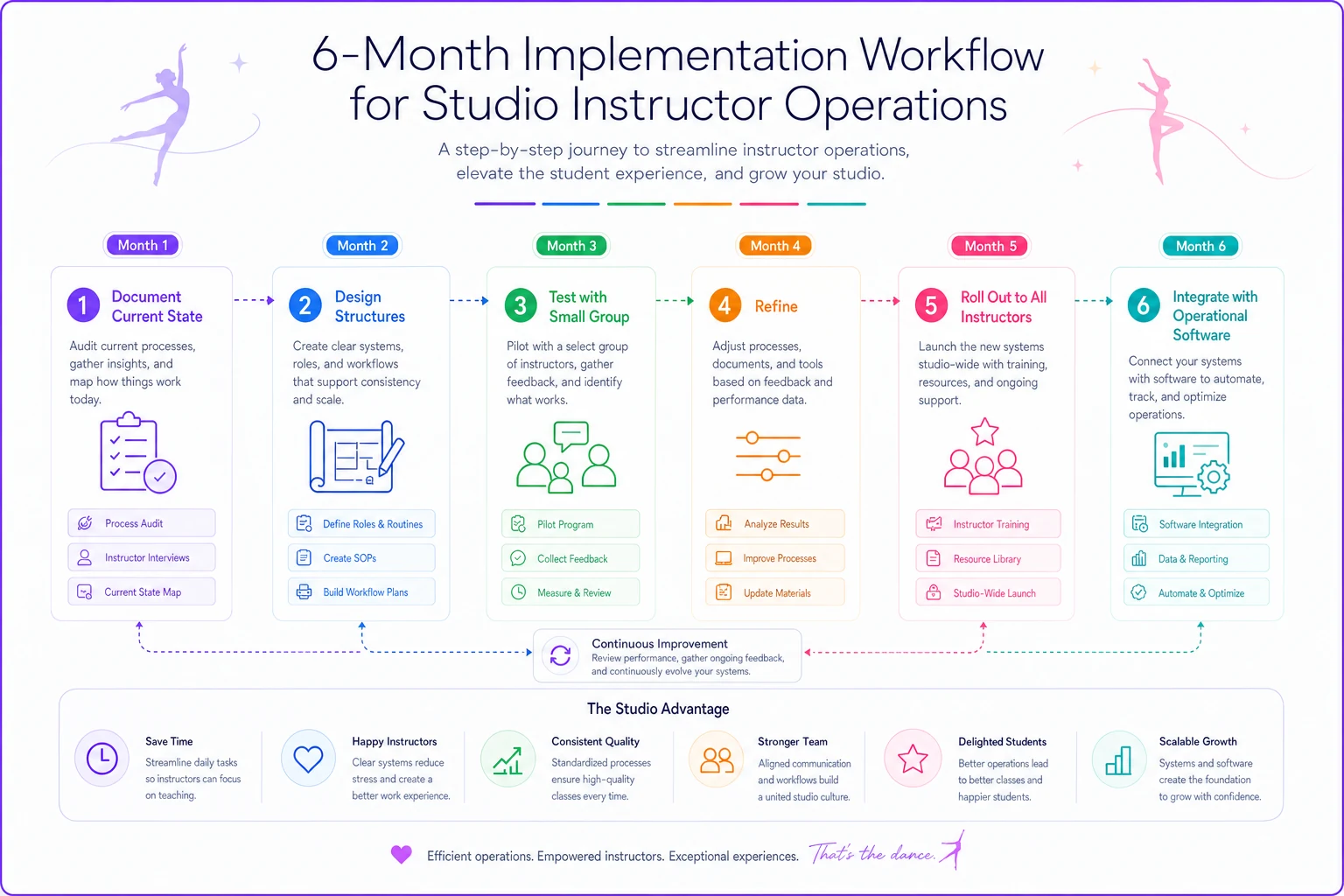
This visual maps the sequence so you can follow the steps in order while involving your team at the right times.
Your instructor team represents your studio's quality to every family. When instructor operations run smoothly, that quality shows consistently in every class. When operations break down, families notice the chaos even if they can't name it specifically. Building these systems isn't about controlling instructors — it's about freeing them to focus on teaching while you focus on growing the business.
The studios thriving five years from now won't necessarily have the best instructors. They'll have the best instructor operations. Systems that scale, processes that prevent problems, and frameworks that make growth possible without proportional chaos. That transformation starts with documenting what you do now, identifying what breaks under pressure, and building better systems one component at a time.
Ready to elevate your studio operations?
Join 500+ studios using Movioly to save time, reduce admin workload, and enhance student experiences.