


Three months into running her second studio location, Maria discovered something that completely upended her expansion plans. Her flagship studio ran on traditional September-to-June terms, worked beautifully. Parents knew the drill, recital prep flowed naturally, summer camps filled the revenue gap. But the new location? Different neighborhood, different demographics, completely different parent expectations. The term structure that worked perfectly across town was hemorrhaging students at the new spot.
The problem wasn't quality or teaching. It was calendar structure misalignment.
The hidden complexity of calendar models
Hidden complexity
Most studio owners pick their calendar model based on what they know — either what they grew up training under or what nearby studios do. Makes sense at first. But calendar structure affects way more than just when classes start and stop.
-
How parents budget for classes
-
When and how often you're buried in registration work
-
Whether you have stable rosters or constant drop-in churn
-
If summer becomes a revenue gap or a steady income stream
-
How much administrative pressure hits at once
-
When you can realistically take time off
Get the structure wrong and you're fighting uphill constantly. Parents confused about billing cycles. Teachers scrambling to onboard new students mid-sequence. Registration bottlenecks that swallow entire weeks. Cash flow gaps that force you to delay equipment purchases or skip marketing when you need it most.
The tricky part? Both models work — when matched to the right studio situation.
Term-based reality
Term-based reality: concentrated chaos, predictable rhythms
Eliminate scheduling headaches and missed payments.
Movioly streamlines booking, confirming, and managing every class with ease.
- Unified class and instructor scheduling
- Automated student notifications
- Integrated payment tracking
No credit card required
Term-based studios live and die by registration periods. Everything concentrates into specific windows. September registration determines your entire fall revenue. January registration sets winter and spring. Miss those windows, lose those students.
The registration tsunami: Picture 200+ families trying to register during the same two-week window. Phone ringing nonstop. Email inbox out of control. Parents cornering you after every class with scheduling questions. Staff working overtime processing payments, juggling waitlists, shuffling students between full and empty classes. The administrative burden crushes everything else for those few weeks.
The mid-term desert: Once term starts, new enrollment basically stops. Parent calls their friend in October about trying dance? "Sorry, we're mid-term, try again in January." You lose momentum. Empty spots stay empty for months. That intermediate jazz class running with 8 students when it could handle 12? Those 4 open spots represent real lost revenue sitting idle until the next window.
The recital machine: Term structure naturally builds toward a recital. September start, June show. Clean arc. Parents understand the commitment, costume deadlines make sense, rehearsal schedules follow logical progression. The whole system points toward that final performance.
The summer question: Most term studios essentially close for summer or shift to completely different programming — camps, intensives, drop-ins. Different revenue model, different staffing needs. Some studios love the seasonal reset. Others watch a significant chunk of annual revenue potential disappear during those months.
Year-round operations
Year-round operations: steady flow, constant juggling
Year-round studios operate more like gyms — continuous enrollment, monthly billing, students starting whenever. Sounds simpler. Often isn't.
The perpetual onboarding challenge: New students join constantly. Your Tuesday beginning ballet has students who started yesterday, last month, six months ago. Teachers split attention between introducing basics and advancing existing students. Curriculum becomes suggestions rather than structured progression.
The billing complexity: Monthly payments mean monthly payment processing, monthly failed payments, monthly parent communications about expired cards. Instead of collecting larger payments twice a year, you're chasing smaller monthly payments across your entire student roster. One payment processor hiccup affects everyone simultaneously.
The retention pressure: Students can leave anytime. No term commitment holding them through rough patches. Kid has two bad classes? Parent pulls them immediately. A competitor opens nearby? Students drift over mid-month. You're constantly recruiting just to hold your numbers steady.
The recital scramble: Running recitals with rolling enrollment gets messy. Who participates? Students need minimum attendance to perform, but when everyone starts at different times, tracking eligibility gets complicated fast. Some studios run multiple smaller showcases throughout the year. Others maintain one big show but spend months sorting out who qualifies.
Decision matrix
The decision matrix: matching model to reality
After working through these situations across many studios, clear patterns emerge about which model fits which circumstances.
Studio Size Considerations
| Studio Size | Term-Based Fit | Year-Round Fit | Key Factor |
|---|---|---|---|
| Under 150 students | Excellent | Challenging | Administrative burden stays manageable with concentrated registration |
| 150-300 students | Good | Good | Both models viable, depends on other factors |
| 300-500 students | Challenging | Better | Continuous enrollment prevents registration bottlenecks |
| 500+ students | Difficult | Recommended | Term registration becomes a logistical nightmare |
Small studios generally benefit from term structure's concentrated work periods. Handle the registration chaos for two intense weeks, then focus on teaching. But once you push past around 300 students, those registration periods become genuinely overwhelming. Year-round enrollment spreads the administrative load more evenly across the year.
Market Demographics Signals
Term structure works when:
-
Families follow school calendar rhythms
-
Parents are comfortable with larger upfront payments
-
The community expects a traditional "lessons" format
-
Competitors use similar structure
-
You're in a suburban family neighborhood
Year-round fits better when:
-
You have a transient population (military, corporate, university town)
-
Families prefer monthly payment flexibility
-
Urban location with varied schedules
-
Adult students make up a significant share of enrollment
-
Parents work non-traditional hours
Revenue and Cash Flow Patterns
Term studios see massive revenue spikes during registration, then minimal income for months. Great if you can manage the gaps. Difficult if you need consistent monthly income for loans or lease payments.
Year-round provides predictable monthly revenue but requires constant attention to retention and recruitment. Lose 10 students in March? You feel it directly in April.
Some things worth thinking through:
-
Fixed monthly expenses over $15,000? Year-round usually holds up better
-
Can you manage 3-month revenue gaps? Term might work fine
-
Need predictable income for loan payments? Year-round is safer
-
Want a real summer break? Term structure actually enables that
Staffing and Operational Capacity
Your team structure matters more than most people account for when choosing a model.
Term-based needs:
-
Staff who can handle intense registration periods without burning out
-
Teachers comfortable with synchronized curriculum
-
Administrative burst capacity during registration windows
-
Ability to scale down during summer
Year-round requires:
-
Consistent full-time administrative support
-
Teachers who can differentiate instruction week after week
-
Robust student onboarding systems
-
Year-round staffing commitment — no seasonal scaling down
The hybrid experiment (and why it usually fails)
Hybrid experiment
The hybrid experiment (and why it usually fails)
Many studios try running both models simultaneously. Some classes term-based, others continuous. Competitive teams year-round while recreational follows terms. Sounds logical. Usually creates an operational headache.
Parents get confused constantly. "Wait, why does ballet follow terms but jazz is monthly?" Billing becomes a mess — some families on term payments, others monthly, some mixing both. Staff can't keep policies straight. Marketing messages start contradicting each other.
The few studios that run hybrid models successfully tend to separate programs completely — different brands, different locations, or completely distinct program types. Even then, the operational overhead rarely justifies the complexity.
Communication templates
Communication templates for transition
If you're switching models, how you communicate with parents determines whether the transition goes smoothly or costs you a third of your students.
For term-to-year-round transition:
Start communication 6 months before the switch. Not 2 months. Six months minimum.
-
Phase 1 (6 months out)
Plant seeds "We're exploring ways to make classes more accessible for families joining mid-year..."
-
Phase 2 (4 months out)
Announce the change "Starting [date], we're moving to rolling enrollment to better serve our families..."
-
Phase 3 (2 months out)
Detailed logistics Exact billing changes, class structure adjustments, recital participation rules
-
Phase 4 (transition month)
Heavy support Extra staff hours, parent meetings, constant availability for questions
For year-round-to-term transition:
Harder sell, but sometimes necessary.
Focus messaging on:
-
Improved class cohesion
-
Structured curriculum benefits
-
Natural recital preparation
-
Community building within terms
Never frame it as going backwards. Position it as aligning with family schedules and educational rhythms.
Systems and AI
Making the model work with the right systems
Whatever model you choose, success depends on systems built around that specific structure.
Term-based studios need registration platforms that can handle massive simultaneous enrollment — waitlist management, payment processing, class placement — without everything falling apart. Manual registration with 200+ families trying to enroll in the same two-week window is genuinely unmanageable without proper tools.
Choose a registration system with waitlist automation and bulk payment handling to survive term registration windows.
Year-round studios need different infrastructure entirely. Continuous billing management, automated late payment follow-up, flexible class management, drop-in tracking. The administrative burden never fully stops, it just spreads throughout the year. Without solid systems, you're constantly playing catch-up.
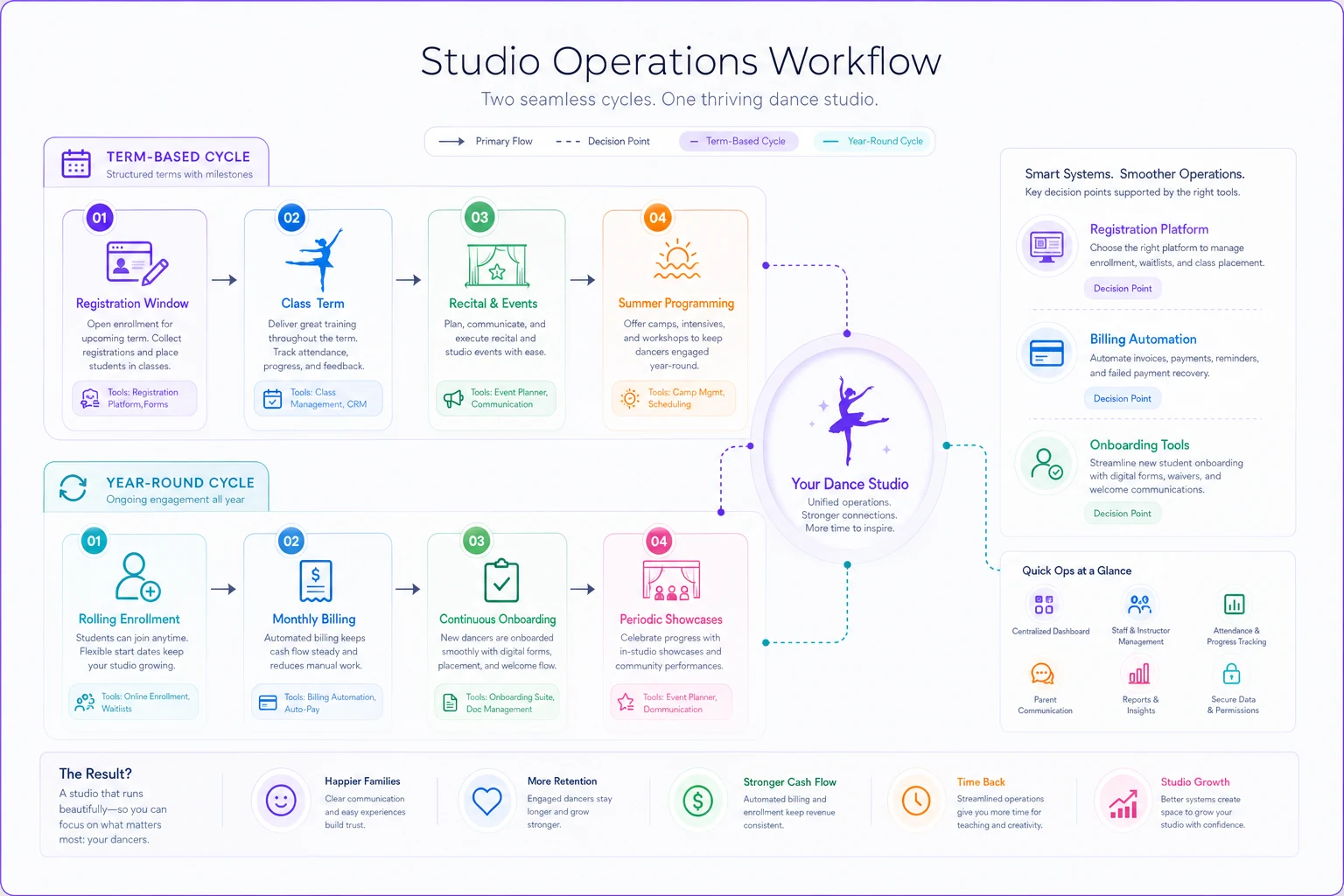
AI-powered operational software helps studios manage either model without the constant administrative scramble. These platforms can handle term registration surges or rolling enrollment flows, automate parent communications based on your specific model, flag attendance patterns that signal early retention risks, and track curriculum progression even with students joining at different points. The goal isn't to automate everything — it's to take the repetitive, error-prone work off your plate so you can focus on what actually moves the studio forward.
The key isn't picking the "right" model in the abstract. It's matching your studio's specific situation to the structure that creates the least friction.
Transition costs
The overlooked transition costs
Switching calendar models costs more than most studios expect — not just financially, but operationally and culturally.
Database restructuring takes weeks. Every student record needs updating. Payment schedules reconfigured. Class structures adjusted. Historical data becomes harder to compare year-over-year.
Teacher retraining is often harder than expected. Instructors comfortable with term progression struggle adapting to continuous enrollment differentiation. Those used to random skill levels find synchronized curriculum frustrating.
Parent relationships shift fundamentally. Some families specifically chose your studio because of the calendar model. Realistically, expect to lose somewhere around 10-15% of families during any model transition, regardless of how well you communicate it.
When to stay
When staying put makes sense (even if it's not perfect)
Sometimes the current model — despite its frustrations — is still the better choice.
If you've built strong community around term traditions, changing models breaks those bonds. Returning student reunions each September, anticipated recital seasons, summer break everyone looks forward to — that culture has real value.
When your reputation centers on your current model, switching confuses the market. Known as "the studio with amazing summer intensives"? Moving to year-round dilutes that identity.
And if your staff and systems finally run smoothly after years of refinement, rebuilding everything from scratch for a new model is a significant setback — not always worth it.
Signs to rethink
Reading the signs: when your model needs reconsidering
Some patterns suggest the model isn't working anymore:
Registration periods getting increasingly chaotic despite better systems. Turning away families regularly because they missed enrollment windows. Summer revenue disappearing while fixed costs stay the same. Teachers burning out from constant new student integration. Parents increasingly asking about different payment options.
The clearest sign is when you spend more time working around your calendar model's limitations than actually benefiting from its strengths.
Most studios resist changing models because it feels too disruptive. But operating with the wrong model creates constant low-level friction that accumulates over years. Six months of transition is usually better than indefinite operational struggle.
Studios that do well long-term periodically reassess whether their calendar model still fits their reality. Markets change, demographics shift, studios grow. What worked at 100 students can genuinely strangle you at 300.
Your calendar model isn't just about when classes start — it's the operational backbone that shapes how your entire business flows. Choose based on your actual situation, not on tradition or what the studio down the street does.
And when that situation changes meaningfully, be willing to evolve the model with it.
Ready to elevate your studio operations?
Join 500+ studios using Movioly to save time, reduce admin workload, and enhance student experiences.