

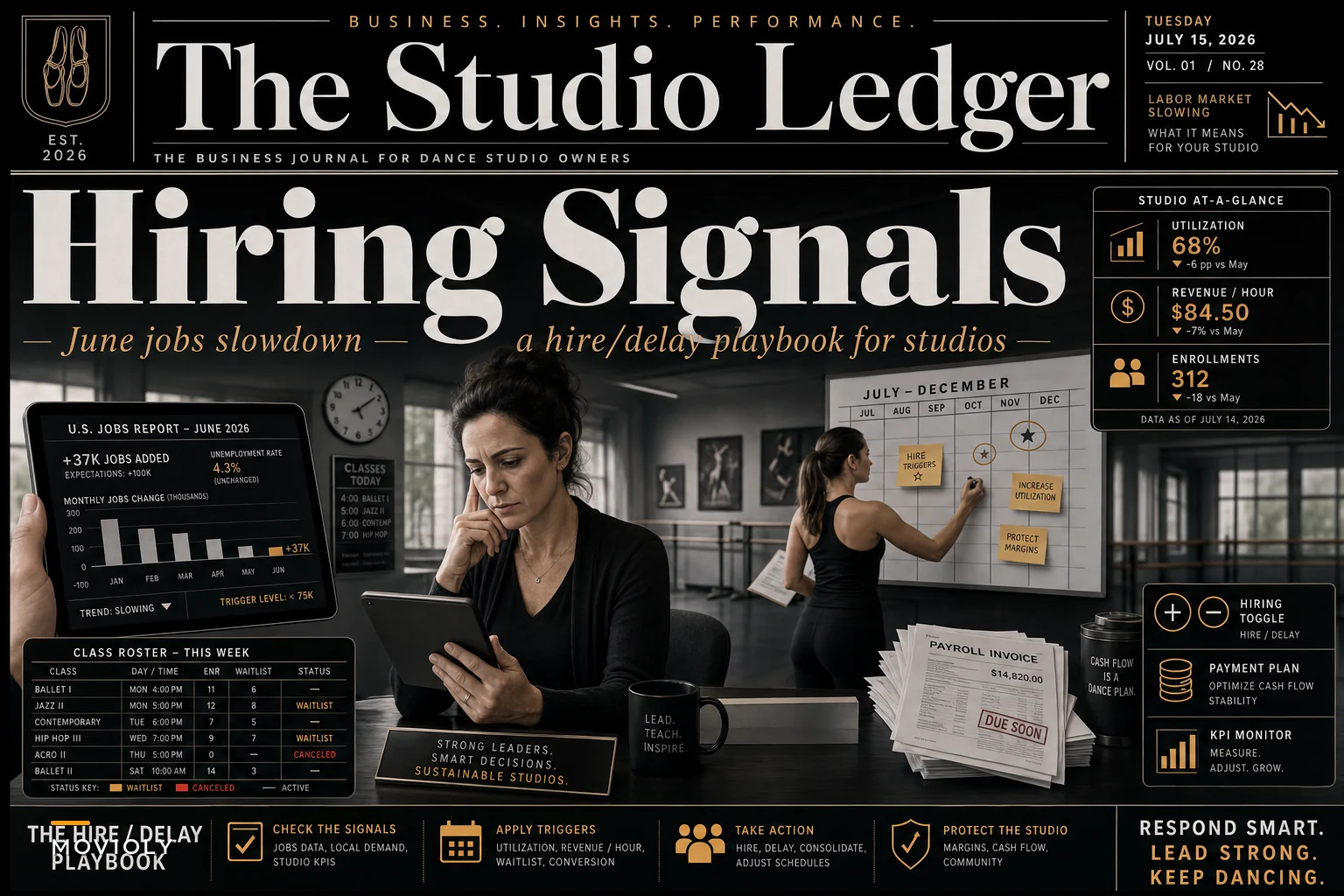

Last week's employment numbers caught a lot of people off guard. The Bureau of Labor Statistics reported that June payrolls grew by just 57,000 jobs — well below the 140,000 economists had expected. Unemployment held around 4.2%, but the broader hiring picture tells a different story.
For dance studio owners, this cooling changes a lot about the staffing decisions you'll be making over the next 90 days.
What the June Jobs Numbers Mean for Your Studio Operations
The instructors who were nearly impossible to find six months ago are suddenly more available. Part-timers who were juggling three different studios are now looking for more stable hours. And parents who would normally sign up for fall classes without hesitating at the price? They're watching household budgets more carefully as job security feels less certain.
This isn't about panic. It's about recognizing that the operational playbook from January doesn't quite apply anymore. Studios that adjust their staffing model, class schedules, and pricing structure now will move through this transition without too much disruption. Those still operating like it's peak 2025 will find themselves overstaffed, underfilled, or both by October.
The Instructor Availability Flip That Nobody Saw Coming
For two years, finding qualified dance instructors felt like a grind. Studios were poaching from each other, offering signing bonuses, and still coming up short. A studio owner in Phoenix told me she was paying $85/hour for a ballet instructor who would've cost $55 eighteen months earlier.
Eliminate scheduling headaches and missed payments.
Movioly streamlines booking, confirming, and managing every class with ease.
- Unified class and instructor scheduling
- Automated student notifications
- Integrated payment tracking
No credit card required
That dynamic just reversed.
-
Former full-time professionals who taught dance in college and want evening work
-
Instructors from competing studios that cut hours
-
Teachers who stepped away from the industry during COVID but need supplemental income now
-
Recent grads who can't find corporate jobs and are reconsidering dance as a career path
The mistake studios keep making right now is staying in scarcity mindset from 2025 — rushing to lock in these instructors with guaranteed hours and higher rates without realizing the leverage has shifted.
Phase 1 (July–August): Audit your current team Look at instructor utilization rates. If someone's teaching 12 hours but you're paying them for 20 guaranteed, that gap just got expensive. Calculate actual revenue per instructor hour — not scheduled hours, but hours where students actually showed up.
Phase 2 (September): Strategic additions only Add instructors only for waitlisted classes or new programs with proven demand. Offer performance-based arrangements — a base rate plus bonuses for maintaining 80%+ capacity. This protects you if enrollment softens while still attracting good talent.
Phase 3 (October–December): Flexible capacity model Build a bench of qualified substitutes and part-timers before you need them. Create a tiered system where your core team gets priority hours, but you maintain relationships with three to five backup instructors who can step in when needed.
The studios that come out ahead will resist the urge to over-hire while strategically upgrading their talent at the same time.
Here's a quick visual workflow of the phased staffing approach and its milestones.
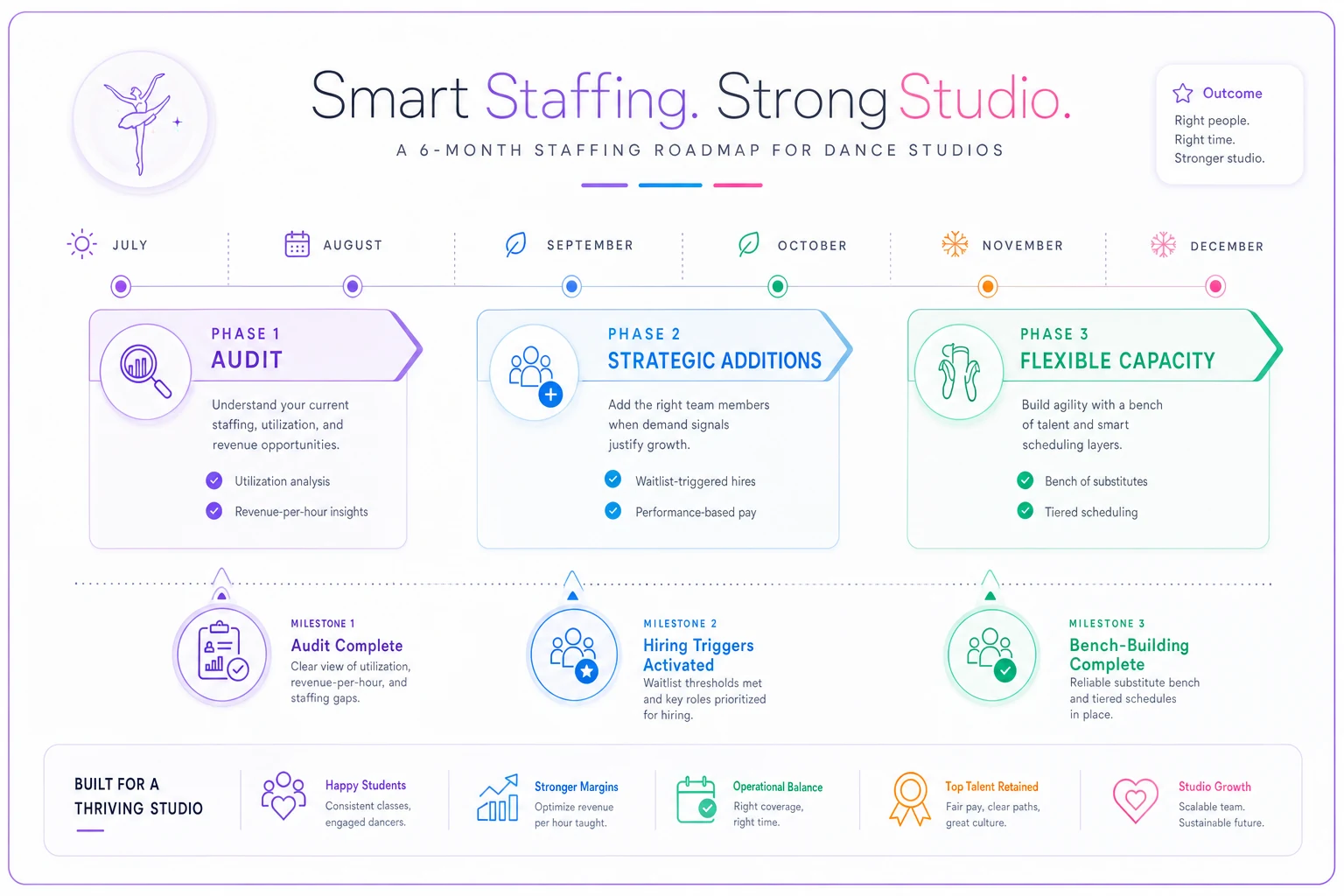
This visual can help teams align on timing and responsibilities.
Why Your Fall Schedule Needs Surgery, Not Tweaks
Most studios are approaching fall 2026 schedule planning like it's fall 2019 — add a few classes, shuffle some time slots, done. That approach isn't going to hold up when household discretionary spending is tightening.
The Reuters coverage of the jobs report noted service sector hiring was particularly weak. When parents feel job uncertainty, dance classes shift from "must have" to "maybe" faster than most studio owners expect.
Kill the ego classes. Every studio has them — the contemporary class with four students kept "for variety," the adult tap class that barely breaks even, the Friday afternoon slot that never fills. In a strong economy, you can absorb these. Right now, you can't afford to.
Run this calculation: total instructor cost per class divided by average attendance. Any class generating under $15 revenue per student per class needs to go. Consolidate those students into other time slots.
Run 6-week trial sessions for borderline classes to test demand before committing to a full semester.
Double down on your actual profit centers. Competitive team, intensive programs, and private lessons probably generate around 60% of your profit on 30% of your schedule. Protect these. Expand them if you can. If you're choosing between keeping an underperforming recreational class or adding another team rehearsal slot, the answer is pretty clear.
Build in schedule flexibility. Instead of locking in a full schedule for the entire semester, build adjustment periods into it. Run certain classes as 6-week sessions initially. If enrollment is strong, extend them. If not, you cut them without the awkwardness of mid-semester cancellations.
A studio in Denver restructured their schedule this way — dropped from 42 weekly classes to 31, and revenue only fell about 5% while instructor costs dropped 22%.
The Pricing Paradox: Why Raising Rates Now Could Actually Help You
This sounds backwards. Economy softening, parents nervous — and you're thinking about price increases?
What holds up through multiple economic downturns is that studios which hold or slightly raise prices while improving perceived value tend to survive. Studios that panic-discount themselves into commodity status usually don't recover cleanly.
But execution matters a lot here.
The wrong way: "Due to inflation, all classes increase 8% effective immediately."
The right way: Strategic value positioning that gives families more control, not less.
| Pricing Strategy | What It Looks Like | Why It Works Now |
|---|---|---|
| Commitment Incentive | 15% discount for full-year enrollment paid upfront | Locks in revenue, reduces churn anxiety |
| Small Group Premium | New 4-student technique classes at 150% standard rate | Higher margin, parents feel exclusive value |
| Flex Pass System | 10-class punch card valid 4 months, 20% premium | Appeals to uncertain schedules, higher per-class revenue |
| Skill Accelerator | 30-minute add-on sessions at $35 | Incremental revenue without new full classes |
These structures give families control while improving your revenue per student. You're not forcing anyone into higher prices — you're creating options that work for both sides. One studio testing this approach saw average revenue per student increase around 11% while enrollment stayed flat. Same number of students, better margins.
Reading the Warning Signs in Your Own Numbers
The national jobs report is one signal, but your studio has its own early warning system if you know where to look. Track these weekly, not monthly.
Trial conversion rate changes. If your trial-to-enrollment rate drops below 60%, families are getting pickier. They're shopping more studios, taking longer to decide.
Payment plan requests. When more than 30% of families start asking about payment plans or financial aid, household budgets are tightening. You don't want to wait until that number hits 50%.
Class hopping patterns. Students switching from unlimited packages to single-class rates, dropping from three classes to two, or asking to pause memberships "just for a month" — these are all stress signals worth noting.
Instructor turnover intentions. Your teachers will often sense shifts before you do. If multiple instructors start asking about more hours or mentioning they're looking for additional work elsewhere, that's worth paying attention to.
The goal is catching these patterns early enough to adjust, not after enrollment has already cratered.
Building Your 90-Day Adjustment Playbook
Studios that thrive through this won't be the ones that cut everything, and they won't be the ones ignoring the signals either. They'll be the ones with clear, staged responses.
-
Weeks 1–2
Operational audit — Calculate true revenue per instructor hour, identify bottom 20% performing classes, review all guaranteed hour contracts, and check what percentage of families are on payment plans.
-
Weeks 3–4
Schedule optimization — Consolidate underperforming classes, adjust instructor assignments based on new availability, test 6-week session formats for borderline classes, and communicate changes as "fall schedule enhancements."
-
Weeks 5–8
Pricing structure evolution — Introduce commitment incentives for families feeling uncertain, launch premium small group options, create flexible payment alternatives, and test value-focused messaging versus discount-focused messaging.
-
Weeks 9–12
Monitoring and rapid adjustment — Weekly KPI tracking on the warning signs above, monthly instructor check-ins on availability and needs, cash flow scenario planning for different enrollment levels.
This isn't about predicting exactly what the economy does. It's about being operationally flexible enough to respond quickly when something shifts. The studios that build that flexibility in now will have a lot more room to maneuver if things get bumpier heading into Q4.
The Instructor Development Opportunity Most Studios Are Missing
While everyone's focused on cutting costs, there's a real opportunity buried in this labor market shift.
Those experienced instructors now available aren't just bodies to fill schedule gaps. They bring teaching methods, choreography styles, and student engagement techniques your current team might not have. If you approach it right, this is actually a quality upgrade.
Pair your longtime teachers with new additions for technique-sharing sessions. Have them observe each other's classes. Build a collaborative culture instead of a competitive one.
A studio in New Jersey did this somewhat accidentally when they brought on two instructors from a closed competitor. Within three months, overall class quality had improved enough that they could justify a 12% tuition increase with almost no pushback from families.
The market disruption becomes your quality upgrade if you structure it intentionally.
When to Pull Which Lever
Not every studio needs every adjustment. Your response depends on where you're starting from.
If you're currently understaffed: This is a good moment. Upgrade talent carefully — don't just fill holes, look for instructors who can eventually take lead roles. Offer competitive but not desperate packages. The talent pool should stay strong for at least another six months.
If you're overstaffed: Reduce guaranteed hours before making outright cuts. Shift instructors toward revenue-generating activities like private lessons or summer programs. Natural attrition will help — don't automatically replace every departure.
If enrollment is steady: Make small pricing adjustments now while families still feel stable. Introduce premium options. Build your cash reserves. You're playing defense for what might come, not reacting to a current crisis.
If enrollment is already dropping: Focus on retention over acquisition. Shore up your core families with better communication and visible value. Reduce schedule complexity. Consider working through the metric framework from our earlier analysis on when to hire, raise prices, or open a class based on the 6 financial metrics — but apply it in reverse for contraction planning.
Protecting Culture While Managing Operations
The hardest part about these adjustments isn't the math. It's maintaining studio culture while making changes that feel uncomfortable.
Your instructors are watching how you handle this. Parents are picking up on any instability. Students feel tension in the room even when nobody says anything directly.
A few things that actually work:
Transparency without alarm. "We're optimizing our schedule to ensure smaller class sizes and more individual attention" is a very different message than "we're cutting classes due to economic concerns" — even if both are technically true.
Instructor involvement. Bring your team into the conversation. Ask which classes they think work best, where they see natural consolidation opportunities, what new formats they'd want to try. You'll get better information and more buy-in.
Family communication. Send updates about the positive changes — new instructor credentials, improved ratios, schedule flexibility. Give families concrete reasons to stay, not just habit.
Celebrate what's working. When a change lands well, say so. "Our new 6-week intensive format filled in 48 hours" shows momentum. That matters more than people realize.
Studios that frame this as evolution rather than crisis management tend to keep their community intact through the whole thing.
The Fall 2026 Reality Check
Three months from now, the dance studio landscape will look noticeably different.
Studios that took the June jobs report seriously as an inflection point will have stronger instructor teams at lower costs, tighter schedules with better margins, pricing structures that improved revenue per student, and cash reserves built from prepaid commitments.
Studios that kept running their spring 2026 playbook will be dealing with overstaffed schedules, empty classes, panicked discounting that trained families to wait for deals, and cash flow stress that's hard to unwind quickly.
The cooling labor market isn't a crisis for prepared dance studios. It's a window to build a more sustainable operation while competitors are still figuring out what changed. Take the signal seriously, adjust in stages, and you'll enter 2027 in a stronger position regardless of where the economy ends up going.
Your families need stability. Your instructors need clarity. Your business needs flexibility. The studios that can honestly offer all three will be in a very different position by December.
Ready to elevate your studio operations?
Join 500+ studios using Movioly to save time, reduce admin workload, and enhance student experiences.