

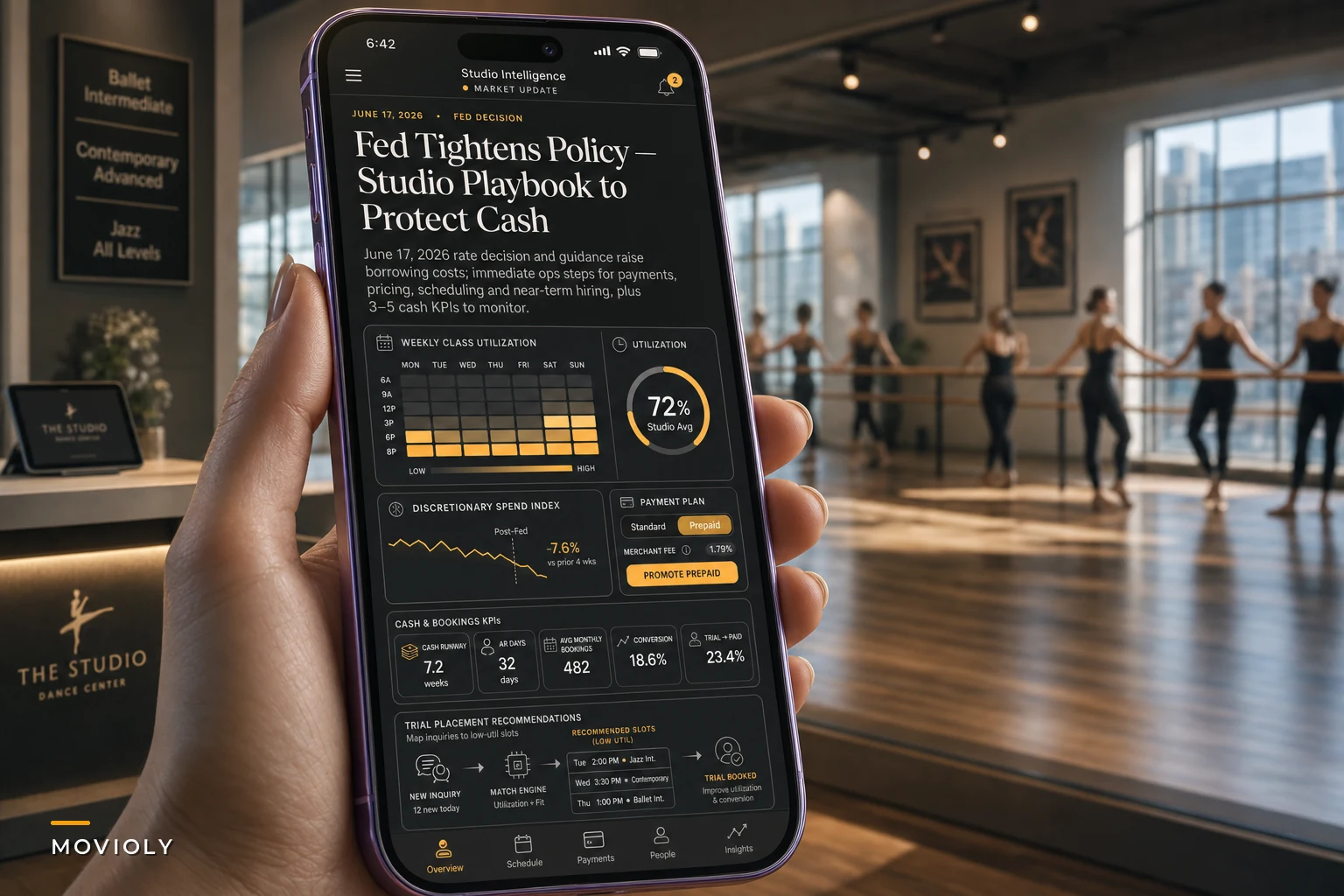

Yesterday's Fed meeting didn't bring the relief many small business owners were hoping for. The Federal Reserve kept rates at 3.50%-3.75% and signaled they might stay elevated through summer—or possibly move higher. For dance studios heading into what should be peak enrollment season, that's an immediate problem.
Parents are already feeling squeezed. That family considering signing their daughter up for ballet is staring at credit card rates near 22%, car loans at 8%, and home equity lines that cost double what they did three years ago. When household budgets tighten, extracurriculars get scrutinized first.
Watching studios navigate the last few months of rate uncertainty has been instructive. The ones holding up aren't just cutting costs—they're making specific operational adjustments that preserve enrollment while adapting to how families actually spend when credit gets expensive.
The cash flow squeeze hitting studios right now
Studios face a rough combination when rates stay high. Operating costs—rent, utilities, insurance—keep climbing with inflation, while families delay enrollment decisions, ask for more payment flexibility, and drop classes faster when unexpected expenses hit.
A studio owner in suburban Atlanta showed me her books last month. Same enrollment as 2023, but cash flow down nearly 15%. The culprit was payment timing. More families choosing monthly over semester prepays, more late payments, more mid-session drops. Each one creates a cascade of headaches beyond just the revenue hit.
The reflexive response—raise prices to offset the squeeze—tends to backfire here. Families comparing your $185 monthly ballet classes to their $190 monthly car payment increase aren't thinking about the value of dance education. They're doing brutal household math.
Three immediate adjustments that actually work
Shift from semester to shorter commitment cycles
Eliminate scheduling headaches and missed payments.
Movioly streamlines booking, confirming, and managing every class with ease.
- Unified class and instructor scheduling
- Automated student notifications
- Integrated payment tracking
No credit card required
Studios traditionally push annual or semester commitments for predictable revenue. When credit costs spike, families resist large upfront payments. The fix isn't monthly drop-in chaos—it's structured short cycles.
One studio switched from 16-week semesters to 6-week sessions with automatic renewal. Enrollment jumped around 20% because families felt comfortable committing to $420 for six weeks versus $1,120 for a full semester. The operational complexity increases, but retention actually improved because families reassess every six weeks instead of dropping mid-semester when money gets tight.
The critical detail: price the 6-week sessions at roughly 85% of the per-class semester rate. Families save compared to drop-in rates, you maintain margin through higher retention, and you're collecting cash every six weeks instead of gambling on semester prepays.
Create utilization-based pricing tiers
Empty spots in classes are pure lost revenue, especially when fixed costs stay constant. Discounting to fill them just trains customers to wait for deals.
The smarter move is dynamic utilization pricing. Classes under 70% capacity get a "community rate" for new students—typically 20% below standard, but only for their first session. Classes at 80%+ hold full pricing with waitlists.
One studio running 18 weekly classes found consistent underutilization in their Tuesday/Thursday afternoon slots. By offering community pricing specifically for those times, they added 34 students without touching prime slots. The marginal revenue from filling empty spots far exceeded the discount cost.
-
Capacity percentage by class
-
Revenue per square foot per hour
-
Instructor cost coverage ratio
When utilization drops below 60% for two consecutive weeks, that's your trigger to adjust pricing, scheduling, or marketing for that specific slot.
Restructure payment processing to protect margins
Payment processing feels like a minor detail until you actually look at how much margin disappears through fees and failed payments. High interest rates correlate directly with increased payment failures—families max out cards, miss payments, or dispute charges when cash gets tight.
Most studios run basic payment processing at 2.9% + $0.30 per transaction. With more families on payment plans, you're eating those fees multiple times per student. Twelve monthly payments versus one annual payment roughly triples your processing costs.
Studios protecting margins have moved to ACH bank transfers for recurring payments (typically $0.50 flat versus 2.9%), stored payment methods with automatic retry logic for failures, and early payment incentives that exceed processing costs—a 3% discount for quarterly prepay saves money if it prevents monthly processing fees.
One studio saved around $8,400 annually just by moving 60% of families to ACH for monthly payments. That's equivalent to adding four or five new students without any marketing spend.
Staffing flexibility without losing quality instructors
The standard advice during cash crunches is cut staff hours. Dance instruction isn't like retail—you can't just reduce coverage and maintain quality. Studios need a different approach to instructor flexibility that doesn't tank the product.
Convert fixed salaries to hybrid guarantee models
Instead of pure hourly or salary, create guaranteed minimums with performance upside. An instructor guaranteed $500 weekly for 15 class hours can earn additional per-student bonuses above baseline enrollment. If baseline is 8 students per class, pay $3 per additional student.
This aligns instructor incentives with studio revenue while providing income security. When enrollment dips, costs adjust automatically. When classes fill, instructors earn more and have real skin in the game.
The math on a typical class:
| Scenario | Students | Revenue | Instructor Pay | Studio Margin |
|---|---|---|---|---|
| Baseline | 8 | $360 | $33/hr | $327 |
| Full class | 12 | $540 | $45/hr ($33 base + $12 bonus) | $495 |
The numbers aren't dramatic, but they add up across a full schedule week after week.
Create "swing instructor" pools
Rather than maintaining full-time staff for peak capacity, build a bench of qualified swing instructors who cover overflow, special workshops, or temporary expansions. These aren't substitutes—they're specialists invested in eventually joining permanently.
Structure it to benefit both sides. Swing instructors get guaranteed minimum monthly hours (typically 10-15), priority for permanent positions, and higher hourly rates for last-minute coverage. Studios get flexibility to scale without carrying excess fixed costs during slow periods. Quality stays up because these instructors want the permanent role, not just a one-off gig.
Fix the summer cash flow valley
Dance studios face predictable cash flow craters during summer when regular classes pause for camps and intensives. The Fed's signal about sustained higher rates makes this summer particularly rough. Families choosing between dance camp and a family vacation will increasingly pick vacation when credit card debt costs 22% annually.
Presell summer during spring peak
Most studios wait until April to market summer programs. By then, families have already committed vacation budgets elsewhere. Start preselling summer in February with early-bird pricing that expires mid-March.
The twist: offer payment plans that start immediately but spread through May. A $600 summer intensive becomes three payments of $200 in March, April, and May. Families lock in before other expenses hit, and you collect cash during strong spring months instead of hoping for lump sums in June.
Bundle summer with fall enrollment
Create continuity packages linking summer participation to fall priority registration. Students attending any summer program get first choice of fall schedule plus 10% off September tuition.
Sounds like you're giving away margin, but the math works. Summer program brings $400 in revenue. Securing fall enrollment in June versus September pushes retention from around 75% historical to roughly 90%. The September discount costs about $18 per student. Giving up $18 to lock in a student two months early is almost always worth it when you're managing cash flow in a high-rate environment.
Run "skills clinics" not camps
Full-day camps require more staff, insurance, and logistics. Targeted 2-hour skills clinics at premium pricing deliver better margins. "Perfect Your Pirouette" at $45 outperforms all-day camp at $120 when you account for true costs.
Parents appreciate focused skill development and scheduling flexibility. You can run multiple clinics daily using existing staff during regular hours. Four clinics daily at 10 students each generates comparable revenue to a 25-student camp with a fraction of the operational complexity.
Technology adjustments for tighter cash flow management
When cash flow tightens, manual processes that were just annoying become actively dangerous. Studios tracking payments in spreadsheets, scheduling via text chains, and managing enrollment on paper can't respond fast enough when customer behavior shifts quickly.
AI-powered studio management platforms have gotten genuinely useful here—not because the technology is exciting, but because they eliminate specific friction points that kill cash flow during rough economic stretches.
Automated payment retry sequences
Failed payments spike when household finances tighten. Manually chasing payments destroys staff productivity and damages customer relationships. Modern studio management platforms handle this with intelligent retry logic—attempting payment at different times, automatically switching payment methods, and notifying both parties only when human intervention is actually needed.
A studio with 200 monthly paying families typically sees 15-20 payment failures monthly. Manual resolution takes around 20 minutes per failure—that's nearly 7 hours of staff time. Automated retry sequences resolve roughly 70% without anyone getting involved, freeing staff for revenue-generating work like following up on trial classes.
Real-time capacity optimization
Knowing exactly which classes can accept more students right now—not after tonight's attendance review—changes how you convert inquiries. AI-enhanced scheduling systems track patterns, predict no-shows, and recommend optimal class placement for trials.
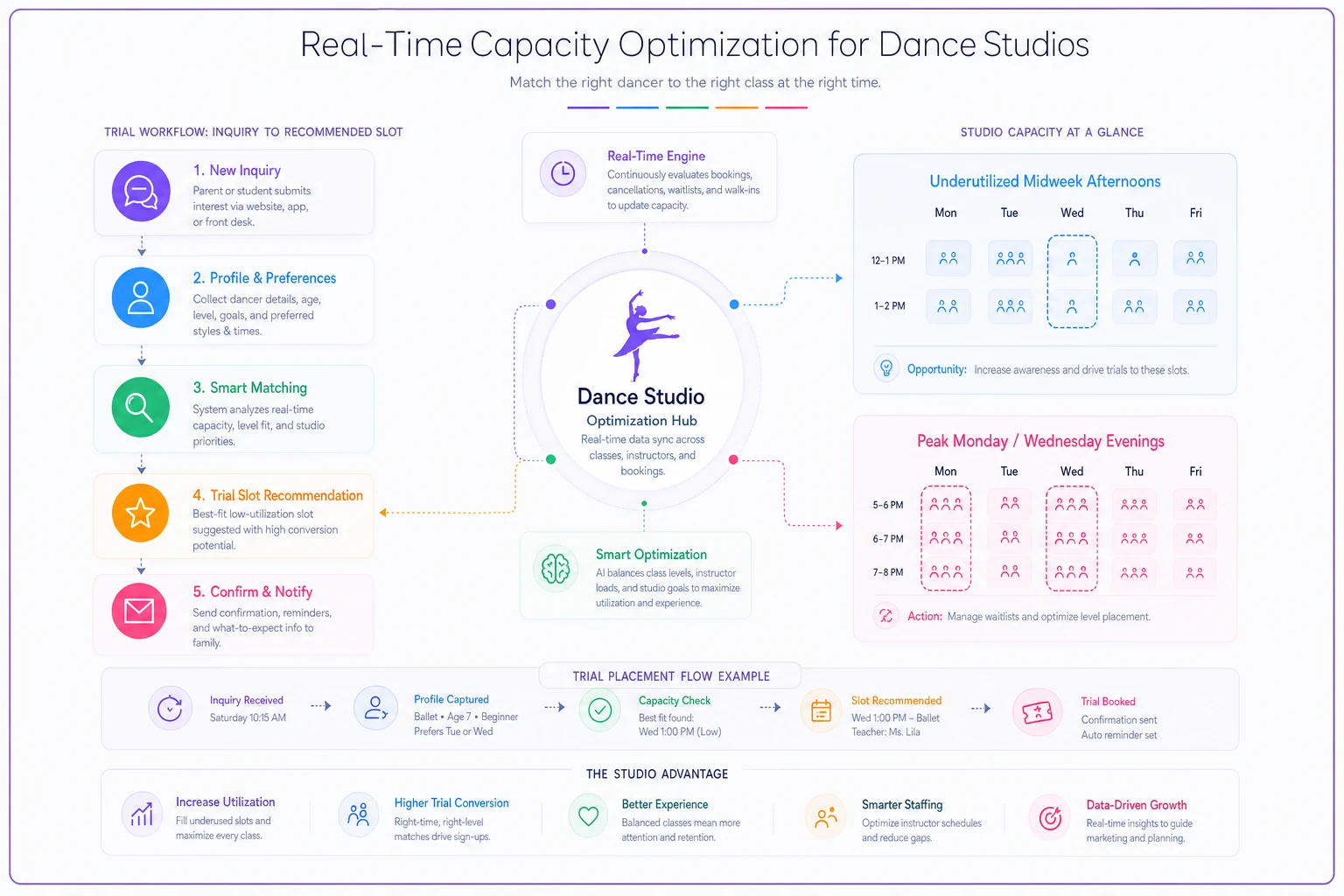
Instead of a generic "try any beginner class," you direct trials to specific underutilized slots where they'll get more attention and are more likely to convert. One studio increased trial conversion by about 15% simply by steering trials away from packed Monday evenings to equally good but emptier Wednesday sessions.
Prioritize automated retry sequences to recover failed payments before staff intervention and free up team time for conversions.
Predictive retention alerts
Students rarely quit suddenly—they show warning signs first. Declining attendance, late payments, reduced engagement all tend to predict drops weeks before they happen. Platforms monitoring these signals can alert staff to intervene before families make final decisions.
The intervention doesn't need to be complex. A text saying "We noticed Emma missed last week—everything okay?" sent automatically when absence patterns change prevents more drops than any formal retention campaign. Studios using predictive monitoring typically reduce unexpected drops by around 30%, which smooths cash flow considerably.
Make the hard choices on class consolidation
No studio owner wants to cancel classes, but running multiple sections at 40% capacity bleeds money when margins are tight. The psychological barrier—"we've always offered Tuesday 4pm intermediate jazz"—prevents rational consolidation decisions.
A framework that actually helps:
-
Calculate revenue per class
number of students × monthly rate ÷ 4
-
Subtract direct costs
instructor pay plus pro-rated studio time
-
Subtract indirect costs
admin time, utilities, insurance allocation
-
Compare profit against the $50/session minimum threshold
Any class consistently below $50 profit per session needs evaluation. Either it builds toward profitability within 6 weeks, serves as a strategic loss leader for other programs, or gets consolidated.
The conversation with affected families matters as much as the decision itself. "We're combining Tuesday and Thursday intermediate jazz into one class with more energy and more friends" lands very differently than "Tuesday class is cancelled due to low enrollment."
When raising prices makes sense (and when it doesn't)
The reflex response to cash flow pressure is across-the-board price increases. With rates staying elevated, blanket increases often accelerate enrollment declines rather than improve revenue.
Targeted adjustments work better.
Raise prices on convenience, not core classes
Families will pay premiums for convenience even when budgets tighten. Priority scheduling, makeup class packages, and flexible attendance options can carry 20-30% premiums without much resistance.
A "Flex Pass" allowing attendance at any age-appropriate class for 25% above standard pricing attracts busy families who value flexibility over savings. These families also tend to be less price-sensitive overall and more likely to hold enrollment during economic uncertainty.
Add premium tiers instead of raising base prices
Rather than bumping beginner ballet from $140 to $155, create a "Ballet Plus" option at $180 that includes private coaching sessions, performance opportunities, or exam prep. Somewhere around 20-25% of families choose premium options when positioned correctly, improving revenue without touching base pricing.
Institute material fees separately
Instead of raising tuition, add modest material fees that feel justified. A $15 quarterly "studio maintenance fee" or $10 monthly "costume fund contribution" meets less resistance than equivalent tuition increases because families understand the specific purpose.
The next 90 days matter most
Fed policy works with a lag—yesterday's decision won't fully hit consumer behavior for months. But families are already adjusting summer and fall spending based on the expectation that relief isn't coming soon.
Studios that act now can capture commitment before the full impact lands. Those waiting for conditions to improve will face empty classes in September when families have already allocated reduced discretionary budgets elsewhere.
The adjustments here aren't revolutionary—they're tactical responses to specific cash flow pressures. The difference between studios thriving and struggling through this period comes down to execution speed, not strategic brilliance.
If more than 30% of families have shifted from annual to monthly payment, if trial conversion has dropped 10% or more, or if payment failures have increased 25% over last year—you're already feeling the impact. The question isn't whether to adjust, it's how fast you can implement changes before summer enrollment locks in.
Understanding which financial metrics actually drive these decisions helps separate noise from signals that actually demand action. Navigating higher rates successfully requires accepting that families' financial reality has changed—even when that means rethinking fundamental assumptions about how your studio operates.
The Fed's decision yesterday wasn't surprising. It confirms what many studio owners already suspected: easy credit fueling enrollment growth is over, at least for now. Studios that acknowledge this and adapt for a cash-conscious customer base will find opportunities while others struggle. Those clinging to pre-2022 operational models will discover that what worked during a decade of near-zero rates breaks down fast when families face real borrowing costs.
Your studio's cash flow after this rate decision depends less on macro policy and more on the dozens of small operational adjustments that collectively determine whether you're capturing available revenue or watching it walk out the door to studios that adapted faster.
Ready to elevate your studio operations?
Join 500+ studios using Movioly to save time, reduce admin workload, and enhance student experiences.