

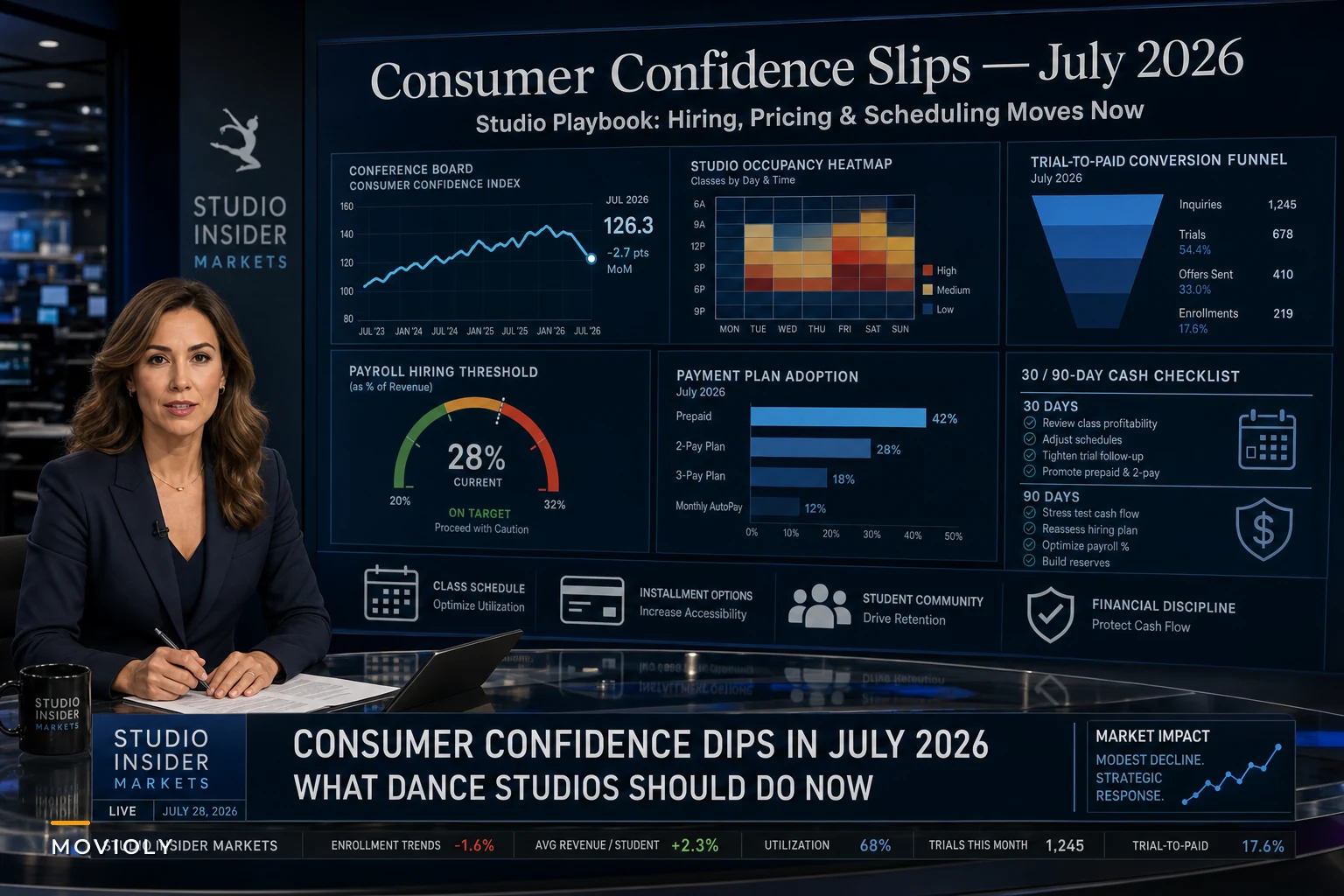

The Conference Board's July consumer confidence report came in at 90.8, down from June's reading. Not a collapse, but enough of a shift that families are starting to second-guess discretionary spending. For dance studios, that lands differently than it does for most businesses. You're not selling necessities—you're competing for shrinking budgets against travel sports, tutoring, and whatever else parents decide looks more impressive on a college application.
During the 2022 slowdown, studios that kept their footing didn't do it by panicking. They adjusted schedules, managed instructor hours carefully, and got creative with pricing. The ones that struggled waited too long. By the time enrollment numbers looked bad, they were already months into a cash flow problem.
The enrollment cliff nobody talks about until it's too late
Consumer confidence doesn't collapse your studio overnight. It creeps. First, trial classes start converting at 35% instead of your usual 50%. Then parents ask about payment plans for packages they used to pay upfront without thinking twice. By the time actual enrollment drops, you're already three months into a cash crunch.
Studios operating at 85% capacity quietly slide to 65%. The payroll cushion disappears. The buffer for rent and utilities gets thin. And the tricky part—you can't just cut Tuesday ballet when half those kids also take Thursday jazz and Saturday contemporary. Cut one class, risk losing three enrollments per student.
Studios relying on paper systems get hit hardest. When enrollment lives in spreadsheets and attendance on clipboards, you miss the early signals. A family that was booking three classes drops to two. Another switches from unlimited monthly to drop-in. These shifts compound, and without centralized tracking, you won't spot the pattern until your deposit account looks thin.
Dance studios also have almost no pricing power during confidence dips. Parents see dance as enrichment. Unlike math tutoring or SAT prep, it's the first thing cut when budgets tighten. Raising prices to offset lower enrollment just accelerates the exodus.
Why traditional cost-cutting destroys studios
The obvious move is cutting instructor hours. Lower enrollment, fewer classes needed—seems logical. But this triggers a pattern that has damaged otherwise healthy studios more than the economic dip itself.
Eliminate scheduling headaches and missed payments.
Movioly streamlines booking, confirming, and managing every class with ease.
- Unified class and instructor scheduling
- Automated student notifications
- Integrated payment tracking
No credit card required
When you cut instructor hours, your best teachers—the ones parents specifically request—start picking up classes at other studios. Now they're unavailable when you need capacity back. Worse, they might take students with them. One studio lost around 40 families when their tap instructor moved to a competitor after her weekly hours dropped from 25 to 12. That studio never fully recovered those enrollments.
The scheduling math gets messy too. Cut intermediate jazz from three sections to two and now 18 kids are fighting for spots designed for 12. Parents notice the crowding. Instructors feel stretched. Quality drops. More families leave. You end up worse than if you'd kept the third section and absorbed tighter margins for a few months.
Meanwhile, the studio across town maintains their full schedule, starts advertising "small class sizes" and "personalized attention," and picks up your departing families. Those families rarely come back even when things improve.
Studios also tend to cut administrative support to save money. Instructors end up fielding enrollment questions between classes, billing gets sloppy, trial follow-ups stop happening. The operational mess costs more in lost revenue than the saved wages ever covered.
The schedule optimization framework that actually works
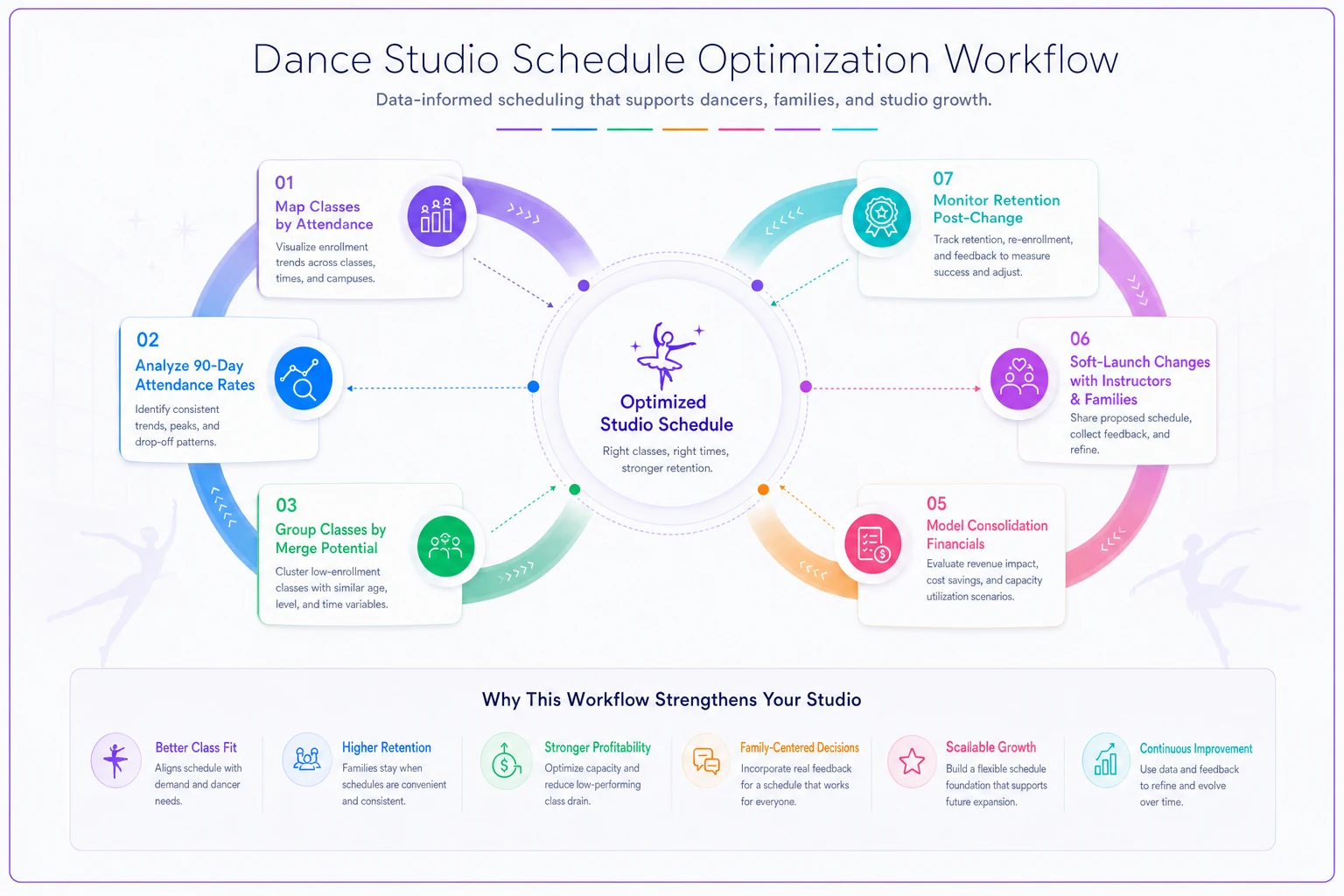
Instead of blind cuts, use utilization-based consolidation. Map every class by fill rate over the past 90 days—not just enrollment numbers, actual attendance. That Saturday morning ballet with 8 enrolled might consistently see 5 kids show up.
Build consolidation plans around natural groupings. Can Monday 4pm beginners ballet (6 kids) merge with Tuesday 4:30pm (5 kids) without wrecking family schedules? Before announcing anything, survey those families about Tuesday availability. Parents become surprisingly flexible when they understand the goal is keeping prices stable.
Timing matters a lot here. Never consolidate mid-session. Wait for natural transition points—end of summer, after winter break, between spring terms. "Schedule updates for the new term" lands much better than "we're cutting your kid's class next week."
A framework that preserves quality while protecting margins:
Week 1–2: Data gathering
-
Pull 90-day attendance actuals for every class
-
Calculate true per-class margins (instructor pay, utilities, admin time)
-
Survey families about schedule flexibility
-
Review competitor schedules for gaps worth targeting
Week 3: Planning
-
Group classes by merge potential (age, skill level, style)
-
Model the financial impact of each consolidation
-
Draft parent communication templates
-
Build "win-back" offers for families who might leave anyway
Week 4: Soft launch
-
Talk to instructors individually before any announcement
-
Call high-value families personally
-
Lead with what you're preserving, not what's changing
Here's a quick visual of the consolidation workflow.
Most studios make the mistake of consolidating their most popular time slots first because those have the most sections. Keep your prime windows strong—4–6pm weekdays and Saturday mornings. Consolidate the fringe times instead. Turn three weak Wednesday sections into two solid ones.
Pricing pivots that keep families enrolled
Discounts are a trap. They train families to wait for sales and gradually erode your margins. Instead, restructure how families pay without reducing total revenue per student.
Payment plans are the first tool. A family that normally buys a $400 ten-class package might not have $400 sitting around right now. But $45 weekly auto-pay is manageable. Yes, you're floating them credit, but keeping them enrolled beats losing them. The catch: make payment plans opt-in for existing families only, not advertised publicly. You don't want everyone shifting to installments if they don't need to.
Shorter commitment windows help too. If families hesitate at fall semester enrollment, offer monthly memberships at a 15% premium. You take a margin hit, but maintain cash flow and keep students in your ecosystem. When confidence stabilizes, most of these families convert back to longer commitments.
The "sibling freeze" works surprisingly well. Instead of sibling discounts that cut revenue, lock multi-child families at their current rates for 12 months even if you raise prices generally. Parents value predictability when they're uncertain. You keep the whole family without discounting.
The counterintuitive move: add premium options for families still spending freely. Small-group intensives, private coaching, competition team add-ons. The top 20% of your families who aren't affected by economic uncertainty will often spend more on exclusive offerings. That offsets revenue lost from families trading down to basic packages.
The instructor conversation nobody wants to have
Teachers need to understand the economic reality without panicking. Most instructors have never run a business—they don't naturally connect consumer confidence reports to enrollment trends to their own paycheck. Be transparent, but be deliberate about how you frame it.
Start with data. Show enrollment trends, trial conversion rates, the competitive picture. Good instructors want the studio to survive. When they see you're making strategic adjustments rather than panic cuts, most will work with you.
Consider alternative compensation structures that align incentives. Instead of cutting hourly rates, offer retention bonuses. Pay an extra $2 per student per class over 8 kids. Give instructors a reason to keep their classes full. One studio that shifted to this model saw instructors actively recruiting from their own networks—friends, neighbors, contacts from other activities. It changed the dynamic entirely.
Creative scheduling can maintain instructor income while reducing overhead. Can a Tuesday/Thursday teacher absorb Saturday classes from someone who wants fewer hours? Can experienced instructors mentor junior staff as paid training time? These arrangements keep talent stable without increasing total payroll costs.
The most important thing: move fast and communicate constantly. Rumor mills in dance studios are brutal. If instructors hear about changes through parent gossip, you've lost their trust, and it's hard to get that back. Short weekly check-ins during slower enrollment periods go a long way.
Building defensive systems before the next dip
Consumer confidence cycles are readable if you're watching the right things. Studios that handle these dips well have early warning built into how they operate. This is where tracking the right financial metrics matters most—you need real-time numbers, not month-end summaries that tell you what already happened.
Track leading indicators weekly, not monthly. Trial conversion rates show family confidence before enrollment numbers actually drop. Payment plan requests signal budget pressure early. Attendance patterns reveal disengagement before families formally withdraw. Most studios check these sporadically—you need them visible and current.
Monitor trial conversion and payment plan requests weekly so you can act before enrollment visibly drops.
Build scenario plans during good times. What happens if enrollment drops 10%? 20%? Which classes merge first? Which instructors have schedule flexibility? What payment options can you offer? Think through these decisions when you're not scrambling, then document them so you're executing a plan rather than improvising during a crunch.
Technology matters here. Studios using integrated platforms spot trends faster than those juggling separate systems for scheduling, billing, and communication. When trial conversion data lives alongside attendance tracking and payment processing, patterns surface quickly. AI-powered analytics can flag unusual shifts before they become serious problems—like noticing that Tuesday families are switching to drop-in rates at a higher rate than any other day of the week.
The communication strategy that prevents mass exodus
Parents need more communication during uncertain periods, not less. But the wrong message creates panic. Sending "we need your support" emails has accidentally triggered studio bank runs—healthy businesses suddenly sounding desperate, with families taking that as a cue to leave.
Frame everything around student experience, not studio finances. "We're combining intermediate and advanced jazz to create more dynamic classes with broader peer learning" is a completely different message than "we need to consolidate due to enrollment changes." Parents care about their kid's experience. Lead with that.
Increase positive touchpoints when confidence dips. Send progress videos. Share student achievements. Run parent watch weeks. One studio started sending weekly technique tip videos during a slow stretch—enrollment actually ticked up because parents felt more invested in what they were paying for.
Get ahead of the concerns parents haven't voiced yet. They'll worry about overcrowded classes, less individual attention, lower quality. Address these preemptively. Explain how right-sized classes benefit students. Share your instructor retention approach. Be confident about the studio's stability even while making adjustments.
A realistic scenario: How one studio navigated a confidence dip
A suburban studio with 340 active students noticed trial conversions dropped from 50% to 35% in late July. Still profitable, but the trend was clear. They acted in early August rather than waiting.
| Move | Action Taken | Result |
|---|---|---|
| Schedule consolidation | Merged 4 of 8 underperforming class pairs | ~$1,100/week saved, no layoffs |
| August Lock-In Pricing | Families who committed by Aug 15 kept current rates through December | ~70% of families locked in fall revenue |
| Technique Tuesday | Free drop-in class for enrolled students ($65 instructor cost) | Boosted retention and became a trial selling point |
By October, when things stabilized, they'd held 315 of their 340 students. The 25 who left were mostly natural departures—graduating seniors, families who moved. Cash flow stayed positive throughout, instructors remained loyal, and they picked up families from a competitor who'd handled things with abrupt cuts and desperate discounts.
The moves weren't complicated. What made them work was that they happened in August, not October.
The technology advantage during volatile periods
Manual tracking is a liability during confidence dips. You need to see patterns as they develop, not at month-end bookkeeping. Modern operational platforms give you real-time visibility into what actually matters: daily trial bookings, conversion rates, payment failure trends, attendance patterns.
Automated payment processing becomes especially valuable when families have less financial cushion. Intelligent retry logic for failed payments, automatic payment plan conversion for declined packages, flexible pause and restart options—these systems prevent the awkward payment failure conversations that push embarrassed families to quit rather than work something out.
The communication tools that feel unnecessary during good enrollment periods become essential when things tighten. Attendance reminders keep classes full. Trial follow-up sequences make sure no potential enrollment falls through the cracks. Birthday and milestone messages maintain the relationship when families are deciding what to cut from the budget.
What most studios miss is the data integration piece. When scheduling, billing, and communication run on separate systems, you can't see that the family whose payment failed also missed three classes and hasn't opened a studio email in two weeks. That's a family getting ready to ghost you. Integrated platforms surface these patterns early enough to actually do something about it.
Moving forward
Consumer confidence dips are temporary. The operational decisions you make during them aren't. Studios that respond thoughtfully tend to come out stronger—schedules are leaner, instructor relationships are more solid, and systems are actually built for volatility. Studios that panic-cut their way through come out weakened, even after demand returns.
Speed matters, but so does strategy. Don't wait for enrollment to visibly drop before acting—by then you're already behind. But don't slash indiscriminately either. Calculated adjustments made early prevent the dramatic cuts that become necessary later.
Families pulling back on dance classes aren't rejecting your studio. They're managing uncertainty. Keep them connected through flexible pricing, maintain quality through consolidation rather than elimination, and communicate value consistently. When confidence returns, they come back to studios that handled the rough stretch professionally. According to Reuters, the July dip reflects broader caution among consumers—not a freefall—which means studios that stay steady now are well-positioned for when spending loosens up again. The question is whether your studio has the operational structure to handle whatever comes next without scrambling.
Ready to elevate your studio operations?
Join 500+ studios using Movioly to save time, reduce admin workload, and enhance student experiences.