

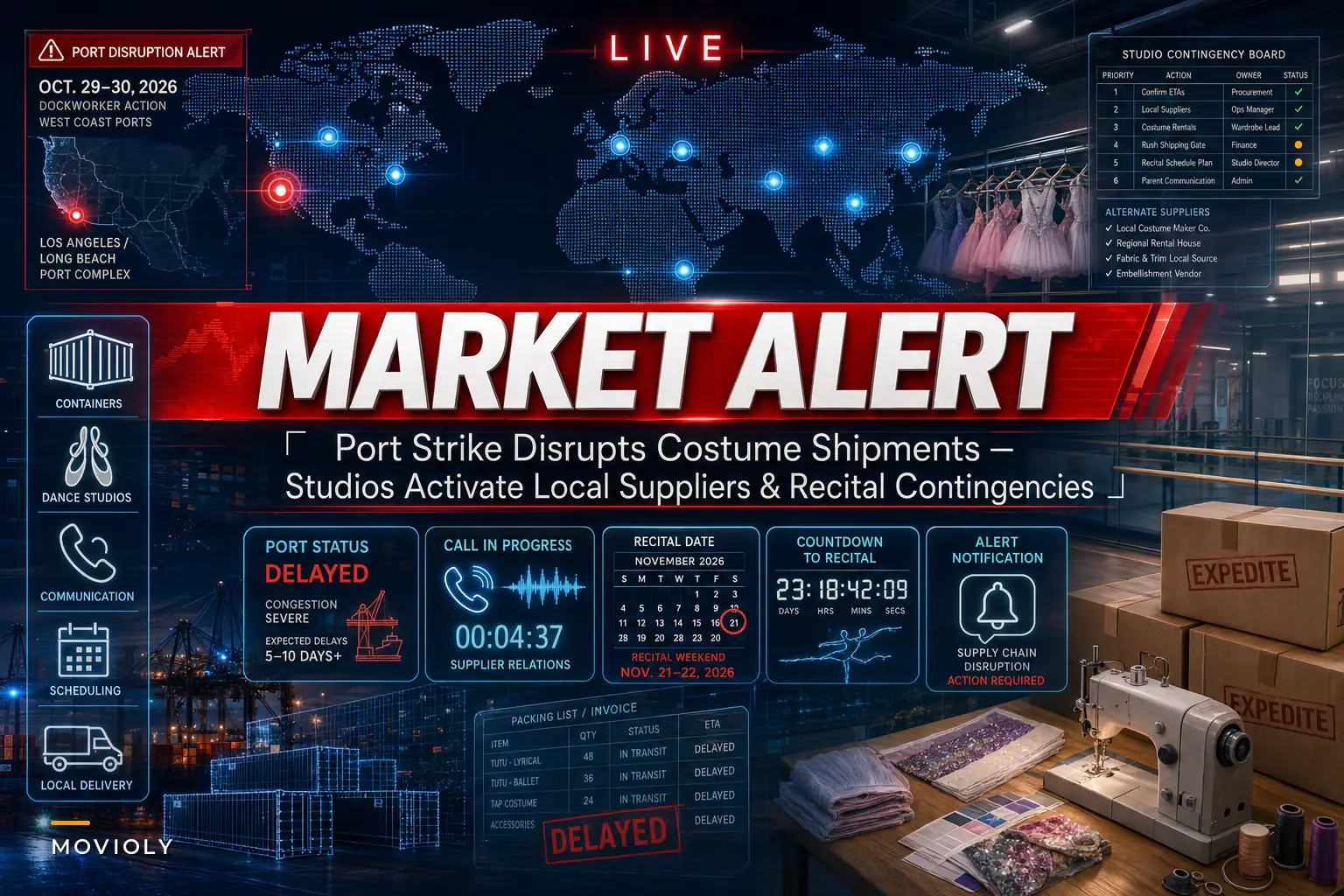

Late October is the worst possible time for shipping to hiccup. Spring recital costumes are getting finalized, holiday performance props are mid-transit, and merch orders for the winter showcase are supposed to be landing. Then the news hits: dockworkers staged coordinated actions across more than 100 ports worldwide on October 29–30, and as Reuters reported on the global port actions, container flows got snarled right in the middle of your busiest sourcing window. Talks at the Los Angeles–Long Beach complex were extended on October 30 to avoid a bigger stoppage, which Reuters also covered, but "extended talks" is not the same as "resolved."
For most studio owners, the ports themselves aren't the problem. The problem is what sits downstream: a costume vendor in another time zone sourcing trims from overseas, a flooring supplier waiting on marley rolls stuck on a vessel, a merch printer whose blank garments haven't moved in two weeks. You don't feel the port. You feel the empty box that was supposed to arrive three weeks before dress rehearsal.
This isn't a "watch the news" piece. It's about what you actually do this week so a supply chain disruption doesn't turn into refunds, a scrambled recital, or costumes showing up the morning of the show.
What breaks first (and it's probably not what you're worried about)
When shipping slows, studios don't lose everything at once. Things break in a specific order, and understanding that order tells you where your attention should go.
The first casualty is almost always custom and semi-custom costumes — anything with a specific dye lot, appliqué, or a sizing run cut to your roster. These have the longest production tails and the least room for substitution. A delayed shipment of base garments pushes the whole production calendar, and because costumes are size-specific per dancer, you can't just grab whatever's in stock.
The second casualty is retail and merch inventory — studio-branded jackets, show tees, logo bags. These feel optional until you remember how much of your recital-season revenue runs through them.
The third thing, and the one people consistently forget, is equipment and facility items: marley flooring, barres, AV gear for livestreaming, replacement sound cables. Never urgent until the week you need them.
What tends to happen across small operations is that owners panic about the wrong tier. They start frantically expediting merch tees — cheap to replace, easy to source locally — while the custom costume order, the one with zero backup plan, quietly slips two weeks because nobody picked up the phone to confirm.
The problem the disruption exposes
A port slowdown doesn't create a new weakness. It reveals one that was already there: most studios have no real visibility into their supply chain past the first vendor.
Eliminate scheduling headaches and missed payments.
Movioly streamlines booking, confirming, and managing every class with ease.
- Unified class and instructor scheduling
- Automated student notifications
- Integrated payment tracking
No credit card required
You know your costume company. You probably don't know where they source fabric, how much buffer stock they carry, or whether their production runs domestic or overseas. When something upstream shakes, you're the last to find out — usually through a vague "slight delay" email that gives you nothing useful.
In a normal year, this invisible dependency is fine. Vendors absorb the variability and you never notice. During a disruption, the slack disappears, and suddenly your recital date depends on a container you didn't know existed.
The studios that handle this well aren't the ones with bigger budgets. They're the ones who treat procurement as an actual operational function instead of a seasonal scramble — which means knowing lead times, having named backup suppliers, and building confirmation checkpoints into the calendar rather than assuming "ordered" equals "arriving."
Run these this week: a triage sequence
Don't try to fix everything. Work through this in order.
-
Pull every open order and sort by substitutability, not dollar value. Custom costumes and dyed-to-order items go to the top. If an item can be replaced locally in 48 hours, it goes to the bottom. This sort tells you where your real exposure is.
-
Call — don't email — your top three most-exposed vendors. Ask two specific questions: "Is this order already produced and shipped, or still in production?" and "If it's delayed, what's your realistic worst-case date?" A phone call gets you a real answer. Vague email replies buy you nothing.
-
Lock your dress-rehearsal and recital dates against the worst-case delivery date, not the promised one. If your vendor's worst case is a two-week slip, your production schedule needs to assume two weeks.
-
Identify local and domestic backup sourcing for your top two risk items now, while you still have time to compare options — not the week before the show when you'll overpay for whatever's available.
-
Freeze any new non-essential orders competing for the same freight capacity or your own attention. Winter merch restock can wait.
-
Communicate early with families only where it actually affects them. Don't blast a panic email. Prep a short, calm message in case a costume collection or fitting date needs to shift.
Here's a quick visual to map that triage flow.
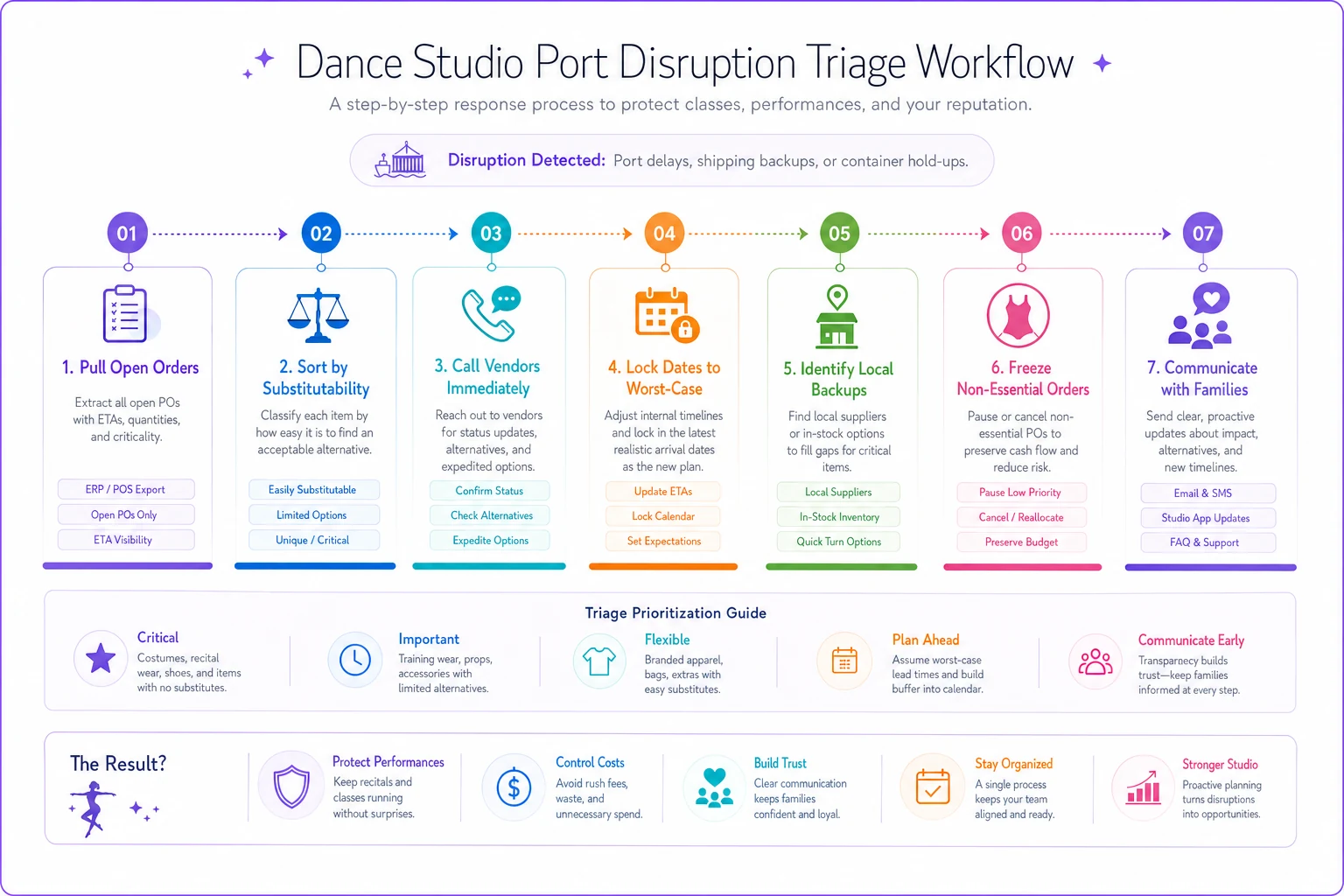
The goal isn't to solve the disruption. It's to convert an unknown risk into a known, scheduled one.
A simple exposure table to map your orders
Before making any expedite decisions, spend twenty minutes building something like this in a spreadsheet. It stops you from throwing money at the wrong problem.
| Item category | Substitution difficulty | Deadline sensitivity | Right move during a slowdown |
|---|---|---|---|
| Custom/dyed recital costumes | Very high | Very high | Confirm production status immediately; adjust schedule to worst case |
| Semi-custom costumes (standard sizing) | Medium | High | Identify a backup vendor with similar styling |
| Studio merch / branded apparel | Low | Medium | Switch to local printer if needed; don't overspend expediting |
| Marley / flooring | Medium | Low–Medium | Rent locally for the event if delivery slips |
| AV / livestream gear | Low | Medium | Rent or borrow; buy later |
| Props / set pieces | Low–Medium | Medium | Build or source locally |
The table does one quiet thing that matters: it stops you from treating a $40 tee shortage and a $4,000 custom costume order with the same urgency. They're not the same problem.
A real scenario: the studio that got the sequence right
A mid-size studio running a spring showcase for roughly 180 dancers had about $11k in costume orders in progress when delivery timelines started slipping. Their first instinct was to expedite everything, which the vendor quoted at close to $1,400 in rush and freight fees.
Instead, the owner sorted by substitutability. It turned out only two costume groups — around 40 dancers' worth of custom-dyed pieces — were genuinely at risk. The rest were standard styles a regional backup supplier could match within the original window.
They expedited only the two custom groups (around $380 in rush fees), moved the standard pieces to the backup supplier at near-normal cost, and pushed one fitting date back by nine days to absorb the slip. Total extra cost landed closer to $500, no recital date moved, and the showcase ran on schedule.
The lesson wasn't "spend more." It was "spend precisely." Most of the savings came from not panicking on the 140 dancers whose costumes were never actually at risk.
Where good procurement systems quietly earn their keep
Here's what owners realize during a disruption and then forget by the following spring: tracking lead times, logging vendor contacts, and flagging orders that haven't confirmed shipping is brutal to do manually under pressure. When that information lives in someone's inbox and a paper folder, you can't run the triage sequence above quickly — because you don't have the data in one place.
Put vendor lead times and confirmation checkpoints into a shared operational tool so you can run triage without digging through email threads.
This is where having procurement and inventory tracking inside your operational platform, rather than scattered across emails and spreadsheets, actually makes a difference. A well-set-up system lets you see open orders, expected delivery windows, and which items are tied to which recital date without digging through threads. Some platforms will flag orders that are past an expected-confirmation date automatically, so a silent delay doesn't blindside you three weeks later. That kind of automated nudge isn't flashy. It's just useful when attention is the scarce resource.
If you want to build this properly rather than react every season, it's worth working through a procurement playbook with an RFP template, evaluation scorecard, and long-term TCO checklist. The studios that don't scramble during disruptions are the ones who did this groundwork during a calm month.
When expediting makes sense — and when it's a trap
Rush shipping is a tool, not a reflex. Use it for items where substitution is impossible and the deadline is immovable — custom costumes, dancer-specific sizing, anything with a vendor-controlled dye lot. For those, a few hundred dollars in rush fees is cheap insurance.
It becomes a trap when you expedite things that have local alternatives. Paying premium freight to rush-ship branded tees when a local printer could turn them in a week is just burning cash during a season when it's already tight. Same with AV gear and flooring — rent locally before you pay to fly something across the country.
There's also a quieter case: studios that shouldn't expedite anything at all. If your recital is more than six to eight weeks out, you likely have room to absorb a normal slip without any rush fees. Confirm your timelines, track worst-case dates, and don't act just because the news feels urgent.
The move that actually protects next year
The real takeaway from a disruption like this isn't about this specific October. Ports will have good years and rough ones, and freight will always be lumpy around the holidays. The difference between studios that stay calm and studios that scramble is whether procurement is a running system or a once-a-season fire drill.
Build the habit now: know your top exposure items, keep a named backup supplier for each, schedule against worst-case delivery dates, and keep your order data somewhere you can actually read it under pressure. Do that, and the next port headline becomes a Tuesday-afternoon triage call instead of a threat to your show.
The costumes will get there. The question is whether you spent $500 and a few phone calls making sure, or $1,400 and a week of panic finding out the hard way.
Ready to elevate your studio operations?
Join 500+ studios using Movioly to save time, reduce admin workload, and enhance student experiences.