

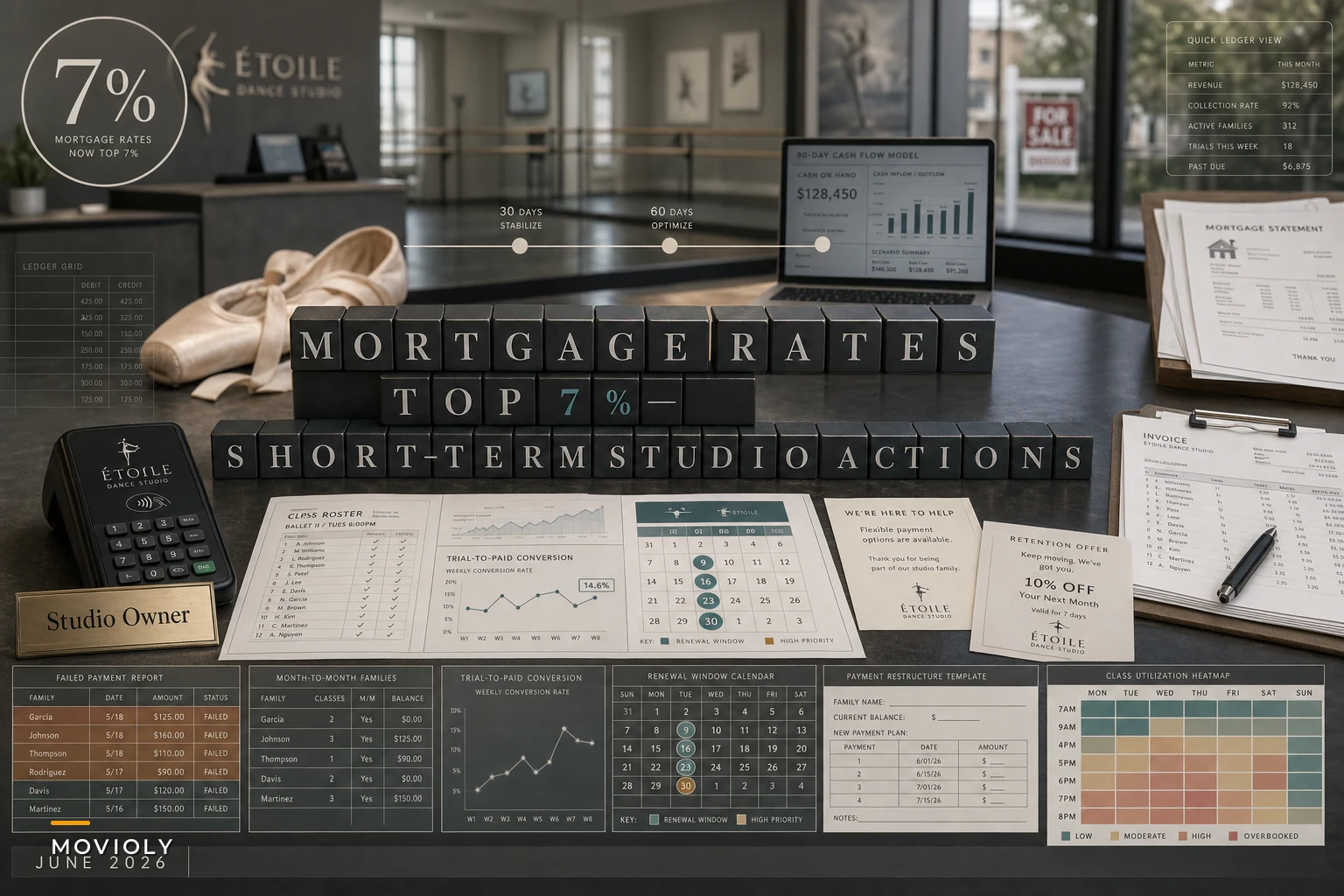

The jump in borrowing costs late last week wasn't gradual. Daily broker surveys showed 30-year fixed rates spiking to roughly 7.45% on Thursday, and by the weekend the story had shifted to a broader "rates have broken past 7%" narrative as Treasury yields climbed. CNBC reported the Thursday spike, and NPR tied the move to surging bond yields and a deepening housing gridlock.
On the surface, none of that is a dance studio problem. You don't lend money. You teach ballet and hip-hop and spend most of your Tuesday evenings keeping a room full of eight-year-olds pointed in roughly the same direction. But the mortgage rates impact on dance studios is real — it just shows up through the family budget, not through your balance sheet. When a household's housing cost climbs, or a planned refinance falls apart, or a move gets frozen, discretionary spending is the first thing that gets cut. Dance tuition sits squarely in that category.
So this post isn't really about interest rates. It's about what you should actually do in the next 30 to 60 days to protect enrollment and keep cash coming in while family budgets tighten.
The part most owners get wrong about rate shocks
The most common mistake when outside economic pressure hits a studio: owners wait for the cancellations before reacting.
That's backwards. By the time families are emailing to drop a class, you've already lost the easier fight. The damage from a budget squeeze doesn't start with cancellations — it starts with quiet hesitation. Trials don't convert. The second kid doesn't get enrolled. A family that would've bought a 20-class package buys 10 instead. Auto-pay cards that were already running close to the limit start failing more often.
None of that generates an email. It just shows up as softer numbers three weeks later, and by then you're reacting to a trend instead of getting ahead of it.
The studios that handle these moments well treat the first two weeks as a window to act on leading indicators, not lagging ones — trial-to-paid conversion, failed payment rates, package downgrade behavior. Not just total headcount.
What actually happens to studio cash flow when budgets tighten
Understanding the mechanism tells you where to intervene.
Eliminate scheduling headaches and missed payments.
Movioly streamlines booking, confirming, and managing every class with ease.
- Unified class and instructor scheduling
- Automated student notifications
- Integrated payment tracking
No credit card required
-
Prepaid commitment shrinks first. Instead of paying the term up front, they ask about monthly. Instead of two kids, one. Your average revenue per enrollment drops before your enrollment count does.
-
Payment failures rise. Cards that were already close to their limit start declining near month-end. If your dunning process is slow or passive, a failed card quietly becomes a churned enrollment.
-
Conversion slows at the top. Trial families who would've said yes now say "let me check with my husband" — which is often a polite no. Your funnel looks fine in volume but worse in close rate.
-
Cancellations trail everything else. This is the lagging indicator everyone watches, and it's the last thing to move.
By the time step 4 is visible, steps 1 through 3 have been eating your revenue for a month. Your cash flow softens quietly before your enrollment report shows anything alarming.
This is exactly why a tight, forward-looking cash view matters right now. If you don't already have a running 90-day projection, this is the moment to build one — the small-studio bookkeeping checklist and 90-day cash-flow template is a solid starting structure to adapt, because the mechanics of a budget-squeeze crunch are nearly identical to a seasonal one.
The 30-day protection checklist
Ordered by impact, not by ease:
-
Pull your failed-payment report from the last 90 days. Know your baseline failure rate before the squeeze hits so you can actually spot the increase.
-
Review every family currently on month-to-month. These are your highest-risk accounts. They've already signaled some budget sensitivity just by being on that structure.
-
Audit your trial-to-paid conversion rate weekly, not monthly. A drop here is your earliest warning sign.
-
Identify your prepaid renewal window. Which families have terms expiring in the next 60 days? That's where downgrades happen.
-
Build one flexible payment option you're comfortable offering. Not a discount — a restructure. More on this below.
-
Draft retention outreach scripts now, so your front desk isn't improvising when the first "we need to pause" email lands.
-
Freeze non-essential hiring and new contractor commitments until you've seen two clean weeks of enrollment data.
-
Review class utilization and flag any under-filled sections you could consolidate without disrupting progression.
You won't do all eight in week one. But items one through four are pure information-gathering — you can knock those out in an afternoon.
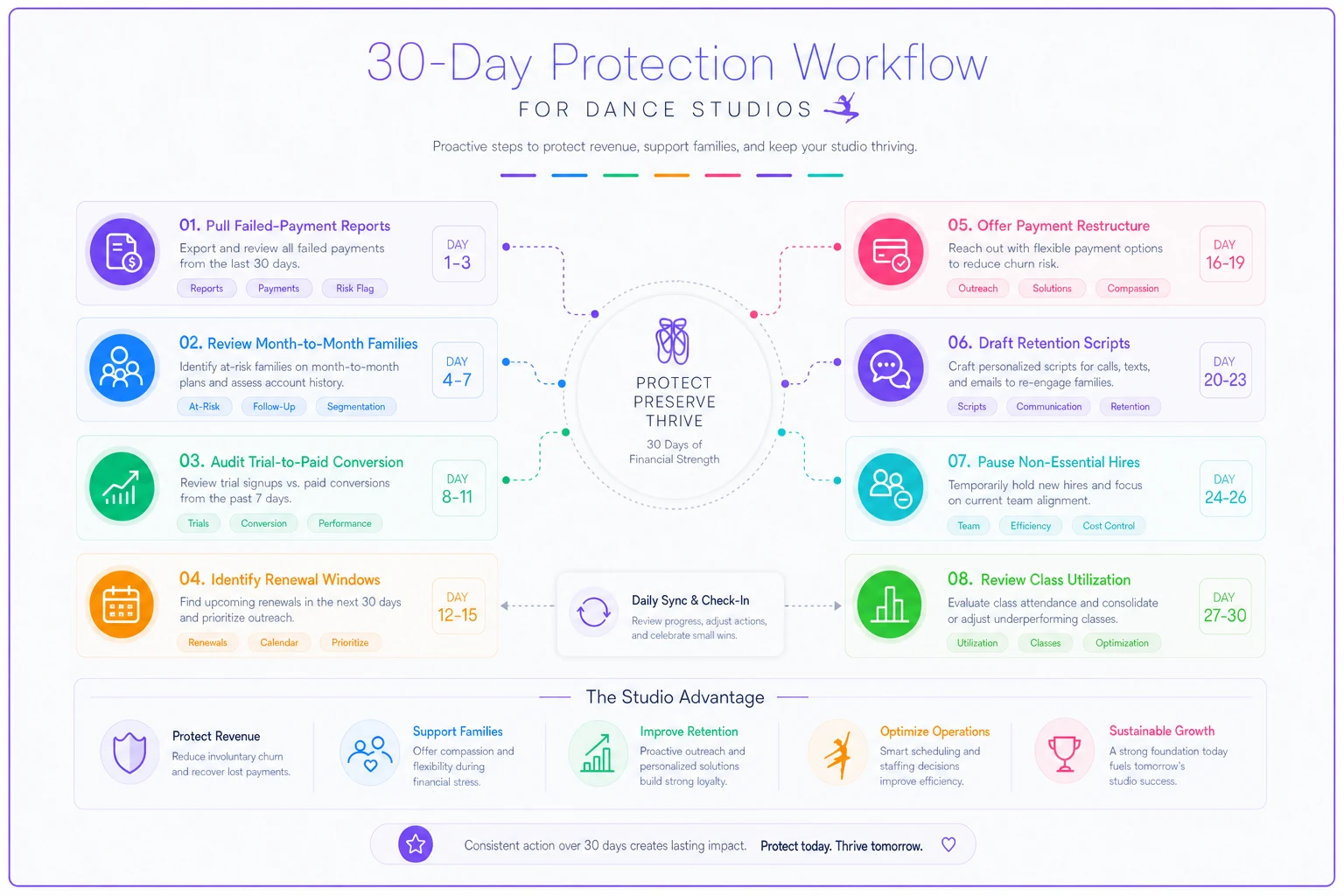
Use this as a quick visual checklist for the 30-day actions.
Flexible payment plans vs. discounts — know the difference
When budgets tighten, the instinct is to discount. Resist it. A discount permanently lowers your revenue per student and trains families to wait for the next deal. A payment restructure keeps your total price intact while making the monthly number easier to absorb.
| Approach | What it does to revenue | Retention effect | Risk |
|---|---|---|---|
| Across-the-board discount | Permanent per-student drop | Helps short-term, erodes pricing power | Hard to reverse; attracts price-shoppers |
| Payment plan restructure | Revenue stays the same, timing shifts | Keeps committed families enrolled | Slightly more admin + collection risk |
| Prepaid incentive | Pulls cash forward, mild margin cost | Locks in committed families | Only works on families with cash on hand |
| "Pause, don't cancel" option | Defers revenue, preserves the relationship | Very high — keeps the spot and the habit | Temporary cash gap |
The pattern worth noticing: the healthiest options protect timing and relationship rather than cutting price. A family under housing-cost stress rarely wants to quit dance — they want the monthly number to stop hurting. Give them a way to stay, and most will.
A realistic scenario
Think about a mid-sized suburban studio — roughly 260 enrolled students, mostly recreational, with a mix of prepaid-term and monthly auto-pay families. Normal monthly card failure rate sits around 2–3%.
Two weeks into a borrowing-cost squeeze, that failure rate creeps toward 5–6%, and trial-to-paid conversion drops from around 55% down into the low 40s. Nobody's canceling yet. The owner almost misses it because total enrollment still looks fine.
What turns it around isn't a sale. It's two moves. First, they switch failed-payment handling from a once-a-week manual check to a same-day retry-and-text sequence, which recovers a meaningful chunk of those declines before they turn into dropouts. Second, they quietly offer their month-to-month families a "split your term into smaller payments, keep your spot" option. About a dozen families take it — families who probably would've paused by November otherwise.
The result isn't a revenue jump. It's a revenue hold — roughly $4k–$5k of monthly tuition that would have leaked out through silent churn and failed cards instead stays on the books. In a tight stretch, holding your line is the win.
Where your systems quietly matter
You don't need to overhaul your whole operation to handle this. But the studios that ride out budget shocks without too much damage tend to have a few unglamorous things already in place — and the ones that struggle are usually doing those same things by hand.
The biggest one is failed-payment handling. If your dunning is a weekly manual chore, every declined card has days to turn into a dead enrollment. Studios running an automated retry-and-notify flow — card fails, family gets a friendly text within hours, charge retries on a smart schedule — recover far more of those payments without anyone having to babysit it. In a normal month that's a convenience. During a squeeze, it's the difference between a 3% and a 6% churn drag.
Set automated retries and friendly texts within hours of a failed payment to recover declines before they churn.
The second is visibility. Most of the leading indicators above — conversion rate, failure rate, package downgrades, renewal windows — are already sitting somewhere in your management platform. The problem is they're scattered across different screens, so nobody actually watches them weekly. Having them surface automatically in one place is what lets you react in week one instead of week five. Less about fancy automation, more about not having to manually build a report every Monday just to notice a trend you could've caught two weeks earlier.
The point isn't to buy new software because rates went up. It's that a budget shock exposes whichever of these you've been doing manually — and that's usually exactly where the quiet revenue leaks are hiding.
When to hold the line vs. when to adjust
Not every studio should react the same way, and over-reacting is its own risk.
Hold steady if your base is heavily prepaid on annual terms, your renewal window is months out, and your failed-payment rate hasn't moved. You've got runway. Watch the leading indicators, prep your scripts, but don't start cutting classes over a headline.
Actively adjust if you run a lot of month-to-month enrollment, your trial conversion is already softening, and you've got new hires or contractor hours committed that assume growth. That's the profile that gets hurt fastest — pausing hires and consolidating under-filled sections genuinely protects you here.
Don't start slashing if you're a newer studio still building your reputation. Cutting classes or visibly scrambling signals instability to exactly the families you're trying to earn trust from. Protect cash through payment flexibility and tighter dunning instead — quietly, behind the scenes.
Most well-run studios survive rate shocks fine. The ones that get hurt are usually the ones that either ignored the early signals or panicked and discounted themselves into a weaker position. Neither of those outcomes is really about the interest rate — they're about how fast and how calmly you read your own numbers.
A spike past 7% doesn't reach into your lobby directly. It reaches into your families' checking accounts, and the pressure arrives at your studio a few weeks later, disguised as a soft conversion week and a couple of extra declined cards. Wait for the cancellations and you're already behind.
Spend an afternoon this week pulling your failure rate, your conversion trend, and your upcoming renewal list. Decide now how you'll help a stressed family stay instead of leave. The studios that treat the next 30 days as a quiet operations check-up — not a crisis — are the ones that come out the other side with their enrollment, and their pricing, fully intact.
Ready to elevate your studio operations?
Join 500+ studios using Movioly to save time, reduce admin workload, and enhance student experiences.