



Most dance studio owners realize they have a cash flow problem around week 8 of summer break. Enrollment dropped in May, expenses stayed exactly the same, and suddenly payroll feels tight. The frustrating part is that this pattern repeats every single year, yet studios keep getting blindsided by it.
Studios that survive seasonal dips almost always maintain a rolling 90-day cash forecast. Not a yearly budget, not monthly P&L reviews — a constantly updated 90-day window that shows exactly when cash gets tight before it actually does.
Why dance studios hit cash crunches in predictable months
Dance studios face a fairly unique cash flow challenge. Revenue clusters around registration periods — September, January — while expenses run steady all year. Rent doesn't drop in July. Insurance premiums don't pause during spring break. Yet most studios operate month-to-month and only notice problems when the bank balance starts looking uncomfortable.
Late February through March: Holiday momentum fades, spring break disrupts attendance, and recital costume orders require upfront payment. Studios often see a 15–25% revenue dip while expenses spike from recital prep.
Mid-July through August: Summer camps generate some revenue, but regular class income drops 40–60%. Meanwhile, studios are paying for fall marketing, facility maintenance, and instructor training — all before September tuition arrives.
Early December: Holiday showcases mean overtime pay for instructors, while families skip classes for travel. Revenue drops roughly 20% as expenses climb for special events and year-end bonuses.
These aren't random bad months. They're structural to how dance studios operate. A competition-focused studio in Texas faces different timing than a recreational studio in Vermont, but the pattern holds: predictable revenue valleys that line up with expense peaks.
The 90-day rolling forecast that actually works
Forget complicated financial software. Effective cash management starts with a simple spreadsheet tracking three things: confirmed income, committed expenses, and cash buffer targets.
Eliminate scheduling headaches and missed payments.
Movioly streamlines booking, confirming, and managing every class with ease.
- Unified class and instructor scheduling
- Automated student notifications
- Integrated payment tracking
No credit card required
Week-by-week tracking (not monthly)
-
Beginning cash balance
-
Expected income (tuition drafts, drop-in classes, retail)
-
Required expenses (payroll, rent, utilities)
-
Discretionary expenses (marketing, supplies, equipment)
-
Ending cash position
Separate recurring from variable income
-
Auto-draft tuition (highly predictable)
-
Drop-in classes and workshops (somewhat predictable)
-
Retail and special events (unpredictable)
Most studios overestimate variable income. Use 70% of your three-month average for drop-ins, 50% for retail. Better to be pleasantly surprised than scrambling.
Flag commitment dates
Mark when expenses become unavoidable. Payroll processes Tuesday for Friday payment. Rent is due on the 1st but late fees start on the 5th. Costume orders require a 50% deposit by February 15th.
Commitment dates matter more than due dates. Once you pass the commitment point, that cash is effectively gone.
Monthly tasks that prevent surprises
The difference between studios that struggle and those that don't usually comes down to consistent financial routines. Not complicated analysis — just regular check-ins that catch problems early.
First Monday: Reconciliation and reality check
Pull actual numbers from the previous month. Compare what you projected versus what happened. Most studios are off by 10–15% on income, sometimes more on expenses.
Update your 90-day forecast with real starting numbers. If last month came in lower than expected, adjust forward projections down by roughly half that variance. One bad month often signals a trend rather than a one-off.
Check aging receivables. Studios typically carry somewhere between $3,000 and $8,000 in overdue accounts, and some of that will never be collected. Anything over 60 days should be marked as unlikely in your forecast.
Second Monday: Expense audit and commitment review
Review upcoming expenses for the next 30 days. Which are truly fixed? Which could shift if needed?
-
Delay equipment purchases to next quarter
-
Temporarily reduce part-time instructor hours
-
Push facility improvements back
-
Shift marketing spend to lower-cost channels
Document these potential adjustments before you need them.
Third Monday: Revenue pipeline check
Count actually enrolled students for next month's billing cycle. Don't assume everyone continues. Studios lose roughly 3–5% monthly to passive churn — families who meant to keep coming but never updated payment info or forgot to re-register.
Review trial conversions from the previous month. If your conversion rate drops below 60%, something in your onboarding process needs attention. When to hire, raise prices, or open a class: the 6 financial metrics covers benchmarks for healthy conversion rates if you want to dig into that.
Fourth Monday: Forecast adjustment and action planning
Update your 90-day projection with everything learned this month. If cash drops below your comfort threshold in the next 12 weeks, start making adjustments now — not when things actually get tight.
Most studios need a minimum cash buffer of about 1.5 months of operating expenses. Drop below that and one missed deposit or unexpected repair turns into a genuine crisis.
Seasonal planning templates that match studio reality
Generic business planning templates don't account for dance studio seasonality. You need frameworks built around recital season, summer programs, and competition schedules.
The September surge template
-
Week -8
Marketing materials designed and printed
-
Week -6
Instructor schedules finalized, contracts signed
-
Week -4
Facility maintenance completed
-
Week -2
Open houses and trial classes scheduled
-
Week 0
Classes begin, but cash lags 2–3 weeks
Budget for negative cash flow in August, even though September will likely be your biggest month.
The recital season survival guide
Recital season creates roughly a 12-week cash flow roller coaster. Costume deposits come in January–February, but final payments might not arrive until May. Meanwhile, you're paying for venue rental, lighting, programs, and flowers — most requiring deposits months in advance.
-
Venue and technical costs (often 35–40% of recital budget)
-
Costumes and accessories (30–35%)
-
Programs, photography, flowers (15–20%)
-
Staff overtime and contractors (10–15%)
A lot of studios actually lose money on recitals when instructor overtime gets factored in. Build in a 15% buffer above your direct cost estimates.
Summer transition planning
The shift from regular classes to summer programs creates specific cash flow challenges. May is when regular tuition ends but summer camp payments haven't started yet. June is a partial month for both programs, which makes scheduling and forecasting messy. July runs full summer programming but revenue is running 30–40% lower than regular season. By August, fall prep expenses are piling up while you're still running a reduced summer schedule.
Create separate forecasts for regular season and summer. The instructor ratios, facility usage, and pricing structures are different enough that combining them makes forecasting nearly impossible.
Payroll timing that preserves cash
Payroll represents 45–55% of most studio expenses. Small timing adjustments can create real cash flow improvements without affecting how instructors feel about working for you.
Align payroll with tuition collection
Most studios default to standard bi-weekly payroll, which creates mismatches with monthly tuition cycles. Two alternatives worth considering:
-
Semi-monthly payroll (15th and last day) aligns better with monthly tuition. Instructors get consistent pay dates and cash flow smooths out. The downside is calculating hourly wages for varying day counts.
-
Monthly payroll for salaried positions, bi-weekly for hourly instructors. This splits the difference — more flexibility for part-time staff, simpler administration for full-time.
Strategic payment scheduling
Process payroll 2–3 days after major tuition collection dates. If auto-drafts run on the 1st, schedule payroll for the 4th. This makes sure cash is actually in your account before committing to payroll.
For summer camps and workshops, collect payment in full at registration but delay instructor payment until after classes complete. This prevents paying instructors for classes that get cancelled due to low enrollment.
The contractor consideration
-
Many studios use independent contractors for specialty classes. Contractor payments tend to bunch up at month-end, which creates unnecessary cash crunches.
-
Spread them out based on class schedules instead. Monday instructors get paid on the 10th, Wednesday instructors on the 20th, weekend instructors on the 30th. Smaller cash outflows throughout the month rather than one big hit.
Smaller cash outflows throughout the month rather than one big hit.
Warning signs your bookkeeping system is failing
Before cash flow becomes critical, a few warning signs indicate that financial tracking isn't working.
The three-month scramble pattern
Every three months, you're frantically gathering receipts, reconciling accounts, and catching up on bookkeeping. This quarterly panic means daily systems aren't functioning. Studios operating this way typically miss 15–20% of deductible expenses and overlook slow-moving problems until they hit crisis level.
Surprise credit card balances
If credit card statements regularly surprise you, expense tracking has broken down. Studios often put recurring subscriptions, insurance, and software on cards and then forget those automatic charges exist. A $2,800 monthly credit card bill might quietly include $400 in services you stopped using a year ago.
Parent payment confusion
When a parent asks about their balance and you can't answer immediately, your tracking system has gaps. That uncertainty costs more than just the occasional missed payment — it erodes parent trust and creates ongoing administrative headaches.
-
Make-up classes not tracked properly
-
Discounts applied inconsistently
-
Drop-in classes mixed with monthly tuition
-
Private lesson credits lost in the shuffle
Migrate from paper without chaos: a phased checklist for dance studios covers detailed steps for cleaning up payment tracking without disrupting operations.
Building your studio-specific dashboard
Generic financial dashboards don't capture dance studio realities. You need metrics that reflect your actual operational model.
| Metric | What to track | Target |
|---|---|---|
| Current cash position | Actual available cash minus pending obligations | — |
| Next 4 weeks' confirmed income | Auto-drafts and confirmed payments only | — |
| Next 4 weeks' committed expenses | Everything already obligated | — |
| Buffer ratio | Current cash ÷ average weekly operating expense | > 6 weeks |
| Collection period | Average days to collect payment | < 7 days |
| Expense coverage | Months of expenses covered by current cash | > 1.5 months |
| Revenue per student | Total revenue ÷ active students | Track trend |
| Cost per class hour | Total expenses ÷ total class hours offered | Track trend |
Add metrics specific to your studio type. Competition studios should track competition fee collection status, travel expense commitments, costume payment tracking, and private lesson revenue pipeline. Recreational studios are better served tracking trial conversion pipeline, birthday party bookings, drop-in class trends, and seasonal program pre-registration. Studios running multiple programs need to watch revenue per program type, instructor cost per program, facility usage efficiency, and cross-enrollment percentages.
Track trends, not just snapshots. Is your buffer ratio improving or declining month over month? Are collection delays getting longer? The direction matters more than any single number.
The spreadsheet template that requires 10 minutes weekly
Complex financial systems fail because they require too much maintenance. This simple structure takes about 10 minutes to update weekly but prevents most cash flow surprises.
Tab 1: 90-Day Cash Flow
-
Week starting date
-
Beginning cash
-
Confirmed income (itemized by source)
-
Fixed expenses (rent, insurance, salaries)
-
Variable expenses (supplies, marketing, contractors)
-
Ending cash
-
Buffer weeks (ending cash divided by average weekly expense)
Color coding: green when buffer exceeds 8 weeks, yellow for 4–8 weeks, red below 4 weeks.
Tab 2: Monthly Checklist
-
- [ ] Bank reconciliation complete
-
- [ ] Credit card statements reviewed
-
- [ ] Payroll scheduled and funded
-
- [ ] Upcoming expenses identified
-
- [ ] Parent balances reviewed
-
- [ ] 90-day forecast updated
-
- [ ] Tax obligations checked
-
- [ ] Seasonal adjustments made
Tab 3: Seasonal Adjustment Factors
| Month | Adjustment Factor |
|---|---|
| January | 95% of average |
| February | 88% of average |
| March | 85% of average |
| April | 92% of average |
| May | 90% of average |
| June | 75% of average |
| July | 65% of average |
| August | 70% of average |
| September | 115% of average |
| October | 105% of average |
| November | 95% of average |
| December | 80% of average |
Apply these factors to your baseline revenue projections for more realistic seasonal forecasting. Your numbers will differ — the point is to build your own version of this over time.
Tab 4: Quick Ratios Dashboard
-
Current ratio
Current assets / current liabilities (target: >1.5)
-
Collection period
Average days to collect payment (target: <7 for auto-draft studios)
-
Expense coverage
Months of expenses covered by current cash (target: >1.5)
-
Revenue per student
Total revenue / active students (track the trend)
-
Cost per class hour
Total expenses / total class hours offered (track the trend)
This framework adapts to any studio size or model. Consistency is what matters — update it weekly, no exceptions.
Making the template work with operational software
Spreadsheets are flexible, but manual data entry introduces errors and creates delays. Modern operational software can automatically populate most of your financial tracking, cutting that weekly update from 10 minutes to 2.
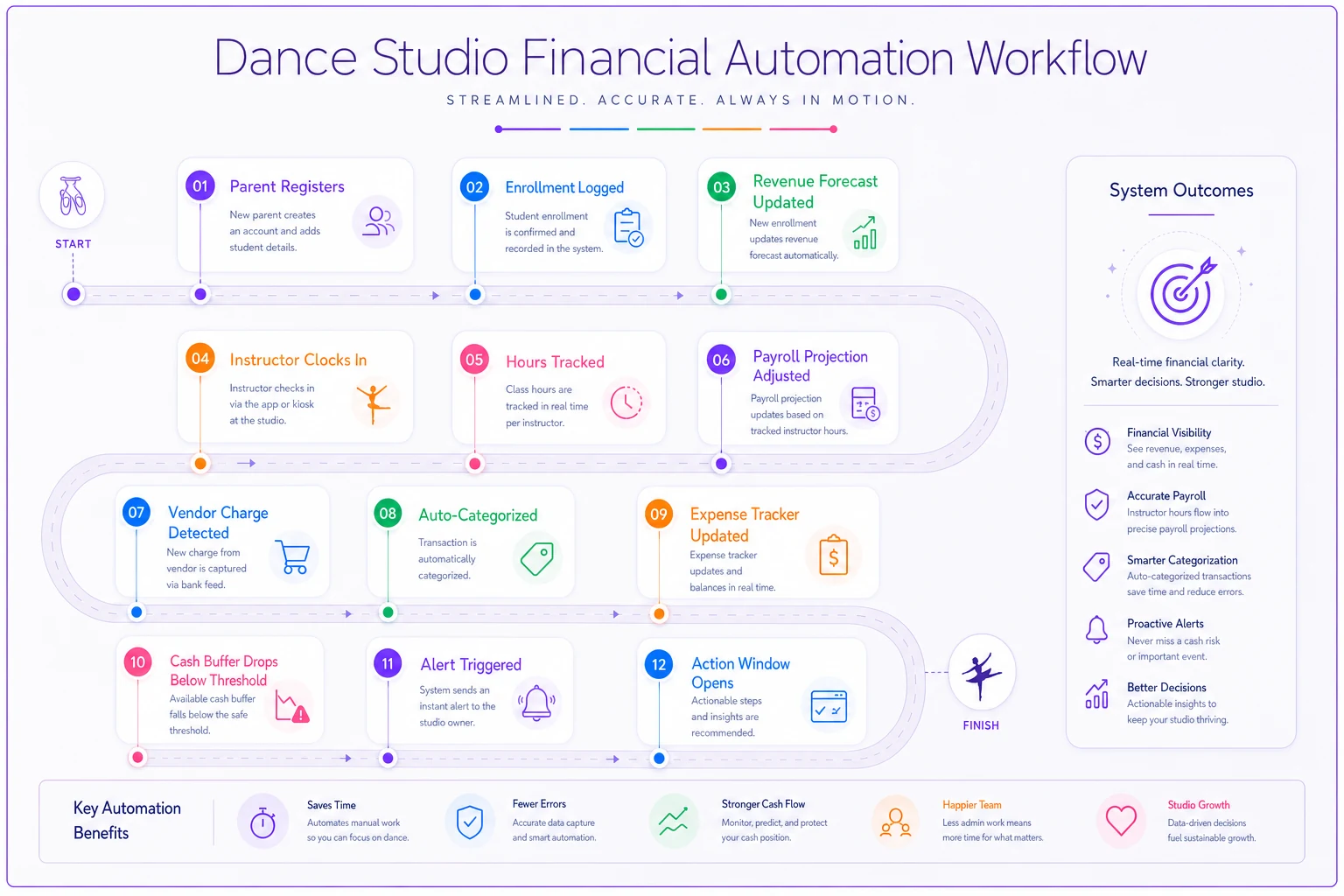
Here's how the automation flow typically works in a well-configured platform:
Parent registers → enrollment logged → revenue forecast updated Instructor clocks in → hours tracked → payroll projection adjusted Vendor charge detected → auto-categorized → expense tracker updated Cash buffer drops below threshold → alert triggered → action window opens
A few specific automation points eliminate most of the manual work. Enrollment-to-revenue pipeline tracking is one — AI-assisted platforms analyze patterns from past trials to project realistic conversion rates and revenue timing, rather than leaving you to guess whether those 12 trial students will actually convert. Recurring expenses get automatically tagged and categorized as the system learns which vendors are always costume-related or which monthly charge is insurance. Parent balance tracking happens in real time across every class attendance, payment, and credit, so parents can check their own balances and administrative questions drop significantly. And when cash flow projections show a potential shortfall based on historical patterns and enrollment trends, you get an alert with enough lead time to actually do something about it.
The goal isn't to replace your understanding of studio finances. It's to eliminate the manual work that gets in the way of regular monitoring. When updating your finances takes 2 minutes instead of 20, you'll actually do it every week.
Beyond survival: using cash flow data to grow
Once cash flow stabilizes, the same tracking system starts revealing growth opportunities. Studios with consistent cash management can spot expansion windows that studios operating in reactive mode simply miss.
Consistent 12-week buffer: When reserves consistently exceed 12 weeks of expenses, there's room to invest in growth without putting operations at risk.
Seasonal dips shrinking: If your summer revenue drop goes from 60% down to 40% year-over-year, you're building enrollment that holds up across seasons.
Collection period shortening: When average collection time drops below 5 days, your systems and parent relationships are solid enough to support expansion.
These metrics tell you not just whether you can afford to grow, but when growth becomes necessary to maintain momentum.
The discipline that separates thriving studios from struggling ones
Financial discipline in dance studios doesn't mean complex accounting or elaborate systems. It means consistent, simple habits that catch problems before they turn into crises.
Studios that maintain healthy cash flow through all seasons share a few specific habits. They update projections weekly even when business feels fine. They track seasonal patterns and adjust before problems hit rather than after. They keep recital finances separate from operational budgets. They know their numbers well enough to make quick decisions when something unexpected comes up.
The bookkeeping checklist and templates in this post aren't revolutionary. They're just structured, consistent applications of basic financial awareness. Studios that struggle usually aren't lacking intelligence or effort — they're lacking systems that make financial management routine rather than stressful.
Every September, some studios scramble to cover fall startup costs while others execute smoothly using reserves built through summer. Every recital season, some studios lose money on their biggest event while others generate profit that funds summer improvements. The difference usually isn't market position or luck. It's the discipline to track cash flow weekly, adjust for seasonality monthly, and plan ahead for challenges you already know are coming.
A studio doing $300k annually with solid cash management often runs more smoothly than one doing $500k without it. The framework is here. Using it consistently is what determines whether any of it actually matters for your studio's financial stability.
Ready to elevate your studio operations?
Join 500+ studios using Movioly to save time, reduce admin workload, and enhance student experiences.