

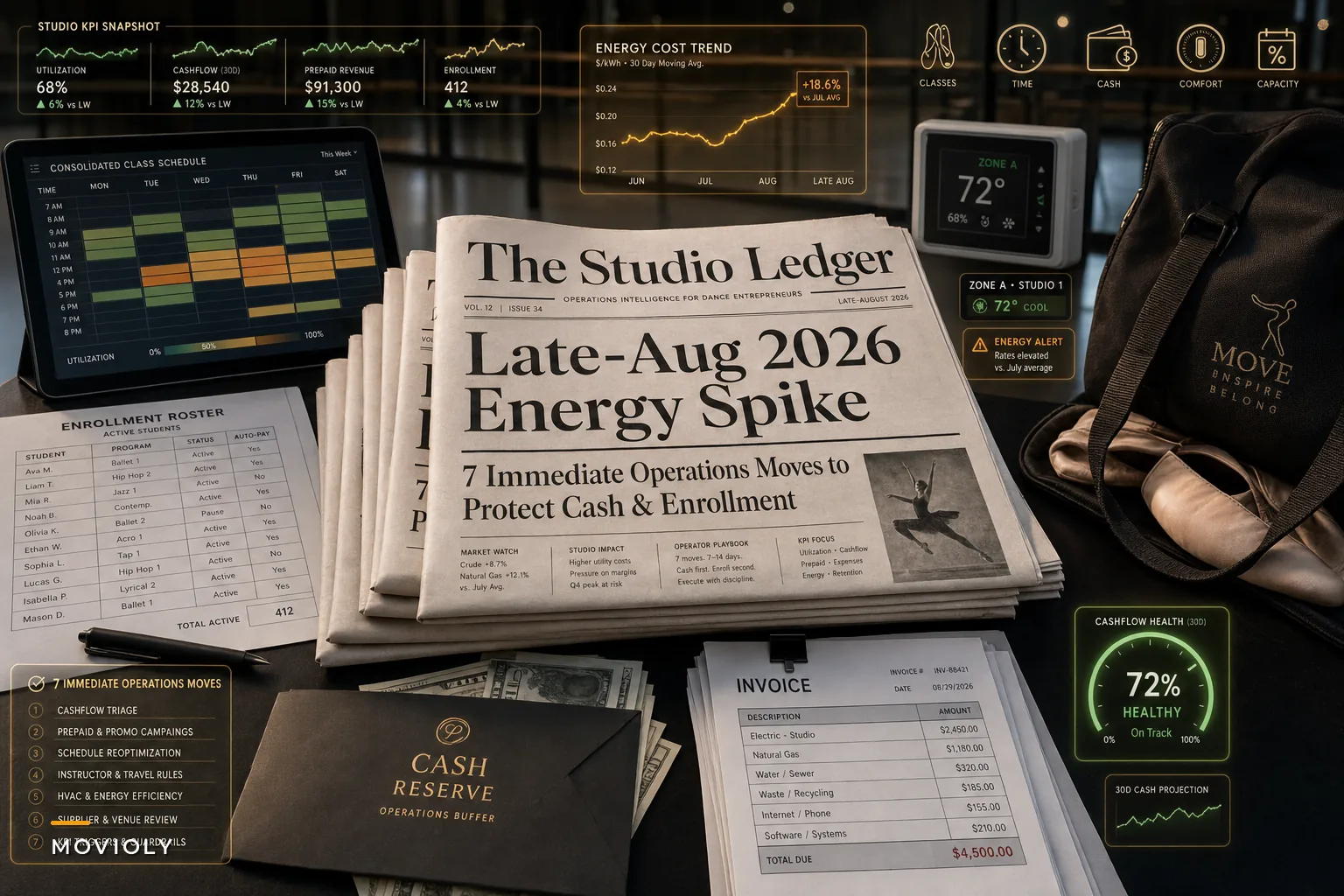

The late-August jump in oil prices caught a lot of small service businesses off guard. After renewed U.S.-Iran hostilities, Brent crude pushed above $90 a barrel, and as CNBC reported, the near-term worry is supply disruption around the Strait of Hormuz. For a dance studio, none of that sounds like your problem — you're not buying barrels of crude, you're buying tap shoes and printer toner.
But that's the trap. Oil prices don't hit you directly. They hit you three or four steps down the chain: your electric bill in a drafty rehearsal space, the gas cost for your traveling instructor, the fuel surcharge your costume supplier quietly adds, and the parents driving 20 minutes each way who suddenly start rethinking that second class. The U.S. Energy Information Administration's Short-Term Energy Outlook flags exactly this kind of transmission — refined-product prices move fast, and they ripple into transport and utility costs before most owners notice.
This isn't a piece about geopolitics. It's about what a margin-sensitive studio should actually do in the next few weeks, before the fall enrollment and recital-prep season locks your cost structure in place.
Why energy costs hit dance studios harder than most people assume
A dance studio is a weirdly energy-hungry business for its size. You're heating or cooling large open rooms with high ceilings, running sound systems for hours, keeping lights on across long evening blocks, and — depending on your setup — powering sprung floors, mirrors with dedicated lighting, and sometimes a lobby that stays warm for waiting parents.
Energy is usually the second or third largest fixed cost after rent and payroll, but it's the one owners pay the least attention to. Rent is negotiated once a year. Payroll gets scrutinized constantly. The utility bill just… shows up, gets paid, and disappears. That inattention is fine when energy prices are flat. It gets expensive fast when they're not.
The underlying problem this spike exposes: most studios have no idea what their cost-per-class-hour actually is. They know tuition. They know roughly what they pay instructors. But the fully loaded cost of keeping Studio B lit, heated, and running for a Tuesday 6 p.m. ballet class? Almost nobody has that number. And when energy costs rise 10–15%, you can't make smart scheduling or pricing decisions without a baseline.
The two-sided squeeze: costs up, discretionary spending down
The nasty part of an energy-price spike is that it pinches you from both directions.
Eliminate scheduling headaches and missed payments.
Movioly streamlines booking, confirming, and managing every class with ease.
- Unified class and instructor scheduling
- Automated student notifications
- Integrated payment tracking
No credit card required
On the cost side, your utilities climb, instructor travel gets more expensive, and suppliers pass along fuel surcharges. On the revenue side, the same rising prices hit your families' household budgets. Dance is discretionary. When gas and heating bills jump in the same month, some parents quietly drop the second class, skip the summer intensive deposit, or don't convert after the free trial.
A typical example: a studio with around 180 enrolled students might see 8–12 families reduce from two classes to one over a single billing cycle when household costs spike. Nobody sends an angry email. It's a slow leak — and a slow leak of $60–$90 per family per month adds up to real money by December.
The moves below are split intentionally: some protect your costs, some protect your cash and enrollment. You'll want a mix.
The 7 immediate moves
1. Calculate your true cost-per-class-hour before you touch anything else
You can't cut what you can't see. Before making schedule or pricing changes, get a rough fully loaded cost for each room per operating hour.
-
Pull your last 3 months of utility bills and average the monthly cost.
-
Count your total operating hours per month across all rooms.
-
Divide to get a blended energy cost per room-hour.
-
Layer in instructor pay and a slice of rent to get a fully loaded class-hour cost.
You don't need accounting-grade precision. Even a ballpark number changes how you think. A studio that discovers a lightly attended Friday-evening class costs roughly $40–$55 an hour to run — and brings in three students — suddenly has a very clear decision to make.
2. Kill or consolidate your lowest-utilization time blocks
This is the single biggest lever, and energy prices just made it urgent.
-
Classes running below 40–50% of room capacity
-
Isolated single classes that force you to power up a whole room
-
Overlapping low-attendance sections you could merge
Consolidating two half-full 5-student classes into one 10-student block can cut the energy footprint for that slot nearly in half while improving the class experience. The mistake owners make here is treating the schedule as sacred because "that's when we've always run it." Parents adapt to schedule changes far more than owners expect, especially with a few weeks' notice.
3. Push prepaid and multi-month packages now, while enrollment intent is high
When household budgets tighten later in the fall, you want your revenue already locked in. The families most likely to drop are the ones paying month-to-month, deciding fresh each cycle whether dance is worth it.
Prepaid semester or multi-month packages do two things: they pull cash forward when you may need it for a higher utility bill, and they psychologically commit the family. Someone who's paid through December doesn't drop in October.
A modest incentive works — something like 5–8% off a full-semester prepay, or a free branded item bundled in. The goal isn't a fire sale. It's converting your most committed families into locked cash before the discretionary squeeze fully hits. This connects directly to broader cash-timing strategy, and if you haven't built a proper cash buffer plan, the small-studio bookkeeping checklist and 90-day cash-flow template walks through exactly how to sequence this.
4. Rethink instructor travel and assignment logic
If you run multiple locations or have instructors traveling between sites, fuel cost increases quietly inflate your effective payroll.
The fix is scheduling geography. Cluster an instructor's classes at one location on a given day instead of bouncing them across town. An instructor teaching three classes at one site burns far less fuel — and far less of your mileage reimbursement — than the same three classes split across two locations with a gap in between.
For studios that reimburse travel, even a 15–20% jump in gas prices meaningfully changes the math on which assignments make sense. Group commitments geographically wherever the schedule allows.
5. Set your building's conditioning to actual occupancy
This sounds obvious, but it's the most commonly ignored move. Studios routinely heat or cool the whole building all day even when only one room is in use, or keep the lobby fully conditioned during long gaps with no families present.
-
Use a programmable or smart thermostat tied to your actual class schedule, not a set-and-forget temperature.
-
Zone your conditioning if the building allows it — don't heat Studio C when only Studio A has class.
-
Shift the building to a lower baseline during your midday dead zone and ramp it back before the evening rush.
-
Audit your lighting — evening-heavy studios burn a lot on lighting, and LED conversions pay back faster when energy prices are elevated.
Studios that do this well align every recurring cost to their schedule, not to a static "open hours" assumption.
Set thermostats to start ramping 10–20 minutes before class begins to balance comfort with lower overall runtime.
6. Renegotiate or lock supplier and venue costs before surcharges compound
Costume suppliers, recital venue rentals, and equipment vendors all feel fuel costs — and they pass them along. If your recital venue contract or costume order isn't locked yet, now is the moment.
Ask suppliers directly whether a fuel surcharge is coming, and lock pricing where you can. For recital venues, a signed rate now protects you from a spring price bump if energy costs stay elevated. This is also a good time to consolidate orders — one larger costume shipment usually beats three small ones once shipping and fuel surcharges enter the picture.
7. Protect trial conversion with clearer value, not deeper discounts
When money's tight, families scrutinize discretionary spending harder. Your free-trial-to-enrollment rate is the first place a discretionary squeeze shows up.
The instinct is to discount. Resist it. Discounting trains families to wait for deals and erodes the margins you're already fighting to protect. Instead, sharpen the value at the trial stage — send parents a short note on what their child worked on, what's next, and how progress builds. A family that clearly sees where dance is heading is far less likely to cut it when the heating bill arrives.
The moves above are split intentionally: some protect your costs, some protect your cash and enrollment. You'll want a mix.
A quick comparison: reactive vs. planned response
The difference isn't budget size. It's whether the studio saw the cost structure clearly enough to move early.
| Situation | The reactive studio | The planned studio |
|---|---|---|
| Utility bill jumps 12% | Absorbs it, notices in Q4 | Already zoned conditioning to schedule |
| Low-attendance Friday class | Keeps running "as always" | Consolidated or cut it in week one |
| Family tightening budget | Loses them to month-to-month drop | Already converted them to prepay |
| Costume supplier surcharge | Pays the higher invoice | Locked pricing before the bump |
| Instructor bouncing between sites | Reimburses rising mileage | Clustered classes by location |
The difference isn't budget size. It's whether the studio saw the cost structure clearly enough to move early.
A real scenario
A single-location studio with roughly 150 students noticed their fall utility bill running about 13% higher than the prior year, right as a couple of families quietly dropped their second class. Instead of waiting to see how bad Q4 got, the owner did three things over two weeks: mapped cost-per-class-hour, cut one chronically half-empty Friday evening slot and merged another, and pushed a semester prepay offer to their most engaged families.
The Friday consolidation alone trimmed a meaningful slice off the monthly energy footprint by eliminating a low-value operating block. The prepay push locked in cash from roughly 30 families before the deeper autumn squeeze hit. Nothing dramatic — no crisis averted with fanfare. The studio just went into the tightest part of the year with cleaner utilization and more predictable cash, instead of hoping the numbers held.
Where this gets easier with the right systems
Most of these moves come down to one thing: knowing your numbers in near-real-time and acting on them quickly. That's hard when your schedule lives in one place, your billing in another, and your utility costs in a folder of PDFs.
An operational platform that centralizes scheduling, enrollment, and billing earns its keep here — not because software magically lowers your energy bill, but because it lets you see utilization by time block, spot low-attendance classes before they drain a whole quarter, and run a prepay campaign without manually chasing every family. When your class occupancy data and your billing sit in the same place, "which slots are bleeding money" takes minutes to answer instead of an evening with a spreadsheet. The point isn't automation for its own sake — it's shortening the gap between noticing a cost problem and actually doing something about it.
Here's a quick visual of the workflow tying scheduling, enrollment, billing, and utilization together.
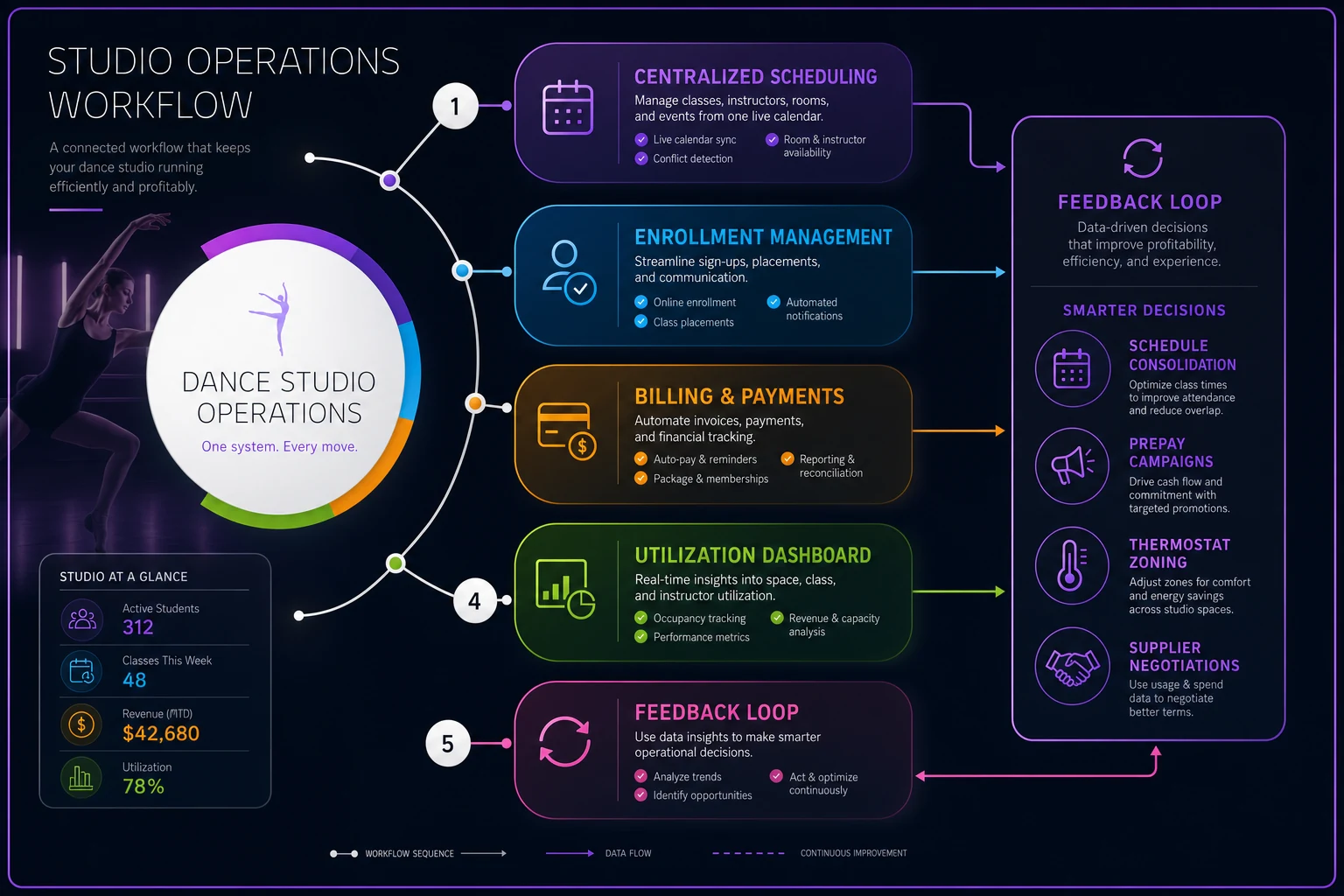
When your class occupancy data and your billing sit in the same place, "which slots are bleeding money" takes minutes to answer instead of an evening with a spreadsheet.
When to move aggressively — and when not to
Cut and consolidate hard when you have clear low-utilization blocks and a building that's expensive to condition. Those decisions pay off immediately and rarely hurt enrollment.
Be more careful when the class in question is small but strategic — a beginner feeder class that grows into your bigger levels, or a specialty class that's part of your studio's identity. Don't cut future pipeline to save a short-term utility dollar.
And skip the panic pricing entirely if your enrollment is healthy and your cash buffer is solid. Not every studio needs to react to every headline. If you've already got strong prepay adoption and lean scheduling, locking supplier pricing and holding steady might be the smartest move you make.
The takeaway
An oil-price spike is a stress test for a cost structure most studios never look at closely. The ones that come through fall in good shape aren't the ones with the lowest bills — they're the ones who knew their cost-per-class-hour, tightened utilization early, and pulled committed revenue forward before household budgets tightened. Energy prices will move again, up and down, for reasons no dance studio can control. What you can control is how quickly you see the impact and how cleanly you respond.
Ready to elevate your studio operations?
Join 500+ studios using Movioly to save time, reduce admin workload, and enhance student experiences.