
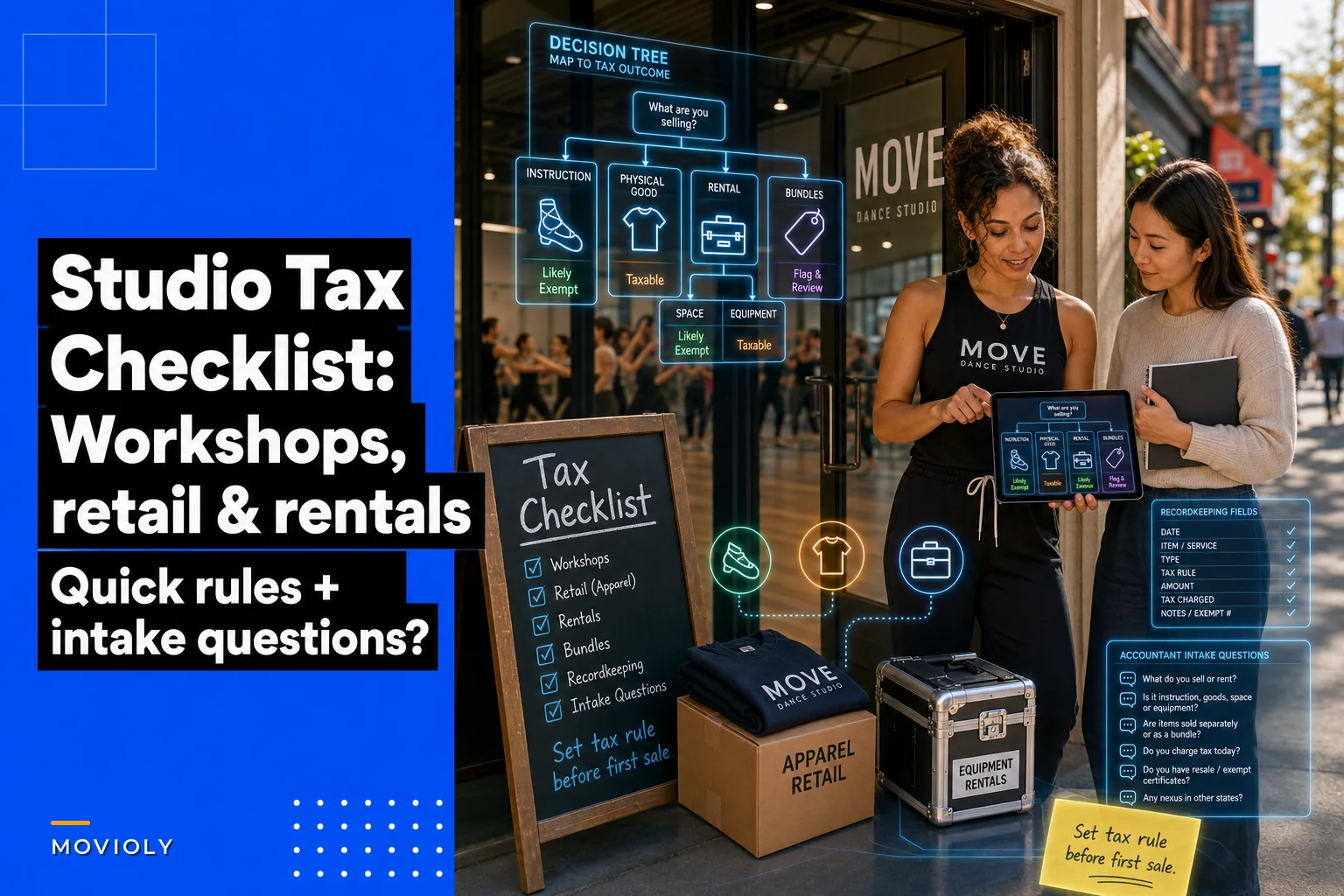

Most studio owners don't get tripped up by income tax. That part is annoying but manageable — you make money, you report it, your accountant handles the deductions. Where studios actually get burned is sales tax, because it's a per-line-item, per-state, sometimes per-city mess that nobody explains until you're already doing it wrong.
The hard part isn't complexity. It's that the same studio can have three completely different tax treatments running at once: tuition that's usually exempt, a logo hoodie that's almost always taxable, and a floor rental that could go either way depending on where you are. Nobody hands you a rulebook.
So this is that rulebook — scoped specifically to the three product lines that cause the most confusion: workshops, retail, and rentals. It won't replace your accountant, and it shouldn't. But it'll make that conversation a lot shorter and keep you from accidentally absorbing a tax bill that should've been passed to the customer.
Why studios get this wrong (and why it's expensive)
The core problem is that a dance studio isn't one business for tax purposes. It's three or four.
Tuition and instructional services are exempt in most states — but not all, and not in every form. Retail is almost always taxable. Rentals sit in a gray zone that depends entirely on whether you're renting a space or renting equipment, and what state you're in.
What typically happens: an owner sets up their payment system when they open, taxes everything the same way (usually "tax nothing" because tuition dominates), and then years later starts selling merch or renting out the studio on Sundays. The tax settings never get revisited. The merch sales quietly accumulate uncollected sales tax, and when it finally surfaces — usually during a state notice or a bookkeeping cleanup — the studio owes the tax out of its own pocket, because you can't go back and bill customers from 18 months ago.
A studio doing even $15k–$20k a year in retail at a 7% rate is sitting on roughly $1,000–$1,400 in liability they never collected. Not catastrophic, but it's a pure loss — plus penalties and interest if the state catches it first.
The three product lines, decoded
Workshops and special classes
Eliminate scheduling headaches and missed payments.
Movioly streamlines booking, confirming, and managing every class with ease.
- Unified class and instructor scheduling
- Automated student notifications
- Integrated payment tracking
No credit card required
A workshop is still instruction, so in most states it follows the same exemption as regular tuition. A weekend hip-hop intensive, a guest-choreographer masterclass, a summer camp — these generally aren't taxed the way a sweater is.
-
Bundled workshops where you include a t-shirt or branded item "free" with registration. Some states treat the tangible item inside a bundle as taxable, even when the service wrapped around it isn't. If the shirt has a stated or implied value, it can create a taxable portion.
-
Online workshops sold to students in other states. This gets into economic nexus territory, which almost no small studio actually triggers — but worth a quick question to your accountant if you sell virtual intensives to a wide audience.
Workshops themselves are rarely the problem. The stuff attached to workshops is where the taxable line sneaks in.
Retail
This is the clean one. Leotards, shoes, tights, water bottles, hoodies, hair ties, recital DVDs, branded merch — if it's a physical good you're selling, assume it's taxable until your accountant tells you otherwise. Most states tax tangible personal property, full stop.
-
Selling shoes "at cost" as a convenience and forgetting that "at cost" is still a taxable retail sale.
-
Running a pop-up merch table at the recital with cash sales that never touch the POS, so no tax gets recorded.
-
Treating a bulk costume order as part of tuition when it's really a resale of goods.
Costumes are the trickiest sub-category because they blur into recital fees. If you're reselling a costume to a family, that's typically taxable. If the costume cost is baked into a non-itemized recital participation fee that's part of the instructional program, the treatment can differ. This is exactly the kind of thing to pin down with your accountant rather than guess at.
Rentals
Rentals split into two very different buckets, and conflating them is the number-one rental mistake.
| Rental type | What it is | General tax tendency |
|---|---|---|
| Real property rental | Renting your studio room/floor to another instructor or group by the hour | Often not subject to sales tax (but some states/cities tax short-term space rentals) |
| Tangible equipment rental | Renting out portable barres, sound gear, props, costumes | Frequently taxable as a lease of tangible property |
Renting Studio B to a yoga teacher on Monday nights is usually treated differently from renting out a set of portable barres for a weekend event. Same word — two different tax worlds.
The quiet trap: owners set one "rental" line item in their system and apply one tax rule to all of it. Equipment rentals, which are often taxable, get lumped in with space rentals that aren't, and the mapping is wrong from day one.
Same word, completely different rules — and most systems aren't set up to reflect that distinction unless someone deliberately configures it.
A quick reference table
Treat the "tendency" column as a starting assumption to confirm, not gospel — your state is the final word.
| Product line | Typical treatment | Biggest watch-out |
|---|---|---|
| Regular tuition | Usually exempt | Don't accidentally bundle taxable goods into it |
| Workshops / intensives | Usually exempt (instruction) | Attached merch or "free" items may be taxable |
| Summer camps | Usually exempt | Non-instructional add-ons (meals, merch) can differ |
| Retail (shoes, apparel, merch) | Usually taxable | Pop-up/cash sales that bypass the POS |
| Recital DVDs / media | Usually taxable | Treated as a good, not a service |
| Costume resale | Often taxable | Blurs with recital fees — itemize carefully |
| Studio/floor rental | Often not taxed | Some cities tax short-term space rentals |
| Equipment/prop rental | Often taxable | Lumped in with space rentals by mistake |
Treat the "tendency" column as a starting assumption to confirm, not gospel — your state is the final word.
Recordkeeping rules that keep this simple
You don't need a complicated system. You need separation. The entire goal of studio tax recordkeeping is to be able to answer, for any dollar that came in: what product line was this, and was tax collected on it?
-
Separate every product line into its own revenue category. Tuition, workshops, retail, rentals — four buckets, not one "income" lump. If your books mash retail into tuition, you'll never be able to prove what should have been taxed.
-
Record tax collected as its own line, never mixed into revenue. Sales tax you collect is not your money — it's money you're holding for the state. If it sits inside your revenue number, you'll spend it without realizing it.
-
Keep a tax-collected vs. tax-remitted log. A simple monthly tally of what you charged customers in tax versus what you sent to the state. A gap here is the earliest warning sign something's miscoded.
-
Save exemption documentation. If you buy inventory for resale, you may use a resale certificate so you don't pay tax on goods you're going to resell and tax later. Keep those certificates filed.
-
Capture cash sales immediately. The recital merch table is where records go to die. Every cash sale should hit the same system as card sales, same day.
File resale certificates by vendor and year so they're easy to produce during an audit.
This recordkeeping discipline connects directly to the broader bookkeeping habits that prevent cash-flow problems — the small-studio bookkeeping checklist covers the seasonal side of this in depth.
The intake questions to bring to your accountant
Don't walk into your accountant's office and say "how does tax work for my studio?" You'll get a vague answer and a bill. Walk in with these specific questions:
-
Is instructional tuition exempt from sales tax in my state, and does that exemption cover workshops and camps?
-
Do I need to register for a sales tax permit given that I sell retail and/or rent equipment?
-
Are costume resales to families taxable, and does it change if I itemize vs. bundle into a recital fee?
-
Is renting my studio space to outside instructors taxable here, and is there a short-term rental threshold?
-
Are my portable equipment/prop rentals treated as taxable leases?
-
What's my filing frequency — monthly, quarterly, annual — based on my expected tax volume?
-
Can I use a resale certificate when buying inventory so I'm not double-taxed?
-
Are online/virtual workshop sales to out-of-state students something I need to worry about yet?
Hand that list over. Every answer should get written down and turned into a setting in your payment system.
Sample transaction mapping
This is the part that actually prevents mistakes — translating the rules into how each transaction gets tagged when money comes in. Here's a realistic mapping for a mid-size studio:
| Transaction | Revenue category | Tax applied? |
|---|---|---|
| Monthly tuition autopay | Tuition | No |
| Weekend masterclass registration | Workshops | No |
| Summer camp week | Workshops/Camps | No |
| Logo hoodie sold at front desk | Retail | Yes |
| Ballet shoes sold "at cost" | Retail | Yes |
| Recital DVD download | Retail/Media | Yes |
| Costume billed separately to family | Retail/Costume | Yes (confirm) |
| Studio room rented to yoga instructor | Rental – space | No (confirm city) |
| Portable barres rented for event | Rental – equipment | Yes (confirm) |
Two things called "rental," two different tax treatments. That single distinction is where most mapping errors live. If your payment system lets you set tax rules per product, this mapping becomes something you configure once instead of deciding manually every time — which is the whole point of getting it right upfront.
The decision tree: run this before you price or launch anything new
Before you set a price on a new program, product, or rental, walk through this:
-
Is this instruction or a service I'm teaching? → Yes
likely exempt. Confirm it's not bundled with goods. Done. → No: keep going.
-
Is this a physical good I'm selling? → Yes
assume taxable. Set the tax rule, price accordingly. Done. → No: keep going.
-
Is this a rental? → Of space/floor
likely not taxed, but check your city's short-term rental rules. → Of equipment/props/costumes: likely taxable as a lease. Set the tax rule.
-
Is anything bundled together (a service + a good)? → Yes
flag it for your accountant before launch — bundles are where exempt and taxable collide.
-
Did I set the tax rule in my system before taking the first payment? → If no: stop. This is the step everyone skips, and it's the one that costs money.
Visualize this decision tree before you price or launch so you don't ship first and configure second.
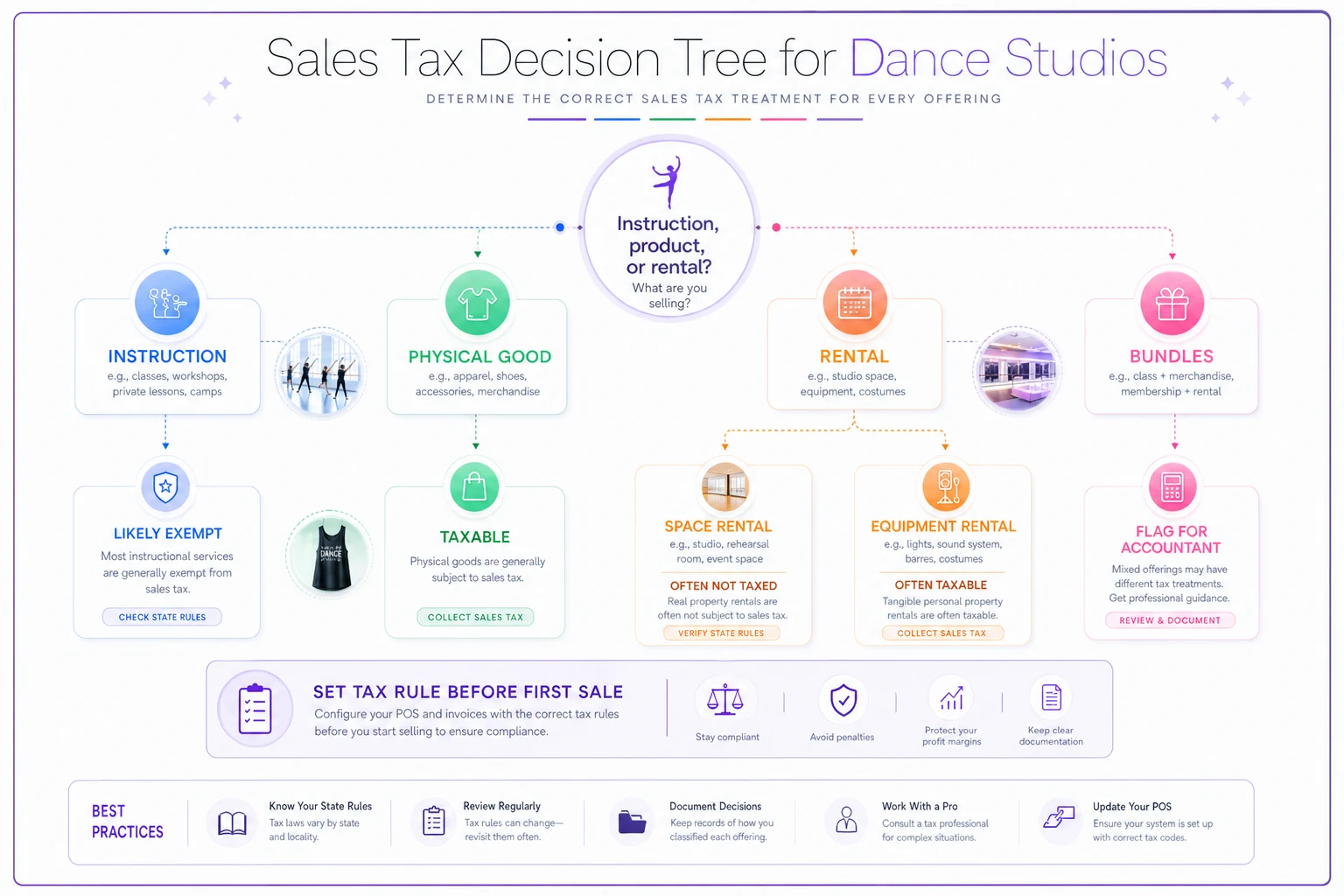
That last question matters most. The uncollected-tax problem almost never comes from not knowing the rule — it comes from launching the program first and configuring the tax second.
A short real scenario
A studio added a merch line and weekend workshops in the same season — hoodies, water bottles, a couple of guest intensives. The workshops were handled fine, treated as instruction with no tax applied. The merch got set up as a generic "product" with no tax rule, because that's how everything else in their system was configured.
Over about ten months they did roughly $18k in retail. Nobody caught the tax setting until a year-end bookkeeping review. At a ~7% rate, that came to around $1,200–$1,300 in sales tax that should've been collected from customers but wasn't. Since you can't invoice families retroactively for last spring's hoodie, the studio paid it themselves, plus a small late-filing penalty once they registered properly.
The fix was straightforward: set the retail category to taxable, register for the permit they already needed, and add a monthly tax-remittance line to the books. The next season of merch collected tax correctly from the start. The only thing that went wrong the first time was sequence — they launched before configuring.
When to not overthink this
If you run a studio that's pure tuition — no merch, no DVDs, no rentals, no reselling anything physical — you probably don't have much sales tax exposure, and you shouldn't build a complicated system for a problem you don't have. Confirm the exemption with your accountant once and move on.
The moment you add any physical good, costume resale, or equipment rental, this checklist kicks in. And if you're spinning up seasonal programming — camps, intensives, recital season retail — that's exactly when new taxable lines sneak in alongside the exempt ones. Worth doing the mapping before the season rather than untangling it after. The summer intensive operations guide covers the planning side if you're building programs from scratch.
Bringing it together
Studio sales tax isn't hard because the rules are complicated. It's hard because one business runs three tax treatments at once, and the only way to keep them straight is to separate your product lines, tag each transaction correctly, and set the tax rule before the first sale.
Get the mapping right once. Keep tax collected separate from revenue. Bring specific questions to your accountant instead of vague ones. Run anything new through the decision tree before you price it.
This isn't legal or tax advice — rules vary by state and city, and your accountant is the final word. What this gives you is the structure to make that conversation fast, and the operational habits to make sure the right answer actually gets built into how you take payments.
Ready to elevate your studio operations?
Join 500+ studios using Movioly to save time, reduce admin workload, and enhance student experiences.