


Summer camps can make or break a dance studio's annual profit. Studios that get their dance studio summer camp operations dialed in typically add $15,000 to $45,000 in extra revenue between June and August. The ones that fumble it burn through instructor goodwill, create scheduling chaos, and somehow lose money on programs that should be their most profitable.
The difference usually comes down to operational structure. Not marketing. Not even camp themes. Pure mechanics around instructor pay, scheduling conflicts, and registration windows.
Half-day camps generate more profit per hour than full-day programs
Most studio owners default to full-day camps because parents want childcare coverage. Makes sense on the surface. But when you break down the operational reality, half-day camps often generate around 40% more profit per instructor hour.
A typical full-day camp runs 9am to 4pm — seven hours of instruction, usually with a lunch break that still requires supervision coverage. Parents pay around $275–$350 per week for this. Sounds fine until you factor in instructor costs.
Full-day camps need at least two instructors rotating throughout the day to maintain energy levels. No instructor can effectively engage kids for seven straight hours of dance. By hour five, they're running on fumes and camp quality tanks. So you're paying two instructors, roughly $25–$35 per hour each, with overlapping coverage. That's $350–$490 in daily instructor costs alone.
Half-day camps tell a different story. Run them 9am–12:30pm or 1pm–4:30pm. Parents pay $175–$225 per week. You need one instructor, maybe a junior assistant for larger groups. Daily instructor cost drops to $87–$122. Profit margin jumps from around 30% on full-day camps to nearly 50% on half-day programs.
The scheduling also works better. Morning camps let working parents drop kids off before heading to work. Afternoon camps align with school pickup timing once other activities wrap up. Run both slots with different instructors and you avoid burnout while doubling camp capacity.
Studios running half-day camps also tend to see better retention into fall classes. Kids aren't exhausted from full days. They leave wanting more, not feeling overwhelmed. Parents see engaged instruction rather than a tired instructor trying to fill time.
Instructor pay models that prevent summer staffing disasters
The standard hourly pay model breaks down during summer intensives. Your regular instructors expect premium rates for camps — they're giving up other summer opportunities. But paying $40–$50 per hour for camp instruction wrecks your margins.
Eliminate scheduling headaches and missed payments.
Movioly streamlines booking, confirming, and managing every class with ease.
- Unified class and instructor scheduling
- Automated student notifications
- Integrated payment tracking
No credit card required
A tiered pay structure specifically for summer programs is the fix. Start with a base camp rate that's 15–20% below regular class rates, then add performance bonuses tied to enrollment and retention.
| Instructor Level | Base Camp Rate | Enrollment Bonus | Retention Bonus |
|---|---|---|---|
| Lead Instructor | $28/hour | $50 per 10 students | $100 if 70% register for fall |
| Regular Instructor | $22/hour | $30 per 10 students | $75 if 70% register for fall |
| Junior Assistant | $15/hour | None | $50 if 70% register for fall |
The enrollment bonus kicks in at realistic thresholds — most camps run profitably around 8–10 students minimum. The retention bonus creates accountability for camp quality without feeling punitive.
Some studios also add a "camp development stipend" of $200–$300 for instructors who build their own curriculum and materials. That one-time payment generates buy-in and ensures instructors come prepared instead of improvising.
Mistakes to avoid:
-
Paying regular class rates for camps — it kills margins faster than you'd expect
-
Skipping performance incentives entirely — instructor engagement drops noticeably
-
Overcomplicating bonus calculations — creates confusion and quiet resentment
-
Setting different pay rates for similar camp roles — causes conflict between staff
This keeps base costs manageable while giving instructors a real reason to show up prepared and engaged.
Registration windows and deposit strategies that lock in commitment
Summer camp registration needs different timing than regular classes. Open too early and families forget or plans shift. Open too late and parents have already committed elsewhere.
The sweet spot is 10–12 weeks before camp starts. For mid-June camps, that means opening registration in late March or early April — when parents are actively planning summer but haven't locked in other activities yet.
Week 1–2: Current families only (early bird pricing)
Week 3–4: Open to waitlist and former students
Week 5–6: Public registration opens
Week 8: First deposit due (50% or $100 minimum)
Week 10: Final payment due
Week 12: Camp starts
The deposit structure matters more than most studios realize. A 50% deposit due four weeks before camp reduces no-shows by a significant margin. Studios collecting only $25–$50 upfront see much higher dropout rates as camp approaches.
Make deposits non-refundable but transferable to other camps or fall tuition. This protects revenue while giving families flexibility if plans change. Spell this out clearly during registration and in confirmation emails — no surprises.
Cap enrollment at realistic numbers too. Two sessions at 14 students each will almost always run smoother than one crammed session with 28 kids. Oversized camps damage your reputation and strain instructor relationships more than the extra revenue helps.
For multi-week camps, offer a small discount — usually 5–10% off the second week and beyond — for families who register for multiple weeks upfront. It locks in longer commitments and reduces mid-summer dropoff.
Insurance requirements and safety protocols specific to camps
Summer camps create different liability exposures than regular classes. Your standard studio insurance might not fully cover intensive programs, visiting instructors, or off-site activities. Missing these gaps usually only becomes obvious after an incident.
Verify your current policy explicitly covers camps. Many studio policies treat camps as special events requiring additional coverage or riders. The extra cost typically runs $200–$400 per camp session — worth it.
Build a separate camp waiver that addresses specific summer intensive risks:
-
Extended hours on studio property
-
Outdoor activities or demonstrations
-
Photography and video for camp showcases
-
Lunch supervision for full-day camps
-
Field trips or guest instructor sessions
Your regular class waiver probably doesn't cover these. A lawyer can draft camp-specific language for around $300–$500. Generic online templates miss state-specific requirements and studio-particular situations.
Staff-to-student ratios also need reconsideration. Regular classes might run fine at 1:15. Camps involve more varied activities, longer time periods, and different age dynamics. Keep camp ratios at 1:10 maximum — ideally 1:8 for younger groups.
If you're bringing in guest instructors or junior counselors, run background checks regardless of how long they're helping. Services like Sterling or GoodHire run checks for $25–$45 per person. Build it into the camp budget.
Emergency contact systems need an upgrade too. Regular class parents are often waiting nearby. Camp parents drop off and disappear for hours. Make sure you have two emergency contacts per child, explicit pickup authorization lists, allergy and medication documentation, clear protocols for minor injuries, and a reliable system for tracking attendance throughout the day.
The operational burden feels heavy. But one incident without proper coverage or documentation can be financially and reputationally devastating.
Preventing conflicts between camps and regular summer classes
The biggest operational failure in summer programming is when camps cannibalize regular classes. Studios get excited about camp revenue and forget their core students still need consistent training through summer.
Block out your regular class schedule before planning any camps. These protected time slots maintain continuity for serious students and preserve instructor availability for stable income. A student who's been in Tuesday/Thursday ballet for three years shouldn't lose their spot because you scheduled a camp over it.
Map studio space usage hour by hour. Multiple rooms helps, but studios often forget to account for transition times, cleaning between programs, and parking lot congestion during overlapping pickups. Build in 30-minute buffers between camps and regular classes.
Instructor scheduling gets complicated quickly. Your best teachers want both camp hours and their regular classes — but running a three-hour morning camp then teaching back-to-back evenings burns people out by week two. A rotation system where instructors alternate between camps and classes works better than trying to load everyone up.
A scheduling framework that works well for mid-sized studios:
Monday/Wednesday/Friday: Morning camps only (9am–12:30pm)
Tuesday/Thursday: Afternoon camps only (1pm–4:30pm)
Evenings: Regular classes as normal (4:30pm onward)
Saturdays: Technique intensives for regular students
Here's a quick visual to map the scheduling workflow and instructor rotations.
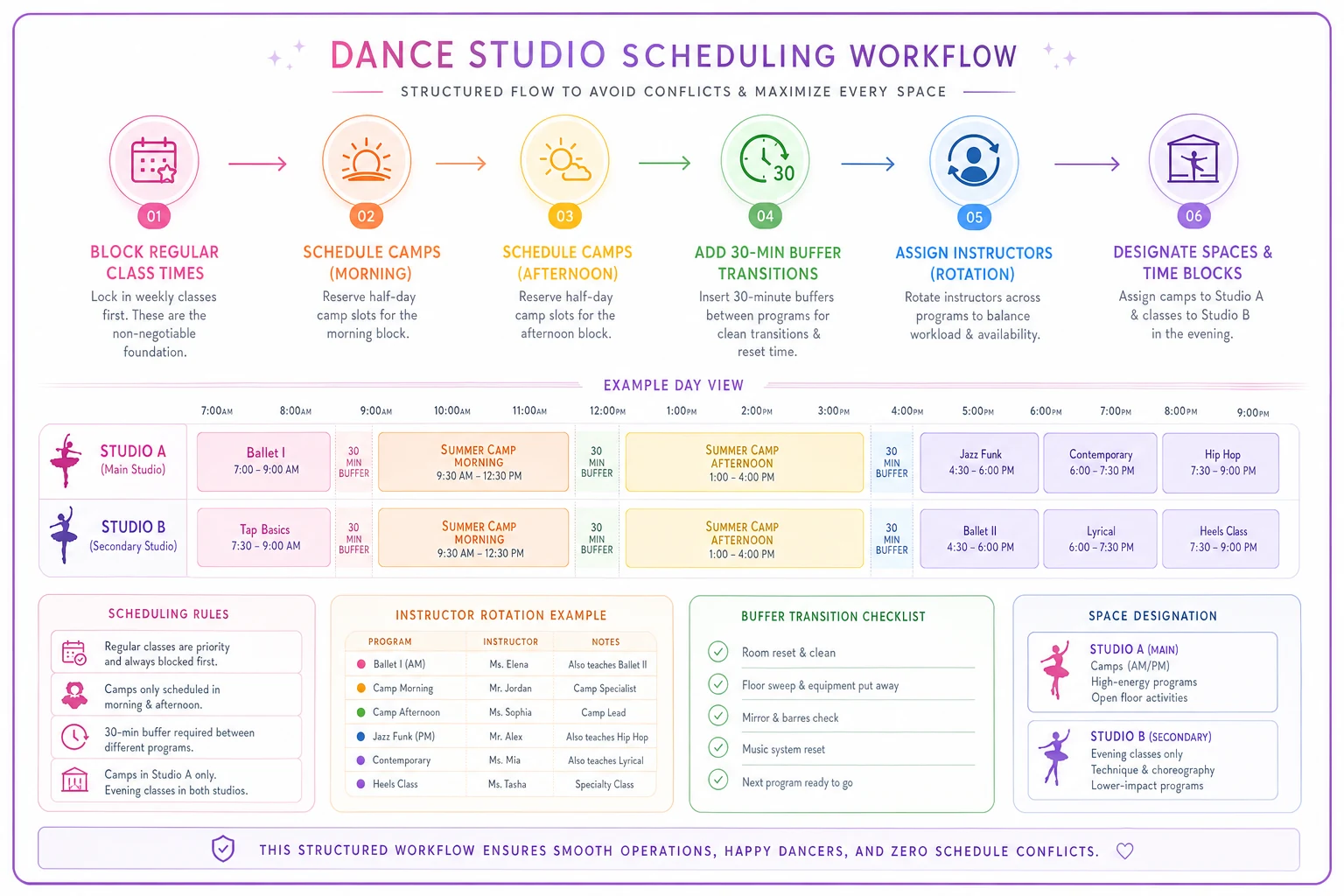
This visualization helps coordinate instructor rotations and buffer times.
Conflict patterns to watch for:
-
Camps using competition team rehearsal space or time
-
Instructor fatigue bleeding into regular class quality
-
Camp noise disrupting adjacent technique classes
-
Parking lot chaos during overlapping programs
-
Costume or prop storage overwhelming limited space
Some studios try running camps and regular classes simultaneously in different rooms. This rarely works. The energy difference between an intense camp activity and a focused technique class creates distraction on both sides. Better to separate them by time than fight the friction.
Protecting regular programming during busy seasons requires similar thinking about resource allocation and schedule protection.
Real financial comparison: Traditional summer schedule vs optimized camp model
Two similar studios in suburban markets, each around 200 regular students.
-
Regular classes
60% attendance, roughly $18,000 monthly revenue (down from $30,000)
-
Two full-day camps
18 kids each week at $325, total $11,700
-
Instructor costs
$14,500 (maintaining regular staff plus camp coverage)
-
Net summer profit
$15,200
-
Regular classes
75% attendance on a tighter schedule, $22,500 monthly revenue
-
Six half-day camp sessions
average 12 kids at $195, total $14,040
-
Instructor costs
$11,200 (efficient scheduling and tiered pay)
-
Net summer profit
$25,340
That $10,000 difference came entirely from operational decisions. Studio B actually spent less time managing their summer programs because the structure prevented most of the conflicts and confusion before they started.
Payment collection and refund policies that protect camp revenue
Camp payment policies need more structure than regular classes. The short timeframe and upfront costs mean you can't absorb late payments or last-minute cancellations the way you might with monthly tuition.
Automate payment collection for deposits and final payments. Chasing camp payments manually wastes administrative time right when you're busiest preparing for the camps themselves. Set up auto-charge dates at registration and send reminder emails a few days before each charge.
A workable refund policy:
-
More than 4 weeks before camp
Full refund minus $50 processing fee
-
2–4 weeks before
50% refund or full credit toward fall classes
-
Less than 2 weeks
No refund, credit only for documented medical issues
-
After camp starts
No refunds or credits regardless of reason
This might seem strict, but camps have fixed costs you've already committed to — instructor contracts, materials, insurance riders. A few last-minute dropouts can flip a profitable camp into a loss.
For families with genuine hardship, payment plans work better than refunds. Split fees into three payments over the six weeks leading up to camp. Most families who use this option complete all payments on schedule, and you preserve the revenue.
Track camp payments separately from regular tuition. Different timing, different amounts, different policies — mixing them into monthly billing creates accounting confusion and makes it harder to evaluate camp profitability accurately.
Building staff schedules that avoid burnout and maintain quality
Instructor burnout during summer intensives creates cascading problems. Quality drops, regular students notice their teachers are exhausted, and good instructors start declining future camp assignments. Studios that maintain energy through eight weeks of camps tend to do a few things differently.
First, limit any instructor to 20 camp hours maximum per week. That might mean one full-day camp or two half-day sessions plus some regular classes. Beyond that, instruction quality noticeably declines and injury risk increases.
Limit instructors to 20 camp hours maximum per week to prevent burnout.
Second, bring in junior instructors or advanced students as paid assistants. These assistants handle bathroom breaks, help with crowd management, and give lead instructors brief recovery moments throughout the day. Paying an assistant $12–$15 per hour seems like an added expense until you realize it's preventing your $30/hour lead instructor from burning out and canceling week two.
Third, build in paid planning time. Give instructors two paid prep hours for every ten hours of instruction. Studios that skip this get instructors who improvise, which leads to disorganized camps and poor parent reviews.
Week 1: Morning camp (15 hours) + Regular evening classes (8 hours) = 23 hours
Week 2: Afternoon camp (15 hours) + Competition team (6 hours) = 21 hours
Week 3: No camps, regular classes only (15 hours) — Recovery week
Week 4: Morning camp (15 hours) + Regular evening classes (8 hours) = 23 hours
Marketing camps to different parent segments
Camp marketing requires different messaging than regular class promotion. Parents evaluating camps care about different things than those choosing year-round training.
For working parents, emphasize reliability. They need to know your camp runs exactly as scheduled, every day, without surprise cancellations or last-minute changes. Include specifics about drop-off procedures, supervision ratios, and emergency protocols. These parents are solving a childcare problem first, enrichment second.
For dance families, focus on skill development and performance opportunities. They want camps that advance technique, not just entertain. Describe specific skills students will work on, showcase opportunities, and how camp training connects to fall advancement.
For new families, reduce barriers to entry. They don't know your studio culture or instructors yet. Offer shorter trial camps — two or three days — at lower price points. Detailed schedules, what-to-bring lists, and clear experience requirements help reduce hesitation.
Price anchoring works well for camps. List your full-day option at premium pricing, then position half-day camps as the sensible choice at roughly 60% of that cost. Most families pick the half-day option and feel like they made a smart financial decision — while you maintain better margins.
Converting camp families into year-round students
Summer camps serve as extended trial runs for new families. Conversion from camp participant to regular student happens through intentional relationship building, not aggressive sales pitches.
During camp, assign each new family to a specific instructor or staff member for relationship management. That person sends a welcome email before camp starts, checks in mid-week, and follows up after camp with specific observations about their child's development.
The most effective conversions happen through peer connections. When camp kids make friends with regular students, they want to continue those relationships. Mix a few regular students into camps as junior helpers or demonstrators. They naturally share excitement about regular classes and upcoming performances without anyone having to sell anything.
Timing matters here too. Don't wait until camp ends. On Wednesday of camp week, send parents a progress update that includes:
-
Specific skills their child has worked on
-
Areas where they show natural ability
-
Which fall classes would build on what they've learned
-
An early registration discount exclusive to camp families
Around 35–40% of new camp families will register for fall classes when approached this way. Studios that wait until after camp to follow up tend to see conversion rates well below that.
A "Camp Graduate" class for the first month of fall also helps. It gives camp kids a familiar entry point into regular class structure with faces they already know. After a month, they integrate into appropriate level classes with confidence and existing social connections.
Operational software and systems that scale camp management
Managing camps through spreadsheets and paper forms stops working somewhere around 30 participants. The coordination complexity overwhelms manual systems — double-bookings, missed payments, parent frustration.
The core issue is information flow. Parents need different details at different times. Instructors need rosters, medical information, and emergency contacts. Administrators need payment status, attendance tracking, and capacity management. When those streams aren't connected, things fall through the cracks.
-
Registration confirmations with camp details sent immediately at signup
-
Payment reminders triggered before auto-charges run
-
Week-before preparation emails to parents with logistics and what-to-bring info
-
Daily attendance notifications if a child is marked absent
-
Post-camp follow-ups with fall class suggestions tied to what the student worked on
That frees your staff to focus on actual camp delivery rather than administrative coordination. Choosing between calendar models also becomes more manageable when your operational platform can handle both term-based camps and year-round classes without needing separate systems.
Instructor access is another area where platforms help. Instead of printing rosters or sharing spreadsheets, instructors get mobile access to their camp information. Attendance, student notes, flagged concerns — all documented in the system rather than on sticky notes or memory.
The difference between profitable and painful summer programs
Studios running profitable summer camps share consistent operational patterns. They protect regular programming while adding camps strategically. They build instructor pay structures that incentivize quality without blowing margins. They systematize registration, payment, and communication early enough that administration doesn't become the job during camp weeks.
Studios that struggle try to do too much. They schedule camps whenever space appears, burn out instructors, and confuse parents. They apply regular-class policies to camp programs and wonder why the friction is so high. They treat camps as casual add-on revenue rather than distinct programs with their own operational requirements.
Done well, summer camps can generate 15–20% of a studio's annual revenue. But that requires treating them as serious business operations with proper planning, clear systems, and deliberate structure. The financial upside justifies the investment.
The studios that get it right balance three things: profitability for the studio, sustainability for instructors, and real value for families. When any of those gets out of alignment, the whole program suffers. Get the structure right, and summer stops being a slow season and starts being your most profitable quarter.
Ready to elevate your studio operations?
Join 500+ studios using Movioly to save time, reduce admin workload, and enhance student experiences.