

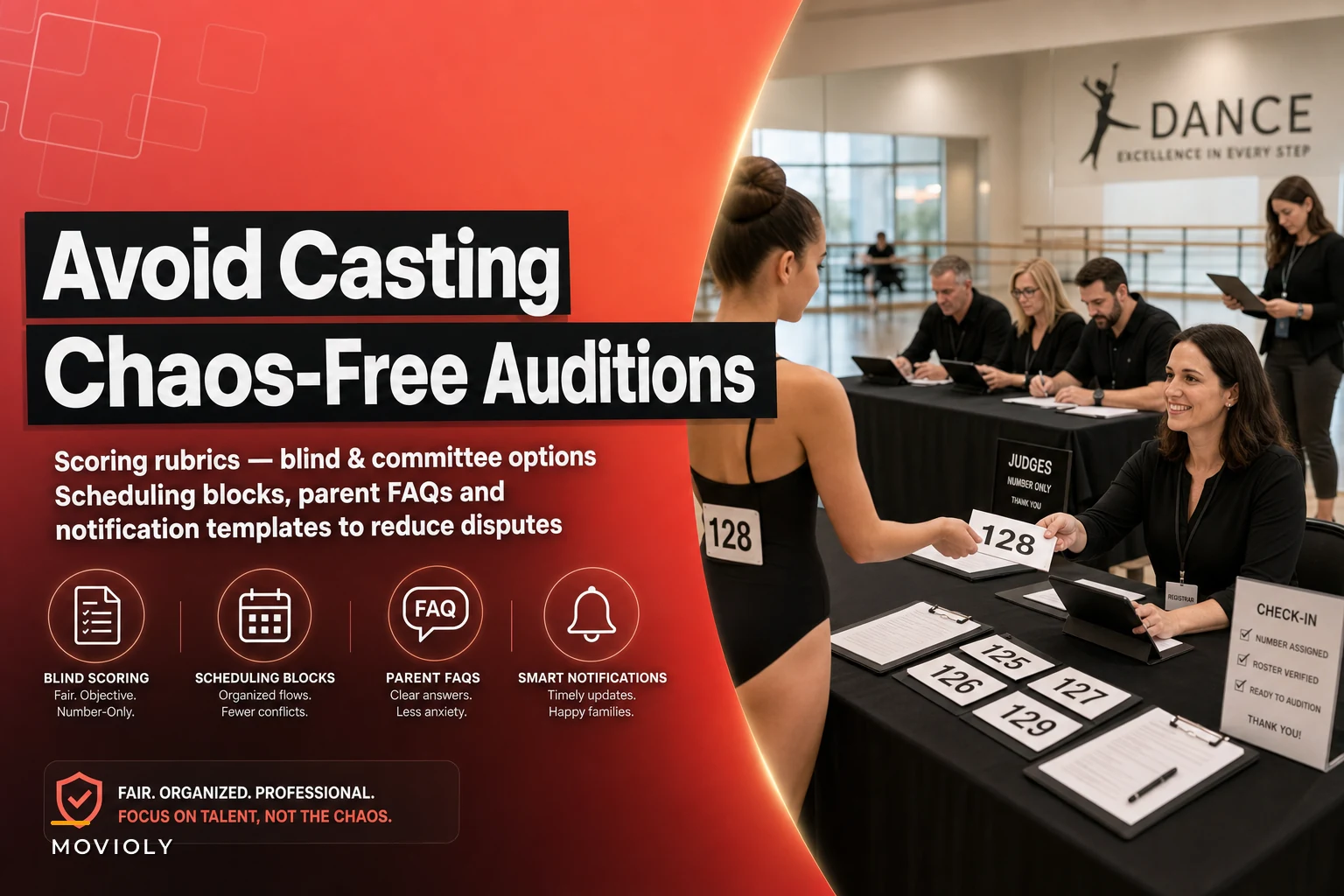

Audition season creates a perfect storm. You're evaluating talent while managing anxious parents, coordinating judges, fitting everything around regular classes, and documenting decisions that families might question weeks later. Most studios handle this with spreadsheets, printed score sheets, and endless back-and-forth emails — a system that barely holds together at 50 kids and completely falls apart at triple digits.
The difference between smooth auditions and operational chaos comes down to three things: your scoring process, your scheduling framework, and how you communicate with parents. Get these right, and auditions become something you can actually run without dreading. Get them wrong, and you're spending weeks dealing with complaints, schedule conflicts, and favoritism accusations.
The scoring transparency problem that creates parent disputes
Traditional audition scoring creates problems almost immediately. Judges scribble notes on paper forms, scores get tallied manually, and results feel arbitrary to families who weren't watching the process from the inside. When little Sophia doesn't make the competition team, her mom wants answers — and without clear documentation, you're stuck in conversations that damage relationships and eat hours of your time.
The scoring itself is often inconsistent by design. One judge focuses heavily on technique, another weights performance quality, a third is quietly factoring in attendance history. Without a standardized rubric, you're not running a fair evaluation — you're averaging opinions. Parents sense this, especially when results don't match what they expected.
Documentation is another weak point. Paper score sheets get filed away somewhere, making it nearly impossible to reference specific feedback weeks later. You can't show a parent exactly where their child scored or what they need to improve. That opacity breeds resentment, and it creates the perception that decisions were political rather than merit-based.
Building blind scoring systems that protect against bias accusations
Blind scoring changes the whole dynamic. Instead of judges seeing names on forms, dancers receive numbered assignments that map back to a master list only you control. It's a simple operational change that eliminates most bias accusations before they even start.
Eliminate scheduling headaches and missed payments.
Movioly streamlines booking, confirming, and managing every class with ease.
- Unified class and instructor scheduling
- Automated student notifications
- Integrated payment tracking
No credit card required
Here's the framework that makes it work:
-
Create numbered bibs or stickers (101, 102, 103, etc.)
-
Build a master spreadsheet linking numbers to names
-
Prepare scoring sheets with only number fields
-
Brief judges on scoring criteria without sharing student identities
-
Set up a check-in table separate from the judging area
The rubric needs specific, measurable criteria. Vague categories like "stage presence" are useless — break evaluation into observable elements:
| Category | Weight | Scoring Elements |
|---|---|---|
| Technical Skills | 40% | Turns (clean singles/doubles), leaps (height/extension), flexibility (demonstrated range) |
| Performance Quality | 25% | Facial expression consistency, energy maintenance, character embodiment |
| Choreography Retention | 20% | Combination accuracy, transition smoothness, timing with music |
| Audition Preparation | 15% | Appropriate attire, arrival time, warm-up participation |
Judges score each element on a 1-5 scale with clear descriptors. A "3" in turns means "executes clean singles consistently, doubles need work." That specificity makes scores defensible and gives families something actionable.
A quick visual of the blind scoring workflow.
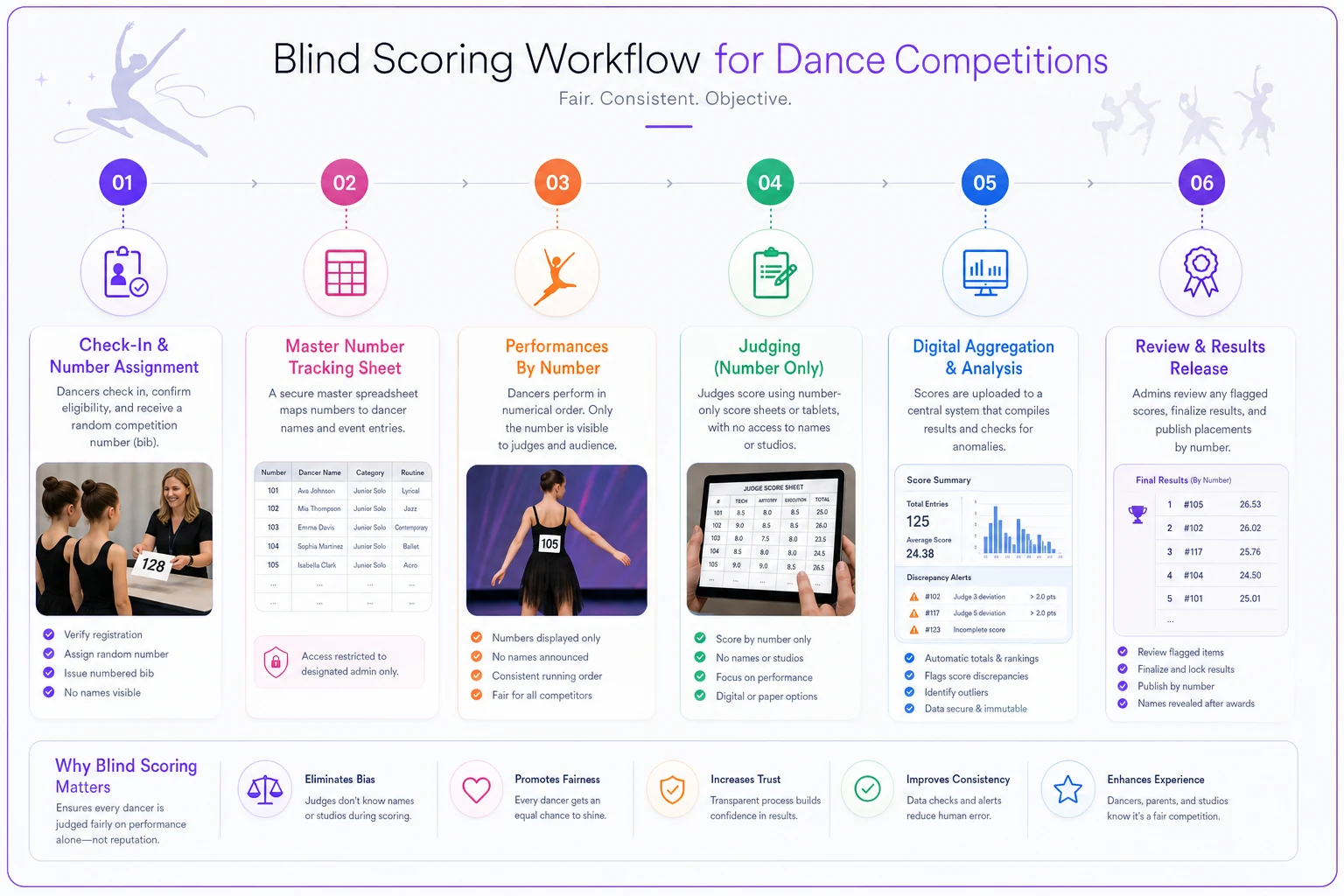
Blind scoring changes the whole dynamic. Instead of judges seeing names on forms, dancers receive numbered assignments that map back to a master list only you control. It's a simple operational change that eliminates most bias accusations before they even start.
Committee scoring variations for larger programs
Single-judge systems break down fast when you're evaluating multiple teams or levels. Committee scoring distributes the workload and tends to produce more balanced results — but it multiplies your coordination challenges.
The standard approach uses three judges who score independently, with the middle score counting when there's significant variance. That works fine for smaller auditions. Once you're evaluating 200+ dancers across multiple age groups, you need something more structured.
For large-scale auditions, the station model is worth considering. Dancers rotate through skill-specific stations — one judge evaluates turns and leaps, another watches performance quality during a combination, a third assesses flexibility and strength. Each station uses focused rubrics and scores aggregate into final rankings. You process more dancers per hour without sacrificing evaluation quality.
The panel discussion model works better for advanced teams where nuanced judgment matters more than throughput. All judges watch together, score independently, then discuss significant discrepancies. If Judge A gives a dancer a 4.8 and Judge B gives a 3.2, they explain their reasoning and potentially re-evaluate. Slower, but the placements tend to be more thoughtful.
Digital scoring accelerates any committee setup. Instead of paper sheets requiring manual compilation, judges enter scores on tablets or phones that feed a central spreadsheet. Results calculate instantly, discrepancies flag automatically. The time savings are real — what typically takes hours of manual tabulation happens in seconds.
Scheduling blocks that don't destroy your regular class schedule
The scheduling challenge with auditions is fitting evaluation sessions around existing classes without canceling a week of programming. Parents paying for regular classes won't tolerate multiple disruptions, but you also can't run quality auditions in 30-minute gaps.
Block scheduling helps, but it requires some planning. The most practical approach dedicates specific days to auditions while keeping modified regular schedules running. Here's a framework that minimizes the disruption:
Saturday block model (for studios with lighter weekend schedules):
-
8
00-9:00 AM: Staff setup and judge briefing
-
9
00-11:00 AM: Ages 6-9 auditions (15-minute age group blocks)
-
11
00-11:30 AM: Judge deliberation and reset
-
11
30 AM-2:00 PM: Ages 10-13 auditions (20-minute level blocks)
-
2
00-2:30 PM: Judge deliberation
-
2
30-5:00 PM: Ages 14+ and advanced team auditions
This concentrates disruption into one day. Regular Saturday classes either cancel once or shift to Sunday depending on your calendar model and term structure.
For studios that can't sacrifice entire Saturdays, spreading auditions across weekday evenings is a reasonable alternative:
Weeknight distribution:
-
Monday 6
00-8:30 PM: Beginning competition team
-
Tuesday 6
00-8:30 PM: Intermediate competition team
-
Thursday 6
00-9:00 PM: Advanced company
-
Regular classes run until 5
30 PM each day
You lose prime evening slots for a week, but you keep daytime and afternoon programming intact. This works particularly well if your competition teams already use these windows for regular practice.
Parent communication templates that prevent information overwhelm
Most audition disputes come from information gaps, not actual unfairness. Parents miss critical details in lengthy emails, don't understand the process, then blame the studio when confusion creates problems. The fix isn't more communication — it's communication designed for clarity.
Start with a single-page audition fact sheet distributed three weeks out. Not an email — a physical or PDF document with clear sections:
Essential Information Only:
-
Date, time, location (with parking notes)
-
What to wear (specific requirements)
-
What to bring (water, snack if needed)
-
Check-in opens 20 minutes before slot
-
Results posted date and method
-
One contact for questions
Keep it under 200 words. Parents won't read more than that, and extra details tend to create more confusion than they prevent.
Follow with a FAQ document that addresses the concerns parents won't ask directly:
"How are dancers evaluated?" We use blind scoring across five skill categories. Three judges score independently and we average results. Dancers wear numbers instead of names so judges evaluate purely on performance.
"Can my child audition for multiple teams?" Yes, but each team requires a separate audition. Register for all desired teams during initial sign-up.
"What if my child is sick on audition day?" Contact us immediately for make-up options. We hold one make-up session the following Saturday for documented illnesses.
"When are results posted?" Results post to our parent portal within 72 hours. We don't discuss results by phone or email to ensure all families receive information at the same time.
Each answer is brief and operational. No philosophy, no lengthy explanations — just what parents actually need to know.
Digital documentation that makes results defensible
When a parent challenges a placement decision six weeks after auditions, your documentation determines whether you have a quick conversation or a drawn-out dispute. Paper systems fail here because retrieving specific information takes too long and looks disorganized even when it isn't.
Digital documentation starts during the audition itself. Judges enter scores directly into tablets or phones using forms that timestamp each entry. Video recording each audition provides the most complete record, though storage and privacy considerations make it impractical for many studios.
Judges enter scores directly into tablets or phones using forms that timestamp each entry.
A workable middle ground: comprehensive score capture with narrative notes. Your scoring system should preserve:
-
Individual judge scores by category
-
Averaged final scores
-
Rank ordering within age groups
-
Judge comments for dancers near cutoff points
-
Any special circumstances noted during the audition
Store this in a structured format you can actually access quickly. When parents request feedback, you pull their child's complete record in seconds.
How you deliver that feedback matters too. Instead of showing raw scores — which tends to invite arguments about point differences — use a simple feedback format:
Audition Feedback for Dancer #147:
-
Demonstrated strong technical foundation, particularly in turn sequence
-
Performance quality showed good energy but needs more facial expression consistency
-
Choreography retention was excellent — no missed sections
-
Flexibility assessment indicated need for additional stretching work
-
Overall placement
Alternate for intermediate team, guaranteed spot on developmental team
Parents leave understanding where their child stands and what to work on. That's the goal.
The proactive dispute prevention system
Even with solid systems, some parents will dispute results. The key is preventing disputes from escalating into something that damages your reputation publicly.
Establish a formal review process in your initial audition communication:
"Result Review Policy:" We understand families may have questions about audition outcomes. If you'd like to discuss your child's evaluation:
-
Submit a review request through our parent portal within 5 days of result posting
-
We'll schedule a 15-minute phone consultation within one week
-
During this call, we'll review scores and provide specific feedback
-
This consultation is informational only — placements are final once posted
Acknowledging that questions are normal, and giving parents a structured outlet, tends to prevent emotional immediate reactions from turning into public complaints.
Build in natural placement flexibility where you can. Instead of hard cuts, create alternate pools and developmental tracks. A dancer who barely missed the competition team becomes "first alternate with guaranteed placement if space opens." It softens the rejection without lowering standards.
Timing matters too. Post results on Wednesday evenings, not Friday afternoons. Families have time to process and use your review process before a weekend of stewing. And schedule feedback calls quickly — delays feed resentment.
Real scenario: How one studio transformed their audition operations
A studio in suburban Denver ran paper-based auditions for years. With around 180 students, they'd spend an entire Saturday on auditions, then another full day tallying scores and fielding parent calls. The owner was regularly handling 20-30 dispute calls, some turning into heated in-person meetings.
They shifted to digital blind scoring with committee evaluation. Setup took real effort — building rubrics, training judges on tablets, establishing the numbering system. But execution was a different story. Audition day compressed from nine hours to six. Score compilation happened immediately instead of eating all of Sunday. Disputes dropped to five or six review requests, all resolved through structured phone calls.
The bigger change was perception. Even families whose children didn't make top teams felt the process was fair. The competition program grew by roughly 30% the following year, largely through word-of-mouth about how professionally the auditions were run.
Making the operational investment worthwhile
Building systematic audition operations takes upfront work — process design, digital tools, staff training. For studios running auditions once a year, it can feel like a lot. But the benefits extend well beyond audition day.
The scoring rubrics you develop become assessment tools for regular classes. The communication templates adapt for recital season logistics. The documentation habits improve your overall operational discipline. And professional audition operations become a real differentiator for attracting serious dance families.
There's also a risk angle worth being honest about. One complaint stemming from perceived bias in scoring could trigger a much larger problem. A wave of parent frustration on social media can damage a reputation you spent years building. The investment in proper audition operations is risk mitigation as much as it is process improvement.
The technology component that multiplies efficiency
Paper systems can technically support blind scoring and committee evaluation. Digital tools just make everything faster and less prone to human error. The right operational platform removes manual score compilation, automates parent communications, and keeps audition records accessible indefinitely.
Modern dance studio software should handle:
-
Digital registration with automated slot assignment
-
Judge scoring interfaces that work on any device
-
Automatic score compilation and ranking
-
Parent portal result posting with acknowledgment tracking
-
Historical audition data for year-over-year comparison
AI-powered automation adds another layer on top of this. Instead of manually building balanced audition groups, automated scheduling can optimize groupings based on age, level, and judge availability. Automated workflows can trigger follow-up communications based on placement results without anyone having to remember to send them. It doesn't replace human judgment in the actual evaluation — it just removes the administrative weight that makes auditions so exhausting to run.
When the logistics are handled, studio owners can focus on what actually matters: building strong programs and maintaining relationships with the families who make those programs possible.
Strong audition operations don't just prevent chaos on the day itself. They build trust that translates into program growth, reduce the administrative drain throughout the season, and establish a reputation for running things professionally. The work you put in before a single dancer walks through the door pays off long after teams are formed and rehearsals begin.
Strong audition operations don't just prevent chaos on the day itself. They build trust that translates into program growth, reduce the administrative drain throughout the season, and establish a reputation for running things professionally. The work you put in before a single dancer walks through the door pays off long after teams are formed and rehearsals begin.
Ready to elevate your studio operations?
Join 500+ studios using Movioly to save time, reduce admin workload, and enhance student experiences.