

Most studio owners treat referrals as something that just happens. A parent tells another parent, someone posts in a Facebook group, a dance mom brings her friend to a trial. All good — but it's random. You can't forecast it, you can't scale it, and you definitely can't build a budget around it.
The studios that actually get predictable referrals treat partnerships like an operational system, not a lucky break. And this is one of the cheapest growth channels available to a studio. A good partnership with the pediatric clinic two doors down or the local gymnastics gym can send you three to eight qualified families a month, month after month, for basically the cost of a few coffees and some printed cards.
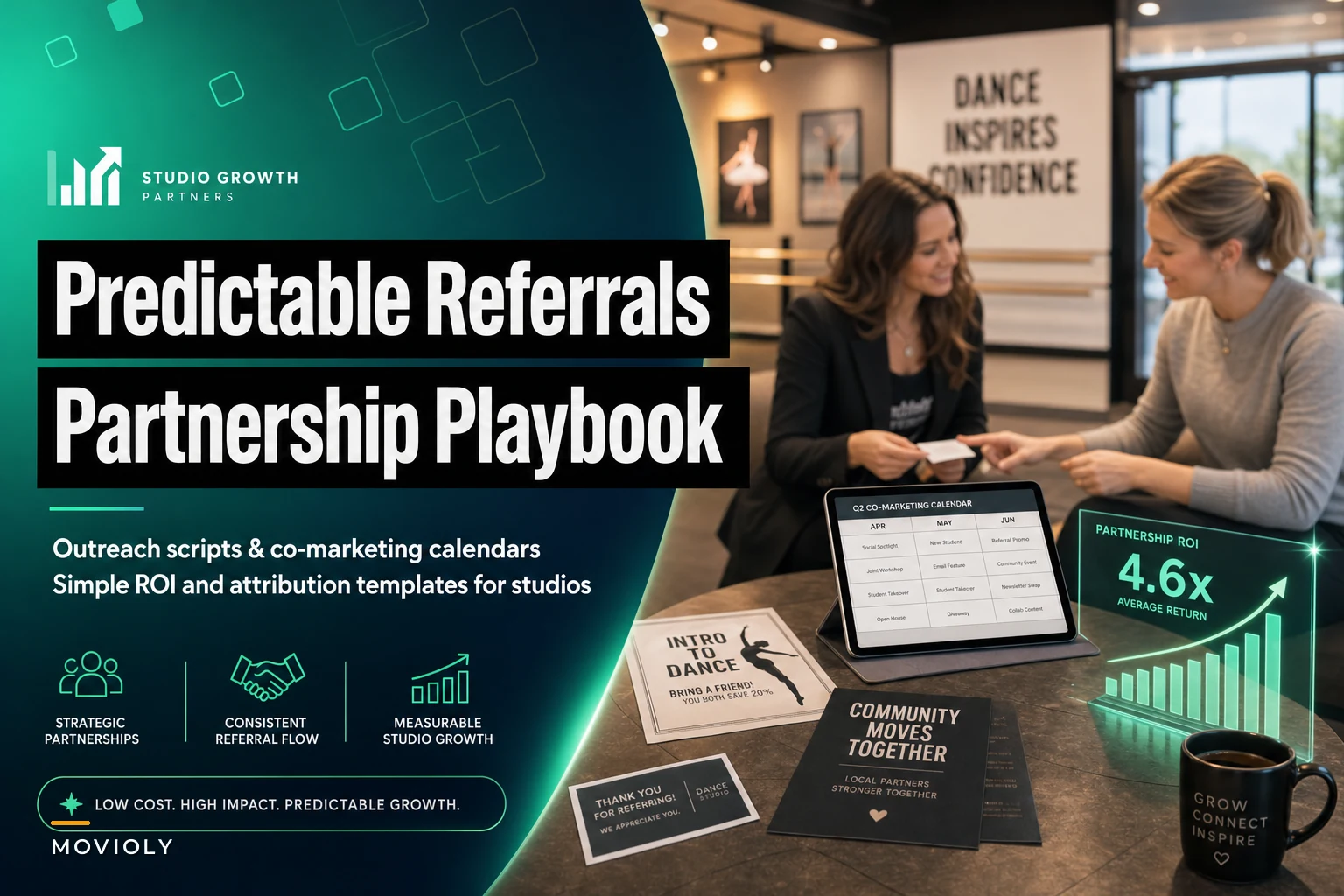
This is the part almost nobody does well. Owners "network," swap business cards, and then wait. Nothing happens because there's no offer, no follow-up, no tracking. This playbook fixes that — with the specific offers to make, the exact words to say, a co-marketing calendar you can copy, and a simple way to measure whether any of it is working.
Why most studio partnerships quietly die
The typical partnership attempt goes like this. You meet the owner of the kids' hair salon or the tumbling gym. You both agree that partnering "makes total sense." You leave a stack of flyers on their counter. Three months later you check in and the flyers are still there, curled at the edges, untouched.
-
The offer wasn't specific. "Send families my way" is not an offer. It's a hope.
-
There was no reason for the partner to act. They got nothing concrete out of it, so it dropped to the bottom of their priority list.
-
Nobody owned the follow-up. Both sides assumed the other would drive it.
-
There was no tracking. So even if a family did come in, nobody knew the partnership caused it, which meant nobody bothered to keep it going.
Partnerships fail because they're built on goodwill instead of mechanics. Goodwill fades. Mechanics keep running. The whole point of a dance studio partnership playbook is to replace "we should work together sometime" with a defined, repeatable exchange that both sides can actually track.
Pick the right partners first (this is where the ROI lives)
Not every nearby business is worth partnering with. The best partners share your audience but don't compete for the same dollars. A parent buying tumbling classes is very likely to buy dance classes. A parent buying birthday-party photography is a strong lead. A competing dance studio down the road? Obviously not.
Eliminate scheduling headaches and missed payments.
Movioly streamlines booking, confirming, and managing every class with ease.
- Unified class and instructor scheduling
- Automated student notifications
- Integrated payment tracking
No credit card required
Here's a quick way to score potential partners before you spend any energy on them.
| Partner type | Audience overlap | Competes with you? | Referral potential | Effort to set up |
|---|---|---|---|---|
| Pediatric / family clinic | High | No | Steady, year-round | Low |
| Kids' hair salon | High | No | Moderate | Very low |
| Gymnastics / tumbling gym | Very high | Slightly | High | Medium |
| Elementary / preschool | Very high | No | Seasonal spikes | Medium–high |
| Children's boutique / dancewear shop | High | No | Moderate | Low |
| Family photographer | Moderate | No | Bursty (recital season) | Low |
| Local coffee shop / café | Low | No | Low | Very low |
The pattern worth noticing: the easiest partnerships to set up (the café flyer) usually produce the least, and the highest-value ones (schools, gyms) take a little more setup but pay off for years. Skip the low-effort/low-return stuff. Go straight for two or three high-overlap partners and do those properly.
The mutual offer: what you actually put on the table
The single biggest reason partnerships stall is that only one side benefits. If you're asking a gym owner to promote your studio, they need something real in return — for their business, not just a warm feeling.
Sample mutual offers that actually work:
-
Studio ↔ Tumbling gym. They hand a "First Class Free" card to every new tumbling family. You do the same for your dance families. Customer gets a free trial at a complementary activity. Both of you fill off-peak slots.
-
Studio ↔ Kids' salon. They keep a small "recital-ready hair & makeup" discount card at the register. You send families their way before recital — huge, predictable demand in May. They send families to you year-round.
-
Studio ↔ Preschool. You run one free 30-minute creative movement demo at their location per term. In exchange, they include your enrollment flyer in their monthly parent packet. Customer gets a fun free activity; the preschool looks like they offer more.
-
Studio ↔ Family photographer. During recital season, you refer families needing headshots or event photos. They offer your families a sibling package discount and mention you to their booking clients.
None of these cost real money. They cost a discount you were probably willing to give anyway, or a bit of your time. That's what makes this a low-cost channel — you're trading access to audiences, not paying for it.
One thing worth flagging: keep the offer stupidly simple to redeem. If your partner has to explain a complicated code or your front desk has to look something up, redemption drops. A physical card with one clear action beats a clever multi-step promo every time.
Outreach scripts that don't feel weird
Most owners freeze at the actual ask. So here are scripts you can adapt. Keep them short — long pitches signal that you want a lot and give little.
Cold email / DM to a potential partner: > Hi [Name] — I run [Studio] a few blocks from you. A lot of the families in my classes have kids the same age as yours, and I think we're reaching the same parents without competing at all. I'd love to set up a simple referral swap — you hand my families a card, I hand yours one, both get a free first class/session. No cost to either of us. Could I stop by for 10 minutes this week to show you what I mean?
In-person ask (after the small talk): > "Here's what I'm thinking — nothing complicated. I'll give you a stack of these cards. Any family you think would enjoy dance, you hand one over. It gets them a free first class. And I'll do exactly the same for you — every dance family that comes through my door leaves knowing about you. We check in once a month to see if it's working. Want to try it for 60 days?"
The follow-up (this is the one everyone skips): > "Hey [Name], quick check-in — two families came in last month with your card, which is great. I've got a fresh stack of cards for your counter. How's it going on your end? Anything I can do to make it easier?"
That follow-up message is doing most of the work. Partnerships die from silence, not rejection. A simple recurring check-in — even a one-line text — keeps the arrangement alive.
A co-marketing calendar you can copy
Random partnership activity produces random results. A calendar turns it into something you can forecast. The key is aligning your asks with your partner's natural busy periods and your own enrollment windows. If your studio runs on a term-based schedule, your outreach should cluster around your enrollment openings — worth reviewing which calendar model fits your studio before you lock this in, since your enrollment rhythm drives the whole calendar.
Here's a simple quarterly structure:
-
Month 1 (enrollment push) Fresh cards to all partners. Run one in-person demo at a school or preschool. Send the "new term starting" message to every partner.
-
Month 2 (maintenance) Monthly check-in with each partner. Restock cards. Ask for one social media shoutout swap — they post about you, you post about them.
-
Month 3 (event tie-in) Co-host something small. A "bring a friend" week timed with your partner's slow period. Photographer partner promotes recital packages. Salon partner promotes recital hair.
-
Repeat, adjusting for season. Preschool demos hit hardest right before fall and January enrollment. Photographer and salon partnerships spike in the six weeks before recital.
The whole calendar fits on one page. That's on purpose. A partnership calendar that needs a project manager to run will not survive a busy recital season.
Below is a simple visual of the quarterly workflow if that helps you explain it to a partner.
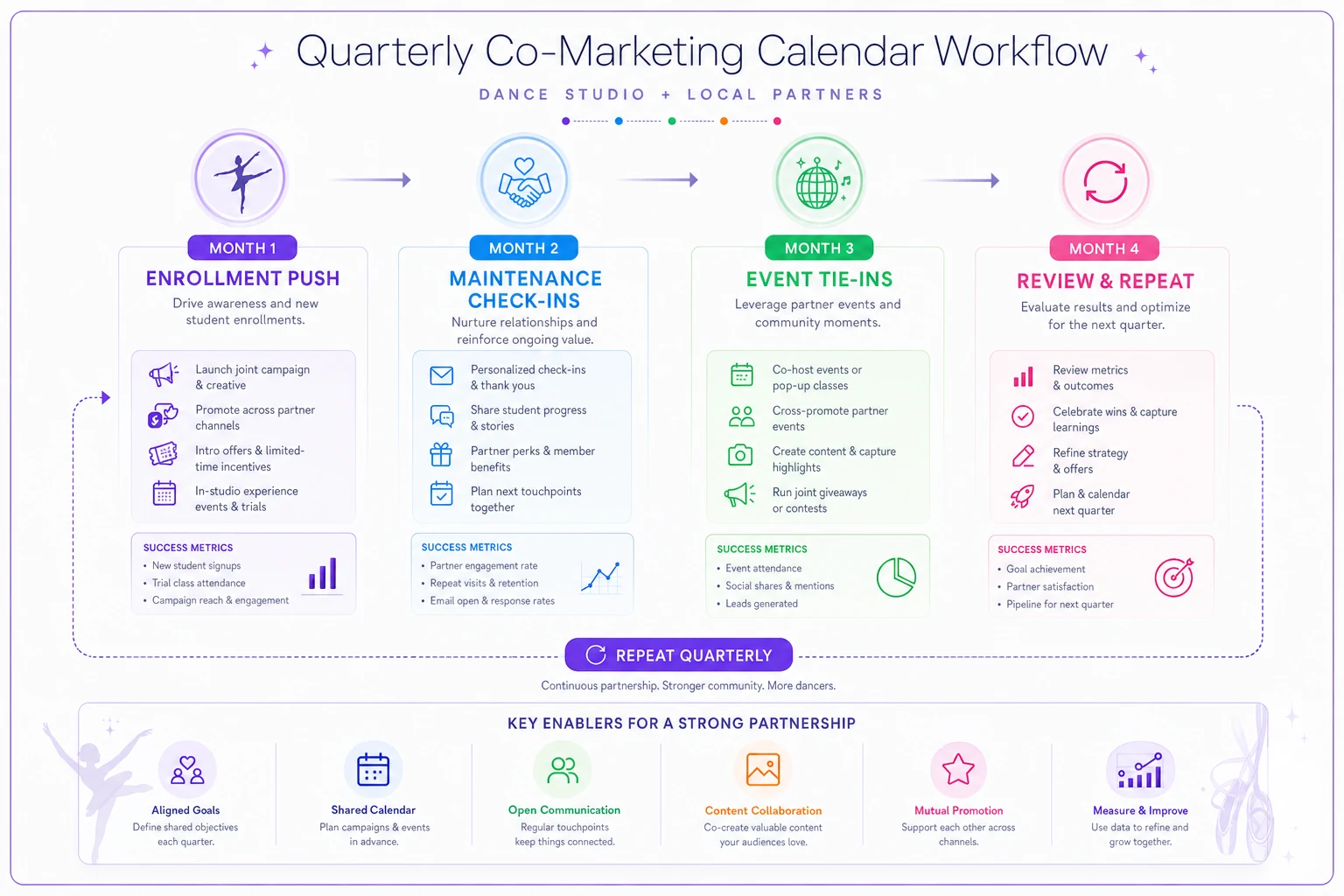
Keep the visual to one page and share it when you ask a partner to try the 60-day test.
Tracking ROI so you know what's actually working
This is the part that separates real partnerships from wishful ones. If you can't answer "how many students came from Partner X and what were they worth," you're flying blind — and you'll keep pouring effort into partners that produce nothing while ignoring the one quietly sending you families every month.
You don't need anything fancy. A single tracking sheet does the job. Track per partner:
-
Cards distributed (roughly)
-
Trials booked from that partner
-
Trials that converted to enrolled students
-
Enrolled students' first-year value (tuition + any extras)
-
Your cost (usually just the discount you gave)
A realistic tracking example: Say the tumbling gym partnership brought in nine trial families over a quarter. Six enrolled. If your average student's first-year value runs somewhere around $1,100–$1,400, that's roughly $7k–$8k in new revenue from one partner, against a cost of maybe a few dozen free trial slots you had spare capacity for anyway. Meanwhile the café flyer, same quarter, produced one trial that didn't convert. Now you know exactly where to spend next quarter's effort.
The insight most owners miss: the conversion step matters more than the referral step. A partner can send you plenty of trials, but if your trial-to-enrollment process is leaky, none of it sticks. If your referrals are booking but not staying, the problem isn't the partnership — it's the onboarding. Tighten that up first; a solid day-by-day trial onboarding funnel will get more out of the same number of referrals.
Where this gets operationally messy (and how to keep it clean)
Once you've got three or four partnerships running, the admin creeps up. Different cards, different codes, different check-in dates, and no clean way to see which family came from where. This is usually where owners give up — not because partnerships stopped working, but because tracking them by memory got too hard.
-
Use a unique promo code or intake question per partner. "How did you hear about us?" with a dropdown of your partner names does most of the attribution work automatically.
-
Log the source at trial booking, not later. If you try to reconstruct it after the family enrolls, you'll guess wrong.
-
Set a recurring monthly reminder for partner check-ins so they don't slip.
If your studio management software lets you tag lead sources and pull a simple report by source, lean on it — capturing the referral source at the point of booking turns your ROI sheet into something that fills itself in instead of a manual chore you'll abandon by month two. The tool matters less than the habit of always capturing where each family came from.
Capture the referral source at booking (dropdown or unique code) so reports populate automatically and you avoid guessing later.
The tool matters less than the habit of always capturing where each family came from.
When this makes sense — and when it doesn't
This works well when:
-
You have some spare capacity in classes (a free trial costs you nothing if the seat was empty).
-
There are complementary kids' businesses within a reasonable radius.
-
You can commit to the monthly follow-up. Partnerships are low-cost, not zero-effort.
This is a bad idea when:
-
Your trial-to-enrollment process is broken. Fix conversion first, or you'll waste your partners' goodwill funneling families into a leaky bucket.
-
You're already at capacity and can't take new students. Referrals into a waitlist annoy everyone.
-
You're not willing to reciprocate. One-sided "please send me students" arrangements always die.
Who should skip this entirely: brand-new studios with no track record and no available class times. Get your first cohort and a working trial process running before you ask a partner to put their name behind you.
A quick real scenario
A mid-sized suburban studio — around 180 students, mostly ages 4–12 — was spending close to $600 a month on social ads that produced a trickle of unqualified leads. They cut the ad spend and set up three partnerships instead: the local gymnastics gym, a children's hair salon, and one preschool.
Setup took about two weeks of coffees and card printing. Over the next four months, the gym and preschool together sent roughly 20 trial families, and a little over half enrolled. The salon partnership didn't move students but drove a noticeable bump in recital hair-and-makeup bookings the families appreciated, which actually strengthened the relationship.
The rough math: partnership costs were nearly nothing beyond printing and free trial seats they had spare. The referred enrollments were worth somewhere in the low five figures over the year. Same effort as running the ads, better-qualified families, and a channel that keeps producing without an ongoing budget.
Bringing it together
Referrals stop being random the moment you treat them like an operation: a specific mutual offer, a clear ask, a follow-up you actually do, a calendar tied to your enrollment rhythm, and a tracking sheet that tells you which partners deserve more of your time.
Start with one partner. Get the offer and the tracking right on a single relationship before adding more. Once you can look at a sheet and say "the gym sent us six families this quarter worth about $8k," you're no longer hoping for word of mouth — you've built a channel you can plan around. That's the whole difference between studios that grow steadily and studios that lurch from one enrollment scramble to the next.
Ready to elevate your studio operations?
Join 500+ studios using Movioly to save time, reduce admin workload, and enhance student experiences.