


Most dance studios don't realize they're losing a student until the formal withdrawal email shows up. By then, that family has mentally checked out for weeks — sometimes longer. And the damage isn't just the lost tuition. It's the empty spot in class formations, the disrupted group dynamics, and the other parents who start noticing and quietly questioning their own commitment.
These dropouts almost always follow predictable patterns. A student misses two Saturday classes. Then skips Tuesday. By week four they're gone — but the studio only finds out when next month's payment fails.
You don't need fancy software or complex analytics to build a dance studio attendance early warning system. You need a clear framework for spotting warning signals, sorting families by risk level, and reaching out before students mentally disconnect.
The real patterns hiding in your attendance sheets
Studios generate a lot of attendance data. Most owners only look at it when calculating makeups or sorting out billing issues. Meanwhile, dropout signals sit there unnoticed for weeks.
The most reliable predictor isn't a single absence — it's a pattern disruption. A student who attends every Tuesday/Thursday suddenly starts coming only on Tuesdays. Someone who never misses Saturday ballet starts showing up every other week. These aren't scheduling hiccups. They're commitment erosion signals.
Three distinct warning profiles tend to show up across attendance data. The "sudden stop" student goes from perfect attendance to nothing within two weeks — usually triggered by something specific like an injury, a conflict with another student, or frustration with progress. The "slow fade" gradually reduces attendance over six to eight weeks, often pointing to financial stress or competing priorities. Then there's the "irregular attender" — chaotic, inconsistent patterns — and these kids typically mean the family never really built dance into their routine. They usually quit within a few months.
Each profile needs a different response. Sudden stops need immediate personal contact to surface whatever happened. Slow fades often respond to schedule flexibility or a payment plan conversation. Irregular attenders need more structural support — the kind of onboarding work covered in converting trials into committed students through structured onboarding.
Building your triage matrix without overcomplicating it
Not every absence needs a response. Chasing down every missed class wastes staff time and annoys families dealing with normal life. The goal is systematic triage — separating real risk signals from background noise.
Eliminate scheduling headaches and missed payments.
Movioly streamlines booking, confirming, and managing every class with ease.
- Unified class and instructor scheduling
- Automated student notifications
- Integrated payment tracking
No credit card required
A simple three-tier system works well for most studios.
Low Risk (Green)
-
First absence in 30+ days
-
Absence was communicated in advance
-
Makeup class already scheduled
-
Strong payment history
-
Multiple family members enrolled
-
Active parent engagement
Medium Risk (Yellow)
-
2 absences within 10 days
-
No makeup scheduled
-
Recent payment delay
-
Decreased parent communication
-
Social media engagement dropped
-
No response to general studio communications
High Risk (Red)
-
3+ absences in 14 days
-
Payment failure or dispute
-
No communication for 3+ weeks
-
Sibling already withdrew
-
Negative feedback received
-
Competition enrollment spotted
Each tier triggers a different response. Green gets standard makeup reminders. Yellow gets a personalized check-in within 48 hours. Red needs immediate attention from senior staff or ownership.
| Risk Tier | Trigger Criteria | Response |
|---|---|---|
| Green | First absence in 30+ days, advance notice given | Standard makeup reminder |
| Yellow | 2 absences in 10 days, no makeup scheduled | Personalized check-in within 48 hours |
| Red | 3+ absences in 14 days, payment failure, no comms | Immediate senior staff or owner contact |
Prioritize yellow-tier check-ins within 48 hours — it greatly increases re-engagement.
A simple triage-to-outreach workflow looks like this.
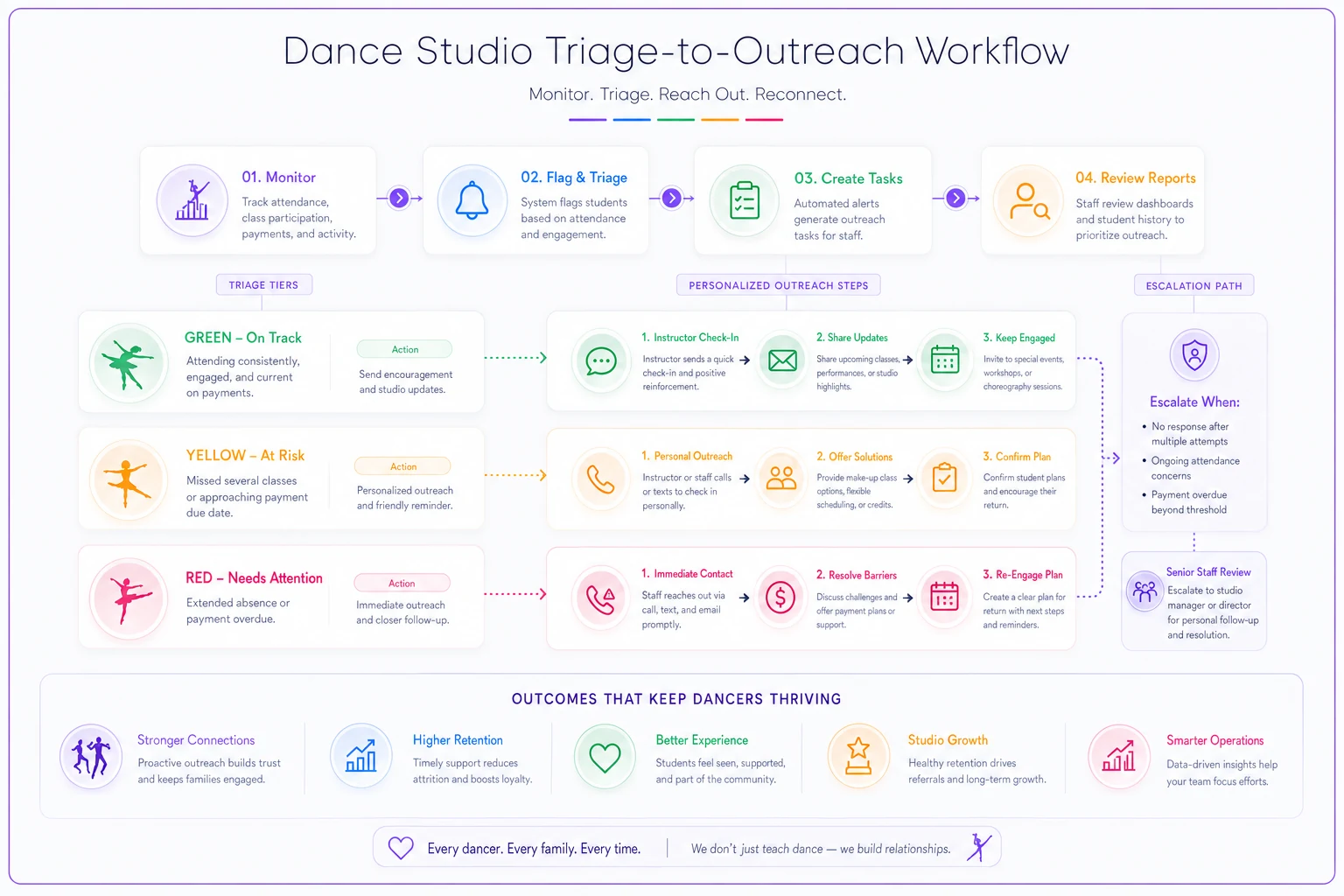
A lot of studios try to manage this through spreadsheets, but even a basic operational platform with some automation built in can flag these patterns automatically — saving hours of manually cross-referencing attendance, payments, and communication logs.
Outreach playbooks that actually reconnect families
Generic "we missed you" emails don't move the needle. Neither do guilt-heavy messages about commitment or passive-aggressive reminders about studio policy. Effective re-engagement means matching your method and message to the specific situation and how well you actually know the family.
For sudden-stop students, first outreach should happen within 72 hours — and it should come from their primary instructor via personal text or phone call. Not email, not an automated message. "Hey Sarah, Emma mentioned Lily seemed upset after Tuesday's class. Everything okay? Would love to chat when you have a minute." That opens a real conversation without creating pressure or assuming the worst.
Slow-fade families need a different approach — one that acknowledges the pattern without making it feel like an accusation. "Hi David, noticed Luke has been missing some Thursdays lately — spring sports season is brutal! Would dropping to once-weekly until summer help, or would a different time slot work better?" That gives them a path to stay connected rather than forcing an all-or-nothing decision.
For irregular attenders still in their first couple of months, the focus should be routine-building, not attendance lectures. "Maria, I noticed Sofia has made it to about three of her last eight classes — totally normal as families figure out their schedule! Would a buddy system help? I can pair her with Jade who lives nearby."
Response rates to these kinds of targeted messages tend to run 70-80%, compared to 15-20% for generic absence notifications. More importantly, roughly half of the families you actually reach will share something real — a scheduling conflict, a transportation issue, a frustration with skill progression, a social problem in class. Those are things you can actually address.
Tracking KPIs that predict retention problems before they explode
Most studios track the wrong things. Monthly attendance percentages and total enrollment numbers smooth over developing problems until it's too late. The metrics that actually matter for early warning focus on pattern changes and how fast things are declining.
Weekly Pattern Consistency Score: What percentage of students attended the same number of classes this week as their four-week average? When this drops below 75%, something is off — and it usually predicts future dropouts. One studio noticed their consistency score tanked every time they swapped instructors without proper transition communication.
Response Rate to Intervention: Of yellow and red-tier families who get outreach, how many respond? Below 50% usually means your messaging isn't landing or your timing is off. Studios using immediate text-based outreach typically see 65-75% response rates. Those waiting a week to send formal emails get 20-30%.
Recovery Success Rate: Of the families you successfully reach, how many return to regular attendance? If contact rates are solid but recovery stays low, the problem isn't communication — it's the actual studio experience.
Time-to-Detection: How many days pass between a student's last regular class and your first intervention attempt? Studios averaging under five days retain around 70% of at-risk students. Those taking two or more weeks to act retain less than 30%.
Tracking these numbers creates real feedback loops. One studio noticed their recovery rate jumped after adding payment plan options to their intervention toolkit — which directly addressed financial stress most families hadn't volunteered upfront.
The intervention hierarchy that prevents awkward confrontations
Nobody wants to feel monitored. Parents especially don't want to feel judged about their kid's attendance. The intervention system has to feel supportive, not like surveillance.
Start with environmental interventions before direct contact. When a yellow-tier student does show up, make sure they get extra positive attention from their instructor. Have them demonstrate for younger students. Give them a small role in class. Make attending feel rewarding — without ever mentioning the absences.
Next comes peer-level intervention. Instead of the studio making direct contact, use natural social connections. "Hey Amy, I'm pairing Sophia with Emma for buddy stretch next week!" Accountability through friendship lands very differently than accountability through authority.
Direct intervention should come after those two approaches, and even then the framing should be about the student's experience — not attendance metrics. "Noticed Chloe seemed less energetic lately — is she enjoying hip-hop, or should we try contemporary?"
From there, escalation follows this order:
-
Instructor check-in (genuine personal concern)
-
Parent coffee chat (relationship building)
-
Schedule flexibility offer (removing barriers)
-
Payment discussion (if relevant)
-
Break or hiatus option (staying connected even if paused)
-
Exit interview (learning from the loss)
Each step gives families a graceful way to re-engage or explain what's going on without confrontation. A studio that built out this full hierarchy retained about 62% of at-risk students — compared to 35% when they were only sending "missed you" emails. The difference wasn't magic. It was just giving families more off-ramps before they felt like quitting was their only option.
Technology that helps without replacing the human stuff
The most effective early warning systems pair systematic tracking with real human relationships. Technology handles pattern recognition and alert generation. People handle the actual relationship repair.
Operational platforms with AI automation can monitor attendance patterns across hundreds of students at once and flag concerning changes faster than any manual process. But the real value isn't just the detection — it's freeing up staff time for outreach that actually matters. Instead of spending hours comparing attendance sheets, staff can focus on personalized contact. Some platforms can suggest optimal outreach timing based on family response patterns and draft initial messages that staff can quickly personalize.
One studio connected their attendance tracking to their communication platform so that intervention tasks automatically queued up when a student crossed a yellow or red threshold. Retention improved around 18% over six months — but the bigger shift was that staff spent less time on administrative busywork and more time actually talking to families.
The system also helps identify what's working. Tracking which outreach methods land for different family profiles means you can refine the playbook based on real outcomes rather than guesswork.
Creating a monitoring routine that doesn't burn out your staff
The biggest failure point for these systems isn't the design — it's consistent execution. Staff get busy, monitoring slips, and suddenly you're trying to re-engage families who mentally left two months ago.
Build monitoring into workflows that already exist rather than bolting on new tasks. Use the first 10 minutes of your Monday morning meeting to review the risk report. Make it a standing agenda item alongside upcoming events and key financial metrics that drive operational decisions.
Distribute ownership by class or level instead of trying to manage everything from the top. Each lead instructor owns their cohorts and checks their warning reports weekly. The person doing outreach should actually know the students — that's what makes the contact feel genuine rather than administrative.
Build response templates staff can quickly personalize. Not rigid scripts, but flexible frameworks that keep a consistent studio voice while leaving room for authenticity. Keep them in a shared doc everyone can access and update as you learn what works.
Set realistic response windows by tier: Red gets same-day contact, Yellow within 48 hours, Green within a week. That prevents everything from feeling like a crisis while making sure the urgent stuff actually gets handled.
And celebrate saves, not just new enrollments. When a staff member re-engages an at-risk family, recognize it. Track retention wins the same way you'd track competition results or recital success.
The compound effect of retention on studio growth
Studios pour energy into new student acquisition while slowly bleeding existing families through dropouts that were probably preventable. Retention improvements compound in ways that new enrollment doesn't.
A studio with 200 students losing 15% annually needs 30 new enrollments just to stay flat. Drop that loss rate to 10%, and those same 30 new students represent actual growth. Retained students also bring referrals, contribute to class energy, and build the kind of culture that makes your studio more attractive to prospects in the first place.
The financial picture goes further than just tuition. Retained families buy costumes, attend workshops, join summer intensives, and tell other parents. Some studios have found that a retained student generates over three times their annual tuition in total lifetime value when you factor in additional purchases and referrals.
A systematic dance studio attendance early warning system isn't about surveillance or pressure. It's about noticing when families start drifting before they make the mental decision to leave — and giving them a reason to stay. The studios doing well right now aren't necessarily the ones with the best facilities or biggest marketing budgets. A lot of them have just gotten better at keeping the families they already have. The patterns are predictable, the interventions work when executed consistently, and the only real question is whether you build the system before or after losing another wave of families to dropouts you could have prevented.
A systematic dance studio attendance early warning system isn't about surveillance or pressure. It's about noticing when families start drifting before they make the mental decision to leave — and giving them a reason to stay. The studios doing well right now aren't necessarily the ones with the best facilities or biggest marketing budgets. A lot of them have just gotten better at keeping the families they already have. The patterns are predictable, the interventions work when executed consistently, and the only real question is whether you build the system before or after losing another wave of families to dropouts you could have prevented.
Ready to elevate your studio operations?
Join 500+ studios using Movioly to save time, reduce admin workload, and enhance student experiences.