

Most studios treat events like isolated marketing stunts. You rent a booth at the local fall festival, your instructors run a free mini-class, maybe 200 people walk past, forty kids try a few moves, you collect a handful of email addresses on a clipboard, and then... nothing. Three weeks later nobody remembers who those families were, the clipboard is sitting in a tote bag in the back office, and you've got no way to tell whether the whole thing was worth the Saturday.
That gap — between the energy of the event and the quiet of the inbox afterward — is where almost all the enrollment potential leaks out. Everyone obsesses over the performance, the banner, the choreography. Almost no one builds the operational scaffolding that actually converts an event attendee into a paying family six weeks later.
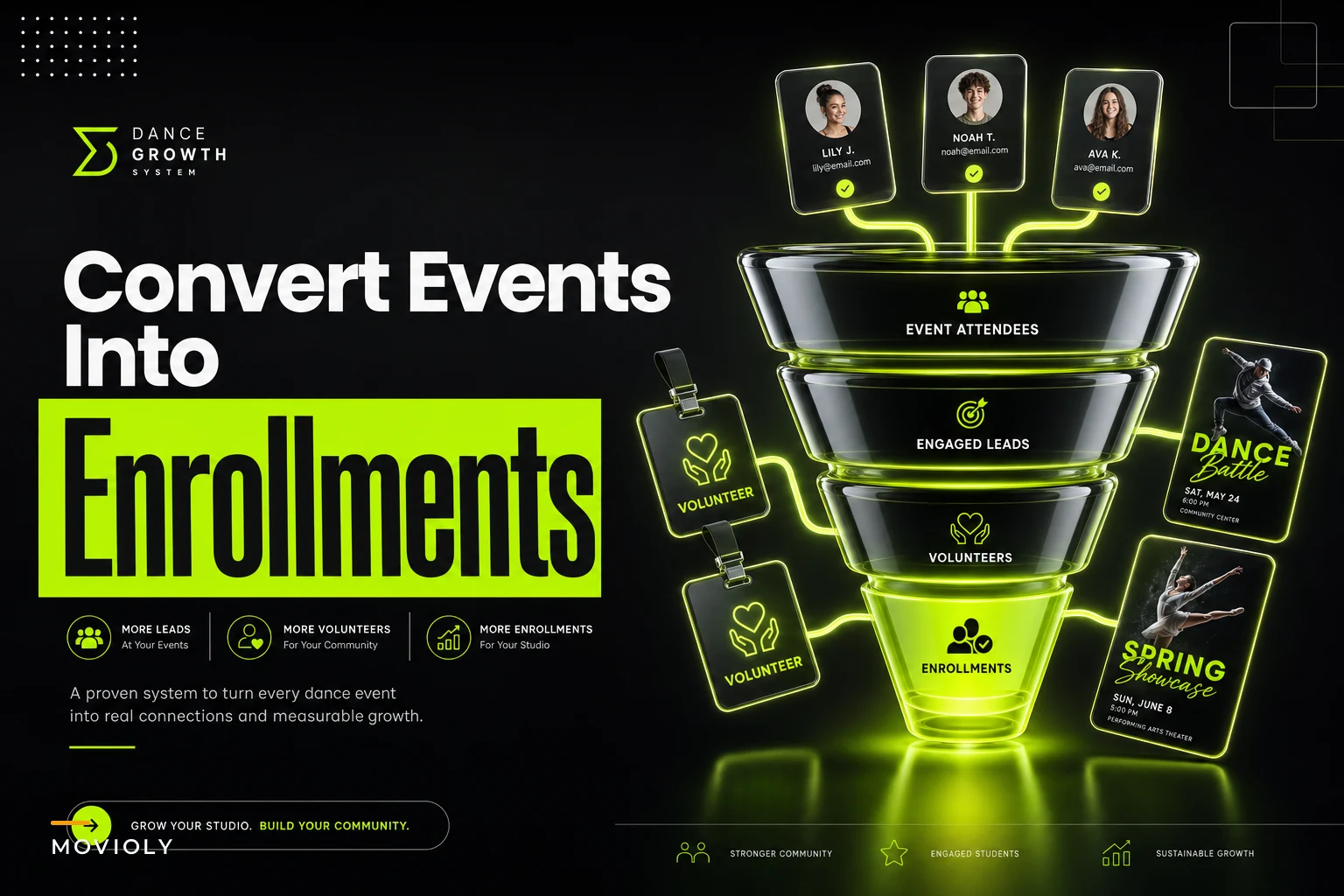
This is a practical walkthrough of how to run events as an acquisition channel instead of a feel-good activity. Partner agreements, volunteer role sheets, a signup flow that captures usable data, and a 30-day nurture sequence with real conversion math.
Start with the partner MOU, because the venue decides your yield
The quality of your event leads is set before the event, by who you partner with. A school PTA, a children's museum, a youth soccer league, a Y — these aren't the same audience, and the agreement you sign shapes how many of their families you can actually reach afterward.
The mistake studios make is going in with a handshake. "Sure, we'll do a demo at your spring fair." Then on event day you discover you're not allowed to collect contact info, you're stuck in a far corner by the restrooms, and the partner forgot to mention it in their newsletter. You brought three instructors and got nine leads.
A partner MOU (memorandum of understanding) is a one-page document that locks in the things that determine your yield. It doesn't need a lawyer. It needs specifics.
What a usable partner MOU actually contains:
-
Audience access — Does the partner email their list about your presence? When, and how many times? Get the send dates in writing.
-
Data rights — Are you allowed to collect names and emails at the event? Can the partner share a post-event list, or is that off the table?
-
Physical placement — Where's your space, and how much foot traffic passes it? "Main entrance" vs. "back lawn" is a meaningful difference in leads.
-
Deliverables from you — Number of instructors, class length, giveaway, insurance certificate. Partners care about liability.
-
Follow-up permission — Can you offer attendees a trial-class code? Some venues, public schools especially, restrict direct solicitation. Know this before you print flyers.
-
Mutual promotion — You tag them, they tag you. Cheap and underused.
A studio that signs an MOU with a local gymnastics gym for a joint open-house weekend — specifying two email blasts to roughly 600 families, a table at front check-in, and permission to collect emails via QR code — is in a completely different position than one that shows up with a folding table and hopes for the best. That one clause about front placement is often the difference between 15 and 60 signups.
If you're building partnerships more broadly, this event work layers neatly on top of a low-cost partnership referral pipeline — the same partners who host your events often become your steadiest referral sources.
Volunteer role sheets: the reason your event feels chaotic
Walk up to a studio booth at a busy event and you can usually tell within ten seconds whether they've assigned roles. If three instructors are simultaneously demoing, chatting, and fumbling with the signup clipboard, leads walk away. Nobody captured them because everybody assumed someone else would.
Eliminate scheduling headaches and missed payments.
Movioly streamlines booking, confirming, and managing every class with ease.
- Unified class and instructor scheduling
- Automated student notifications
- Integrated payment tracking
No credit card required
Events fail operationally not because people don't work hard, but because nobody owns the capture. Dancing and demoing is fun. Standing at a table saying "want to try a free class? Scan this" forty times in a row is not fun, so by default it gets skipped.
The fix is a volunteer role sheet that assigns one job per person, with a specific success metric attached to each.
Core event roles and what each one owns:
-
The Demo Lead — runs the mini-class energy. Owns the crowd, not the data. Never touches the signup station.
-
The Capture Person — stands at the signup station the entire time. Their only job is getting scans and conversations into the system. Measured on number of signups.
-
The Floater — pulls parents watching from the edges toward the Capture Person. "Your daughter looks like she's having fun — we've got a free trial, let me get you set up."
-
The Closer (for bigger events) — handles families who seem genuinely interested, books an actual trial date on the spot, answers pricing questions.
-
The Runner — restocks flyers, swaps water, handles the small chaos so nobody leaves their post.
Give each volunteer a half-page sheet: their role name, one sentence describing their job, their metric, and a script for their two most common interactions. New volunteers especially need the script — a nervous teenage assistant who doesn't know what to say will just smile and let families walk by.
One thing worth internalizing: the Capture Person should never be your most charismatic instructor. Charisma pulls them into conversations and away from logging. Put your organized, slightly introverted person at the table and let the extroverts work the crowd.
The signup flow: where most leads quietly die
A clipboard at an event converts terribly — not because people won't write their email, but because handwriting is unreadable and nobody follows up for days. By the time you type "jmiller@gmial.com" into your system, the family has forgotten you existed.
The signup flow needs to do three things at the moment of contact: capture clean data, set a next step, and start the relationship before they leave the booth.
A workflow that actually holds together:
At the table — A QR code on the tablecloth and a small sign goes to a short mobile form. Three fields only: parent name, email or phone, child's age. Age matters because it lets you route them to the right class later. Every extra field drops completion, so resist the urge to ask for address, how-they-heard, dance history, all of it. You can get that later.
The instant acknowledgment — The moment they submit, they get a text or email: "Thanks for stopping by [Studio]! Here's your free trial code: FALL-TRY. Reply here to pick a day." This single automated step does more for conversion than almost anything else, because it moves the relationship off the chaotic event floor and into a channel you control. Families who get an instant message convert at a meaningfully higher rate than families who hear nothing until Tuesday.
The waiver, handled right — For any event where kids are physically dancing, you need a liability/participation waiver. Don't make it a paper pile. A digital waiver checkbox inside the same signup form — or a separate one-tap form for participating kids — keeps you covered without creating a bottleneck at the table. The common failure is a stack of paper waivers that nobody fills out because the pen ran out and the line got long, so half the kids dance unwaivered and you've got a liability gap and no record of who they were.
Put the liability waiver checkbox inside the same mobile form so participation is one quick tap and the line keeps moving.
Modern studio platforms handle this quietly — QR-linked forms, automatic trial-code texts, digital waivers that attach to a lead record the second someone submits. You're not duct-taping a Google Form to a Mailchimp list and hoping for the best. The data lands in one place, clean, already tagged as "event lead," and the first follow-up fires on its own. The point isn't the software — the point is that the Capture Person stays free to capture instead of babysitting a spreadsheet.
The 30-day nurture funnel: what happens after everyone goes home
An event lead is colder than a website lead in one way — they didn't seek you out, they wandered by. But they're warmer in another — they met you, their kid danced, there's a face attached. That warmth fades fast. You've got roughly 30 days before an event lead is functionally dead.
So you build a 30-day sequence with a clear spine: acknowledge, book the trial, show up for the trial, convert to enrollment, and catch the ones who stall.
| Day | Touch | Channel | Goal | Message core |
|---|---|---|---|---|
| 0 | Instant thanks + trial code | Text/email | Start relationship | "Great meeting you — here's your free trial" |
| 1 | Trial booking nudge | Book a date | Direct link to pick a class time | |
| 3 | Social proof | Build trust | Short parent testimonial + a photo from the event | |
| 5 | Soft text nudge | Text | Re-engage non-bookers | "Still want to grab that free class? Happy to help" |
| 7 | "What to expect" | Reduce no-shows | What to wear, where to park, how first class works | |
| Trial day | Reminder + warm welcome | Text | Show up | Day-of reminder, front desk expects them by name |
| Trial +1 | Post-trial follow-up | Email/call | Convert | "How'd [child] like it? Here's how to enroll" |
| Trial +3 | Enrollment offer | Close | Clear next-step, maybe a small enroll-this-week incentive | |
| 14 | Re-engage no-shows | Text | Recover | "Missed you! Want to reschedule?" |
| 21 | Value email | Stay warm | Progress story, class culture, why families stay | |
| 30 | Last call | Final push | "Trial code expires Friday — want us to hold a spot?" |
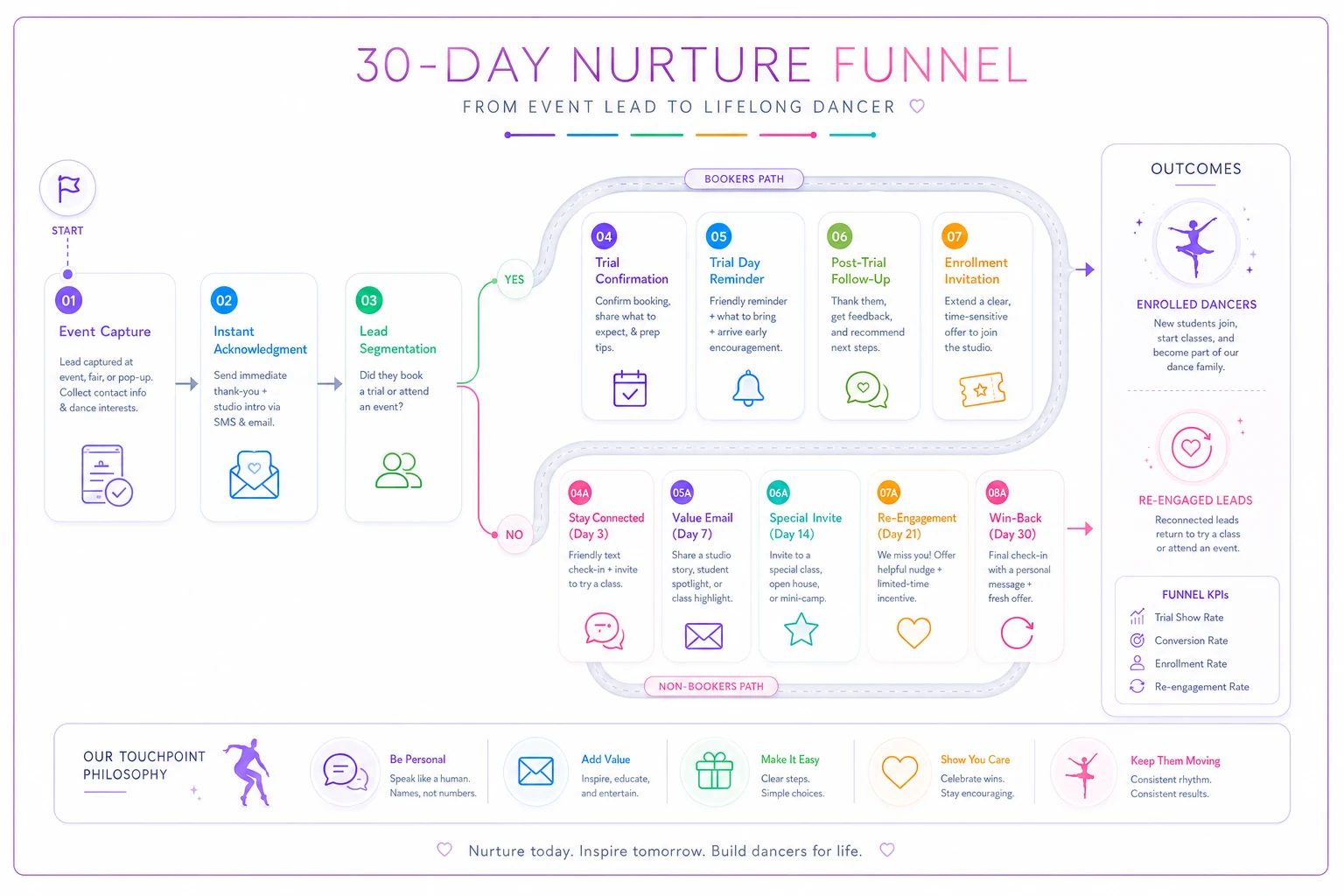
A quick visual of the 30-day nurture workflow.
A few things that make this sequence actually work:
-
Segment on behavior, not just time. The family that booked a trial on day 1 should not get the "still want to grab that free class?" text on day 5. Branch the sequence: bookers go one way, non-bookers another. Blasting all event leads the same messages makes the engaged ones feel like they're talking to a machine — because they are.
-
Texts carry the booking actions, email carries the storytelling. People book from a text. They get convinced from an email.
-
The trial day is the hinge. Everything before it exists to get them in the door. Everything after converts them. If your no-show rate on event-sourced trials is high, pour your effort into days 5–7.
The trial day is the hinge. Everything before it exists to get them in the door. Everything after converts them. If your no-show rate on event-sourced trials is high, pour your effort into days 5–7.
A real scenario with the numbers
A mid-size studio — around 180 enrolled students — ran a booth at a community spring festival. First year, no system: paper clipboard, no follow-up plan, three instructors all demoing at once.
-
Leads captured
roughly 22 (several unreadable)
-
Trials booked
4
-
Enrolled
1
-
Effective cost per enrollment
steep, once you count three staff for six hours
The next year, same event, same booth fee, but they ran the playbook. Partner MOU that got the festival to include them in two email blasts. Volunteer role sheet with a dedicated Capture Person. QR signup with an instant trial-code text and a digital waiver. The 30-day branched nurture sequence.
-
Leads captured
around 70, all clean
-
Trials booked
roughly 20
-
Showed up
about 14
-
Enrolled
6, with 2 more still "thinking" at day 30
Six enrollments at their tuition works out to somewhere in the range of $4k–$6k of first-year revenue from a single Saturday, before you count referrals and siblings. Same event. Same cost. The difference was entirely operational — who owned capture, how clean the data was, and whether anyone followed up on day 5 instead of never.
Tracking ROI so you know which events to repeat
If you run four events a year and can't say which one produced enrollments, you'll keep sinking Saturdays into the fun-but-useless ones. You need a simple per-event scorecard.
Track per event:
-
Total cost (booth fee + staff hours + giveaways + printing)
-
Leads captured
-
Trials booked
-
Trials attended
-
Enrollments at day 30 and day 60
-
Cost per enrollment
-
Projected first-year revenue from those enrollments
Tag every lead by event source in your system so you can run the numbers two months later without guessing. The studio that tags leads can say "the gymnastics open house produced 6 enrollments, the farmers market produced 1, drop the farmers market." The studio that doesn't tag just has a vague feeling and keeps doing both.
One pattern worth flagging: enrollment from events often shows up at day 45–60, not day 30. A family meets you in spring, sits on it through summer, enrolls for fall. If you measure ROI only at 30 days, you'll undercount your best channels. Keep the source tag alive and check again at the 60-day mark.
When this is worth it — and when it isn't
This makes sense when:
-
you have classes to fill, a partner with real audience overlap (parents of young kids, mostly), and at least three people who can staff an event with assigned roles. Events reward studios that can field a team.
This is a bad idea when:
-
you're already at capacity with a waitlist — spend that Saturday on retention instead. It's also a poor fit if you can't commit to the follow-up. An event with no nurture sequence is worse than no event, because you've spent the money and trained families to see you as the studio that never followed up.
Who should probably skip it: a solo instructor with no staff to run roles. You can't demo, capture, and close at the same time, and a half-captured event will drain you for no yield. Build the follow-up system first, then run your first event once you have one extra set of hands.
Events can be one of the most cost-effective acquisition channels a studio has — but only when they're run as an operational process with clear owners, clean capture, and a sequence that carries families from a chaotic Saturday booth all the way to an enrolled spot. If you're already thinking about community presence as a growth lever, it pairs well with treating community impact as a measurable growth system rather than a series of one-off good deeds. Build the scaffolding once, and every festival, school fair, and open house after becomes easier to convert.
Ready to elevate your studio operations?
Join 500+ studios using Movioly to save time, reduce admin workload, and enhance student experiences.