
Most studios already do community work. A canned-food drive during December recital week. A free class for a local school. A dance-a-thon for a family going through a hard time. The instinct is right and the heart is in the right place. The problem is that almost none of it is treated as a program. It's treated as an event — a one-off that eats a Saturday, exhausts your staff, and disappears from memory by the time the next tuition cycle hits.
That's the gap worth digging into. Because when you look at studios that have built a real dance studio community impact program, the difference isn't that they're more generous. They've just wired their good work into the same operational systems they use for scheduling, enrollment, and retention. The impact becomes measurable, repeatable, and — this is the part people flinch at — it becomes a growth lever without becoming cynical about it.
Why "one-off good deeds" quietly cost you
The pattern tends to go like this. A studio runs a big charity performance. It's beautiful. Families cry. The local paper maybe shows up. Then nothing is captured. No emails collected in a usable way. No follow-up sequence. No record of which families participated. No number attached to any of it except maybe the dollar amount raised, scribbled on a whiteboard.
Six months later the owner is trying to justify the time it took, and there's nothing to point to. Did it bring in students? Did it improve retention? Did the partner organization ever hear from you again? Nobody knows. So the next community project starts from zero, reinventing the logistics, re-explaining it to staff, burning the same energy all over again.
The hidden cost isn't the event itself. It's that every time you do good work, you throw away the operational asset it created — the relationships, the goodwill, the contact data, the story you could tell prospective families. A studio that runs four community initiatives a year and captures nothing has done four expensive marketing campaigns and deleted the results.
There's a subtler problem underneath all of that too. Community work done reactively — because a family got sick, because a cause landed in your inbox — has no rhythm. It competes with recital season, with summer intensives, with your busiest enrollment windows, and it always loses. Good intentions with no calendar slot get bumped. Every time.
What breaks when you try to scale it
Say you decide to get serious. You go from one big annual event to a real quarterly cadence — a sustainability push, a partnership with a school, a volunteer performance program, an alumni give-back. That's when the informal approach falls apart in specific, predictable ways.
Eliminate scheduling headaches and missed payments.
Movioly streamlines booking, confirming, and managing every class with ease.
- Unified class and instructor scheduling
- Automated student notifications
- Integrated payment tracking
No credit card required
Coordination collapses first. One person — usually the owner — is holding the whole thing in their head. Which teacher agreed to lead the outreach class. Which parent volunteered to run the collection drive. What the partner organization expects and by when. When it was one event a year, one brain could hold it. At four events across multiple staff, the mental load creates dropped balls, double-bookings, and that awful moment where a partner org shows up expecting 20 dancers and gets six.
Measurement never gets built. Because the work feels "soft," nobody sets KPIs. But without numbers you can't tell a growing initiative from a dying one, and you can't defend the time. You keep doing the food drive out of habit even though it stopped bringing in anyone new three years ago.
Volunteer models get messy. When you start asking families to volunteer — to perform at a senior center, to staff a fundraiser — you need scheduling, reminders, and a way to recognize them. Do that with group texts and a shared spreadsheet and you get no-shows, confusion, and your two most reliable families quietly burning out because they're covering everyone else's flakiness.
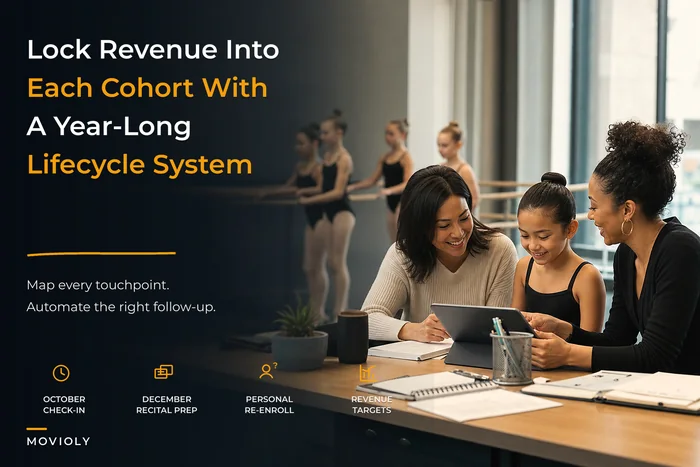
The studios that navigate this are the ones already thinking in systems for the rest of their operation. If you've built structured re-enrollment and alumni flows — the kind of thinking in locking revenue into cohorts with a family lifecycle system — you already have the muscle. Community programs run on the exact same logic: define the audience, define the touchpoints, measure what happens, repeat what works.
Impact and enrollment aren't separate funnels
The mental shift that changes everything is this — a community impact program is an enrollment channel, and often a better one than paid ads.
Think about what a well-run community initiative actually produces. A performance at a local elementary school puts your dancers in front of hundreds of families who've never heard of you. A sustainability partnership with a neighborhood business gets your name in their window and their name in your newsletter. An alumni give-back day brings former students back into the building, and former students who feel connected refer siblings, cousins, and their own kids years later.
None of that is charity-as-marketing in a gross way. You're doing genuinely good work. But there's no rule that says good work has to be operationally invisible. The families who discover you through a school outreach performance are warmer leads than anyone clicking a Facebook ad, because they've already seen your dancers, met your teachers, and associated your name with something positive in their own neighborhood.
The trick is treating the back end of impact work with the same rigor you'd treat a trial-class funnel. Every touchpoint should have a next step. Every participant should be captured. Every initiative should have a number attached to it.
Building the program: pick your models first
Before you touch a calendar, decide what kinds of impact your studio will run. Most studios overcommit to too many types and do all of them badly. Pick two or three models and go deep.
| Model | Staff effort | Primary payoff | Feeds enrollment? | Best cadence |
|---|---|---|---|---|
| School / community performances | Medium | New-family exposure | Strongly | 2–3x per year |
| Sustainability initiatives (recycling, eco-recitals, reuse programs) | Low–Medium | Brand values, parent loyalty | Indirectly | Ongoing + 1 flagship |
| Partnership with local businesses/nonprofits | Low | Cross-promotion, referrals | Moderately | Quarterly |
| Volunteer/service performances (senior centers, hospitals) | Medium | Student character, family pride | Weakly (retention) | Monthly or quarterly |
| Alumni give-back events | Medium–High | Re-engagement, referrals | Strongly | Annually |
| Scholarship / access programs | High | Mission depth, community trust | Long-term | Annual intake |
Notice the payoffs are different. A sustainability program mostly deepens loyalty with families you already have — it's a retention play. School performances are an acquisition play. Volunteer performances are a character-and-culture play that shows up in retention over years, not weeks. Don't judge them all by the same metric.
Attach KPIs — even to the "soft" stuff
The objection that always comes up: "You can't measure community impact, it cheapens it." You can, and it doesn't. Measuring how many people your work reached and what it produced doesn't make the work less meaningful. It makes it survivable, because you can defend it internally and keep funding it.
-
Reach How many non-studio people were exposed? (Audience at a school show, followers reached, businesses involved.)
-
Capture rate Of those reached, how many entered your world — signed up for a newsletter, scanned a QR code, booked a trial?
-
Conversion How many capture contacts became trials or enrollments within 60–90 days?
-
Participation How many of your own families volunteered or attended? (This is your internal engagement signal.)
-
Cost/time Total staff hours plus hard costs. You need this to decide whether it's worth repeating.
A mid-sized studio doing a spring performance at two local schools might reach somewhere around 400–600 family members across both events. If you capture even 8–12% into a follow-up list, that's roughly 40–70 warm contacts, and converting a modest slice into trials over the following couple of months can produce a handful of new enrollments — often at a lower effective cost per student than paid advertising. The point isn't the exact figure. Once you have the figure, the community show stops being "a nice thing we do" and becomes a defensible line in your growth plan.
Calendar integration is what makes it real
This is the piece that separates studios that talk about community impact from studios that actually run it. If it's not on the calendar with owners and deadlines, it will get eaten by recital season and enrollment crunches every single year.
Lock community initiative dates into your master calendar before public schedules go live so they don't get bumped.
-
Late summer / early fall School performance push. It coincides with when families are choosing activities, so exposure converts. Lock school contacts and dates before your fall schedule fills.
-
Winter Sustainability flagship or a service-performance series during the slower post-holiday stretch, when you want to keep families engaged and the building feels quiet.
-
Spring A partnership or fundraiser, deliberately kept away from recital's twelve-week crunch so it doesn't compete for staff attention.
-
Early summer Alumni give-back, timed to catch former students who are home and to seed summer/fall enrollment conversations.
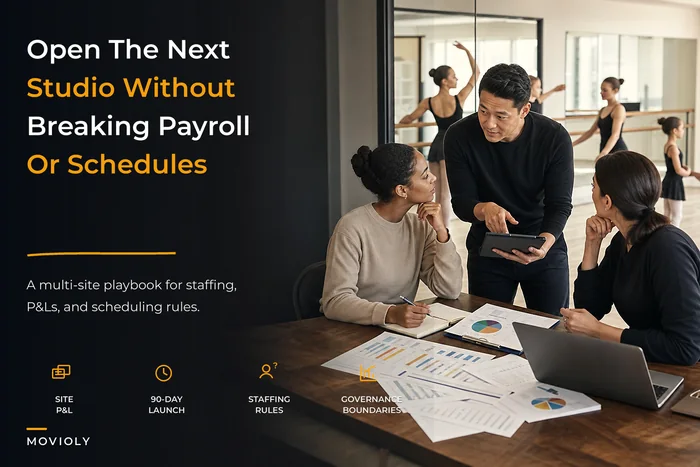
The mechanics matter as much as the timing. Each initiative needs a named owner (not always you), a prep timeline working backward from the date, a volunteer signup with reminders, and a defined follow-up sequence for anyone you captured. When these live in the same system you use for classes and communication, reminders fire automatically, the volunteer roster is visible, and nobody's holding everything in their head. This is the kind of coordination that gets harder the moment you add locations — the same operational discipline covered in the blueprint for multi-location staffing and scheduling applies directly to running impact programs across a studio group.
The volunteer and partnership workflow
Here's how a single initiative should actually flow, because the workflow is where most of these die.
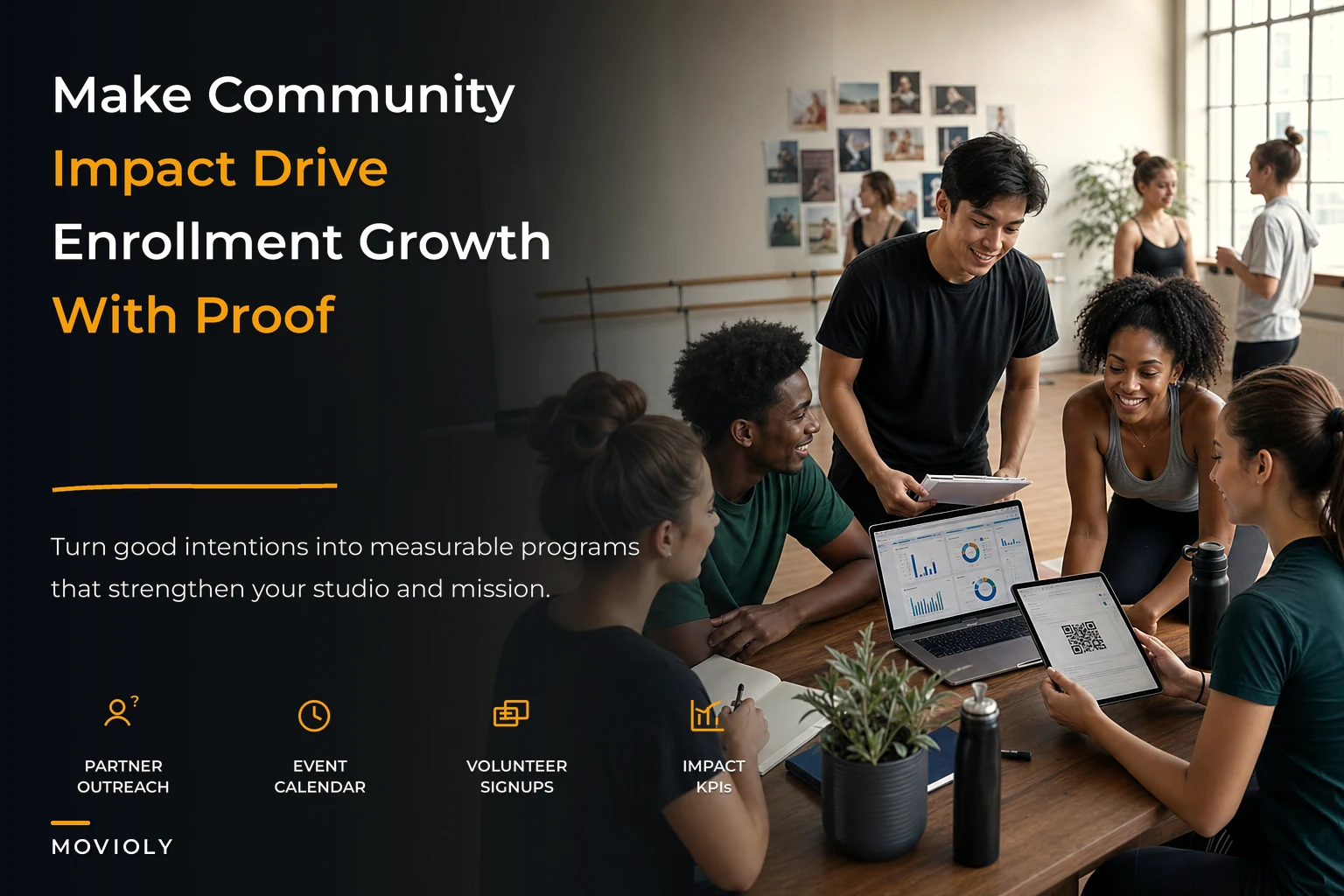
Start with the partner. You reach out to a school or business, agree on a date and scope — say, a 20-minute performance by your junior company at their fall assembly. That agreement gets a calendar entry, a point of contact, and a shared expectation doc so nobody's surprised on the day.
Next, the internal side. You open a volunteer/participation signup for the dancers and families involved, with a clear ask, a date, and automated reminders leading up to it. The reminders are non-negotiable — the difference between a smooth event and a chaotic one is almost always whether people got nudged at the right times.
Then, the capture mechanism. At the event itself, you need a low-friction way for new families to raise their hand — a QR code to a landing page, a signup sheet, a "text this number for a free trial" card. Without this, you've done a beautiful performance and captured zero. This is the step studios skip most often, and it's the step that turns impact into enrollment.
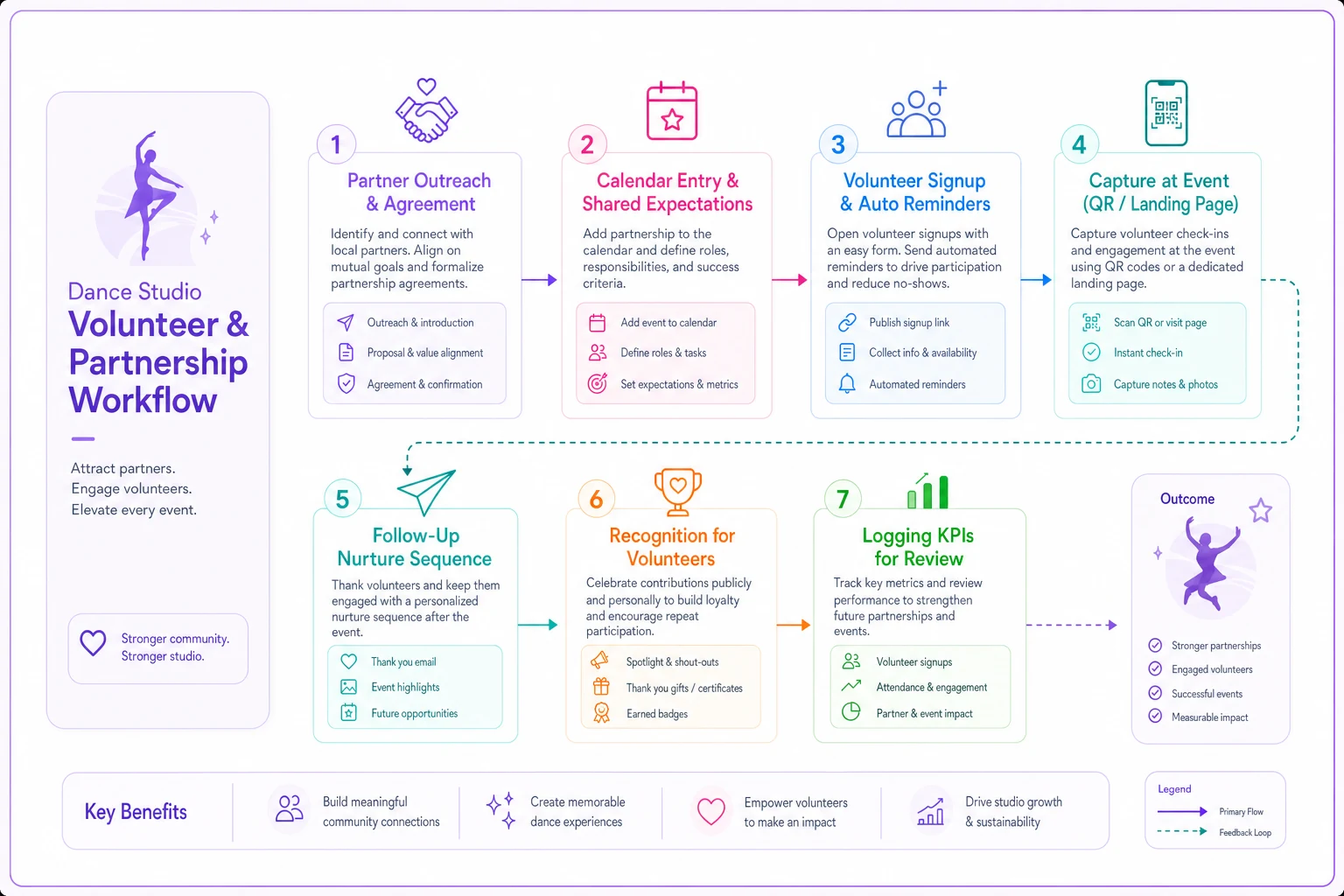
After the event, the follow-up. Captured contacts go into a nurture sequence — a thank-you, photos from the event, a genuine invitation to visit. Your own volunteers get recognized: a shout-out, a small perk, something that makes them want to show up again. Recognition is what keeps your volunteer pool from quietly burning out.
Finally, the review. You log reach, capture, conversion, and hours. You decide: repeat, adjust, or cut. That decision is only possible because you measured.
A real scenario
A suburban studio with around 210 students had been running the same December toy drive for years. Warm feelings, zero tracking. The owner suspected it wasn't doing much beyond the good deed itself, but couldn't say for sure.
They restructured around two intentional initiatives instead of scattered ones: a fall performance series at three local schools, and a spring "green recital" sustainability push — reusable costumes, digital programs, a small community garden partnership. Each got a named owner, a calendar slot away from recital crunch, KPIs, and a capture-and-follow-up flow.
Over the following year, the fall school series reached somewhere in the neighborhood of 700–800 family members total. Capture landed around 9%, giving them roughly 65 warm contacts, and follow-up converted into about a dozen new trial bookings across the season — a meaningful chunk of their fall growth, at a cost well under what they'd been spending per acquired student on ads. The sustainability push didn't drive new enrollment much, but it noticeably lifted engagement and gave families something to talk about with their friends. Just as important, the whole thing ran without the owner personally holding every detail, because the coordination lived in the system rather than her head.
The toy drive? They kept it. But now they knew it was a culture gesture, not a growth channel — and that clarity let them stop over-investing time in it.
When this makes sense — and when it doesn't
This whole approach is worth building when you have enough operational stability that you're not fighting fires weekly. If your scheduling, billing, and enrollment basics are shaky, fix those first. Community programs sit on top of solid operations; they don't fix broken ones.
It also makes sense when you genuinely care about the work. Families can smell a program that exists only to funnel leads. The studios that win here are the ones where the impact is real and the operational rigor just makes sure it doesn't get wasted.
It's a bad idea when you're trying to bolt it on during your busiest season, or when you're treating it purely as a marketing tactic with no real substance. Launching five different models at once is also a recipe for doing all of them poorly, capturing nothing, and concluding "community stuff doesn't work" when the real problem was scope.
Who should probably wait: brand-new studios still figuring out core delivery, and owners who can't yet delegate an initiative to a named staff member. If every impact project routes entirely through you, adding more of them just adds more single-point-of-failure risk.
Pulling it together
Studios that get real value from community and sustainability work aren't more virtuous than everyone else. They've just refused to let their good work stay operationally invisible. They picked a couple of models, attached honest numbers, put initiatives on the calendar in the gaps where they won't get crushed, and built a simple capture-and-follow-up flow so the goodwill turns into relationships and, yes, enrollment.
You don't need a fancy platform to start — you need a decision that impact work will be treated like a program, with owners, dates, and metrics, not a series of well-meaning one-offs. Once it's structured, the same tools you already use to coordinate classes, remind families, and track your pipeline can carry the community side too, so it scales without eating you alive.
Do it right and the line between "doing good" and "growing the studio" mostly disappears. Which is how it should be — a studio genuinely woven into its community tends to be the one families stay loyal to for years, and the one they tell their friends about without you ever asking.
Ready to elevate your studio operations?
Join 500+ studios using Movioly to save time, reduce admin workload, and enhance student experiences.