
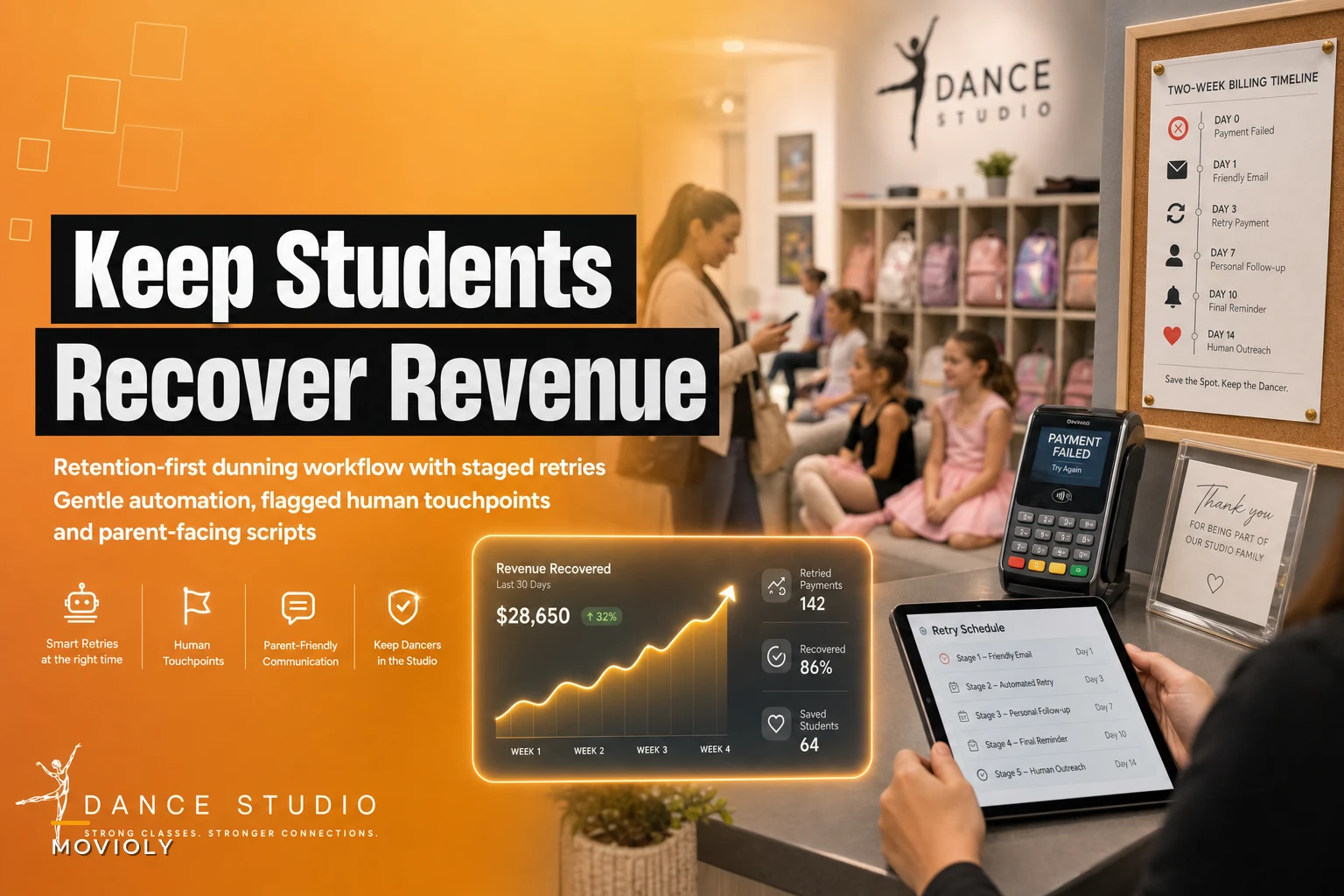

A failed card almost never means a family is leaving. That's the part most studios get backwards. The card expired, the bank flagged a purchase and froze the account, the parent got a new debit card and forgot to update it — the reasons are boring and mechanical, completely unrelated to whether their kid loves your Tuesday jazz class.
But the way most studios handle the failed payment is what actually creates the churn. A cold, automated "Your payment has failed" email fired off at the wrong hour, followed by silence, followed by a slightly panicky "final notice" three days later. That sequence turns a two-minute card update into an awkward situation the parent would rather just avoid — and avoidance, when a family is paying $140 a month, looks a lot like quietly not coming back.
This is about building a dance studio failed payment recovery workflow that gets the money and keeps the relationship. The whole thing comes down to one idea: assume the family wants to stay, and make it easy for them to fix a boring problem.
Why the standard dunning sequence fails studios specifically
Dunning sequences were designed for faceless SaaS subscriptions and utility bills. Copying that logic into a studio is a mistake because your relationship with customers is completely different. You know their kid's name. Their kid stands in your lobby twice a week. The parent chats with your front desk. A generic "Account Past Due — Immediate Action Required" email feels absurd coming from a place that just posted their daughter's recital photo.
The pattern that keeps showing up: the failed payment isn't the problem, the tone mismatch is. When a warm, personal business suddenly sends a cold collections message, it creates cognitive dissonance for the parent. It feels like a mistake, or worse, like the studio doesn't actually see them as a person. Some parents get defensive. Some get embarrassed. A surprising number just freeze and do nothing, hoping it resolves itself.
The second reason standard dunning fails: timing gets treated as an afterthought. Most systems retry the card immediately, then again 24 hours later, then 48 hours after that — right into the same declined account, burning through processor retry limits and racking up fees while annoying the bank. Meanwhile the parent gets three "payment failed" emails in three days and mentally files your studio under "harassing me about money."
The two families you're actually dealing with
Before you write a single script, split failed payments into two buckets. They need completely different handling.
Eliminate scheduling headaches and missed payments.
Movioly streamlines booking, confirming, and managing every class with ease.
- Unified class and instructor scheduling
- Automated student notifications
- Integrated payment tracking
No credit card required
| Signal | Likely cause | Right response |
|---|---|---|
| Card expired, new card on file elsewhere, one-off decline | Purely mechanical — expired card, wrong CVV, bank fraud hold | Gentle, low-friction reminder. Assume goodwill. |
| Repeated declines, insufficient funds, no response after warm outreach | Possible financial stress or a family that's mentally checked out | Human conversation, flexibility, and a real decision |
The first bucket is 80–90% of your failed payments. These families are not a retention risk unless you make them one. The second bucket is smaller but far more sensitive — this is where a payment plan or an honest conversation matters, and where a blast email destroys trust.
The mistake studios make is treating everyone like bucket two. You send collections-flavored messaging to a parent whose only crime was getting a new Visa, and now they're irritated at you over a bank's expiration date.
The retention-first workflow, step by step
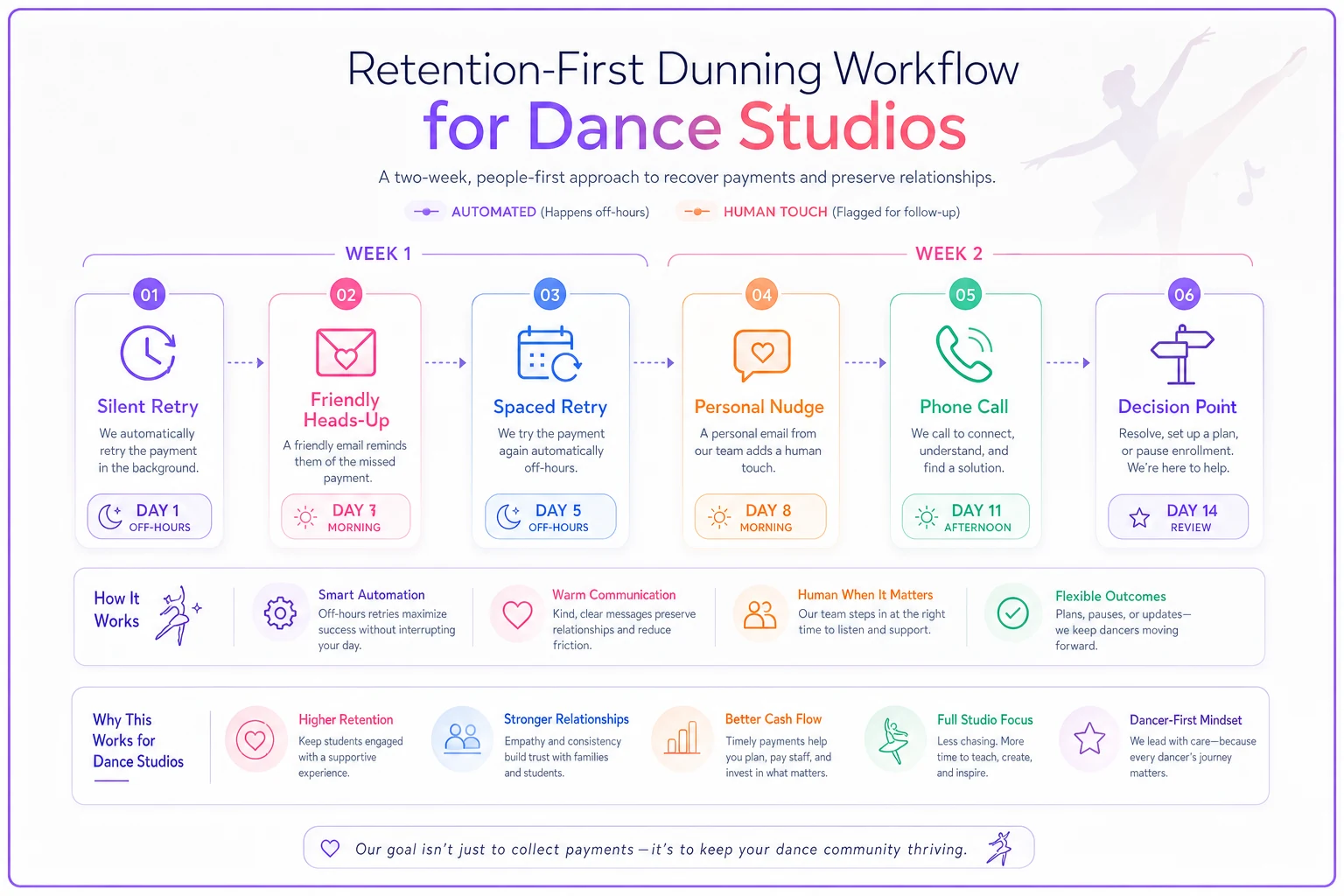
Here's the sequence that recovers the money while keeping the family warm. Think of it as a slow, forgiving ramp — never a cliff.
-
Silent retry (Day 0, off-hours). When the card first declines, don't tell anyone yet. Retry once quietly, usually the next morning. A meaningful chunk of declines clear on their own — a temporary hold lifts, funds land. No reason to alarm a parent about a problem that fixed itself overnight.
-
The friendly heads-up (Day 1–2). If the retry fails, send a genuinely warm, short message. Not "PAYMENT FAILED." Something like a friend flagging that their card bounced. One-click update link. No urgency, no threat. This message alone recovers the majority of your bucket-one families.
-
Second gentle retry (Day 3–4). Retry the card again after the parent's had a couple days to notice. Space it out — hammering the card daily just triggers more bank flags and fees.
-
The personal nudge (Day 5–6). Now a human enters. A quick text from the front desk, or a short personal email that references their kid by name. "Hey, wanted to catch you before it slips — our system flagged Maya's tuition card as declined, probably just an expiration thing. Here's the quick link." This is the single most powerful step and the one most studios skip entirely.
-
The phone call (Day 8–10). If there's still no resolution, a two-minute call sorts everything. Sometimes it's "oh my gosh, so sorry, updating now." Sometimes it's a quieter "money's tight this month" — and that's your cue to offer a plan, not a shutoff.
-
The decision point (Day 12–14). Only now, after multiple warm touches, does a clear-but-kind final message go out with account consequences spelled out. By this point you've earned the right to be direct, and the parent knows you tried to help rather than collect.
Notice how long that ramp is. Two full weeks of decreasing gentleness. Most studios compress this into 72 hours of increasing aggression, which is exactly backwards.
Here's a visual of the ramp and where human touchpoints matter.
Most studios compress this into 72 hours of increasing aggression, which is exactly backwards.
Timing rules that quietly matter more than the words
The content of your messages gets all the attention, but when they land often decides whether they get read at all.
-
Never send payment messages before 9am or after 8pm. A billing text at 6:40am feels aggressive even when the words are kind.
-
Avoid Monday mornings and Friday evenings. Monday, everyone's inbox is a warzone. Friday night, nobody's updating a card.
-
Space retries at least 48–72 hours apart. Back-to-back retries burn processor goodwill and can escalate a temporary hold into a hard block.
-
Don't stack a reminder email and a text in the same hour. Pick one channel per touchpoint so it feels like a nudge, not a swarm.
Mid-morning on Tuesday through Thursday consistently pulls the best card-update response. Parents are settled, at a desk, phone nearby. It sounds trivial, but shifting your "friendly heads-up" from 7am Monday to 10am Wednesday can move your recovery rate noticeably.
Parent-facing scripts that fit a family relationship
The voice matters. You're not a wireless carrier. Here are tone shifts that keep families warm.
The friendly heads-up (Day 1–2): > Hi [Parent] — quick heads up, the card we have on file for [Child]'s tuition didn't go through this month. Usually it's just an expired card or a bank hold, nothing to worry about. You can update it in about 30 seconds here: [link]. Thanks so much! — [Studio]
The personal nudge from a human (Day 5–6): > Hey [Parent], it's [Name] at [Studio]. Didn't want [Child] to miss anything, so wanted to catch you — the tuition card bounced, probably just needs a quick update: [link]. Let me know if anything's up on our end!
The financial-stress path (bucket two): > Hi [Parent] — no pressure at all, but I noticed tuition hasn't gone through and wanted to check in. If this month is a tight one, we can absolutely work something out so [Child] doesn't have to miss class. Just reply here and we'll figure it out together.
That last one is the difference between retention and churn. A family under financial stress who feels seen often stays for years. A family who gets a cold shutoff notice during a rough month leaves and never comes back — and tells other parents why.
A real scenario
A mid-sized studio with around 210 enrolled families was quietly losing students every semester to failed payments without realizing that's what was happening. Their setup: automatic retry, then a generic "payment failed" email, then account suspension after five days. On paper it looked efficient.
When they actually traced it, roughly 12–15 families per semester were slipping out this way — most of them bucket-one, mechanical declines. Parents got the cold email, felt embarrassed or annoyed, didn't update, got suspended, and just drifted. At an average of around $130/month per family, they were bleeding somewhere in the neighborhood of $18k–$22k annually over expired Visas.
They rebuilt the sequence into the retention-first ramp above: silent retry, warm heads-up, spaced retries, a personal text from the front desk around day five, a call before any suspension. Nothing fancy. Recovery on failed payments climbed from roughly half to somewhere around 85–90%, and the "silent drifters" mostly disappeared. Same declines, same amount owed — just a workflow that treated a card error like a card error instead of a moral failing.
Where the workflow quietly runs itself
The catch with all of this is the moving parts. Silent retries, staggered timing, knowing which family got which message, remembering to make the day-eight call — do this manually across 200 families and things slip through, or your front desk spends hours a week babysitting a spreadsheet of declines.
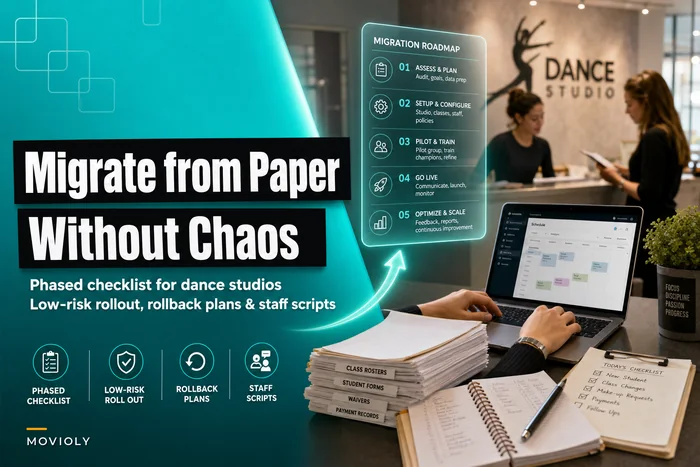
This is where operational software with sensible automation earns its keep. A good platform handles the mechanical layer: the quiet off-hours retries, the correctly-timed friendly reminders, the flag that tells your front desk "this family needs a human now, not another email." The automation runs the boring, well-timed steps so your staff can focus on the handful of conversations that actually need a warm voice. If you're still tracking payments on paper or a patchwork of tools, that's usually the first thing worth fixing — our phased checklist for moving studios off paper walks through doing it without chaos.
Automate off-hours silent retries and the correctly-timed friendly reminders so staff only handle families that truly need a human touch.
The goal isn't to automate the relationship. It's to automate the logistics so the relationship survives a declined card.
When to be flexible, and when to hold the line
Retention-first doesn't mean pushover. A few honest guardrails:
-
Offer flexibility once, clearly. A payment plan for a struggling family is generous. An open-ended "pay whenever" is how you end up carrying accounts for months.
-
Watch for the pattern, not the incident. One late month is life. Three in a row with no communication is a different conversation, and it's fair to have it directly.
-
Don't let recovery become a discount. If families learn that ignoring a bill gets them a break, you've trained the wrong behavior. Flexibility is for stress, not for gaming the system.
If failed payments seem to cluster after a rate increase, that's worth reading separately — the financial metrics that tell you when to adjust pricing can help you figure out whether you have a collections problem or a pricing signal.
The one thing to remember
A failed card is a logistics problem wearing the costume of a churn problem. The families you lose to declined payments are almost never leaving because of money — they're leaving because the recovery process made a warm relationship feel cold and transactional at exactly the wrong moment. Slow the ramp down. Assume goodwill. Put a human in the middle before you ever put an account on hold. Get the timing right and write like a person who actually knows the kid's name. Do that, and most of your "lost" revenue turns out to have never really been leaving at all.
Ready to elevate your studio operations?
Join 500+ studios using Movioly to save time, reduce admin workload, and enhance student experiences.