



Once you get past two locations, the hardest question stops being "can I fill the classes?" and starts being "who actually gets to make decisions here?" That's the real fork in the road — and most studio owners don't realize they've already chosen a governance model by accident. Usually the worst possible hybrid of all three.
The franchise vs multi-site debate typically gets framed as a binary: do I franchise or not? That's too narrow. There are three structural models you can run a studio group under, and each one reshapes your profit margins, your scheduling flexibility, and — the part nobody really warns you about — the personality of your studios. Get the model wrong and you'll spend years fighting your own structure.
The three models, and what they really cost you
The three governance shapes are: franchise, multi-site company-owned, and central-services (a hub-and-spoke shared backbone). People blur these together constantly, but they behave very differently once real money and real instructors are involved.
A franchise means someone else owns the location, pays you a fee and royalty, and runs it under your brand and systems. You trade control for capital and speed. A multi-site setup means you own every studio outright — you carry all the risk, keep all the profit, and make all the decisions. Central-services is the middle path a lot of successful studio groups drift into: locations may be co-owned or partner-run, but scheduling, billing, curriculum, and hiring standards live in one shared operations layer.
| Dimension | Franchise | Multi-site (owned) | Central-services |
|---|---|---|---|
| Revenue to HQ | Royalty (~6–9%) + fees | 100% of profit | Management/service fee |
| Capital needed to expand | Low (franchisee funds it) | High (you fund everything) | Medium |
| Scheduling control | Weak — franchisee sets local | Strong — full control | Strong at core, flexible at edges |
| Culture consistency | Hard to enforce | Easiest to enforce | Moderate, depends on shared standards |
| Speed of growth | Fast | Slow | Medium |
| Downside risk | Low (spread to owners) | High (all yours) | Shared |
| Quality control | Contractual only | Direct | Operational + contractual |
The numbers in that table are directional, not gospel — royalty rates vary, and central-services fee structures are all over the map. But the shape holds: the more control you keep, the more capital and risk you carry, and the slower you move.
Where each model quietly breaks
None of these models fail on day one. They fail around the third or fourth location, when the informal systems that worked for two studios stop holding.
Eliminate scheduling headaches and missed payments.
Movioly streamlines booking, confirming, and managing every class with ease.
- Unified class and instructor scheduling
- Automated student notifications
- Integrated payment tracking
No credit card required
Franchise breaks at the culture seam. You sold a franchisee on your teaching method and your recital energy. Two years in, they've quietly swapped your progression-based curriculum for whatever their lead instructor prefers, because it's easier for them and you're not in the room. Parents who visit both locations notice. The brand you built starts meaning two different things in two towns. In practice, this usually happens when your operations manual is a PDF nobody opens and your only enforcement tool is an annual visit.
Multi-site breaks at the P&L blind spot. When you own everything, every location's problems become your problems — and they don't show up in aggregate. You look at combined revenue, it's up, everybody's happy. Meanwhile Studio B has been running at a 4% margin for eight months because its rent is higher and its class fill rate is soft, and Studio A's profit is quietly masking it. This is exactly the trap covered in the six financial metrics dance studio owners should act on — you can't manage what you only see blended together. Per-location P&Ls aren't optional past two studios; they're the whole game.
Central-services breaks at the authority gap. This is the sneaky one. You've centralized scheduling and billing, but you never wrote down who wins when the central schedule conflicts with a local instructor's preference. The location partner thinks they run their studio. The central ops person thinks they run scheduling. When a popular teacher wants Tuesday nights but the central system already slotted a beginner class there, nobody knows who decides. Decisions stall, resentment builds, and you end up with the worst of both worlds — central overhead with local chaos.
The pattern across all three: the model doesn't fail on the structure, it fails on the undocumented decision rights.
Worked example: the same three studios under each model
Say you've got a group doing roughly $1.4M in combined annual revenue across three studios, about 800 active students total. Instructor pay runs around 32% of revenue, rent and facilities around 18%, admin and software around 8%. Run the same group through each governance model and things look pretty different.
As a franchise group: You own one flagship, franchise the other two. Each franchisee pays you a 7% royalty. On roughly $470k per franchised location, that's about $33k each — call it $66k to HQ annually, plus your flagship's full profit. Your risk on the two franchised locations is near zero. But you've also given up direct control of about two-thirds of your students' experience. If a franchisee under-invests in instructor training, your churn creeps up and you feel it in the brand before you feel it in the bank.
As multi-site owned: You keep 100% of the profit across all three. If the group nets 12% blended, that's roughly $168k to you. Nearly triple the franchise royalty income. But you funded all three buildouts (easily $80k–$150k each), you carry all three leases personally, and one bad year at one location hits you directly. The upside is real; so is the exposure.
As central-services: Two locations are partner-run, one is yours, and a central layer handles billing, scheduling architecture, curriculum, and hiring standards for a service fee of around 5% plus your flagship profit. You net less than full ownership but more than pure franchising — and critically, you keep scheduling and curriculum consistent across all three. Fill rates tend to hold better because the shared scheduling logic doesn't let partners accidentally cannibalize their own class times.
Notice what changed and what didn't. Revenue is roughly the same. What moved was where the profit lands, who absorbs a bad month, and how consistent the actual dance experience stays. That's the whole decision in one sentence.
Scheduling: the operational stress test
Scheduling is where governance stops being theoretical.
Under a franchise model, each franchisee owns their own schedule — which means your total group has no coherent view of instructor capacity, no ability to share a strong teacher across locations during a crunch, and no coordinated recital calendar. When three franchised studios all book the same weekend theater, that's not a scheduling conflict. That's a governance failure that shows up as a scheduling problem.
Under multi-site, you can coordinate, but coordination doesn't happen automatically just because you own everything. Plenty of owned groups still run three disconnected calendars because nobody built the shared scheduling rules. This is the exact operational trap detailed in the operational blueprint for multi-location staffing, P&Ls and scheduling rules — ownership gives you the right to coordinate; systems give you the ability.
Under central-services, scheduling is the reason the model exists. A shared scheduling backbone lets you:
-
See instructor availability across all locations in one view
-
Move a floating specialist teacher (say, a pointe or hip-hop specialist) between studios without double-booking
-
Stagger recital dates and studio-photo weekends so they don't collide
-
Enforce class-size and fill-rate rules consistently instead of location by location
Require partners to use the shared scheduling system for a trial term before allowing local overrides.
This is genuinely where shared operational software earns its keep. When billing, enrollment, and scheduling live in one connected system rather than three separate ones, the central-services model actually functions instead of just existing on an org chart. The failure mode isn't lack of ambition — it's three studios each running their own tools, so "central" is a person emailing spreadsheets around. That's not central-services, that's central-suffering.
Culture: the thing that doesn't show up on the P&L until it's expensive
Culture has no line item, which is exactly why it's the most underrated variable in this whole decision.
In a franchise, culture is the first thing to drift and the last thing you can control. You can mandate curriculum in a contract, but you cannot contractually mandate that a franchisee's front desk greets nervous first-time parents warmly, or that instructors stay ten minutes after class to talk to a struggling kid. Those small things are your brand — and they're exactly what a fee-and-royalty relationship can't reach.
In a multi-site group, culture is enforceable but effortful. Because you employ everyone, you can set the standard — but every location develops its own micro-culture based on its lead instructor's personality. That's not necessarily bad. The mistake owners make is trying to stamp out all local flavor. The better move is defining the two or three non-negotiables — how you talk to parents, how you handle a kid who's behind, safety standards — and letting everything else breathe.
Central-services tends to land in a healthy middle if, and only if, the shared standards are about how you treat people, not just how you process payments. The groups that scale culture well centralize the values and the training, then let each location keep its own character.
When each model actually makes sense
Franchise makes sense when: you have a genuinely repeatable, documented system (not just a good gut), you're short on capital, and you're willing to become a systems-and-support company rather than a dance company. If your SOPs aren't written down cold, you're not ready to franchise — you're just selling chaos with a logo.
Franchise is a bad idea when: your "secret sauce" is you personally. If parents enroll because of your reputation and your presence, that doesn't transfer through a franchise agreement.
Multi-site makes sense when: you have access to capital, you want to keep full control and full profit, and you're comfortable being operationally hands-on across every location. It's the model with the highest ceiling and the highest floor of effort.
Multi-site is a bad idea when: you're expanding to escape being overworked. Owning three studios is not less work than owning one — it's a different, heavier kind of work.
Central-services makes sense when: you've found strong local partners who can run a studio but shouldn't be reinventing billing, curriculum, and scheduling from scratch. It gives them autonomy where it matters and structure where it counts.
Who should not do central-services: anyone who won't write down decision rights. This model lives or dies on clarity about who decides what. Without that, it's the most confusing of the three.
A short real scenario
A three-location studio group in a mid-size metro — around 620 students, roughly $980k combined revenue — was technically "multi-site owned" but operating like three separate businesses. Each location had its own spreadsheet schedule, its own way of handling makeup credits, and its own recital date. Two of the three shared a strong jazz instructor who was constantly double-booked because neither location's schedule could see the other.
They didn't change their ownership structure. They shifted to a central-services operating model on top of the ownership they already had — one shared scheduling and enrollment system, one credit policy, one master calendar. The double-booking problem disappeared within a term. Blended margin moved from around 9% to just over 13% over the following year, mostly from better fill rates and eliminating the duplicated admin work each location had been running separately.
The lesson wasn't that central-services is the best model. It was that they'd been paying the costs of multi-site ownership while getting none of the coordination benefits, because they never built the shared operational layer. The governance model on paper meant nothing until the operations underneath matched it.
A quick decision process before you commit
Work through these six steps in order before settling on a model:
-
Write down your actual non-negotiables — the 3–5 things that must be identical at every location. If you can't name them, you're not ready to expand under any model.
-
Check whether your systems are documented — could someone run your studio from your written process alone? Franchise requires yes. The others tolerate "mostly."
-
Decide how much control you're truly willing to give up — be honest, not aspirational.
-
Map who decides what — scheduling, hiring, pricing, curriculum. Assign every one to a role, not a vibe.
-
Match the P&L structure to your risk tolerance — do you want royalty income with low risk, full profit with full exposure, or a shared middle?
-
Confirm your operational tools can support the model — three disconnected systems can't run a central-services or coordinated multi-site group, no matter what the org chart says.
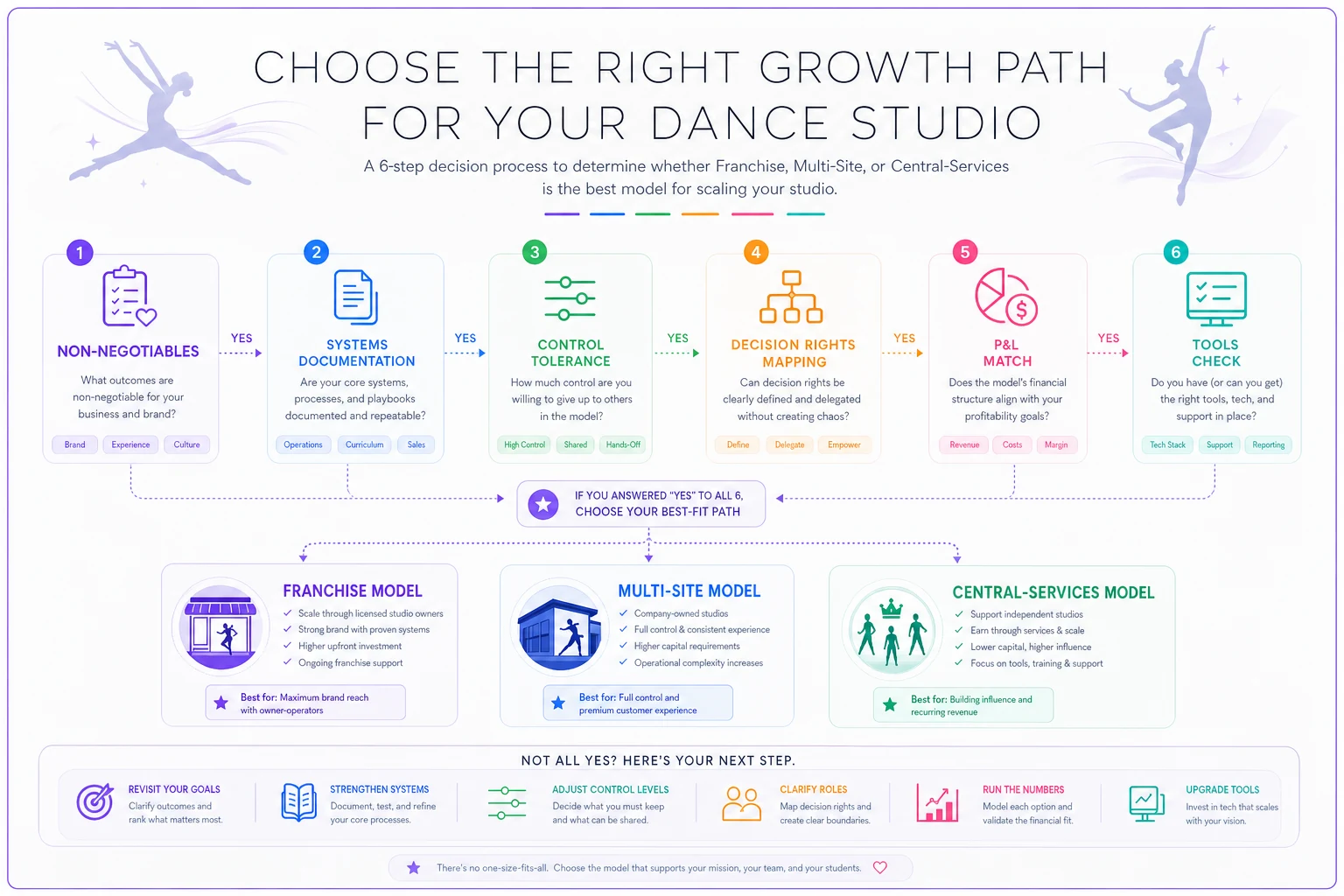
Use the flow to step through the checks visually and see which model aligns with your answers.
The right model usually becomes obvious around step three or four. If it doesn't, that's a sign you need to tighten your systems before you scale, not after.
The real takeaway
The franchise vs multi-site question isn't really about franchise fees or ownership percentages. It's about which tradeoff you can live with: control versus capital, profit versus risk, consistency versus speed. Every studio group is already running some governance model right now — the only question is whether you chose it deliberately or backed into it.
The groups that scale cleanly aren't the ones who picked the "best" model. They're the ones who picked a model on purpose, wrote down who decides what, and made sure their day-to-day operations actually matched the structure they claimed on paper. Get those three things aligned and any of the models can work. Leave them undefined and none of them will.
The franchise vs multi-site question isn't really about franchise fees or ownership percentages. It's about which tradeoff you can live with: control versus capital, profit versus risk, consistency versus speed. Every studio group is already running some governance model right now — the only question is whether you chose it deliberately or backed into it.
The groups that scale cleanly aren't the ones who picked the "best" model. They're the ones who picked a model on purpose, wrote down who decides what, and made sure their day-to-day operations actually matched the structure they claimed on paper. Get those three things aligned and any of the models can work. Leave them undefined and none of them will.
Ready to elevate your studio operations?
Join 500+ studios using Movioly to save time, reduce admin workload, and enhance student experiences.