

Opening a second dance studio location feels like the logical next step when your waitlists are full and families are driving 45 minutes just to make class. But the operational complexity that comes with running multiple locations catches most studio owners completely off guard.
The mistake isn't in the decision to expand — it's assuming your single-location systems will somehow stretch to cover two sites. They won't. What works for managing 12 instructors at one location breaks down fast when you're coordinating 28 instructors across two buildings, dealing with separate landlords, managing inventory in multiple places, and trying to figure out whether Location B is actually profitable or just quietly draining money from Location A.
Studios that successfully scale multi-location operations build entirely different organizational structures before they sign the second lease. The ones that struggle try to manage both locations like they're one big studio that happens to be in two buildings.
Why single-location thinking destroys multi-location operations
Your first studio probably runs on relationships and informal communication. The office manager knows every family by name. Instructors swap classes through text messages. You handle scheduling conflicts over coffee. This works because everyone's in the same physical space with the same context.
Add a second location 15 minutes away and those informal systems collapse almost immediately. Instructors at Location A have no idea what's happening at Location B. Parents enrolled at both locations get conflicting information. Staff meetings become logistical nightmares. The owner ends up spending entire days driving between sites trying to maintain the personal touch that built the business in the first place.
The financial picture gets even murkier. Most studio owners track revenue and expenses for the whole business, not by location. Six months after opening Location B, they realize they have no idea if it's actually profitable. Total revenue went up, but so did total expenses. Is Location B carrying its weight? Is it cannibalizing Location A? Without site-level P&Ls, you're flying blind.
Then there's staffing chaos. Single-location studios share instructors informally all the time — someone covers ballet at 4pm and contemporary at 6pm in the same building. Scale that across locations and you get instructors racing between sites, arriving late, mixing up which choreography belongs to which class. Parents notice the drop in quality quickly.
The hub-and-spoke model that prevents organizational collapse
Studios that successfully run multiple locations adopt a hub-and-spoke organizational model early in their expansion planning. This isn't really about hierarchy — it's about creating clear boundaries between shared services and location-specific responsibilities.
Eliminate scheduling headaches and missed payments.
Movioly streamlines booking, confirming, and managing every class with ease.
- Unified class and instructor scheduling
- Automated student notifications
- Integrated payment tracking
No credit card required
The hub handles everything that benefits from centralization:
-
Financial management and bookkeeping
-
Marketing and enrollment systems
-
Curriculum development
-
Instructor training standards
-
Technology platforms
-
Policy creation
Each spoke (location) maintains autonomy over:
-
Daily scheduling decisions
-
Local community partnerships
-
Site-specific equipment and supplies
-
Parent communication for their families
-
Location culture and environment
This structure seems obvious on paper, but implementing it requires completely rethinking how decisions get made. The owner can't approve every schedule change at both locations. The office manager can't personally handle every parent concern. Department heads need actual authority, not just titles.
One studio with three locations structures it this way: their Director of Education oversees curriculum and standards across all sites but doesn't dictate specific class times. Each Site Director owns their location's schedule within the curriculum framework. The central office handles all billing and enrollment through unified systems, but Site Directors manage day-to-day parent relationships. This prevents the constant territorial battles that plague poorly structured multi-location businesses.
Building site-level P&Ls before you need them
The biggest financial mistake in multi-location expansion is treating all locations as one financial entity. You need separate P&Ls for each site from day one — actually, from before day one. Build the reporting structure during your planning phase, not after Location B has been draining money for six months.
A functional site-level P&L allocates:
Direct location costs (easy to assign):
-
Rent and utilities for that specific location
-
Site-specific staff wages
-
Location-specific supplies and equipment
-
Local marketing spend
Shared costs (require allocation rules):
-
Administrative staff time (usually by enrollment percentage)
-
Technology subscriptions (by active student count)
-
Insurance (by square footage or revenue)
-
Owner/executive salaries (by time spent or revenue)
The allocation methodology matters less than consistency. Pick a method and stick with it for at least a year so you can actually spot trends. A studio running two locations might allocate shared costs 60/40 based on enrollment, then discover Location B generates 40% of students but 55% of revenue because it runs more intensive programs. That kind of insight only surfaces with consistent P&L tracking.
Here's what a simplified monthly P&L comparison might look like:
| Category | Location A | Location B | Allocation Method |
|---|---|---|---|
| Revenue | |||
| Tuition | $42,000 | $31,000 | Direct |
| Workshops | $3,200 | $5,400 | Direct |
| Retail | $800 | $600 | Direct |
| Direct Expenses | |||
| Rent | $8,000 | $6,500 | Direct |
| Instructor wages | $18,000 | $14,000 | Direct |
| Utilities | $400 | $350 | Direct |
| Supplies | $1,200 | $900 | Direct |
| Allocated Expenses | |||
| Admin salary (40hrs) | $2,400 | $1,600 | 60/40 by enrollment |
| Software | $300 | $200 | 60/40 by enrollment |
| Insurance | $540 | $360 | 60/40 by enrollment |
| Marketing | $1,200 | $800 | 60/40 by enrollment |
| Net Operating Income | $13,960 | $12,290 |
This breakdown reveals that while Location A generates more total profit, Location B actually runs better margins (32% vs 29%). That information drives completely different decisions than just knowing total company profit went up.
The shared services matrix that prevents duplicate work
Multi-location studios waste enormous amounts of time duplicating work across sites. Both locations create their own recital programs. Each site maintains separate costume inventories. Marketing produces different flyers for essentially identical programs. This duplication doesn't just waste time — it confuses families and weakens your brand.
A shared services matrix clarifies what gets centralized versus what stays local. Without clear boundaries, you get constant friction between locations fighting over resources and responsibilities.
Fully Centralized Services:
-
Financial systems and reporting
-
Enrollment and billing platforms
-
Website and main social media
-
Instructor hiring and onboarding
-
Curriculum standards
-
Performance licenses and rights
Locally Managed with Central Standards:
-
Class scheduling
-
Substitute teaching assignments
-
Parent communications
-
Studio cleanliness and maintenance
-
Community partnerships
-
Student placement decisions
Hybrid Approach:
-
Marketing (central strategy, local execution)
-
Recitals (shared creative direction, site-specific logistics)
-
Customer service (central policies, local relationships)
-
Inventory (central purchasing, local management)
The hybrid category causes the most confusion in practice. Take marketing. Central marketing creates the overall fall enrollment campaign, designs templates, and manages ad spend. Each location customizes messaging for their specific community, manages local Instagram stories, and handles neighborhood partnerships. Without this clarity, you get Location A posting conflicting information that undermines Location B's local campaign.
The 90-day staged checklist for opening location two
Opening a second location requires a staged approach that builds systems before you actually need them. Studios that rush into expansion without proper preparation spend the first year in crisis mode, damaging their reputation at both sites.
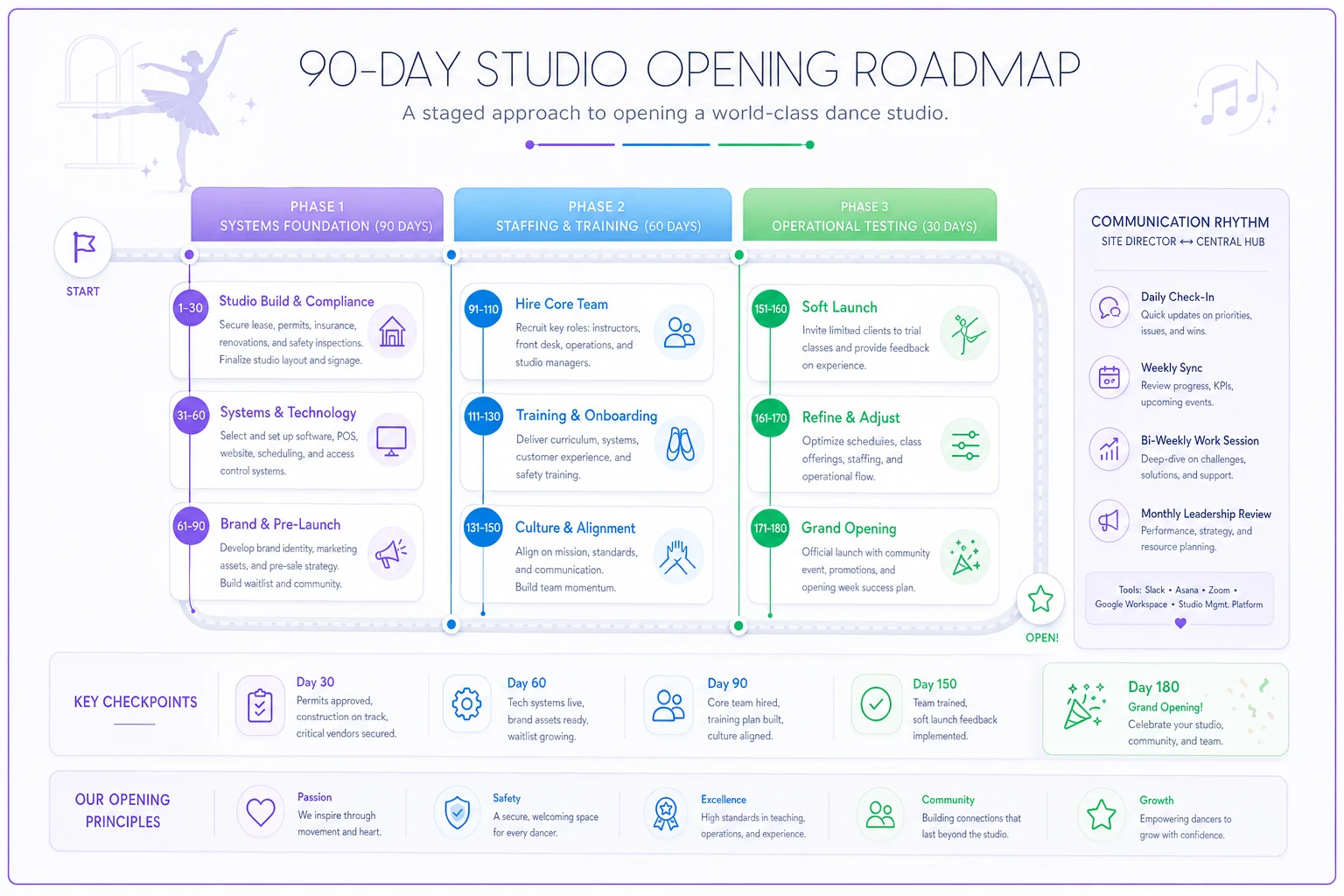
Phase 1: 90 days before opening (Systems Foundation)
Start with the organizational structure. Promote or hire a Site Director for Location A — yes, your existing location needs one too. You can't manage Location B if you're still the primary operator of Location A. Build your site-level P&L templates and test them with three months of historical data from Location A to work out the allocation kinks.
Create role definitions that specify decision-making authority. Can Site Directors adjust pricing for their location? Who approves instructor raises? What spending requires owner sign-off versus site-level discretion? Document these boundaries before you're making decisions in crisis mode.
Technology infrastructure needs attention during this phase. Your scheduling software needs to handle multi-location complexity — instructors teaching at both sites, families enrolled at both locations, equipment that moves between buildings. Set up location-specific phone numbers that route to a central system. Create separate Google My Business profiles while maintaining brand consistency.
Phase 2: 60 days before opening (Staffing and Training)
Staffing the second location requires more than just hiring instructors. You need a bench of qualified teachers at both locations because someone will always be sick, pregnant, or moving. Start recruiting 60 days out even if you don't need everyone immediately. Better to have trained substitutes available than scrambling to cover classes opening week.
The training challenge multiplies with distance. Instructors at Location B need the same standards as Location A, but you can't be everywhere. Record training videos for your standard progressions. Create detailed lesson plan templates. Set up a peer mentoring system where experienced instructors from Location A partner with new hires at Location B.
Build communication protocols now. How do instructors at different locations share choreography? Where do they post schedule changes? Who handles parent complaints at each location? These seem like minor details until a miscommunication sends a parent to the wrong building for their child's solo rehearsal.
Phase 3: 30 days before opening (Operational Testing)
The month before opening, run everything as if Location B were already operational. Hold staff meetings that include both locations. Process mock enrollments through your systems. Test inventory transfers between locations. Have Location B staff shadow operations at Location A.
This is when you discover that your attendance tracking system doesn't properly separate locations, or that instructor timesheets can't handle someone teaching at both sites on the same day. Finding these issues during testing is frustrating but manageable. Discovering them during Week 1 with paying customers is a much bigger problem.
Run through this checklist before you open the doors:
-
Confirm scheduling software correctly separates instructors by site
-
Run mock enrollments for families attending both locations
-
Test inventory transfer requests between sites
-
Verify instructor timesheets work for split-site staff
-
Confirm parent communications route to the correct Site Director
-
Hold a joint staff meeting across both locations
-
Set your inter-location communication rhythm
weekly Site Director check-ins, monthly financial reviews, quarterly planning sessions
Set that communication rhythm before problems arise. Those meetings feel excessive early on, but they're essential for catching issues before they compound.
This workflow outlines the staged opening steps and checkpoints.
Run through this checklist before you open the doors:
Governance boundaries that keep locations aligned but autonomous
The tension between standardization and local autonomy never fully resolves. You want both locations to feel like the same brand while serving potentially different communities. You need consistent quality while allowing Site Directors to actually make decisions. This requires clear governance that specifies what's negotiable versus what isn't.
Non-negotiable standards (protect the brand):
-
Safety protocols and ratios
-
Instructor qualification requirements
-
Core curriculum progressions
-
Tuition payment policies
-
Performance quality standards
-
Child protection policies
Site Director discretion (serve the community):
-
Class times and schedule density
-
Which electives to offer beyond core curriculum
-
Local partnership decisions
-
Studio decor and atmosphere (within brand guidelines)
-
Special events and workshops
-
Instructor scheduling preferences
The governance structure needs enforcement mechanisms. Monthly audits comparing class sizes, retention rates, and safety incidents across locations. Quarterly reviews of site-level P&Ls with Site Directors explaining variances. Annual parent surveys compared across locations to spot quality differences before they become reputation problems.
One successful studio group uses a "variance allowance" system. Site Directors can deviate from standard pricing by up to 10% based on local market conditions, adjust class caps by a couple of students up or down, and modify recital formats within established parameters. This gives them real flexibility while preventing radical departures from the core model.
Common failure points in multi-location operations
Even well-planned expansions hit predictable failure points. The instructor who's exceptional at Location A becomes inconsistent when splitting time between sites. The family enrolled at both locations who gets conflicting information about recital requirements. The inventory system that shows 30 pairs of ballet shoes in stock but doesn't specify which location has them.
Schedule coordination breaks down first. One studio discovered their highest-level competitive team had members training at both sites, but the instructors weren't communicating about choreography changes. By competition season, dancers had learned different versions of the same routine. Three months of work scrapped. Now they use a shared choreography portal where any changes get documented within 24 hours.
Financial controls get messy when money moves between locations. Location A buys costumes for a combined recital. Location B's instructor picks up supplies and expects reimbursement from Location A. Parents pay at the "wrong" location for convenience. Without clear policies and tracking, you lose thousands in misallocated expenses without ever noticing where it went.
Quality drift happens gradually. Location A maintains strict technical standards because the owner teaches there regularly. Location B slowly relaxes those standards because the Site Director prioritizes fun over technique. Six months later, Location B families complain their dancers struggle to keep up when they take classes at Location A. Regular cross-location training and evaluations prevent this, but you have to build it into your operations calendar intentionally.
Technology and systems that enable true multi-location scale
The technology stack for multi-location operations looks different than single-site needs. You can't just add another location to your existing systems and hope they scale. The complexity grows faster than you'd expect.
Your class management software becomes mission-critical. It needs to track which instructors are qualified for which locations, prevent double-booking across sites, show families their full enrollment picture regardless of location, and generate accurate site-level financial reports — all without requiring duplicate data entry or awkward workarounds.
Communication platforms matter more with distance. A studio running three locations might use Slack for urgent staff coordination, shared Google calendars for scheduling, project management software for recital planning, and automated parent communication through their enrollment system. The key is choosing tools that reduce confusion, not add to it.
This is where AI-powered operational software starts to show real value. Instead of manually coordinating schedules across locations, automated systems can flag conflicts when an instructor gets scheduled at both sites without adequate travel time. Rather than tracking inventory separately at each location, these platforms maintain real-time visibility across all sites. The routine coordination tasks that multiply with each new location — sending placement notifications, tracking costume orders, reconciling multi-location enrollments — get handled automatically instead of falling through the cracks.
The most valuable automation handles information flow between locations. When Location A updates a policy, Location B receives the change automatically. When a family enrolls in classes at both locations, their information syncs without duplicate entry. When an instructor calls in sick at Location B, qualified substitutes from both locations get notified immediately. These feel like small efficiencies until you're managing 300+ families across multiple sites and the gaps start costing real money.
Making the expansion decision with clear metrics
When to hire, raise prices, or open a class: the 6 financial metrics covers the baseline financial analysis every studio owner should run — but the decision to open a second location requires an even more careful read. You need sustained demand, operational stability, and financial reserves before taking on expansion complexity.
The metrics that indicate readiness for a second location:
Demand indicators:
-
Consistent waitlists for at least 6 months
-
25%+ of families traveling more than 20 minutes
-
Turning away 50+ qualified students annually
-
Competition successfully operating in your proposed area
Operational readiness:
-
Current location running without daily owner involvement
-
Management team making routine decisions independently
-
Systems documented and consistently followed
-
Staff retention above 80% annually
Financial requirements:
-
6 months operating expenses in reserves
-
Current location generating 20%+ margins
-
Capital for build-out plus 12 months of potential negative cash flow
-
Credit line established for unexpected expenses
Missing any of these doesn't automatically mean you shouldn't expand, but it does mean you need a real risk mitigation strategy. No reserves? Consider starting with a satellite program in rented space before committing to a full second location. Operations aren't stable? Hire and train management before expanding, not during.
The competitive advantage of proper multi-location operations
Studios that master multi-location operations build competitive advantages most other businesses can't easily replicate. They offer families convenience and variety. They give instructors more teaching opportunities and a real career path. They negotiate better rates with vendors through volume purchasing. And they achieve economies of scale that actually improve margins across all locations, not just the flagship.
The operational complexity that scares away casual competitors becomes your strategic advantage. While other studios struggle to manage one location effectively, you're optimizing curriculum across three sites, leveraging shared services to reduce costs, and building a regional brand that attracts better talent.
Which calendar model fits your studio — a decision matrix for choosing becomes even more relevant with multiple locations. You might run year-round programming at your established site while using terms at the new location until demand stabilizes. That kind of flexibility only works with proper organizational structure and clear P&Ls showing which model performs better in which market.
Moving from reactive to strategic multi-location management
The shift from one location to multiple sites fundamentally changes the owner's role. You move from operator to strategist, from teacher to executive, from managing tasks to managing managers. This isn't a loss of the personal touch that built your business — it's an evolution that lets you impact more families while building something that doesn't depend entirely on you being present.
Success requires accepting that Location B will never be "Location A in a different building." Each site develops its own personality, serves its own community, and faces its own challenges. Your job isn't to make them identical — it's to ensure they deliver consistent quality while adapting to local needs.
The studios that thrive with multiple locations build the infrastructure before they need it, track the metrics that matter for each site, and create governance structures that balance autonomy with alignment. They treat expansion as a strategic capability, not just a growth tactic. The operational complexity never fully disappears, but with proper systems and structure, it becomes manageable background noise rather than daily crisis.
Scaling dance studio multi-location operations isn't just about having enough students or finding the right real estate. It's about building an organization capable of delivering consistent quality across distances, managing complexity without losing authenticity, and maintaining financial visibility when you can't be everywhere at once. The blueprint exists — the challenge is having the discipline to follow it before expansion fever takes over.
Ready to elevate your studio operations?
Join 500+ studios using Movioly to save time, reduce admin workload, and enhance student experiences.