

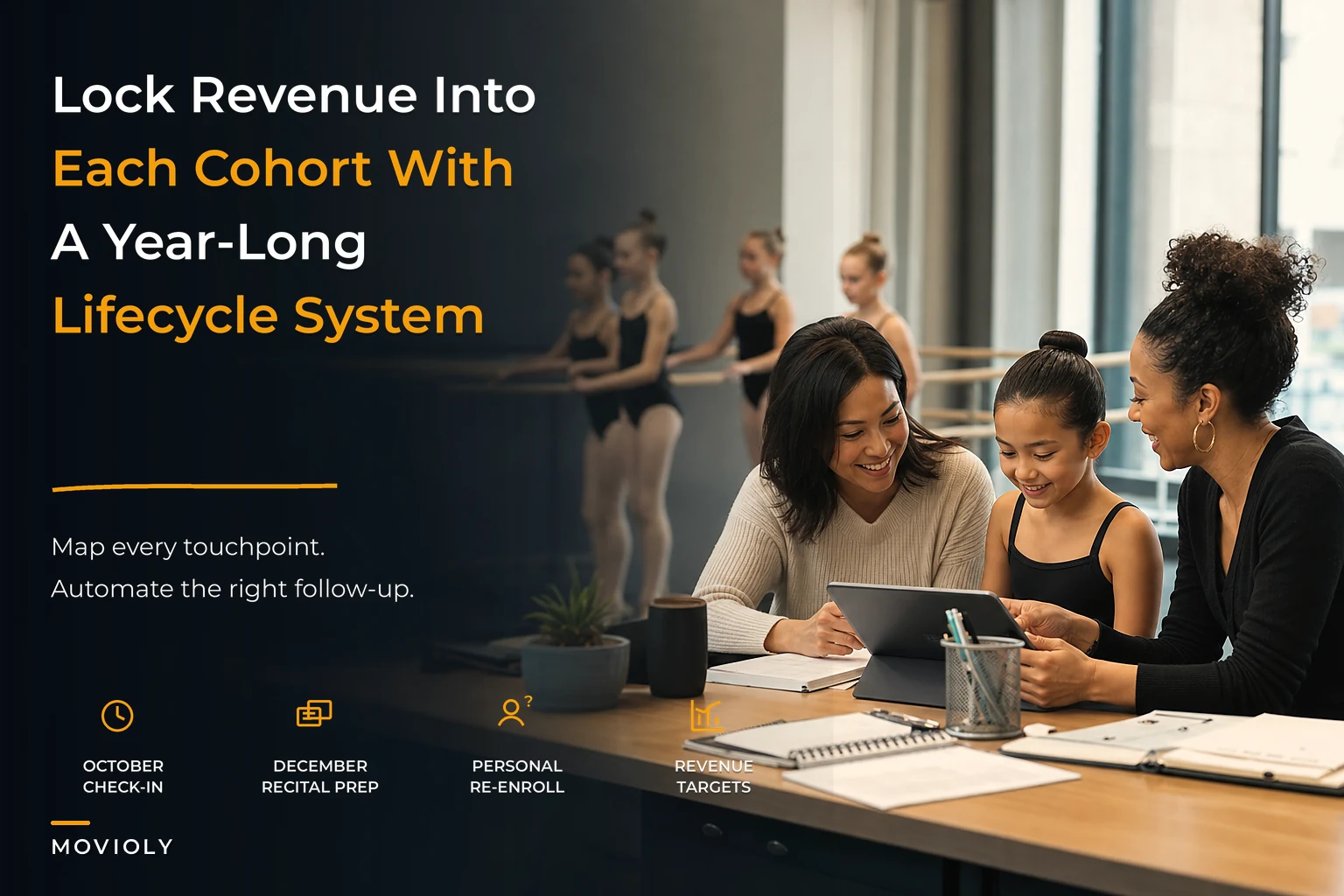

Most dance studios treat re-enrollment like an annual scramble. Around March or April, you send out forms, chase signatures, and hope families come back. By May, you're still tracking down stragglers while trying to plan summer camps and next year's schedule. Meanwhile, the families who've been with you for years get the same generic "register now!" email as someone who joined last month.
This reactive approach leaves money on the table every single year — not just from families who slip through the cracks during re-enrollment season, but from the deeper relationships you never build because you're too busy managing the chaos.
The hidden economics of dance studio families
A first-year dance family generates maybe $1,800 in tuition. But a family that stays for seven years? They'll spend somewhere in the $15,000–20,000 range across classes, costumes, competitions, and camps. Add in younger siblings who join later, the friends they refer, and the private lessons that come as their dancer advances.
The real revenue isn't in the first enrollment. It's in years three through ten. Yet most studios operate without any systematic way to nurture families through this lifecycle. No triggers for when a toddler sibling becomes old enough to join. No real pathway for multi-dancer households. No structured approach to turn graduating seniors into assistant teachers or adult class students.
Why traditional re-enrollment fails at scale
When you're running 30 students, you can keep track of everything in your head. You know Emma's little brother will be ready for pre-ballet next fall. You remember that the Martinez family always needs payment plans. You personally text anyone who hasn't re-enrolled by April.
Eliminate scheduling headaches and missed payments.
Movioly streamlines booking, confirming, and managing every class with ease.
- Unified class and instructor scheduling
- Automated student notifications
- Integrated payment tracking
No credit card required
But around 150 students, that personal touch starts breaking down. By 300, you're drowning in spreadsheets and sticky notes. The families who actually need attention — the ones considering quitting, the ones with financial concerns, the ones with scheduling conflicts — get lost in the shuffle.
The operational burden compounds fast. Admin spends 30–40 hours in April just processing re-enrollments. Instructors field the same questions about next year's schedule over and over. Meanwhile, you're trying to make staffing decisions without knowing if that Tuesday hip-hop class will have eight students or eighteen.
The cohort-based revenue model most studios miss
Instead of thinking about individual enrollments, successful studios track families as cohorts moving through predictable lifecycle stages. Each stage has different needs, different revenue potential, and different retention risks.
| Cohort | Description | Average revenue |
|---|---|---|
| Year 1–2 families: | Still figuring out if dance is their thing. Need lots of communication about progress. High dropout risk around the first recital. | ~$1,800/year |
| Year 3–5 families: | Committed to dance but may be comparing studios. Start adding camps and workshops. Considering competition team. Ready to bring siblings. | ~$3,200/year |
| Year 6–8 families: | Deeply invested. Multiple classes per week. Competition fees. Private lessons. Often multiple kids enrolled. | ~$5,500/year |
| Year 9+ families: | Studio advocates. Refer friends consistently. Kids might assist with classes. Parents volunteer. Some transition to adult programs. | ~$4,000/year (declining as kids age out, but high referral value) |
When you map families into these cohorts, you can predict next year's revenue with a reasonable degree of accuracy. More importantly, you can spot problems before they become crises. If your Year 3–5 retention drops below 75%, something's wrong with your intermediate program. If Year 1 families aren't bringing siblings by Year 3, you're missing cross-enrollment opportunities that are sitting right in front of you.
Building triggers and touchpoints across the lifecycle
A dance studio re-enrollment system isn't just about collecting signatures in spring. It's about creating strategic touchpoints throughout the year that strengthen family relationships and surface expansion opportunities naturally.
-
October Two classes in, automated check-in asking about their experience. Flag any concerns for personal follow-up.
-
December Before holiday break, send a recital prep timeline and what to expect. Include a subtle mention of spring camps.
-
February Progress update from the instructor. Note that their daughter is ready for the accelerated class next year. Plant the seed early.
-
March Personalized re-enrollment package based on recommended progression. Include early-bird pricing that actually means something — not just $25 off.
-
April If still not enrolled, triggered personal outreach based on their history. Different messaging for "considering competition team" versus "mentioned financial concerns back in December."
Families receive communication based on their actual situation, not a broadcast email that goes to everyone and gets ignored by most.
A quick visual can make it easier for staff to follow the year-long trigger sequence.
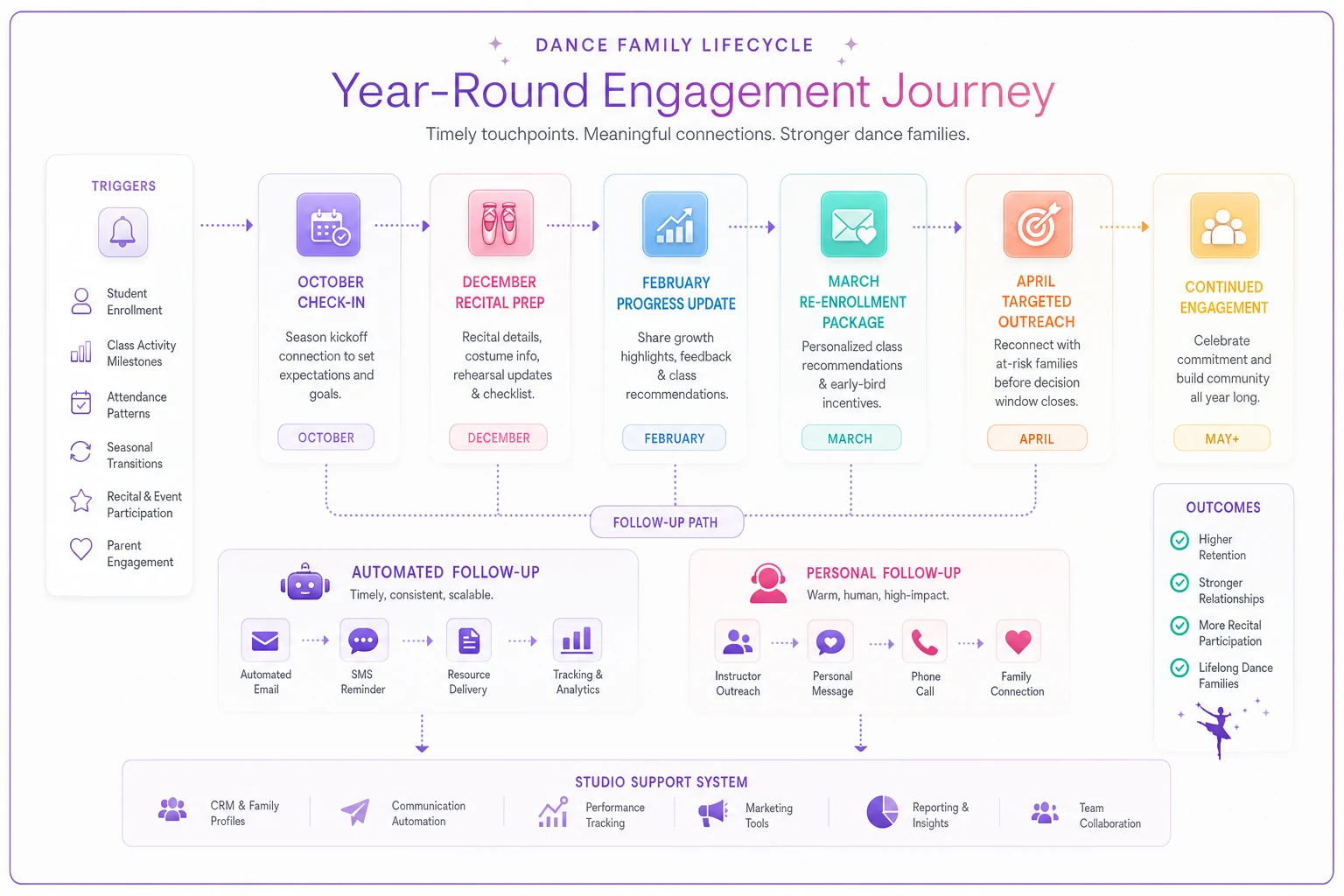
This sequence turns one-off forms into an ongoing relationship-building process.
The re-enrollment window that captures momentum
Most studios open re-enrollment in March because that's what they've always done. But the optimal timing depends on your studio's rhythm and calendar model.
Competition studios should open re-enrollment right after spring competition season when enthusiasm is high. Recreational studios often do better in February, before families start locking in summer plans. Year-round programs need rolling enrollment windows tied to individual student anniversaries.
The point is to match your re-enrollment push to when families are most engaged — not when it's easiest for your admin calendar. Shifting the timeline just two weeks earlier and adding a "team placement meeting" for competitive families can meaningfully move re-enrollment rates. The meeting itself takes 30 minutes per family, but it transforms re-enrollment from a transactional form into an actual conversation about the dancer's future.
Creating different pathways for different family types
Not every family follows the same path through your studio. A competitive dance family needs different touchpoints than a recreational one.
-
Competitive track families need early communication about next year's competition schedule, team fees, and rehearsal commitments. They want to know which conventions you're attending, who's choreographing, and how their dancer will be challenged. Re-enrollment for these families should happen in January, with competition fee deposits structured across several months.
-
Recreational families care more about schedule consistency and who their kid is in class with. Will her friends be in the same session? Is the class time staying the same? Can they skip the recital if they're traveling? These families respond better to simple, low-pressure re-enrollment in March with flexible payment options.
-
Multi-dancer families need bundled pricing and coordinated schedules. Nothing frustrates a parent more than driving to the studio four separate times in a week because their kids' classes are scattered across the schedule. Smart studios build "family blocks" with siblings taking back-to-back classes, then offer meaningful multi-child discounts — something like 15% off the second child, 25% off the third.
-
Transitioning families — those with dancers aging into or out of programs — need specific attention. The family whose daughter is thinking about quitting at 14 needs a completely different conversation than the one whose son just made the competition team.
The family whose daughter is thinking about quitting at 14 needs a completely different conversation than the one whose son just made the competition team.
The technology stack that makes cohort management possible
Running a sophisticated re-enrollment system without the right tools is unnecessarily painful. At minimum, you need:
-
Registration software that tracks family relationships, not just individual students. When a parent logs in, she should see all three kids' schedules, payments, and re-enrollment options in one place.
-
Automated communication based on triggers, not broadcast emails. Different messages for different cohorts, different tracks, different enrollment anniversaries.
-
Payment flexibility including family discounts, payment plans, and early-bird incentives that are actually tracked and enforced.
-
Reporting dashboards showing re-enrollment rates by cohort, by instructor, by class type. If Contemporary 3 has 40% re-enrollment while Contemporary 2 has 85%, you need to know that immediately — not in June when it's too late to do anything about it.
Operational platforms with AI automation built in can handle these workflows without requiring someone to manually track every family. They surface patterns that are easy to miss when you're managing hundreds of relationships — like siblings approaching age eligibility, or families who consistently pay late but always catch up within a few weeks.
Measuring what matters: KPIs across the lifecycle
Tracking overall retention rate as your only metric hides too much. You need to know where things are actually breaking down.
Track retention by cohort year. Year 1 to Year 2 retention should land around 65–70% for recreational programs, closer to 80–85% for competitive. Year 3 to Year 4 should hit at least 85%. If it's lower, you likely have a program quality issue in your intermediate levels, not a marketing problem.
Monitor cross-enrollment rates. By Year 3, at least 30% of families should have multiple children enrolled or have added supplementary programs — camps, workshops, intensives. Lower rates typically mean families don't know what else you offer, which is a communication gap more than anything else.
Calculate lifetime value by entry point. Students who start in preschool dance tend to generate significantly more over their dance journey than students who join at age 10. This shapes where you focus your marketing spend and how you think about trial conversion strategies.
Alumni monetization most studios completely ignore
When dancers graduate high school, most studios do a nice recital send-off and that's the end of it. Maybe they'll visit during college breaks. Maybe they'll bring their own kids someday. But there's usually no real system for maintaining those relationships.
-
Summer teaching assistants Recent grads home from college are nearly perfect summer camp counselors and assistant teachers. They know your culture, want flexible summer work, and younger students look up to them. Pay $15–20/hour while charging $25–30/hour for their presence in camps.
-
Adult classes Alumni-specific adult classes during college breaks — "Home for the Holidays Hip-Hop" or a summer alumni intensive — can generate $500–1,000 per session and keep those relationships alive.
-
Choreography opportunities Experienced alumni can choreograph recital pieces for $300–500 per dance. Parents genuinely love seeing "alumni choreographer" in the program.
-
Marketing assets Alumni success stories, college dance team placements, and professional bookings are legitimately powerful marketing. One professional dancer alumnus is worth more in credibility than most paid advertising.
A simple monthly newsletter costs almost nothing and could be worth tens of thousands in future enrollments over time.
When good families leave anyway
Even with solid systems, some families will leave. The difference is knowing why and when, rather than finding out through absence.
Build exit triggers into your re-enrollment workflow. If a family doesn't re-enroll by their typical date, flag it for personal outreach. If they mentioned scheduling concerns in October, follow up proactively in February before re-enrollment opens — not after they've already made other plans.
Create graceful exit pathways. Sometimes a family needs a break but might come back. Offer "alumni family" status with discounted drop-in rates and priority camp registration. A meaningful percentage of discontinued families return within two years if you stay in light contact. Track exit reasons consistently. "Too expensive" might mean payment plans would've kept them. "Schedule conflicts" might mean you need a morning or Sunday option. "Not progressing" is almost always a communication gap about curriculum expectations, not an actual teaching problem.
The compound effect of systematic re-enrollment
A dance studio re-enrollment system isn't just about maintaining headcount. It's about building a community that generates compound returns over time.
When families stay longer, they spend more per year. They refer more friends. They volunteer. They create the culture that attracts new families. They become the testimonials and success stories that do more selling than any ad you could run.
The studios doing well operationally aren't necessarily teaching better dance. They're running better businesses. They treat each family as a multi-year relationship, not an annual transaction. They use AI-powered operational software to track patterns and automate touchpoints while keeping the personal attention that actually makes families stay.
Most importantly, they think in cohorts and lifecycles rather than individual enrollments. That shift from transactional to relational thinking is what turns re-enrollment from an annual fire drill into a predictable revenue engine.
Your enrollment data from the past few years almost certainly shows clear patterns — when families typically leave, which programs have the highest retention, what tends to trigger successful re-enrollments. The studios that turn those insights into repeatable workflows are the ones building sustainable businesses while everyone else scrambles every spring. The technology exists. The frameworks work. The only real question is whether you keep treating re-enrollment like a seasonal headache, or build something that actually locks in revenue for years to come.
Ready to elevate your studio operations?
Join 500+ studios using Movioly to save time, reduce admin workload, and enhance student experiences.