
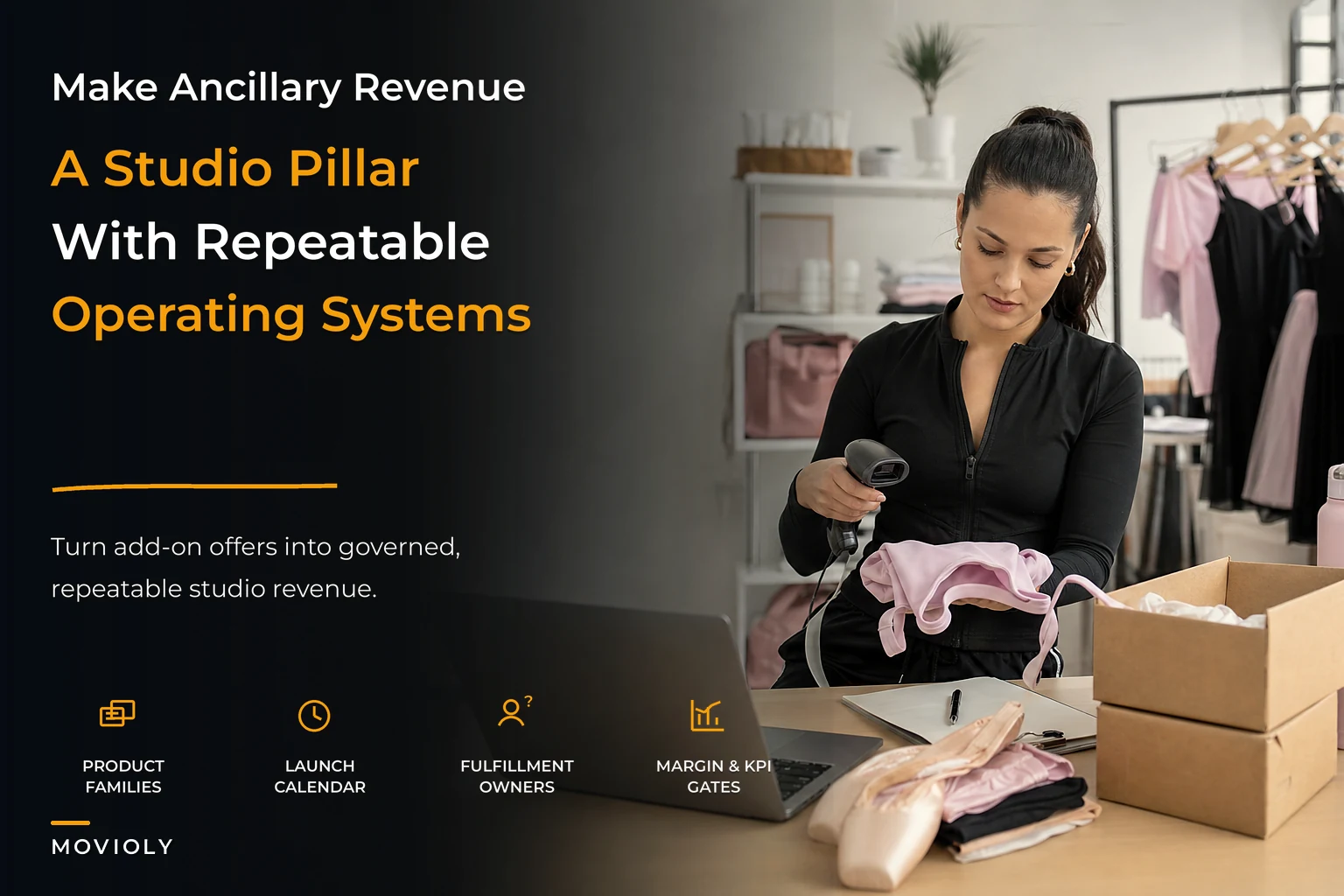

Most studios treat ancillary income like loose change. A rack of leotards near the front desk, a few branded water bottles, maybe a photo package during recital season. It brings in some money, nobody really tracks it, and every year it quietly underperforms while the owner tells themselves they'll "get serious about retail eventually."
The problem isn't that these products don't sell. It's that they're never run as a system. Tuition has structure — enrollment windows, billing cycles, retention playbooks, cohort math. Ancillary revenue usually runs on vibes. Someone orders shoes when they remember to. Prices get set once and never revisited. Half the inventory sits in a closet nobody opened since March.
That gap is why ancillary revenue for dance studios stays stuck at "a little extra" instead of becoming a real pillar. The studios that break through aren't selling harder — they're treating product income with the same operational discipline they apply to classes.
Why Ancillary Revenue Quietly Underperforms at Almost Every Studio
Walk into a studio doing $40k–$60k a month in tuition and ask what their retail margin was last quarter. You'll usually get a blank stare, or a guess that's off by a wide margin. The money moves through the same till as tuition, gets lumped into one deposit, and nobody separates it out.
The pattern underneath that: ancillary income has no owner. Tuition has a billing person. Scheduling has a lead. But product sales float between the front desk, the owner, and whoever happens to be standing there when a parent asks about tights. When something is everyone's side job, it's nobody's governed responsibility — and ungoverned revenue drifts.
-
Pricing rots. Shoes cost you $18 wholesale two years ago and you marked them at $32. Today they cost $24 and you're still selling at $32. Your margin eroded 40% and you never noticed.
-
Inventory lives in people's heads. Nobody knows what's in stock until a parent wants it and it's gone — or until you find a box of unsold recital tees in July.
-
Launches are reactive. You scramble to order spirit wear the week before competition instead of running it as a planned drop with a cutoff date.
-
Fulfillment is chaotic. Orders get taken on sticky notes, families get the wrong size, refunds eat your margin, and the admin time per sale quietly exceeds the profit per sale.
None of these are product problems. They're the absence of a repeatable operating structure around the product.
The Shift: Treat Ancillary Income Like a Revenue Pillar, Not a Hobby
A pillar has five things a hobby doesn't: a defined product catalog, a calendar, margin rules, fulfillment standards, and a dashboard. If any one of those is missing, the whole thing reverts to loose change.
Eliminate scheduling headaches and missed payments.
Movioly streamlines booking, confirming, and managing every class with ease.
- Unified class and instructor scheduling
- Automated student notifications
- Integrated payment tracking
No credit card required
Stop thinking about "products" and start thinking about product families on a seasonality calendar, each with a margin gate and a fulfillment SOP. That sounds heavy for a studio selling leotards, but the structure is what lets you run it on autopilot instead of reinventing it every season.
Build Product Families, Not a Product List
| Product Family | Demand Pattern | Typical Margin | Inventory Risk |
|---|---|---|---|
| Dancewear essentials (shoes, tights, leotards) | Steady, year-round | 45–55% | Low — reorderable, sizes turn over |
| Branded/spirit wear (hoodies, tees, bags) | Spiky around events | 50–60% | Medium — size curves, dated designs |
| Recital & competition add-ons (photo/video, flowers, ad pages) | Sharp seasonal peaks | 60–80% | Low — often pre-sold or drop-ship |
| Convenience retail (water, snacks, accessories) | Steady, low-ticket | 35–45% | Low but perishable |
| Premium/limited drops (special-edition apparel) | Event-driven, FOMO | 55–65% | High if you over-order |
Separating these isn't about tidiness. It's that each family needs different rules. You keep essentials in stock continuously. You run spirit wear as timed drops with a pre-order cutoff so you never eat dead inventory. You pre-sell recital photo packages so cash comes in before you commit a dollar. Lumping them together is exactly why the whole thing feels unmanageable.
The Seasonality Calendar: Where Most of the Money Actually Hides
Studio demand isn't flat, and ancillary demand is even spikier than tuition. The families above peak at completely different times, and if your launches aren't mapped to that rhythm, you're leaving the easiest money on the table.
-
Late summer / back-to-school dancewear essentials surge as new and returning students gear up. Biggest steady-product window of the year.
-
Fall spirit wear and team apparel drops as competition teams form and parents want to show pride.
-
Winter holidays gift-oriented premium drops, gift cards, limited apparel.
-
Spring recital season the single largest ancillary window — photo/video packages, flowers, program ad pages, recital tees. Margins here are high because much of it is pre-sold.
-
Early summer intensive-related gear and camp apparel. If you run summer programming, there's a natural attach here — and it pairs directly with the economics covered in our breakdown on running summer intensives that boost profit.
The insight most owners miss: the calendar should drive the ordering, not the other way around. When you know recital pre-sales open 10 weeks before the show, you order on a schedule, set a cutoff, and never panic-buy. A calendar-driven launch template looks like this:
-
T-minus 10 weeks finalize the product and vendor; lock wholesale cost and confirm your margin gate passes.
-
T-minus 8 weeks open pre-orders with a hard cutoff date.
-
T-minus 6 weeks send reminder to families who haven't ordered; track pre-order count against your break-even quantity.
-
T-minus 4 weeks close pre-orders, place the bulk PO based on actual demand plus a small buffer.
-
T-minus 1 week receive, QC, and sort fulfillment.
-
Event week distribute, reconcile, close out, log final margin.
The fourth time you run a recital drop on this template, it takes a fraction of the effort of the first.
Margin Gates: The Rule That Stops You From Selling at a Loss
Studios add products emotionally — "parents keep asking for it," "the design is so cute" — without ever checking whether the item clears a margin threshold after the hidden costs. And there are always hidden costs: shipping, admin time, payment processing, and the inventory that doesn't sell.
-
Essentials must clear at least 40% net margin after shipping and processing.
-
Apparel/spirit wear must clear 50% and must have a pre-order floor — you don't bulk-buy until X units are committed.
-
Event add-ons must clear 55% and require minimal fulfillment labor per unit.
-
Any item under ~$8 ticket must sell in volume or it's not worth the counter space and admin friction.
The decision rule is blunt on purpose: if it doesn't clear the gate, it doesn't go in the catalog — no exceptions for cuteness. The studios that stay disciplined here are the ones whose retail revenue is actually retail profit, not gross sales that evaporate after costs.
A quick real-number example. A studio wants to sell branded hoodies. Wholesale with printing runs about $22. They want a $45 retail price. Looks like a 51% margin — passes, right? Factor in roughly $2 processing, an estimated $3 in admin and handling per order, and a realistic 15% that don't sell and get marked down or eaten. Real margin lands closer to 38%. Below the 50% gate for apparel. The fix isn't to kill the product — it's to run it as a pre-order only drop so there's zero unsold inventory, which pushes the effective margin back above 50%. That's what a margin gate is for: it changes the decision, not just the spreadsheet.
Fulfillment SOPs: The Part That Silently Eats Your Profit
Margin on paper means nothing if fulfillment is a mess. This is where studios lose money they never see — a parent gets the wrong size, you reorder and ship it at your cost, the original gets returned and sits, and a $13 profit item becomes a net loss plus 25 minutes of front-desk time.
-
- [ ] Order logged in one system — not a notebook, not memory — with size, student name, and payment status
-
- [ ] Payment collected at point of order; no "pay later" on physical goods
-
- [ ] Order confirmation sent to the family automatically
-
- [ ] Stock decremented so the count stays live
-
- [ ] Pick/pack step with a second-glance size check before handoff
-
- [ ] Pickup and distribution logged so you know what's been collected
-
- [ ] Exceptions — wrong size, defect, refund — follow one defined path, not improvisation
-
- [ ] Weekly reconciliation
sales logged vs. payments received vs. inventory remaining
Use your studio management platform's order forms and inventory features to collect payment and log sizes at the point of sale so you avoid manual reconciliation later.
Fulfillment errors scale faster than sales. When you're selling 10 items a month, sticky notes work. At 80–150 items a month across recital season, manual tracking collapses — and the collapse happens right when volume and cash are highest. That's the exact moment studios lose track of who paid and who didn't.
This is where studio management software earns its place, not as a sales pitch but as plain operational relief. When your point-of-sale, inventory count, family billing, and order confirmations live in the same platform your classes already run on, the whole fulfillment chain tightens on its own. Stock decrements automatically, confirmations go out without anyone typing them, and reconciliation becomes a report instead of an evening of detective work. The goal isn't automation for its own sake — it's removing the manual steps where errors and lost revenue creep in.
Inventory and PO Workflow: Order on Data, Not Gut
The inventory side is where cash gets trapped. Over-order and you've got dead stock in a closet. Under-order and you miss sales during a peak that won't come back for a year. The fix is a simple reorder workflow tied to real numbers.
-
Set par levels per essential SKU — the minimum count that should always be on the shelf, based on last year's turnover for that size.
-
Trigger reorders at the par level, not when you visually notice something's low.
-
For seasonal and event items, order against committed pre-orders plus a defined buffer — usually 10–15%, not more.
-
Track vendor lead times so you order early enough. A 3-week lead time makes your T-minus-4-weeks order step non-negotiable.
-
Log landed cost per PO — wholesale plus shipping — so your margin math stays honest as vendor prices shift.
-
Review slow movers quarterly and clear them deliberately with a markdown event rather than letting them rot.
Studios that run inventory on par levels and pre-order data almost never have dead stock, and they almost never miss a sale during peak. The ones running on "I think we're low on size 10s" tend to have both problems at once.
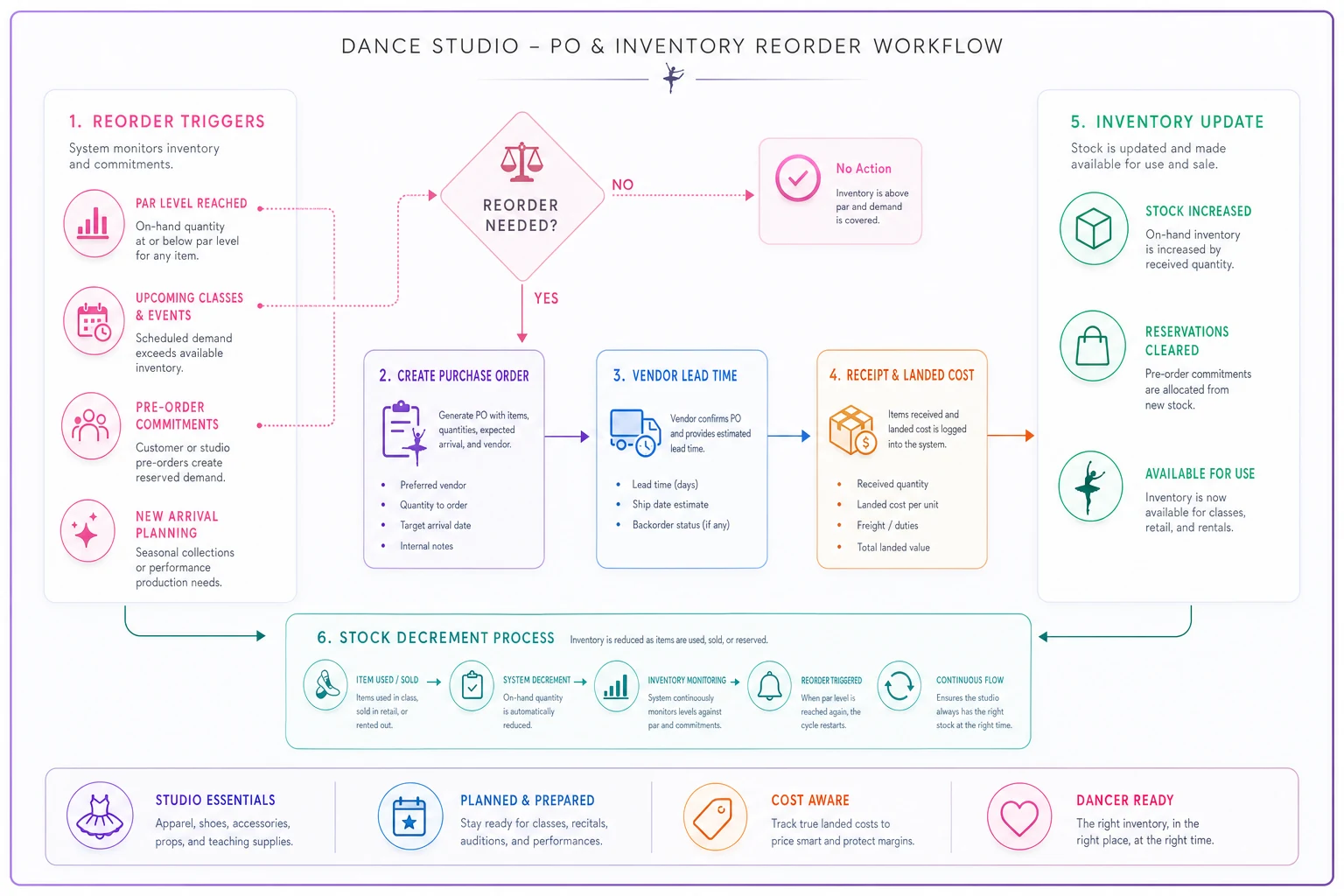
A simple visual of the reorder workflow helps planners see timing risks: par level hits trigger reorders, pre-order commitments adjust bulk PO quantities, and landed cost logging feeds margin checks before purchase.
Staffing Overlays and Launch Cadence
A pillar needs someone accountable. Not necessarily a new hire — but a clearly named product owner who runs the calendar, approves items against the margin gate, and owns the dashboard. During peak windows like recital season, you overlay temporary capacity: an extra front-desk shift during pre-order week, a parent volunteer or two for distribution day.
Launch cadence is the rhythm that keeps this from becoming chaos. Instead of 20 random product moments a year, you run maybe 6–8 planned launches aligned to the seasonality calendar, each on the same template. Predictable cadence is what lets staff get good at fulfillment — they're repeating a known process rather than firefighting a new one each time.
This cadence also plugs into the broader family lifecycle. The families most likely to buy spirit wear, premium drops, and recital add-ons are your most engaged, longest-tenured ones — the same cohorts you're already nurturing for re-enrollment. If you've built out a system for locking revenue into cohorts across the family lifecycle, ancillary launches become a natural extension of that engagement rather than a separate sales effort.
The Dashboard: What You Actually Track
"Total retail sales" is the wrong number to watch. Track these instead:
-
Net margin by product family — gross margin minus fulfillment and dead-stock costs.
-
Attach rate — % of active families who bought anything in a given window. Low attach on a high-engagement cohort means a distribution problem, not a product problem.
-
Pre-order fill rate — committed units vs. break-even quantity before you place the bulk PO.
-
Dead-stock ratio — unsold inventory value as a % of what you ordered. Above ~15% means you're over-ordering.
-
Fulfillment error rate — wrong sizes, returns, reships. This is your silent margin leak.
-
Revenue per launch — so you can kill underperforming launches and double down on the winners.
When studios finally separate ancillary margin from tuition, it's often both smaller and more fixable than they assumed. A studio that thought it was "making decent money on retail" discovers it's clearing maybe 12% net after the hidden costs — and that fixing fulfillment and margin gates alone moves it toward 30%+ without selling a single additional item.
A Real Scenario
A mid-sized studio — around 320 students, roughly $48k/month in tuition — ran retail the way most do. Shoes and tights by the door, recital photo packages each spring, occasional team hoodies. Gross retail was decent, maybe $2k–$3k a month, but nobody could tell you the margin and recital season was pure chaos: sticky-note orders, parents chasing missing packages, a bin of unsold tees every July.
They didn't add products. They added structure. They split everything into four product families, put each launch on a calendar with pre-order cutoffs, applied margin gates (which killed two low-margin items and converted hoodies to pre-order-only), and moved order tracking into the system they already used for classes so stock and payments stayed live.
The change showed up fastest in the stuff that used to leak. Recital pre-sales came in before they placed a single PO, so dead stock basically vanished. Fulfillment errors dropped because every order had a logged size and a payment status. Net ancillary margin roughly doubled over the next two seasons — not from higher sales, but from keeping the profit that used to disappear into refunds, dead inventory, and admin time. Retail stopped being a headache they tolerated and became a line they could actually forecast.
When This Is Worth It — and When It Isn't
This full system makes sense when ancillary already touches a few thousand a month, or when you run recital and competition programming with natural high-margin add-ons. The bigger your event calendar, the more a governed approach pays off.
It's not worth the overhead if you're a tiny studio selling a handful of items a month — you'd spend more time building the system than you'd recover. Start with just two pieces: a margin gate so you never sell at a loss, and a single place to log orders. That alone fixes most of the bleeding.
And it's a bad idea to build this if your core operations are still shaky. If tuition billing, scheduling, or retention aren't running cleanly, fix those first. Ancillary revenue is a pillar, not a foundation — it rewards studios that already have their operational house in order and want a predictable third or fourth revenue stream on top.
The studios that win here aren't the ones with the cutest merch. They're the ones who decided that product income deserved the same calendar, the same rules, and the same accountability as every other part of the business — and then ran it that way, season after season, until it stopped being a surprise and started being a number they could count on.
Ready to elevate your studio operations?
Join 500+ studios using Movioly to save time, reduce admin workload, and enhance student experiences.