

Most studios genuinely want to be welcoming. Ask any owner if they'd turn away a kid who uses a wheelchair, or a dancer with sensory sensitivities, or a family that doesn't read English fluently, and the answer is always no. But wanting to be inclusive and being operationally inclusive are two very different things. The gap shows up in the small stuff — a registration form that assumes two able-bodied parents, a recital venue with a single step at the stage entrance, a class description that lists "must be able to follow verbal cues" without stopping to think about who that quietly excludes.
Inclusion breaks the same way most studio operations break: not through bad intentions, but through defaults nobody ever audited. A dance studio accessibility framework isn't a diversity statement on your homepage. It's a set of checks across your physical space, your teaching, your communications, and your pricing — the four places where "everyone's welcome" either becomes real or quietly falls apart.
This isn't about compliance theater or checking a legal box, though some of it does overlap with liability. There are families in your area right now who'd sign up if the friction weren't there. Finding those friction points before a parent has to spell them out — usually by leaving — is the whole point.
Why inclusion fails as a value but works as an audit
"Be more inclusive" rarely translates into action because it's framed as a mindset instead of a process. Mindsets don't survive a busy Tuesday. When the front desk is slammed and a parent asks whether their autistic son can try a class, the answer depends on whatever the staff member happens to know in that moment — which is usually nothing structured.
What you see across small service businesses is that the values a company lives are the ones baked into its workflows. If your intake form has a field for "any accommodations we should know about," you'll collect that information consistently. If it doesn't, you'll find out about a dancer's needs three weeks in, mid-frustration, when it's already awkward.
So the useful move is to stop treating inclusion as a feeling and start treating it as an audit with four zones:
| Audit Zone | What you're checking | Common failure |
|---|---|---|
| Facilities | Physical access, sensory environment, restrooms, viewing areas | Assuming "no stairs" equals accessible |
| Pedagogy | How instruction is delivered and adapted | One teaching style, verbal-only cues |
| Communications | Forms, signage, tone, language, imagery | Jargon-heavy, assumes one family type |
| Pricing | Financial barriers and flexibility | Rigid packages, no sliding options |
Each zone fails independently. A studio can nail physical access and still lose families because its enrollment emails are written at a tone and reading level that alienates half the neighborhood. The audit forces you to look at all four instead of fixing whichever one you happened to notice.
Zone 1: Facilities — the access you can't teach around
Physical access is where most owners start, and also where they stop too early. "We're on the ground floor, no stairs" gets treated as the finish line. It's barely the beginning.
Eliminate scheduling headaches and missed payments.
Movioly streamlines booking, confirming, and managing every class with ease.
- Unified class and instructor scheduling
- Automated student notifications
- Integrated payment tracking
No credit card required
Walk your space as if you were a parent pushing a stroller with one hand and holding a nervous six-year-old with the other. Then walk it again as if you used a wheelchair. Then again imagining you're sensitive to fluorescent light and loud sound. Each pass reveals different problems.
A common pattern: a studio has a wide front door and a ground-floor studio, so the owner considers it accessible. But the observation window is chest-height for a standing adult — a parent in a wheelchair can't see their kid. The waiting area has no quiet corner, so a sibling with sensory needs melts down every week. The single restroom has a lever handle but a door too narrow for a walker. None of it is malicious. It's just unaudited.
Facilities checklist to run once a quarter:
-
Entrance width, threshold height, and whether doors are openable one-handed
-
A viewing option at seated eye level (window, monitor, or a designated low bench)
-
Restroom door width, grab bars, and turning space
-
At least one lower-stimulation zone — dimmer lighting, away from the speakers
-
Clear floor paths free of bags, cubbies, and equipment clutter
-
Signage that uses symbols plus words, mounted at readable heights
-
A plan for recital and off-site venues, which are often less accessible than your studio
Audit recital and off-site venues with the same checklist as your studio — don't treat them as an afterthought.
That last point matters more than people expect. You can build a perfectly accessible studio and then hold your big recital in a rented theater with a stage only reachable by steps. The families you spent all year including get excluded on the one day that matters most to them. Audit your venues with the same rigor as your own building.
Zone 2: Pedagogy — adapting instruction without lowering the bar
This is the zone owners are most nervous about, usually because they conflate "adaptation" with "watering down." They're not the same thing. Adapting instruction means giving more dancers a real path into the material — not making the material meaningless.
The single most common pedagogical failure is verbal-only instruction. A teacher calls combinations, dancers follow. It works fine for kids who process spoken language quickly, and quietly loses everyone who doesn't: dancers with auditory processing differences, hearing impairments, or who simply learn better by watching or doing.
The fix isn't complicated, it's just deliberate. Layer your cues:
-
Say it — the verbal instruction
-
Show it — demonstrate slowly, then at tempo
-
Mark it — let dancers walk through it small before full-out
-
Feel it, when appropriate — hands-on guidance with consent, or props like a barre or wall for orientation
Good teachers already do some of this instinctively. The point of a framework is that it happens by design for every class, not just when a particularly perceptive instructor happens to be teaching.
Adaptations worth having ready:
-
Modified choreography — same phrase, seated or lower-impact variation, so a dancer performs alongside peers rather than sitting out
-
Predictable structure — same class opening and closing routine helps dancers who need to know what's coming
-
Sensory options — permission to wear ear protection, dim a section of lights, or take a break without it being treated as a discipline issue
-
Buddy or peer support — pairing dancers thoughtfully, without singling anyone out
One thing worth naming: adaptations designed for one group usually help everyone. Predictable class structure calms an anxious neurotypical seven-year-old just as much as it helps an autistic dancer. Visual demonstration helps the kid who was distracted, not just the one with a processing difference. You're not building a separate track. You're building a better default.
Zone 3: Communications — the barrier nobody sees
Communications is the quietest failure zone because the families you're losing here never walk through the door to tell you. They read your website, feel like it isn't for them, and move on. You never register them as a lost lead.
Start with your intake and registration flow. A form that asks for "Mother's name" and "Father's name" instead of "Parent/Guardian" tells single parents, same-sex parents, and grandparents raising grandkids that your studio has a particular family picture in mind. A registration process that requires a smartphone and email assumes a level of tech access not every household has. Small edits, outsized signaling.
Then look at your language. Class descriptions loaded with dance jargon — "prior center work required," "must execute clean pirouettes" — read as gatekeeping to a newcomer even when you don't mean them that way. Say what a class actually involves in plain terms, and note explicitly when adaptations are available. A single line like "We adapt classes for a range of abilities — reach out and we'll figure it out together" converts hesitant parents who'd otherwise never ask.
A few high-leverage fixes:
-
Replace gendered or assumed family fields with neutral ones on every form
-
Add an accommodations field to intake so needs surface before week one, not during it
-
Offer at least one non-digital enrollment path (phone or in-person)
-
If your area has a significant second language, translate your core pages and forms
-
Show a range of bodies, ages, and abilities in your photos — parents look for someone who resembles their kid
That accommodations field only works if the information actually reaches the instructor before the first class. If the front desk knows and the teacher doesn't, it's useless. Keeping student notes, medical flags, and accommodation details in one shared place — rather than scattered across email threads and sticky notes — is the difference between "we knew and prepared" and "we found out the hard way." It's the same coordination logic behind solid safety and incident-reporting SOPs: information only protects people if it reaches the right person in time.
Zone 4: Pricing — access that isn't just physical
You can have a perfectly accessible building, adaptive teaching, and inclusive communications, and still exclude a large portion of your community with rigid pricing. Cost is an accessibility issue.
Most studios price for one kind of family: two incomes, predictable budget, able to pay a full season upfront or in tidy monthly chunks. That leaves out families dealing with irregular income, single-parent households, and families where a child's disability already carries significant extra costs — therapies, equipment, medical expenses. Dance starts to feel like a luxury they have to skip.
Options that work in real studios:
-
Sliding-scale or need-based spots — a handful of reduced-rate places per session, quietly available on request
-
Flexible payment cadence — weekly or bi-weekly instead of one large monthly payment
-
A small scholarship fund — even two or three partial spots a season signals real intent
-
Sibling and multi-class relief — helps larger and lower-income families alike
-
Adaptive or inclusive class pricing that isn't a premium — never charge more for the class a disabled dancer needs
Consider a mid-sized studio running roughly 300 enrollments. Setting aside even four need-based spots per session — say a reduction of $40–$60 a month each — costs somewhere around $2k–$3k over a year. Modest. And those families talk. A parent whose kid finally found a studio that worked for them becomes a durable referral source, because inclusion is exactly the kind of thing families tell each other about. The math often comes out ahead, but even when it's break-even, it's the right call.
When this actually makes sense
A full accessibility overhaul makes sense when you've got the operational stability to sustain it — consistent enrollment, staff who'll stick around long enough to be trained, and a physical space you're not about to leave. It also makes sense when your community clearly has unmet demand: nearby schools with special-ed programs, few or no adaptive dance options in the area, a student body that doesn't reflect the neighborhood around it.
When to slow down
If your studio is mid-crisis — cash flow underwater, staff turning over constantly, systems in chaos — bolting on adaptive programming will likely fail both you and the families you bring in. The cruelest version of inclusion is inviting families in and then quietly dropping them because you weren't ready. Stabilize first. A half-built accessibility effort that collapses does more reputational damage than never having started.
Who should be cautious
Solo instructors or very small operations shouldn't try to become everything to everyone at once. Pick one or two adaptations you can genuinely deliver well — a sensory-friendly class time, or a strong need-based pricing option — and do those consistently. Depth beats breadth. A studio known for doing one thing excellently is worth more than one advertising ten it can't back up.
A real scenario: what changes when you audit
A suburban studio — around 250 students, three instructors plus the owner — kept getting the same question at open houses: "Do you have anything for kids with special needs?" The honest answer was no, and they were watching those families drive 20 minutes to a competitor that did.
They ran the four-zone audit over about six weeks. Facilities were mostly fine, but the recital venue wasn't, so they switched to an accessible theater. Pedagogically, they trained all instructors on layered cueing and built a small library of modified choreography. Communications got the biggest overhaul — neutral family fields, an accommodations question at intake, plainer class descriptions, and photos that actually showed a range of dancers. On pricing, they carved out three need-based spots per session and moved a chunk of families to bi-weekly payments.
Within two sessions they'd enrolled about a dozen students they almost certainly would have lost — several from a single referral chain among special-ed parents who all knew each other. Added revenue roughly offset the reduced-rate spots, and retention on those families ran noticeably higher than average. When a studio actually fits, families don't leave.
The owner's takeaway was blunt: those families had been there the whole time. The studio just hadn't been reachable.
Making it stick: from audit to operating rhythm
The mistake studios make after a first audit is treating it as a project with an end date. Inclusion decays. New staff arrive who weren't trained on layered cueing. A new registration form quietly reintroduces gendered fields. A cheaper recital venue turns out to have that one step again. Without a rhythm, you drift back to old defaults within a year.
Build it into your calendar the way you'd build in any recurring operational review:
-
Quarterly re-walk facilities, re-check the venue for upcoming performances
-
Each hiring cycle train new instructors on adaptations and cueing before they teach solo
-
Each registration open review forms and class descriptions for language creep
-
Each season confirm need-based spots are filled and actually being used
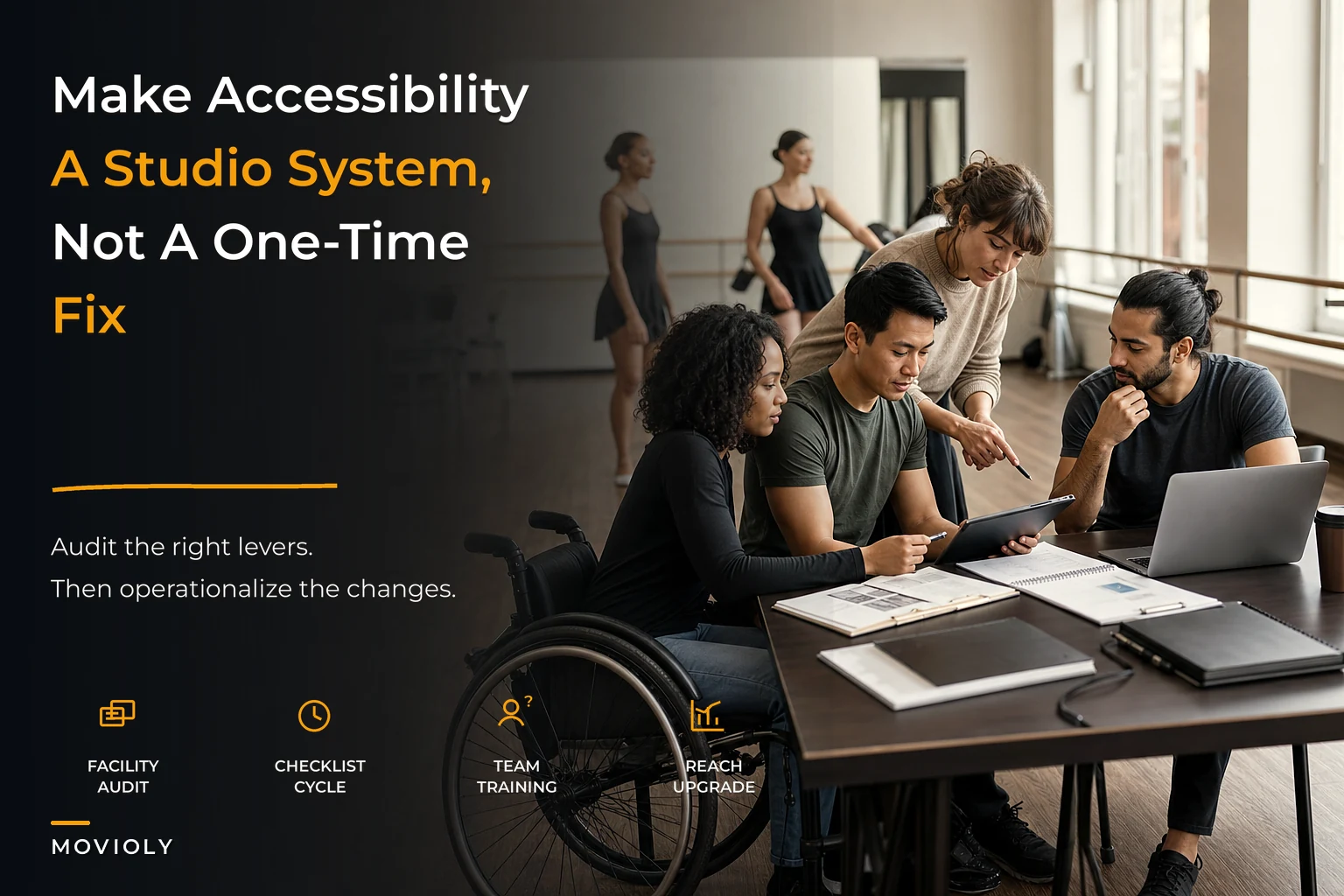
A simple visual can help teams remember who owns each check and when it happens.
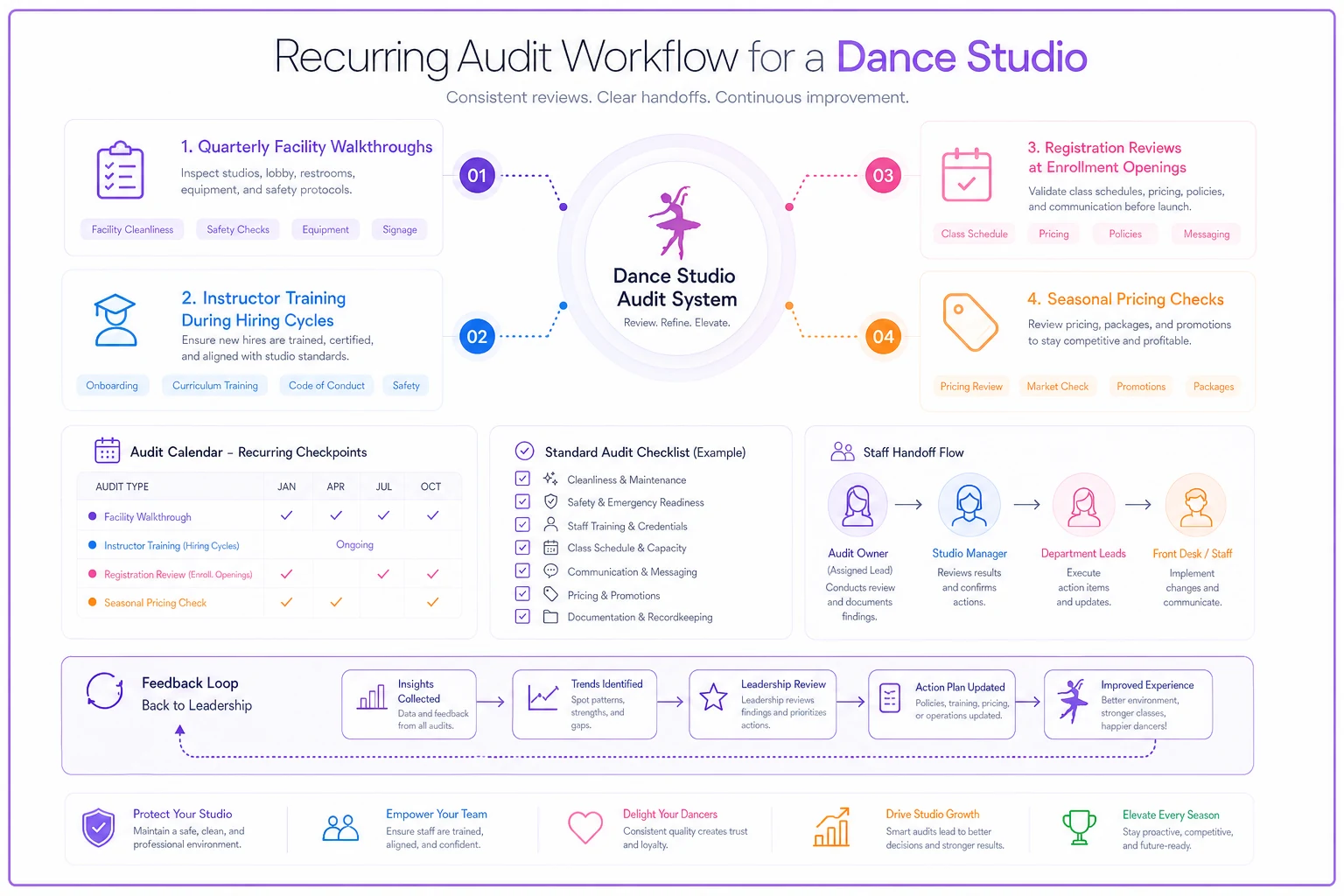
Keeping accommodation notes, family details, and consent information organized in one place — rather than in a folder someone forgot to update — is what lets this survive staff turnover. It ties into the same discipline behind solid record-keeping and media-consent and retention practices: the information is only useful if it's findable and current when someone new needs it.
Inclusion done as an audit — four zones, checked on a rhythm — stops being a vague aspiration and becomes something your studio actually does, consistently, whether or not the most thoughtful person in the building happens to be on shift that day. That's the whole point of turning a value into a system: it keeps working when you're not watching it.
Inclusion done as an audit — four zones, checked on a rhythm — stops being a vague aspiration and becomes something your studio actually does, consistently, whether or not the most thoughtful person in the building happens to be on shift that day. That's the whole point of turning a value into a system: it keeps working when you're not watching it.
Ready to elevate your studio operations?
Join 500+ studios using Movioly to save time, reduce admin workload, and enhance student experiences.