
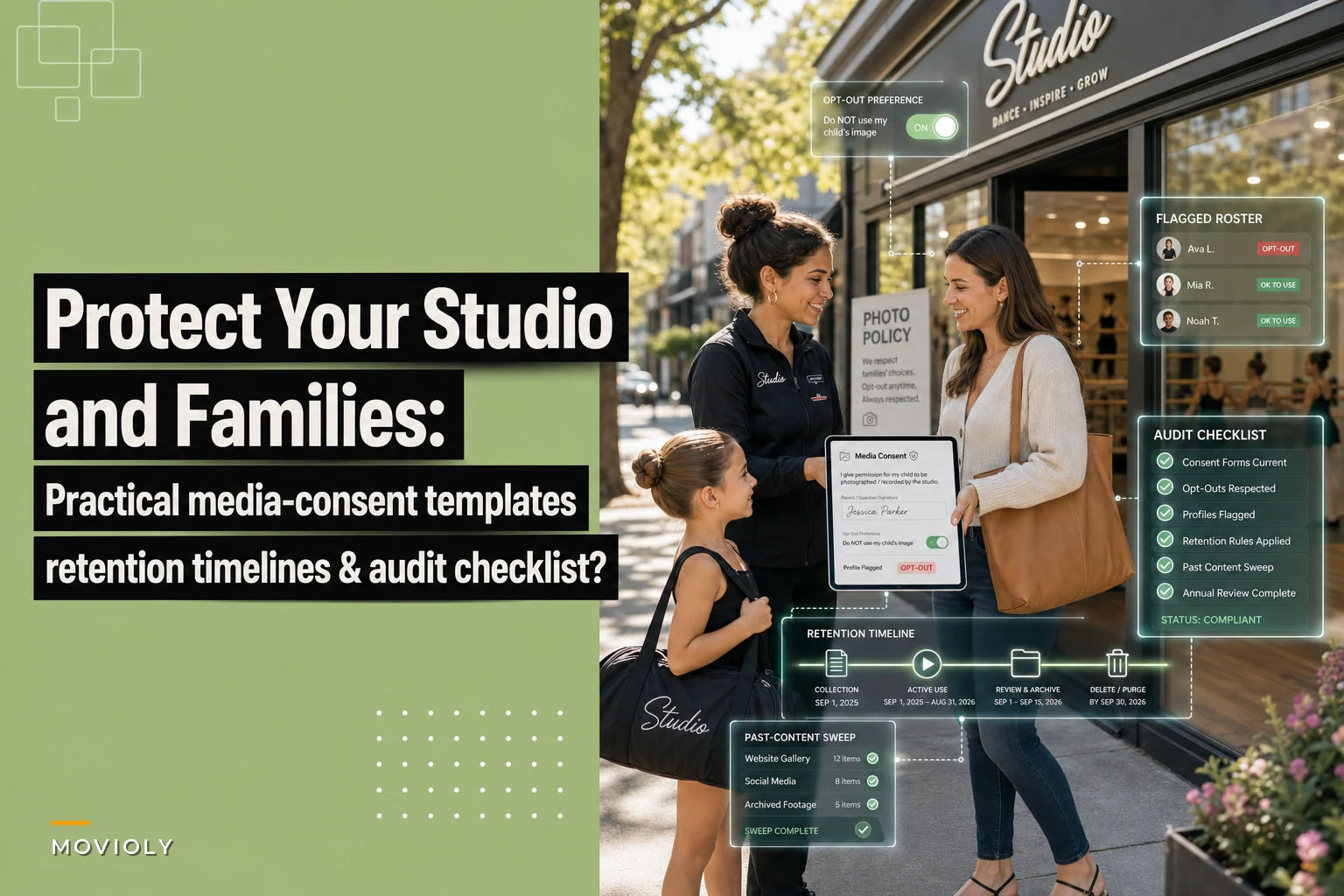

Most studios don't have a media problem until they suddenly do. A parent sees their kid's face on your Instagram reel, they're mid-divorce, and one parent never wanted that photo public. Or a former student turns 18, asks you to delete every image of them, and you realize you have no idea how many folders, phones, and old recital drives those photos actually live on.
None of this requires a lawsuit to hurt you. It just requires one upset family, one screenshot, and a policy that doesn't exist on paper.
This post walks through the actual documents and schedules that keep this boring — the way it should be. A workable dance studio media consent policy, a retention schedule so you're not hoarding student data forever, a parent opt-out flow that doesn't create chaos, and an annual audit checklist you can run in an afternoon. This is legal hygiene, not legal advice. Talk to an attorney for anything specific to your state.
Why studios get burned here (and it's rarely the big stuff)
The dramatic cases — a stalker, a custody dispute — are real but rare. What actually trips studios up is much more mundane:
-
Consent was collected once, on paper, three years ago, and nobody knows where that stack of forms ended up.
-
The "yes" checkbox was buried in a registration form, so parents don't remember agreeing to anything.
-
A part-time instructor posted a class video to their personal account, and now a child appears somewhere the studio doesn't control.
-
A parent said "no photos" verbally at drop-off, but that never got recorded anywhere the front desk could see.
The pattern underneath all of these is the same: consent gets treated as a one-time signature instead of an ongoing operational state. A kid's media status — "okay to post" vs "internal use only" vs "no images at all" — should be live data attached to their profile, not a form sitting in a filing cabinet.
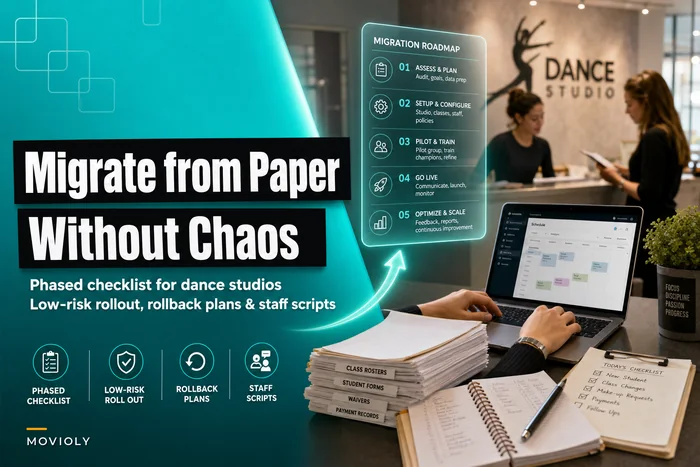
Studios still running this on paper feel the pain hardest, because there's no way to quickly search "which families opted out?" If you're still in that world, the phased approach in migrating from paper without chaos is worth reading first. Media consent is exactly the kind of thing that should live in a searchable system.
The three consent levels you actually need
Most studios use a single yes/no for photos. That's too blunt. A lot of parents are fine with a photo in a private class-parents group but not on public social media. If your only options are all-or-nothing, those families pick "no," and you lose content you could have had.
Eliminate scheduling headaches and missed payments.
Movioly streamlines booking, confirming, and managing every class with ease.
- Unified class and instructor scheduling
- Automated student notifications
- Integrated payment tracking
No credit card required
| Consent Level | What it allows | Typical use |
|---|---|---|
| Level 1 – Internal only | Photos/video used inside the studio (progress reviews, private parent group, printed recital program) | Cautious families, custody-sensitive situations |
| Level 2 – Marketing, no name | Public social posts, website, ads — but no child's name or identifying info attached | The default most families are comfortable with |
| Level 3 – Full permission | Public use including first name, testimonials, featured student spotlights | Families who are enthusiastic and want the recognition |
| Level 0 – No media | No images captured or stored where avoidable; excluded from group photos when possible | Hard opt-out; must be flagged everywhere staff can see |
The thing most owners miss: offering Level 2 as the middle option dramatically increases how much usable content you get. When parents aren't forced to choose between "expose my kid fully" and "nothing," most land comfortably in the middle. You end up with more content, not less — and the families who chose it feel respected because you asked precisely.
A media consent template you can adapt
Keep it short. Long consent forms get skimmed, and a skimmed consent is a weak one.
Media Consent — [Studio Name] > I understand [Studio Name] may photograph or video students during classes, rehearsals, performances, and events. > > Please select ONE for [Student Name]: > > ☐ Full permission — including first name, for social media, website, and marketing. > ☐ Marketing, no name — photos/video may be used publicly, but do not attach my child's name. > ☐ Internal only — for studio use (progress, parent group, recital program) but not public marketing. > ☐ No media — please do not photograph or record my child where avoidable. > > I understand I can change this choice at any time by emailing [contact], and the change will apply going forward. Content already published before my request may take time to remove, and some printed materials cannot be recalled. > > Signature / Date / Parent name / Student name(s)
That last paragraph matters more than people think. The "going forward" and "printed materials cannot be recalled" language sets honest expectations. Studios get in trouble when a parent assumes opting out means every past photo disappears immediately. Say upfront that it doesn't.
One more thing: collect consent per student, not per family. Siblings often have different comfort levels, especially once teens are involved.
Retention schedules: stop keeping everything forever
This is the part almost nobody does, and it's the part that quietly grows into a liability. Every recital video, every registration form with a home address, every medical note about a kid's allergy — if you keep it forever, you're holding sensitive data with no reason and no plan.
-
Media (photos/video) Keep marketing-approved content 2–3 years, then review and purge. Delete "internal only" footage after the season it was needed unless there's a specific reason to keep it.
-
Registration & contact info Keep while enrolled plus about a year after they leave, for re-enrollment outreach. Then archive or delete.
-
Payment records Keep per your accountant's guidance — usually several years for tax purposes. This is the one category where longer is often correct.
-
Medical / allergy / injury notes Keep only while enrolled, then delete promptly. This is the most sensitive data you hold, and there's rarely a good reason to hang on to it.
-
Incident reports Longer retention makes sense here — check with an attorney, but these often need to survive well past when a child leaves.
The thing to internalize: most data should have an expiration date, but financial and incident records usually need to live longer. Owners tend to do the opposite — they keep casual photos forever and lose the incident reports that actually matter.
One studio with around 180 families had eight years of registration forms in Google Drive, including old medical notes for students who'd graduated and moved on. No malice, just nobody ever deleted anything. A one-hour cleanup got them down to current-plus-recent, which is a genuinely better position if anything ever goes sideways.
The parent opt-out flow that doesn't create chaos
Collecting consent is the easy half. The hard half is what happens when a parent changes their mind mid-year, because that's where studios fumble. A parent emails "please stop posting photos of my daughter," it goes to whoever happens to see it, and three weeks later an instructor posts a class reel with the daughter front and center. Now you've broken a promise you actually intended to keep.
-
One intake point. All opt-out requests go to a single, known channel — one email address or a form. Not the DMs, not verbal at pickup, not a text to an instructor's personal phone.
-
Update the student's profile immediately. Change their media level the same day. The status has to change everywhere staff will look.
-
Flag it where content gets made. Whoever posts to social needs to see the "no media" flag before they post. If class rosters show a small marker next to opted-out students, that's most of the problem solved.
-
Acknowledge to the parent. A short reply
"Done — updated going forward. Past posts may take a little time to pull down." Closing the loop prevents the follow-up angry email.
-
Do a quick past-content sweep. Search recent posts for that child and remove what you reasonably can. You don't have to be perfect; you have to be responsive and reasonable.
The single biggest failure point is step 3. Consent lives in one place, but content gets made by whoever has a phone at the front desk. If the person posting can't easily see who's opted out, every other step is just decoration.
This is where having student records in a searchable system pays off — you can filter for opted-out students in seconds, and roster views can carry the flag automatically. Some studio management platforms let you attach a media-status field to each student profile so it shows up on class lists, which turns "did anyone opt out?" from a memory test into a glance. When you're building out your intake and onboarding flow for new families, building consent capture into that first week is the cleanest time to do it.
Add a visible marker on class rosters so instructors don't have to remember opt-outs.
Visualizing the flow can make it easier to train staff.
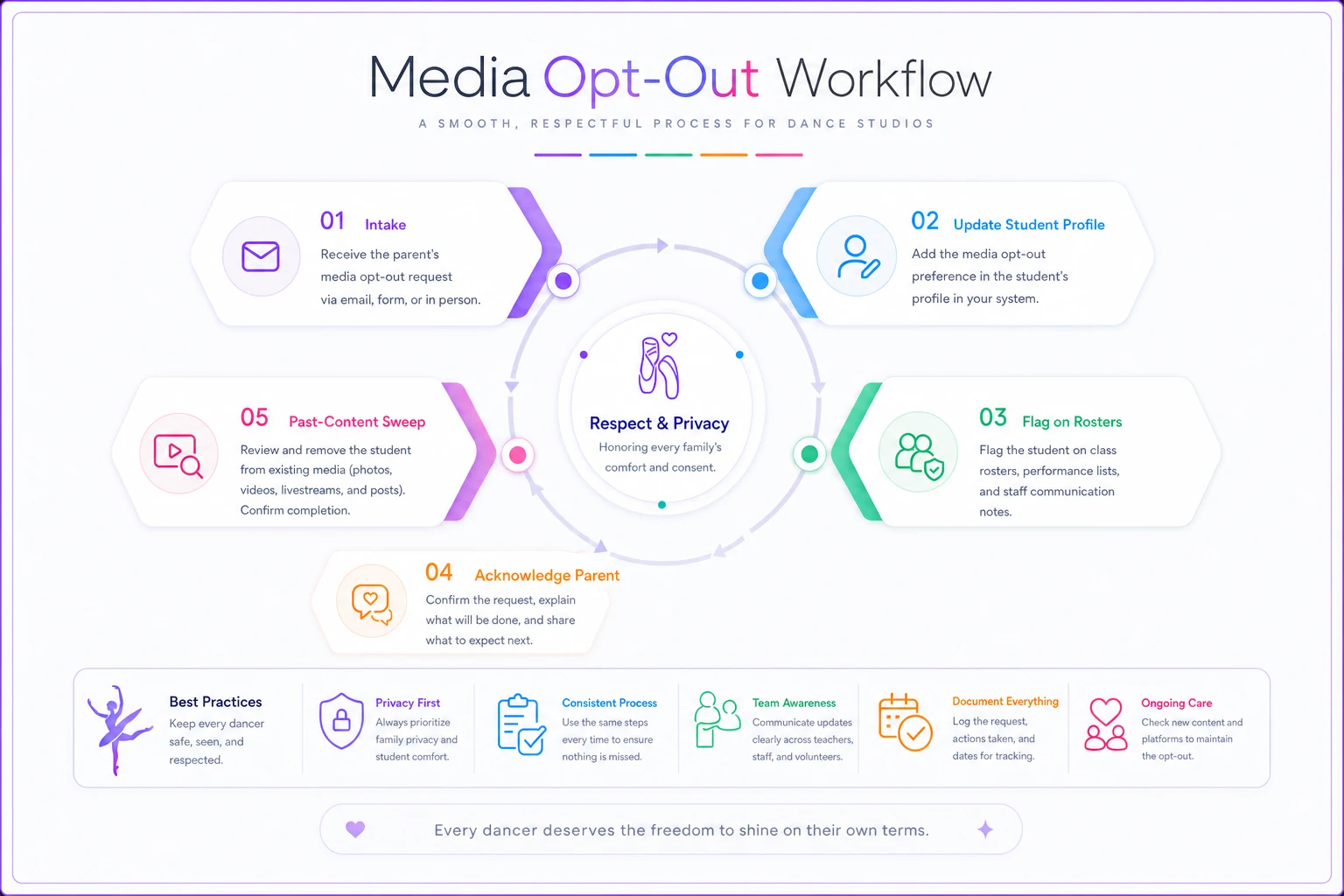
This diagram maps the operational steps that keep a mid-year request from slipping through the cracks.
When strict rules are overkill (and when they're not)
Not every studio needs the full apparatus, and pretending otherwise just gets you a policy nobody follows.
When lighter is fine: A small studio with under roughly 50 students, one or two people posting content, and a stable low-drama parent base can run this simply — a per-student consent choice at registration and one email address for changes. You don't need tiered legal language if everyone knows everyone.
When you need the full version: Once you're past roughly 100 families, have multiple instructors posting to various accounts, or serve a community with custody-sensitive or privacy-sensitive families, the loose approach breaks. Multiple people making content is the real trigger — the moment more than one phone is capturing kids, informal consent stops being trackable.
Who should not treat this casually: Any studio that films for competitions, sells recital DVDs or streams, or runs paid ads featuring students. The moment media becomes a product or an ad, "we didn't really have a policy" is a genuinely bad place to be.
The annual audit checklist
Run this once a year — end of season is natural, when things slow down. It takes an afternoon, and it's probably the most useful hour of legal hygiene you'll do all year.
-
[ ] Every current student has a recorded consent level. No blanks. Chase down anyone missing.
-
[ ] Opt-outs from the past year all made it into the system. Cross-check your opt-out email/inbox against student profiles.
-
[ ] Instructor accounts audited. List every account (studio and personal) where staff post student content. Confirm no child appears on an account the studio doesn't control or approve.
-
[ ] Old media purged per your retention schedule. Delete internal-only footage past its window; review marketing content older than 2–3 years.
-
[ ] Medical/sensitive notes for departed students deleted. This is the one people forget.
-
[ ] Registration data for students gone 12+ months archived or removed.
-
[ ] Consent form language reviewed. Still accurate? Still matches what you actually do with media?
-
[ ] Front-desk/staff know the opt-out flow. A 5-minute refresh so a mid-year request doesn't get lost.
-
[ ] Storage locations mapped. Where do photos actually live — Drive, phones, old hard drives, the recital vendor? You can't purge what you can't find.
That last item is the sleeper. Most consent failures aren't policy failures — they're location failures. Content is scattered across personal phones, a photographer's account, an old laptop, and three cloud folders. Knowing where everything lives is half of being able to honor a deletion request.
A quick real scenario
A studio running around 130 students had the typical setup: a photo checkbox buried in registration, photos stored across two instructors' phones and a shared Drive, no retention rule, and opt-outs handled by whoever caught the email. Nothing had blown up — yet.
They spent one afternoon doing the audit above. What they found: roughly 20 families with blank consent on file, two opt-out requests from the spring that never made it into the system (both kids were still being posted), and years of old medical notes for graduated students sitting in Drive with no reason to be there.
Fixing it wasn't dramatic. They added a three-tier consent choice to registration, moved media status onto each student's profile so it showed on class rosters, set a single opt-out email, and wrote a one-page retention schedule. The whole thing took a few hours spread across two weeks.
The outcome wasn't a headline — it was the absence of one. Instructors could see at a glance who not to post. The two missed opt-outs got corrected and those parents got a straight answer. The studio stopped sitting on sensitive data it had no reason to keep. Boring, which is exactly the goal.
The point
A dance studio media consent policy isn't paperwork for its own sake — it's the difference between honoring a promise to a family and accidentally breaking it. The studios that handle this well don't have fancier documents. They treat media status as live data attached to each student, keep one clean channel for changes, delete what they don't need, and check everything once a year.
Do the audit. Write the retention schedule. Give parents real choices instead of all-or-nothing. It's an afternoon of work that quietly protects both your studio and the families who trust you with their kids — and for anything specific to your situation or state, run it by an actual attorney.
Do the audit. Write the retention schedule. Give parents real choices instead of all-or-nothing. It's an afternoon of work that quietly protects both your studio and the families who trust you with their kids — and for anything specific to your situation or state, run it by an actual attorney.
Ready to elevate your studio operations?
Join 500+ studios using Movioly to save time, reduce admin workload, and enhance student experiences.