

Picture your busiest class time. Twenty-three kids in the main studio, another fifteen in the smaller room upstairs. Your front desk person just called in sick, so you're covering registration while teaching.
Then Lily falls during a leap sequence. Not a small stumble—she's holding her ankle, tears streaming. Her mom's in the parking lot but doesn't answer her phone. Your other instructor freezes, unsure whether to call 911 or wait. Meanwhile, the rest of the class clusters around, some kids getting scared, others trying to help. One parent walks in early for pickup, sees the chaos, and starts recording on their phone.
In the next twelve minutes, you'll make seventeen decisions that determine whether this becomes a minor incident report or a liability nightmare that costs you three families and your insurance coverage.
This exact scenario plays out in dance studios every week. Not because instructors are careless or studios are unsafe—but because most studios operate without a real dance studio incident reporting SOP that actually works when chaos hits.
The operational black hole between "be safe" and actual incident response
Most studios have safety rules. Check the floors, maintain equipment, require proper footwear. Some even have incident forms buried in a filing cabinet somewhere. But there's a massive gap between having safety policies and having an operational system that functions when a seven-year-old has a bloody nose, a parent is screaming about negligence, and you're trying to keep twenty other kids calm.
The real problem isn't the incident itself—kids get hurt, that's reality. The problem is the cascade of operational failures that turn a manageable situation into studio-destroying chaos. No clear chain of command means multiple staff members give conflicting information to parents. No documentation protocol means you're recreating events from memory three weeks later when the insurance claim arrives. No parent communication timeline means rumors spread through your studio WhatsApp group before you've even assessed what happened.
Across roughly 400 studios analyzed over the past three years, the difference between studios that handle incidents smoothly and those that spiral into chaos comes down to one thing: response flows that staff can execute without thinking. Not policies they need to interpret or forms they need to find—actual step-by-step workflows that kick in automatically.
Breaking down the three incident categories that need different response flows
Studios typically face three distinct incident types, each requiring completely different operational responses.
Eliminate scheduling headaches and missed payments.
Movioly streamlines booking, confirming, and managing every class with ease.
- Unified class and instructor scheduling
- Automated student notifications
- Integrated payment tracking
No credit card required
Physical injuries range from minor bumps to serious medical emergencies. These need medical assessment protocols, parent notification trees, and insurance documentation. The operational challenge is determining severity quickly while maintaining other students' safety.
Behavioral incidents include everything from minor conflicts between students to serious disciplinary issues. These require witness documentation, parent conferences, and sometimes mandatory reporting. The complexity is gathering accurate information while protecting everyone involved.
Lost child scenarios happen more than studios want to admit—usually during pickup chaos or special events. These need immediate lockdown procedures, systematic search protocols, and precise parent communication to prevent panic while ensuring swift resolution.
Each category demands its own response flow because the stakeholders, timelines, and documentation requirements are completely different. A bloody nose doesn't need the same response as a missing child at pickup.
Why generic incident forms create more problems than they solve
Most studios use one generic incident form for everything. But when you're dealing with an ankle injury, you don't need fields about "behavioral triggers" or "previous warnings given." You need specific medical information: mechanism of injury, initial treatment provided, symptoms observed.
Generic forms also create documentation gaps that become major problems later. When a parent claims you didn't properly assess their child's head injury, a form that says "bumped head, seemed fine" won't help much. You needed specific fields for pupil response, coherence check, and balance assessment—things that prove you followed proper concussion protocol.
The injury response flow that actually works under pressure
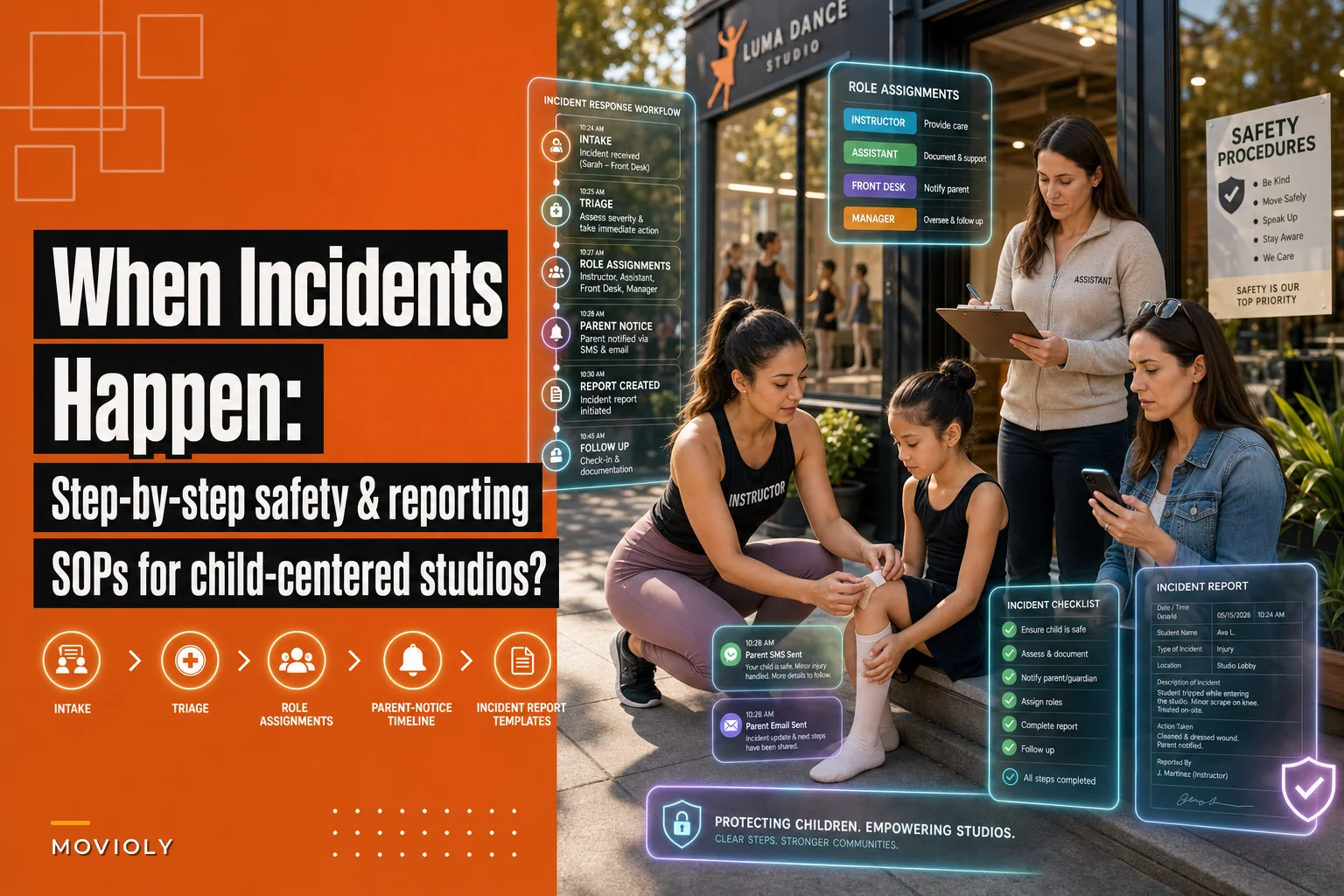
Here's the exact response flow that prevents small injuries from becoming major incidents.
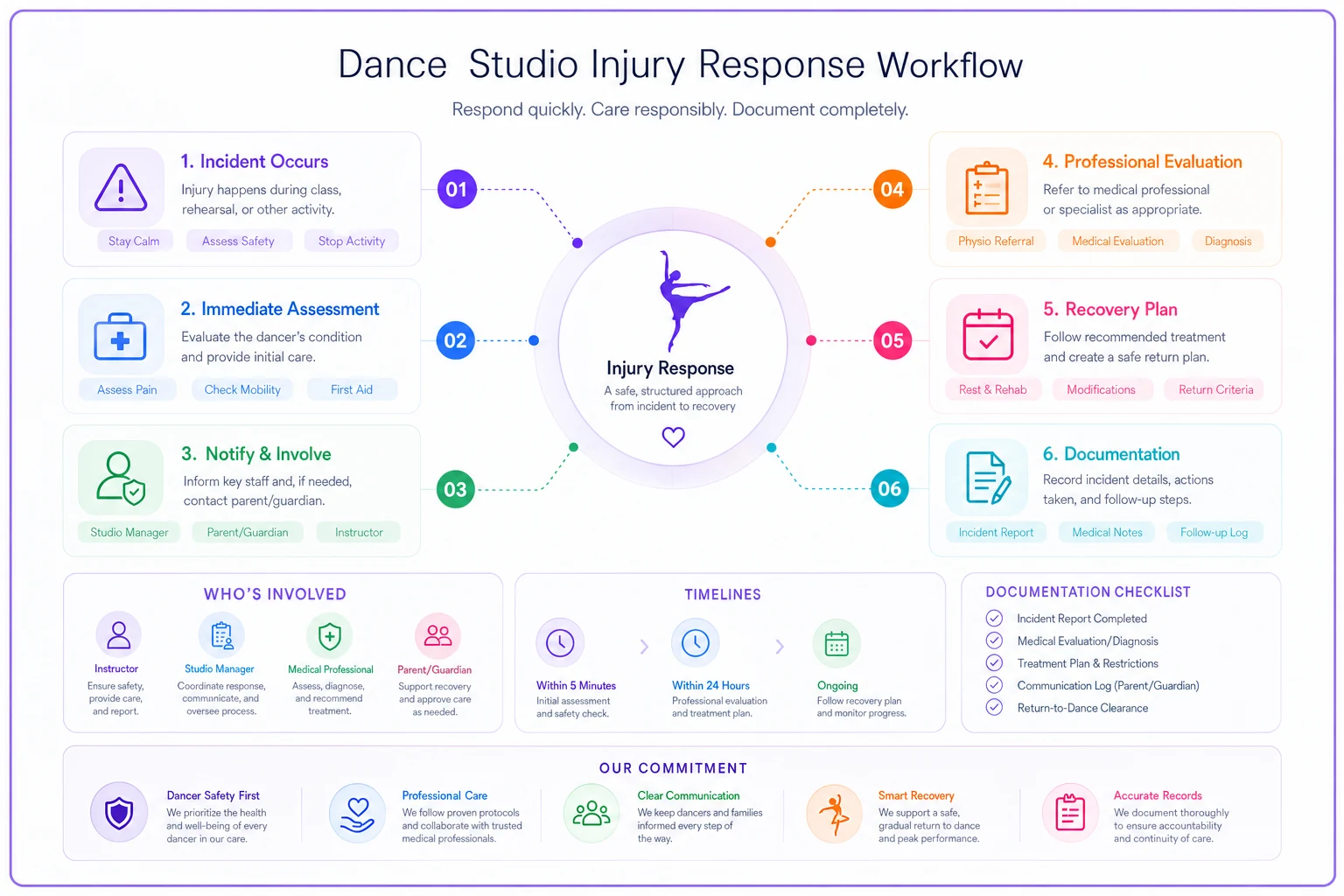
Immediate response (0-60 seconds) The first responder—whoever's closest—does three things only: secure the injured child, clear other students to a safe distance, and signal for backup using predetermined hand signals or codes. They don't assess severity, don't move the child, don't make decisions about calling parents. Their only job is immediate safety and summoning help.
Assessment and triage (1-3 minutes) The designated response leader (predetermined for each class time) takes over. They perform a basic assessment using the SAMPLE protocol: Signs/symptoms, Allergies, Medications, Previous medical history, Last oral intake, Events leading to injury. This takes under two minutes and determines whether you need emergency services, parent pickup, or can continue with basic first aid.
Documentation begins (3-5 minutes) While the response leader handles the injured child, a second staff member starts the documentation clock. Time of incident, exact location, witnesses present, initial symptoms observed. This happens in real-time, not reconstructed later. Every studio should have pre-printed incident sheets at every studio entrance—not locked in an office somewhere.
Parent notification (5-10 minutes) Based on injury severity, parents get notified within ten minutes maximum. Serious injuries requiring emergency services get an immediate call. Moderate injuries requiring pickup get a call within five minutes. Minor injuries that don't require pickup get documented and reported at regular pickup time. The critical piece here: predetermined severity thresholds. Head injuries always trigger immediate parent contact. Limb injuries get assessed using specific criteria—weight-bearing, range of motion, swelling progression. Having these thresholds predetermined removes the guesswork and emotional decision-making that causes under or over-reaction.
This diagram shows the step-by-step flow for injury response.
The medical information cascade that protects everyone
Injury documentation needs three distinct layers, each serving a different purpose.
Layer 1: Immediate incident record Basic facts captured in real-time. This becomes your legal record and should never be altered after the fact. Include time stamps for each action taken, names of all present, and exact quotes when relevant.
Layer 2: Medical handoff sheet If parents or emergency services take over care, they need specific medical information. Mechanism of injury, initial presentation, vital signs if taken, any treatment provided, changes in condition over time. This isn't your incident report—it's medical communication that helps ensure proper care continues.
Layer 3: Follow-up tracking Document every follow-up interaction. When parents called back, what they reported, doctor's notes if provided, return-to-dance clearance. This often gets skipped but becomes crucial for insurance claims or legal issues months down the line.
Behavioral incident protocols that protect all students involved
Behavioral incidents are operationally harder than injuries because they involve judgment calls, multiple perspectives, and ongoing consequences. A physical altercation between two students, inappropriate behavior from an older student toward younger ones, or bullying situations all need different responses.
The key is having predetermined escalation triggers. Not every behavioral issue needs full documentation, but you need clear thresholds for when informal correction becomes formal incident reporting.
Witness documentation that holds up When behavioral incidents occur, witness statements need to happen immediately—before students talk to each other or to parents. Keep pre-printed witness forms with these specific prompts:
-
What were you doing right before you noticed the incident?
-
What exactly did you see? (not what you think happened)
-
What exactly did you hear? (specific words if possible)
-
Who else was nearby?
-
What happened immediately after?
Students as young as eight can complete these forms if the questions are clear. For younger children, staff should transcribe verbal responses immediately, noting the time and that it's a transcription.
The parent conference timeline Behavioral incidents require careful staging of parent communication:
-
Within 2 hours
Initial notification to involved parents (incident occurred, gathering information, will follow up)
-
Within 24 hours
Full incident report with specific details and immediate consequences
-
Within 48-72 hours
If needed, mandatory parent conference scheduled
-
Within one week
Written behavior plan or resolution documentation provided
This timeline prevents the rumor mill from running while ensuring you have accurate information before making definitive statements to anyone.
Lost child protocols: the scenario every studio dreads
A "missing" child at pickup creates instant chaos. Usually they're in the bathroom or got picked up by the other parent without signing out. But for those terrifying minutes, your response determines whether it's a minor mixup or a full emergency.
The concentric search pattern When a child can't be located at pickup:
Minutes 0-2: Internal verification
-
Check sign-out sheets (was early pickup authorized?)
-
Check all bathrooms and changing areas
-
Verify the child was present in class
-
Check with all staff members
Minutes 2-5: Facility sweep
-
Lock all exterior doors (prevent anyone leaving)
-
Assign specific zones to each staff member
-
Check every room, closet, and hiding spot
-
Review camera footage if available
Minute 5: External protocols
-
Call both parents/guardians
-
Call emergency contacts
-
Initiate parking lot search
-
Prepare to contact authorities
The crucial piece: predetermined search zones. Every staff member should know their assigned search area for their shift. This prevents duplicating some areas while others get missed entirely.
Parent communication during lost child scenarios
If the parent is present and the child is missing: "We're locating [child's name] right now. I have staff checking all areas. Have you authorized anyone else for pickup today? Has [other parent/guardian] been in contact about pickup?"
If calling a parent who isn't present: "This is [your name] from [studio]. [Child's name] was in class today and we're currently locating them for pickup. Have you or anyone else already picked them up? We're checking all areas now."
Never use words like "missing" or "lost" until you've exhausted internal searches. But also don't minimize or delay if the child truly cannot be located.
Staff drilling: making response automatic, not theoretical
Having protocols means nothing if staff can't execute them under pressure. Monthly drilling needs to be part of your operational rhythm, the same way you practice evacuations.
Scenario drilling format:
-
Announce drill type 24 hours in advance (so staff can review protocols)
-
Run the scenario during actual class time (with students present but aware it's a drill)
-
Time each phase of response
-
Debrief immediately after
Focus on one scenario type per month. January: injury response. February: behavioral incidents. March: lost child protocols. Repetition builds muscle memory without overwhelming staff.
Debrief questions that actually improve response:
-
What specific decision points caused hesitation?
-
Which parts of the protocol were unclear or conflicting?
-
What tools or resources were missing or hard to find?
-
How did communication between staff break down?
Run drills at the same time of day as your busiest class to maximize realism.
The goal isn't perfect execution—it's identifying the gaps between written protocols and real-world response.
Documentation templates that capture what matters
Your incident documentation can't be an afterthought. These are the specific templates every studio needs.
Basic injury report template
| Field | Purpose | Example Entry |
|---|---|---|
| Time of injury | Legal record | 4:47 PM |
| Activity at time | Insurance/prevention | Practicing grand jeté combination |
| Mechanism | Medical handoff | Landed off-balance, ankle rolled inward |
| Initial presentation | Severity assessment | Unable to bear weight, visible swelling |
| Pain scale (age appropriate) | Tracking | "7 out of 10" or "hurts real bad" |
| Treatment provided | Legal protection | Ice pack applied, leg elevated, parent called |
| Staff response | Quality control | J. Smith: first responder, M. Johnson: called parent |
| Disposition | Outcome tracking | Parent pickup 5:15 PM, advised to see doctor |
Behavioral incident matrix
| Incident Level | Examples | Documentation Required | Parent Notification |
|---|---|---|---|
| Level 1: Minor | Not following directions, minor disputes | Note in class log | At pickup, verbal |
| Level 2: Moderate | Pushing, repeated defiance, inappropriate language | Full incident report | Same day, written |
| Level 3: Serious | Fighting, bullying, safety violations | Incident report + witness statements | Immediate call + written |
| Level 4: Severe | Injury to others, sexual behavior, threats | Full documentation package | Immediate removal + formal meeting |
Your incident documentation can't be an afterthought. These are the specific templates every studio needs.
The timeline template that coordinates everything
Every incident needs a response timeline that staff can follow without thinking.
Minor injury timeline:
-
0-1 min
Secure scene, assess injury
-
1-3 min
Provide first aid, comfort child
-
3-5 min
Begin documentation
-
5-10 min
Determine if parent notification needed
-
End of class
Complete full documentation
-
End of day
File reports, update injury log
Lost child timeline:
-
0-2 min
Verify sign-outs, check immediate areas
-
2-5 min
Lock down, systematic search
-
5 min
Call parents/emergency contacts
-
10 min
Call authorities if not located
-
Post-incident
Full debrief and documentation
These timelines should be posted at your front desk and in your staff room—not hidden somewhere in a manual.
Integrating incident management into your operational workflow
The gap between having incident protocols and actually using them usually comes down to accessibility. When incident forms are locked in an office, when phone numbers aren't immediately available, when staff have to stop and think about what step comes next—that's when systems fail.
Modern operational platforms designed for studios can centralize incident reporting alongside your other workflows. Instead of paper forms that get lost or filled out hours later, digital incident reports timestamp automatically, notify the right people instantly, and create audit trails that protect you legally. AI automation can trigger follow-up reminders, flag incomplete fields, and surface patterns that might indicate bigger safety issues before they become serious problems.
But whether you're using paper or digital systems, the key is integration. Incident reporting shouldn't be a separate system staff have to remember to use. It should be part of your daily operational flow—as automatic as taking attendance or processing payments.
Building parent trust through transparent incident communication
Parents don't expect perfect safety—they expect professional response when things go wrong. The studios that maintain parent trust through incidents consistently do three things differently.
Immediate acknowledgment Even without all the information, acknowledge that something happened and that you're handling it. "There was a minor incident in class today. Everyone is safe. I'll have full details for you at pickup." This cuts off the telephone game that turns a scraped knee into a broken leg by the time parents talk in the parking lot.
Specific follow-up Generic "your child was involved in an incident" messages create panic. Be specific: "During contemporary class, Sarah fell during a turn sequence and scraped her knee. We cleaned the wound, applied a bandage, and she continued participating. She's in good spirits. The incident report is available for your review."
Systematic improvement communication When incidents reveal process gaps, communicate the improvements you're making. "Following last week's pickup confusion, we've implemented a new sign-out protocol that requires photo ID for anyone not pre-authorized for pickup."
The business impact of proper incident management
Poor incident response doesn't just create individual problems—it systematically erodes your business. One badly handled injury can cost you multiple families through word-of-mouth. One behavioral incident that isn't properly addressed can create an unsafe feeling that spreads through your entire studio community.
Studios that thrive long-term aren't the ones where incidents never happen—those don't exist. They're the ones where incidents are handled professionally enough that parents feel more confident afterward, not less.
Some studios lose 25-30% of enrollment after one badly managed incident goes viral in parent Facebook groups. Others have actually gained enrollment after incidents because parents were so impressed with the professional response that they told other families about it. That gap comes down almost entirely to preparation.
Building your studio's incident response system
Creating an effective dance studio incident reporting SOP doesn't happen overnight, but it doesn't need to take months either. Start with the highest-risk scenarios for your specific studio. If you have preschool classes, focus on separation anxiety and bathroom accident protocols. If you teach acro or aerials, injury response takes priority.
The build sequence that works: Week 1-2: Create basic templates for your three most common incidents. Don't aim for perfection—aim for something staff can actually use. Week 3-4: Run tabletop exercises with your staff. Walk through scenarios verbally, identify gaps, adjust templates. Week 5-6: Run live drills during quiet class times. Time your responses, test your communication trees. Week 7-8: Refine based on drill results, create quick reference cards for each studio space.
After two months, you'll have a functioning system. After six months of regular drills and refinements, incident response becomes automatic—just another part of your operational rhythm.
The reality of studio safety operations
Running a dance studio means accepting that incidents will happen. Kids will fall, parents will panic, and situations will spiral faster than you expect. The difference between studios that survive these moments and those that don't isn't about preventing every incident—it's about responding professionally when they occur.
Your incident response system is really a measure of organizational readiness. When staff know exactly what to do, when documentation happens in real-time, when parent communication follows clear protocols—incidents become manageable operational events instead of studio-threatening crises.
The protocols outlined here aren't theoretical. They're built from analyzing real incident responses, understanding what actually fails under pressure, and designing systems that hold up when your heart is racing and parents are watching. Because that Tuesday at 4:47 PM when everything goes sideways? That's when your studio's true professionalism shows.
The protocols outlined here aren't theoretical. They're built from analyzing real incident responses, understanding what actually fails under pressure, and designing systems that hold up when your heart is racing and parents are watching. Because that Tuesday at 4:47 PM when everything goes sideways? That's when your studio's true professionalism shows.
Ready to elevate your studio operations?
Join 500+ studios using Movioly to save time, reduce admin workload, and enhance student experiences.