

Most dance studios lose families not because kids stop loving dance, but because parents stop seeing progress. You watch a parent's face during pickup — that blank expression when their child runs out excited about class but can't really explain what they learned. The parent smiles, nods, then three months later mentions they're "taking a break" to try soccer.
The disconnect happens in translation. Your instructors see technique improving week by week. They notice when a student finally nails a tricky transition or holds their relevé longer. Parents see a monthly charge and wonder if Tuesday ballet is worth rushing through dinner every week.
The perception gap that kills retention
A parent enrolls their 7-year-old in beginning ballet. First month, enthusiasm is high. By month three, they're quietly asking other parents in the lobby, "Can you actually tell if they're getting better?" By month five, without any visible markers of progress, that family becomes vulnerable to any scheduling conflict, financial pressure, or competing activity that comes along.
It gets worse when you factor in multiple levels. Your intermediate jazz class has 12 students ranging from barely-intermediate to almost-advanced. Your instructor adapts brilliantly in the moment — challenging stronger dancers, supporting newer ones. But without documentation, parents on both ends of that spectrum are worried. One thinks their kid is bored. The other thinks their kid is drowning.
Studios running 15 or more classes weekly often only discover this problem through exit surveys. "We just couldn't see the progress" shows up in some form on close to 40% of departure feedback, even when the students themselves were developing exactly on schedule. The gap wasn't teaching quality — it was progress visibility.
Why generic progress reports fail studios
Standard report cards borrowed from academic settings don't work well in dance. Letter grades for "technique" and "participation" tell parents nothing meaningful. What does a B+ in ballet mean for a 9-year-old? How does "satisfactory" footwork translate to readiness for the next level?
Eliminate scheduling headaches and missed payments.
Movioly streamlines booking, confirming, and managing every class with ease.
- Unified class and instructor scheduling
- Automated student notifications
- Integrated payment tracking
No credit card required
It gets more complicated with mixed-age classes. Your teen contemporary group might include a 13-year-old prodigy alongside 17-year-olds with less technical skill but more emotional expression. A single rubric can't capture both journeys honestly. Parents end up with reports that feel either inflated to avoid hurt feelings or blunt without context.
Even studios using detailed skill checklists hit operational walls. When instructors teach 8 classes across 3 locations, expecting them to complete 20-point evaluations for every student monthly means adding 6-8 hours of unpaid admin work. Reports either don't get done, get rushed through mechanically, or slowly burn out your teaching staff.
Building level-specific rubrics that actually communicate progress
Start with short, specific rubrics for each level that focus on observable skills parents can actually understand. Not "demonstrates proper turnout" but "keeps toes pointed outward during pliés." Not "shows musicality" but "claps or moves on the beat consistently."
Beginning Ballet (Ages 5-7) Progress Indicators:
-
Stands in first position without reminders
-
Remembers arm positions for port de bras
-
Balances on one foot for 3+ seconds
-
Follows 3-step combinations
-
Waits turn at the barre patiently
Intermediate Jazz (Ages 10-13) Progress Markers:
-
Executes clean single pirouettes
-
Maintains energy through entire combination
-
Picks up 8-count phrases within 3 attempts
-
Adds personal style to movements
-
Supports other dancers during group work
These aren't comprehensive skill inventories. They're communication tools — highlighting 5-6 concrete things parents can recognize and celebrate. When a mom sees "picks up 8-count phrases within 3 attempts," she finally understands why her daughter keeps running combinations in the living room.
The rubrics work because they're short enough for instructors to complete quickly but specific enough to show real development. An instructor managing 15 students can mentally track these 5-6 indicators during class, then spend 10 minutes after documenting what they saw.
Monthly micro-templates that take 5 minutes per student
The traditional dance studio progress report tries to be comprehensive — and that's exactly why it never gets done consistently. Instead, design monthly micro-updates that capture what matters without burying instructors in paperwork.
Here's a template structure that works across styles and levels:
[Student Name] - [Class] - [Month] Progress Note
This month's focus: [Single technique or skill area]
What I observed: [2-3 specific observations in plain language]
Growth moment: [One specific breakthrough or improvement]
Working on: [One specific area for next month]
Home support: [One optional activity parent could encourage]
Real example for intermediate tap:
This month's focus: Rhythm clarity in wing combinations
What I observed: Sarah's wings are getting cleaner — she's hitting all four sounds distinctly now instead of shuffling through them. Her timing on paradiddles improved a lot. Still rushing through the buffalo steps when she gets tired.
Growth moment: Nailed the entire shim sham shimmy without watching others!
Working on: Maintaining tempo when combinations get complex
Home support: If she practices at home, encourage counting out loud — it really helps with the rushing
Keep micro-reports conversational to make them easy for parents to read and for instructors to write.
These micro-reports take 3-5 minutes per student once the template becomes routine. For a class of 12, that's about an hour monthly — manageable even for busy instructors. The key is keeping them conversational and specific rather than formal and exhaustive.
The following shows the basic workflow for creating and sending these micro-reports.
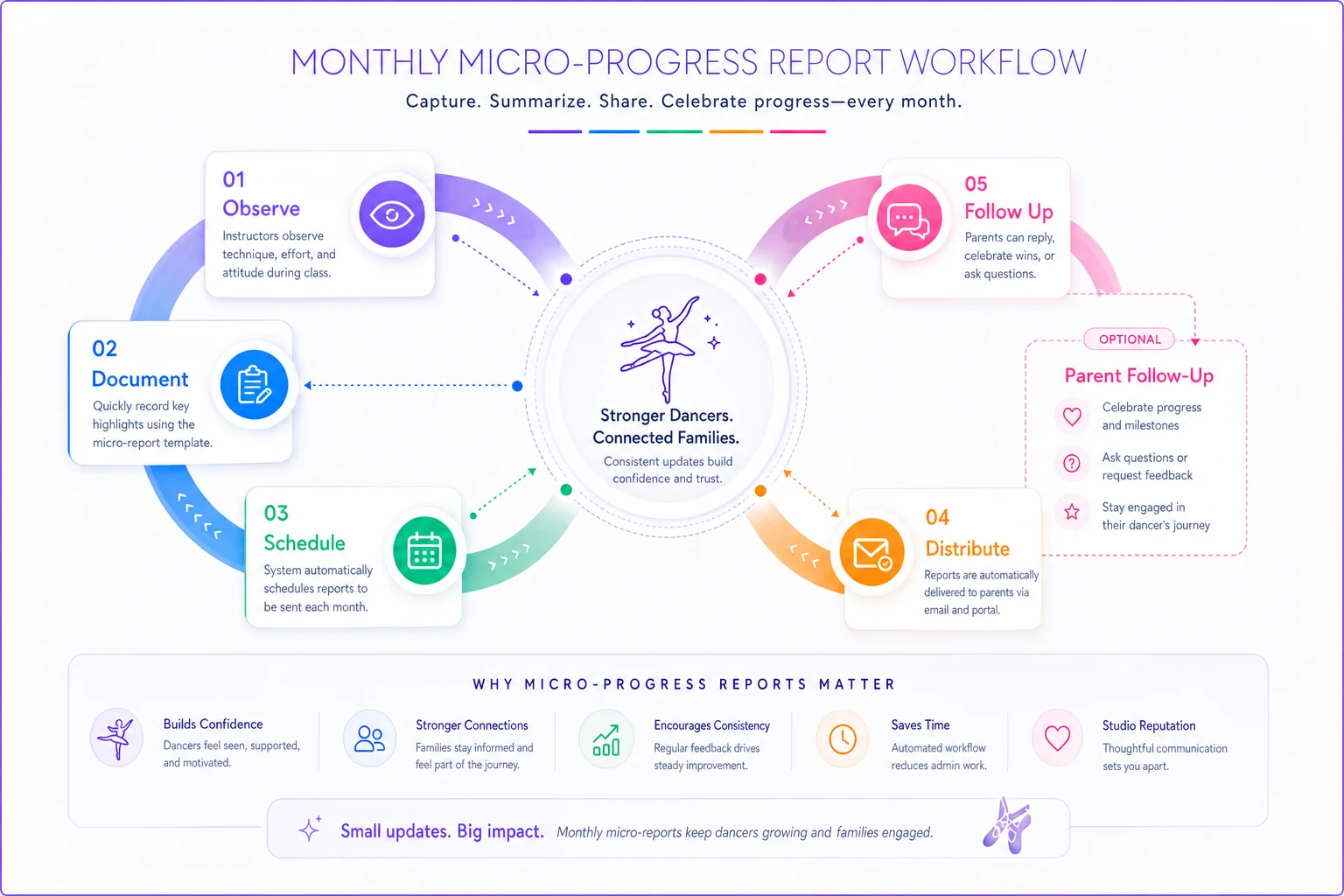
The workflow above keeps the human observation at the center while automating the routine steps that slow instructors down.
Creating curriculum visibility without overwhelming parents
Parents need to see the bigger picture without drowning in technical details. The most effective approach layers information: a simple visual overview for quick reference, with more detailed skills available for whoever wants to dig deeper.
Start with a single-page curriculum map per level showing the journey across the full year:
Level 2 Ballet Year Overview
| Period | Focus Items |
|---|---|
| September-October | Foundation Review - Solidifying basic positions - Building barre strength - Introduction to relevé |
| November-December | Rotation & Extension - Developing turnout control - Beginning attitude work - Chainé turns across floor |
| January-February | Elevation & Landing - Safe jumping technique - Simple allegro combinations - Glissade preparation |
| March-April | Performance Preparation - Recital choreography - Stage presence development - Formation awareness |
| May-June | Technique Refinement - Cleaning all elements for recital - Building stamina - Level 3 preparation |
This fits on one page, uses parent-friendly language, and shows clear progression. Parents can see that November's struggles with turnout connect to March's jumping work. They understand why certain skills need to develop before others.
For parents who want more detail, offer an expandable digital version with specific skills under each phase. But don't force this on everyone — roughly 70% of parents just want the overview, while the remaining 30% will happily dive into the full skill progressions.
Automation opportunities that preserve the personal touch
The challenge with consistent progress communication isn't writing quality — it's operational bandwidth. This is where some strategic automation genuinely helps without making everything feel cold.
Set up your system to automatically remind instructors when reports are due, pre-populate student names and classes, and format everything consistently. But keep the actual observations human-written. Parents can sense the difference between a genuine observation and a generated one.
Here's what to automate:
-
Report scheduling and reminders
-
Student roster population
-
Previous month's focus areas (for continuity)
-
Distribution to parents
-
Follow-up reminders for missing reports
Here's what to keep manual:
-
Specific skill observations
-
Individual growth moments
-
Personalized comments
-
Home activity suggestions
Studios using AI-powered operational software have reported cutting report preparation time by around 60% while keeping the personal feel intact. The platform handles scheduling, formatting, and distribution while instructors focus on the actual observations. One studio director mentioned her instructors went from dreading monthly reports to completing them consistently — mostly because the administrative friction just disappeared.
The compound effect on retention and referrals
Studios implementing structured progress communication typically see retention improvements within 3-4 months. Not dramatic overnight changes, but steady increases in re-enrollment rates and fewer families quietly disappearing mid-season.
One studio running 18 weekly classes saw season-to-season retention climb from roughly 68% to 82% after rolling out monthly micro-reports and curriculum maps. What was more surprising: their referral rate increased too. Parents who genuinely understand their child's progress become active advocates — they can actually explain why the studio is worth it beyond "my kid likes it."
The financial math compounds quickly. If you're running 200 active students at $120 monthly, improving retention from 70% to 82% means holding onto around 24 additional students. That's close to $2,880 monthly, or almost $35,000 annually — from closing a communication gap, not adding a single class.
Warning signs you're overdoing documentation
Some studios swing too hard in the other direction, creating documentation burden without real value. Watch for these:
-
Instructors consistently submitting reports late
-
Parents mentioning they feel "overwhelmed" by communications
-
Reports becoming increasingly generic over time
-
More time spent on documentation than instruction
-
Parents stopping to open reports altogether (track open rates)
The sweet spot sits between "parents feel informed" and "instructors feel supported." If either group starts showing strain, simplify rather than push through.
Some parents genuinely don't want detailed updates — they trust the process and just want their child happy. Don't force engagement on families who are satisfied with minimal communication. Offer the information to those who want it without making others feel guilty for not reading every report.
Timing your rollout for maximum adoption
Best case: Start of fall session when parents expect new systems
Good alternative: January for calendar-year studios
Avoid: March-May when recital preparation takes over everyone's attention
Start with one age group or style to work out the kinks. If you teach ballet, jazz, tap, and contemporary, pick one to pilot. Gather parent feedback, adjust the templates based on real responses, then expand. Most studios find that starting with younger dancers (ages 5-9) works best since those parents typically want the most feedback. Teen programs can often wait — those students increasingly advocate for themselves anyway.
Making progress reports sustainable long-term
The biggest failure point isn't the launch — it's month four, when enthusiasm drops and other priorities crowd in. Build sustainability from the start.
For instructors:
-
Pay for report completion time or build it into class rates
-
Provide quiet time immediately after classes to write notes while observations are fresh
-
Give them templates to customize, not blank pages to fill
-
Acknowledge instructors who submit consistently
For administrators:
-
Block calendar time monthly for report coordination
-
Set up automated reminders and workflows
-
Track completion rates to spot problems early
-
Check in with parents quarterly, not constantly
For parents:
-
Set expectations upfront about frequency and detail level
-
Offer multiple ways to access reports
-
Connect reports to real studio milestones like level placement decisions
-
Celebrate student progress publicly when families give permission
One studio director found that scheduling "report writing parties" — where instructors completed reports together with snacks and music — completely changed the dynamic. They'd knock out everything in two hours while sharing student breakthrough stories. Same work, totally different energy.
Beyond reports: building progress into daily operations
The studios that do this well don't treat progress communication as an add-on task. They weave it into how the whole operation runs. During your trial conversion process, set expectations about progress tracking from day one. Parents who understand your communication rhythm from the start value it more than those who receive it as a surprise midway through the year.
A few places to integrate it naturally:
-
Include progress discussions in parent conference schedules
-
Reference curriculum maps during enrollment conversations
-
Display level progressions visibly in your lobby
-
Share anonymized progress celebrations on social media
-
Build progress check-ins into regular instructor meetings
When progress tracking becomes part of studio culture rather than an administrative chore, it stops feeling like extra work. Instructors naturally observe and document growth because they know parents will ask specific questions. Parents engage more at pickup because they know what to look for.
The real impact on studio culture
Beyond the retention numbers, structured progress communication shifts the culture in ways that are harder to measure but easy to feel. Instructors become more intentional about skill development when they know they'll be documenting it monthly. They catch struggling students earlier because they're actively watching for progress markers.
Parents transform from passive customers to active partners. Instead of "how was class?" they ask "did you practice your chainé turns?" They understand when their child needs encouragement versus when they're ready for a harder challenge. Lobby conversations shift from logistics to genuine celebration.
Students benefit most. When the adults around them talk specifically about their progress, they start to internalize a growth mindset. They understand that struggling with pirouettes in November connects to nailing them in February. Development stops feeling like something you either have or don't.
A studio owner recently shared that one of her 11-year-old students brought her progress report to school for show-and-tell and walked her class through every skill she'd mastered. That kind of pride only shows up when progress is actually visible to the people who matter.
Moving forward with your progress system
Start small and start soon. Pick your most enthusiastic instructor and your youngest class. Build a simple rubric with 5-6 observable skills. Create a micro-template that takes 5 minutes per student. Send it to parents without a big announcement — just "trying something new to help you see your dancer's growth."
Check in after two months. What landed well? What confused parents? What felt sustainable for instructors? Refine based on what's actually happening, not theoretical best practices.
Your instructors already see growth. Your students already hit milestones. Progress reporting is just building a bridge between what happens in the studio and what parents perceive at home.
The studios thriving long-term aren't necessarily teaching better technique. They're better at helping parents understand and appreciate the technique being taught. In a world where families are constantly evaluating how they spend time and money, making progress visible isn't a nice-to-have — it's how you prove your studio is worth coming back to.
Ready to elevate your studio operations?
Join 500+ studios using Movioly to save time, reduce admin workload, and enhance student experiences.