


Every studio owner knows that sinking feeling when you see that parent marching toward the front desk after placements are posted. The conversation always starts the same way: "I need to speak to someone about my daughter's placement."
What follows is usually 45 minutes of explaining technique requirements, carefully avoiding any comparison to other students, and fielding accusations about favoritism. Meanwhile, three other parents are texting about their own concerns, your instructors are getting cornered after class, and the whole studio atmosphere shifts from excitement about the new season to defensive tension.
The frustrating part? Most placement disputes happen because parents genuinely don't understand how decisions are made. When placement feels like a black box, parents fill that information vacuum with their own theories about politics, favoritism, or their child being overlooked.
The real cost of unclear placement policies
Running placement evaluations without documented standards creates cascading problems that eat into your margins and instructor sanity.
First, there's the time sink. A single contested placement typically triggers multiple conversations — the initial parent meeting, follow-up emails, instructor consultations, and often a second meeting with the studio director. Each disputed placement can cost you roughly three to four hours of administrative time. With even five disputes per placement cycle, that's 15-20 hours of non-revenue generating work.
Then there's retention. Parents who feel the placement process is arbitrary are significantly more likely to shop other studios. They might stick around for the current term while grumbling, but when registration opens for next season, they're gone — and they usually take their friends with them.
Instructor morale takes a hit too. Teachers who constantly have to defend placement decisions without clear documentation start dreading evaluation season. Some begin inflating assessments to avoid confrontation. Others get overly rigid. Either way, the consistency of your instruction suffers.
Building assessment rubrics that actually work
Most dance studio placement templates you'll find online are either too vague ("demonstrates appropriate technique") or so complicated that nobody actually uses them. What works is a middle ground — specific enough to be objective, simple enough to be practical.
Eliminate scheduling headaches and missed payments.
Movioly streamlines booking, confirming, and managing every class with ease.
- Unified class and instructor scheduling
- Automated student notifications
- Integrated payment tracking
No credit card required
Start with technique benchmarks parents can actually observe. Instead of "proper turnout," specify "maintains 45-degree turnout in first position during barre combinations." Rather than "good flexibility," use "achieves 90-degree extension at the barre without compromising alignment."
| Skill Area | Not Ready | Approaching | Ready | Exceeds |
|---|---|---|---|---|
| Barre Technique | Needs hands-on corrections for basic positions | Self-corrects with verbal cues | Maintains proper alignment independently | Demonstrates advanced concepts (épaulement, port de bras variations) |
| Center Work | Struggles with simple adagio combinations | Completes combinations with minor balance checks | Performs combinations cleanly with musicality | Adds personal artistry while maintaining technique |
| Jumps | Lands heavily, minimal elevation | Shows improving elevation and control | Consistent clean landings, proper preparation | Demonstrates ballon and varied dynamics |
| Performance Quality | Marks combinations without expression | Shows effort in performance elements | Projects confidence and stage presence | Captivates audience, tells story through movement |
Rubrics need observable behaviors, not subjective judgments. Parents can see whether their child needs hands-on corrections versus verbal cues. They can observe heavy landings versus clean ones. That transparency is what reduces the mystery around placement decisions.
For younger levels, focus more on classroom behavior and readiness indicators. Can the student follow three-part instructions? Do they maintain focus for a 45-minute class? Can they work independently during across-the-floor combinations? These markers often matter more than technique for early progressions.
Scheduled placement windows that reduce anxiety
The worst approach is the surprise evaluation where parents suddenly learn their child is being assessed. This creates unnecessary stress and virtually guarantees disputes from families who feel blindsided.
Establish predictable placement windows that everyone knows about from day one. Most studios run evaluations twice yearly — once in December for students who might be ready for mid-year advancement, and a comprehensive evaluation in April/May for fall placements.
Your placement calendar might look like this:
-
October
Placement process overview sent to all families
-
November
Classroom observations begin (not announced to students)
-
Early December
Formal evaluation week
-
Mid-December
Placement recommendations shared individually
-
January
Mid-year level changes implemented
-
March
Spring placement prep communication
-
April
Observation period begins
-
Early May
Formal evaluation week
-
Mid-May
Fall placement decisions communicated
-
Late May
Appeals window opens
-
June
Final placements confirmed
The December evaluation serves a dual purpose — it identifies students ready for advancement and flags those who might need extra support before fall. That gives you five months to work with struggling students, and gives parents time to arrange private lessons or additional practice if needed.
During evaluation periods, observe each student in at least three regular classes, not just on evaluation day when nerves run high. Document specific examples of skills demonstrated or challenges observed. When parents question a placement, you'll have concrete observations to reference, not vague recollections.
The appeals process that actually defuses tension
Even with clear rubrics and scheduled evaluations, some parents will disagree. Without a formal appeals process, those disagreements turn into ongoing battles that poison studio culture. A structured system channels that energy into a productive review while maintaining your authority over final decisions.
Set clear boundaries and timelines. Parents get one week after placements are announced to submit an appeal in writing. The cooling-off period prevents heated in-the-moment confrontations and forces parents to articulate specific concerns beyond "this isn't fair."
The appeal form should require:
-
Specific skills or requirements they believe their child meets
-
Reference to rubric criteria
-
Any relevant context (recent injury recovery, evaluation day circumstances)
-
Acknowledgment that the review decision is final
Schedule appeal meetings for a specific window — say, the last week of May. This prevents the process from dragging through summer and lets you finalize rosters with confidence. During the meeting, review the evaluation documentation together, referring directly to the rubric. Often, parents simply need to hear the specific observations that led to the decision.
Here's a simple appeals workflow visualization.
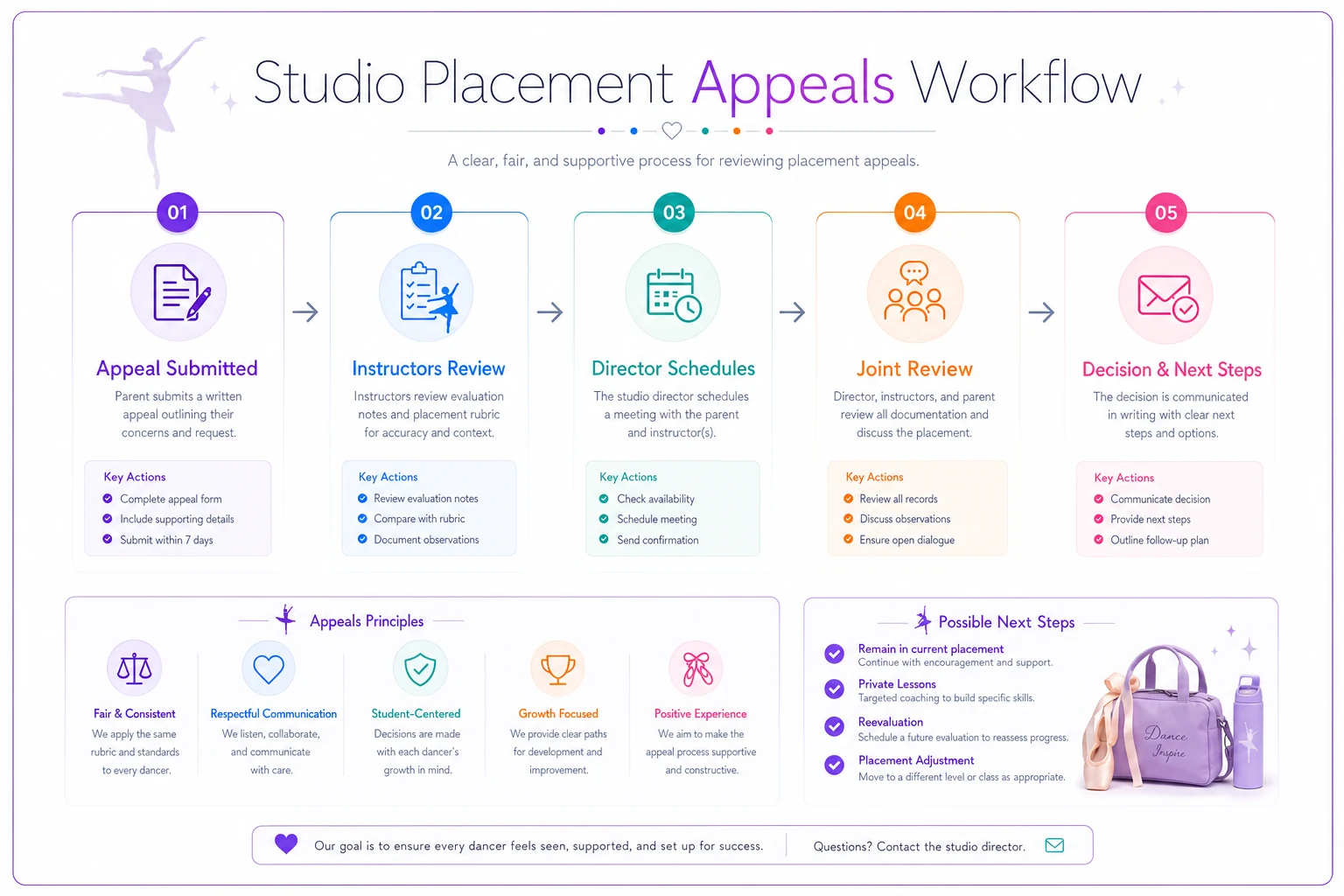
Roughly 70% of appeals end with parents understanding and accepting the placement once they see the documented evaluation. For the rest, offer a concrete path forward: "Sarah needs to demonstrate consistent double pirouettes and cleaner fifth position in jumps. If she achieves these benchmarks by December, we'll reevaluate for mid-year advancement."
Parent communication templates that prevent disputes
"Dear [Parent Name],
Following our spring evaluations, we're pleased to share that [Student] will continue developing their skills in Ballet 2 for the fall season.
During evaluations, [Student] demonstrated strong progress in:
-
Maintaining turnout during barre combinations
-
Memorizing and executing center combinations
-
Showing growing confidence in performance quality
To prepare for Ballet 3, we'll focus on:
-
Achieving consistent 90-degree extensions at the barre
-
Landing jumps with fully pointed feet
-
Developing strength for pirouette preparations
Ballet 2 will allow [Student] to master these foundational skills while building the confidence needed for more advanced work. We typically see students spend 1.5-2 years at this level before advancing.
If you'd like to discuss this placement or explore additional support options (private lessons, summer intensives), please schedule a meeting through our parent portal.
Warmly, [Instructor Name]"
"Dear [Parent Name],
Congratulations! Based on spring evaluations, [Student] has demonstrated readiness for Ballet 3 beginning this fall.
[Student] consistently showed:
-
Independent maintenance of proper alignment
-
Clean execution of pirouette preparations
-
Strong performance quality and stage presence
Ballet 3 will introduce new challenges including:
-
Beginning pointe work (pending foot strength evaluation)
-
More complex adagio combinations
-
Increased focus on artistry and interpretation
To prepare for this transition, we recommend [Student] attend our Ballet 3 Prep intensive in August. This helps students adjust to the increased pace and expectations before regular classes begin.
Please confirm your fall enrollment by [date] to secure [Student's] spot in Ballet 3.
Best regards, [Instructor Name]"
This template celebrates current achievements, clearly identifies growth areas, and normalizes the timeline for progression. Parents feel informed rather than dismissed.
Red flags that signal your placement system needs work
Watch for these warning signs that your current approach is creating more problems than it solves:
Your instructors start mentioning certain parents with dread during placement season. This usually means those parents have historically challenged decisions aggressively — indicating unclear standards or poor communication protocols.
Parents compare notes in the parking lot trying to decode placement logic. When families are constructing their own theories about how placements work, your official process isn't transparent enough.
Enrollment drops after placement announcements. Families who feel the process was unfair often leave quietly rather than complain. Track retention rates specifically around placement periods.
The same students get "bubble" placements year after year — almost ready to advance but never quite. This suggests your rubrics have gaps, or your instructors need calibration on standards.
New families express confusion about level placement during trials. Your criteria should be clear enough that prospective families understand where their dancer fits before committing. This reduces disputes from the start and helps with your trial conversion process.
Making placements work with your performance schedule
Your placement timeline needs to sync with your performance calendar, not fight against it. Studios that announce placements right before recital create unnecessary stress when families are already managing costume fittings, dress rehearsals, and ticket sales.
The sweet spot for spring placement announcements is usually two weeks after recital. Parents have had time to watch their child perform alongside other levels, instructors aren't burned out from production week, and there's still enough runway before summer break for any necessary discussion.
Some studios worry that post-recital placements might hurt summer enrollment if students don't get the advancement they hoped for. The opposite tends to be true — when parents understand what their child needs to work on, they're actually more likely to enroll in summer programs designed to address those specific skills.
Consider building summer programs around placement goals. A "Ballet 3 Readiness Intensive" gives students who didn't quite make the cut a clear path forward while generating additional revenue. An "Excellence in Ballet 3" program helps newly advanced students prepare for increased expectations.
This transforms summer from a placement limbo into active preparation time. Parents see continued investment in their child's development rather than a harsh judgment about readiness.
Documentation systems that protect your decisions
When a placement dispute escalates — and occasionally they will despite your best efforts — documentation becomes your best defense. But maintaining detailed evaluation records for dozens of students can get overwhelming fast without the right systems.
The most effective documentation combines standardized forms with specific observational notes. Create a simple evaluation sheet instructors complete during observation periods:
Student: Date: Class: _
-
Technical Skills (mark observed)
□ Maintains proper alignment independently □ Self-corrects with verbal cues □ Needs physical corrections □ Demonstrates understanding of movement quality □ Shows musicality and timing
Specific Observations: ___
Areas of Growth: ___
Ready for next level? □ Yes □ No □ Evaluate again in December
Keep these forms in digital folders organized by student. When parents request a meeting about placement, you can pull up multiple observations showing consistent patterns, not just a single evaluation day that might have been affected by nerves or illness.
Save each student's evaluation form in a folder labeled with their name and year so you can pull it up immediately during meetings.
This documentation also protects you legally. In the rare case where a family suggests favoritism or raises discrimination concerns, detailed evaluation records demonstrate objective, consistent criteria applied equally across all students.
Training instructors for consistent evaluation
Even the best rubrics fail if your instructors apply them inconsistently. One teacher's "approaching ready" might be another's "exceeds expectations." This inconsistency creates the appearance of unfairness even when everyone's acting in good faith.
Run calibration sessions before each evaluation period. Watch video recordings of students at different levels and have instructors independently score them using your rubrics. Then compare scores and discuss discrepancies. Where do interpretations differ? What specific markers is each instructor prioritizing?
These sessions often surface hidden tendencies. Maybe one instructor weighs flexibility more heavily while another prioritizes strength. Perhaps newer instructors have higher technical expectations while senior teachers value artistry more. Understanding these tendencies helps create more balanced evaluations.
Require instructors to provide specific examples for each rubric score. Instead of marking "approaching ready" for jumps, they should note "sickled feet on landing but showing improvement in elevation." This specificity helps with parent communication and ensures instructors are actually observing rather than relying on general impressions.
When possible, have two instructors evaluate each student independently — especially for bubble placements. When assessments align, you can feel confident in the decision. When they differ significantly, it triggers a closer look before finalizing anything.
Alternative advancement models that reduce pressure
The traditional September-to-June level progression isn't the only way to structure advancement, and it might not be the right fit for every studio.
Rolling enrollment with quarterly assessments lets students advance when they're genuinely ready rather than forcing annual decisions. A student who isn't quite ready in September might be perfectly prepared by January. This reduces the high-stakes feeling of annual placements while giving students more opportunities to progress.
Skill-based progression rather than age-based levels acknowledges that children develop at different rates. Your 10-year-old with three years of training might be more advanced than a 12-year-old who started last year. Building pathways around skill mastery rather than age reduces parent comparisons and "my child should be with their friends" arguments.
Split-level classes for bubble students offer a practical compromise. Students attend their current level twice weekly and their target level once weekly as a "challenge class." This gives them exposure to advanced material while solidifying foundational skills. After a term in this arrangement, advancement decisions usually become obvious rather than contentious.
Some studios also use "graduation" requirements where students must demonstrate specific skills on video before advancing. This puts some control in families' hands — they know exactly what's required and can work toward it. The video submissions also create clear documentation of readiness, or the areas still needing work.
The technology piece that makes this manageable
Managing evaluations, documentation, and parent communications through spreadsheets and email creates inevitable gaps where disputes flourish. The wrong parent gets the wrong notification, evaluation notes get lost, or placement decisions get communicated inconsistently.
A solid digital system maintains transparency while protecting sensitive information. Parents should be able to access their child's rubric scores and progress notes through a secure portal — eliminating "I was never told" disputes. But they shouldn't see other students' evaluations, which would just create a different problem.
AI-powered operational software can standardize your evaluation workflow while keeping the human judgment that dance assessment requires. Instructors input observations through structured forms, patterns get tracked across multiple evaluations, and placement documentation stays comprehensive and consistent without someone manually managing it all.
Automated communication workflows ensure every family receives placement notifications simultaneously with consistent messaging. No more forgetting to notify one family or sending conflicting information to another. Appeals automatically trigger scheduling workflows and documentation requirements. The whole process becomes trackable instead of something you're piecing together from memory.
The time savings add up quickly. Instead of spending 20 hours per placement cycle managing disputes and documentation, studios using these systems often get that down to under five hours. That recovered time goes toward instruction, performance preparation, or anything else that actually moves the business forward.
Placement disputes don't have to be an inevitable part of running a dance studio. With clear rubrics, scheduled evaluation windows, and transparent communication, most conflicts disappear before they start. The ones that do come up get resolved through your appeals process rather than turning into ongoing battles.
The key is building these systems before you need them. Don't wait until parents are upset to create evaluation standards. Build them during calm periods when you can think clearly about what progression actually means at your studio.
Parents fundamentally want to understand how they can support their child's dance journey. When your placement policies provide that clarity, they become partners in the process rather than adversaries. They might not always agree with decisions, but they'll understand them — and that's usually enough.
Your placement system is really about trust. Parents trust that evaluations are fair. Instructors trust that their decisions will be supported with documentation. Students trust that hard work leads to advancement. When that trust exists, your studio culture thrives on positive word-of-mouth rather than despite parking lot gossip.
That parent marching toward your desk after placements? With the right systems in place, they're coming to ask about private lessons, not to argue about fairness.
Ready to elevate your studio operations?
Join 500+ studios using Movioly to save time, reduce admin workload, and enhance student experiences.