



Most studios don't lose money on price. They lose it on exceptions. A 15% "just for you" discount here, a waived registration fee there, a free extra class to keep a wobbly family from leaving. Each one feels small and reasonable in the moment. Stack up a year of those small mercies and you've usually shaved 8–14% off the lifetime value of your enrolled base without ever changing a single number on your published rate sheet.
That's the part that's hard to see. Your tuition looks healthy. Your classes fill. But your effective price per family keeps drifting down because there's no real governance around who can discount, how much, when, and why. Pricing governance isn't about being stingy — it's the set of rules and checks that keep your discounting intentional instead of reactive, so the money you give away actually buys something (a full class, a longer commitment, a referral) instead of just eroding your margin one polite conversation at a time.
This is a systems problem, not a willpower problem. Front desk staff aren't the villains. They're responding to real pressure — an upset parent, a slow enrollment week, a competitor across town — without a framework telling them what they're actually allowed to do. Build the framework and the erosion mostly stops on its own.
Why discount erosion happens across almost every studio
The pattern is remarkably consistent. Erosion creeps in through four doors:
The retention save. A family threatens to leave over money. Someone offers a discount to keep them. It works, so it becomes muscle memory. Within a season, "give them 20% off" is the unwritten answer to every hesitation.
The enrollment-week panic. Numbers look soft two weeks before a session starts, so someone runs a flash promo. It fills seats — but it also teaches your existing prospects that if they wait long enough, a coupon shows up. You've trained your market to delay.
The sibling and loyalty sprawl. Sibling discounts, multi-class discounts, loyalty perks, referral credits — each was added at a different time by a different person for a different reason. Nobody ever checked whether they stack. A family with three kids in four classes can end up paying 40% below rate card and nobody planned it that way.
The comped extra. Free trial extensions, waived late fees, bonus privates. These don't show up in your discount reports at all because they're not coded as discounts. They're just... gone.
What comes up repeatedly across studios is that owners can tell you their published prices to the dollar, but they genuinely have no idea what their realized price per student is. When you actually pull it, the gap between rack rate and what's collected is usually bigger than the entire month's marketing budget. The revenue math behind all this only works if the price you model is close to the price you collect — which is why it's worth reading the revenue math behind scalable studio pricing alongside this, because governance is what makes those package models hold up in real life.
What breaks as you grow
At one location with an owner working the desk, discounting stays sane because one brain approves everything. The owner remembers who got what. The system is basically "me."
Eliminate scheduling headaches and missed payments.
Movioly streamlines booking, confirming, and managing every class with ease.
- Unified class and instructor scheduling
- Automated student notifications
- Integrated payment tracking
No credit card required
Then you add a second instructor who covers the desk. Then a part-time admin. Then a second location. Suddenly three or four people are all authorized to "help" families, and none of them share the same mental model of what's acceptable. The erosion doesn't grow linearly — it compounds, because families talk to each other and discover that the Tuesday admin gives better deals than the Thursday one. Now you've got a fairness problem stacked on top of a margin problem.
Here's the failure chain in order:
-
One owner, informal judgment → works fine
-
Multiple staff, no written rules → inconsistent discounts, some families feel cheated
-
Multiple locations → discount arbitrage, families shop your own staff against each other
-
Scale + no monitoring → you can't even measure the leak, so you keep "fixing" it by raising rack rates, which pushes more families to ask for exceptions
The tragic version of this is the studio that responds to margin erosion by raising published tuition. That just widens the gap between the sticker price and the deal, which increases the number of families who feel they need a discount to justify staying. You accelerate the very behavior you're trying to fix.
The four pieces of a real pricing governance system
Governance has four working parts. They fit together — miss one and the others leak.
1. A discount policy that names the reasons
The core mistake is having discount amounts without discount reasons. Every legitimate discount should map to a named category with a defined purpose:
| Discount type | Purpose it's buying | Typical range | Who approves |
|---|---|---|---|
| Sibling / multi-student | Household lifetime value | 10–15% on 2nd+ student | Auto-applied, no approval |
| Multi-class | Increased engagement & retention | 5–10% on 3rd+ class | Auto-applied |
| Referral credit | New family acquisition | Fixed $ credit, capped | Auto-applied |
| Financial hardship | Access / community mission | Case-by-case | Owner only |
| Retention save | Prevent a specific churn | Capped, one-time | Manager+ |
| Promotional / seasonal | Fill known low periods | Time-boxed | Owner-approved campaign only |
The core idea: if a discount request doesn't fit a named category, the default answer is no. Not because you're being rigid, but because an unnamed discount is by definition one you can't measure or defend to the next family who hears about it.
Notice that most of these are auto-applied with no human approval needed. That's intentional. The discounts that should be rules are rules. The ones that require judgment are exceptions — and exceptions are exactly what your approval matrix controls.
2. A bundling framework that adds value instead of subtracting price
Bundling is where studios accidentally do the most damage, because a bundle feels like added value but often just functions as a hidden discount. The distinction that matters: a good bundle increases what a family commits to; a bad bundle just lowers the price of what they were already going to buy.
-
Bundle toward commitment, not away from it. A 30-week package priced slightly below 30 individual weeks is fine — it locks in the season. A "buy any 2 classes, get 30% off" bundle for someone who was going to take 2 classes anyway is pure margin loss.
-
Never let bundles and category discounts stack silently. If a bundle already includes a multi-class rate, the multi-class discount shouldn't also apply on top of it. This is the single most common leak in studio pricing.
-
Anchor bundles to your highest-value outcome. Recital-inclusive packages, costume-included tiers, or performance-track bundles raise perceived value and commitment at the same time.
-
Cap the total discount a single family can reach. Set a floor — say, no family pays below 25% under rack rate no matter how the discounts combine. That one rule prevents most of the sprawl.
Bundling done right is also a retention tool. A family that's bought a season-long, recital-inclusive package is dramatically less likely to churn mid-year. That connects directly to the lifecycle approach in locking revenue into cohorts — bundles are one of the cleanest ways to convert a month-to-month family into a committed cohort member.
3. Campaign guardrails so promotions don't cannibalize full-price demand
Promotions aren't the enemy. Unstructured, always-on promotions are. Guardrails keep campaigns from teaching your market to wait.
-
Time-box everything. A promo with no end date isn't a promo, it's a price cut. Every campaign gets a start and stop.
-
Tie promos to genuinely soft periods only. Discounting during your natural enrollment surge (late summer for most studios) is money set on fire. Discount the slow windows.
-
Segment eligibility. New families and reactivations are usually worth a promotion. Currently-enrolled full-price families almost never should see one — that's straight margin donated.
-
Set a cannibalization check. Before running a promo, estimate how many people would have paid full price anyway. If it's most of them, don't run it.
-
One campaign at a time per audience. Overlapping offers create confusion and give families a menu of deals to pick the cheapest option from.
4. An approval matrix that puts the decision at the right level
This is the piece that stops the "Tuesday admin vs. Thursday admin" problem. Every discount above the auto-applied categories needs a defined approval level:
-
Front desk / instructor auto-applied structural discounts only. No discretionary discounting at all.
-
Manager / lead capped one-time retention saves within a set dollar limit, logged with a reason code.
-
Owner hardship cases, campaign creation, anything above the manager cap, anything that would push a family below the discount floor.
The point isn't bureaucracy. It's that the person feeling the emotional pressure of an unhappy parent standing at the desk is the worst-positioned person to make a margin decision. Routing the exception up one level, even by a quick message, breaks the reflex and creates a record.
The monitoring layer — where erosion actually gets caught
A policy nobody measures is just a suggestion. The whole system only works if you're watching a small set of numbers monthly. The metrics worth tracking:
-
Realized price per student (total tuition collected ÷ active students) vs. your rack rate. Watch the trend, not just the snapshot.
-
Discount penetration — what percentage of active families are paying below rack rate. If it keeps climbing past what you intended, exceptions are becoming the rule.
-
Average discount depth — for families who do have a discount, how far below rack they are on average.
-
Exception rate by staff member — who's approving discretionary discounts and how often. Not to punish anyone, but to spot where the framework isn't understood consistently.
-
Promo cannibalization — of families who used a promo, how many were already engaged prospects who would've enrolled anyway.
-
Comp/waiver leakage — the free stuff that never gets coded as a discount. Force it into a tracked line.
This is where studio management software earns its place, quietly. When your discount categories, bundle rules, approval levels, and campaign windows are enforced in the system — auto-applying structural discounts, blocking front-desk staff from discretionary ones, requiring a reason code, respecting the discount floor — the monitoring largely builds itself. You're not reconstructing what happened from memory at month-end; the report already exists because the rules ran automatically. That's the practical difference between governance written in a policy doc and governance that actually holds day-to-day.
Log every discretionary save with a reason code to simplify monthly review.
A quick visual of the monitoring workflow can make it easier to implement and explain to staff.
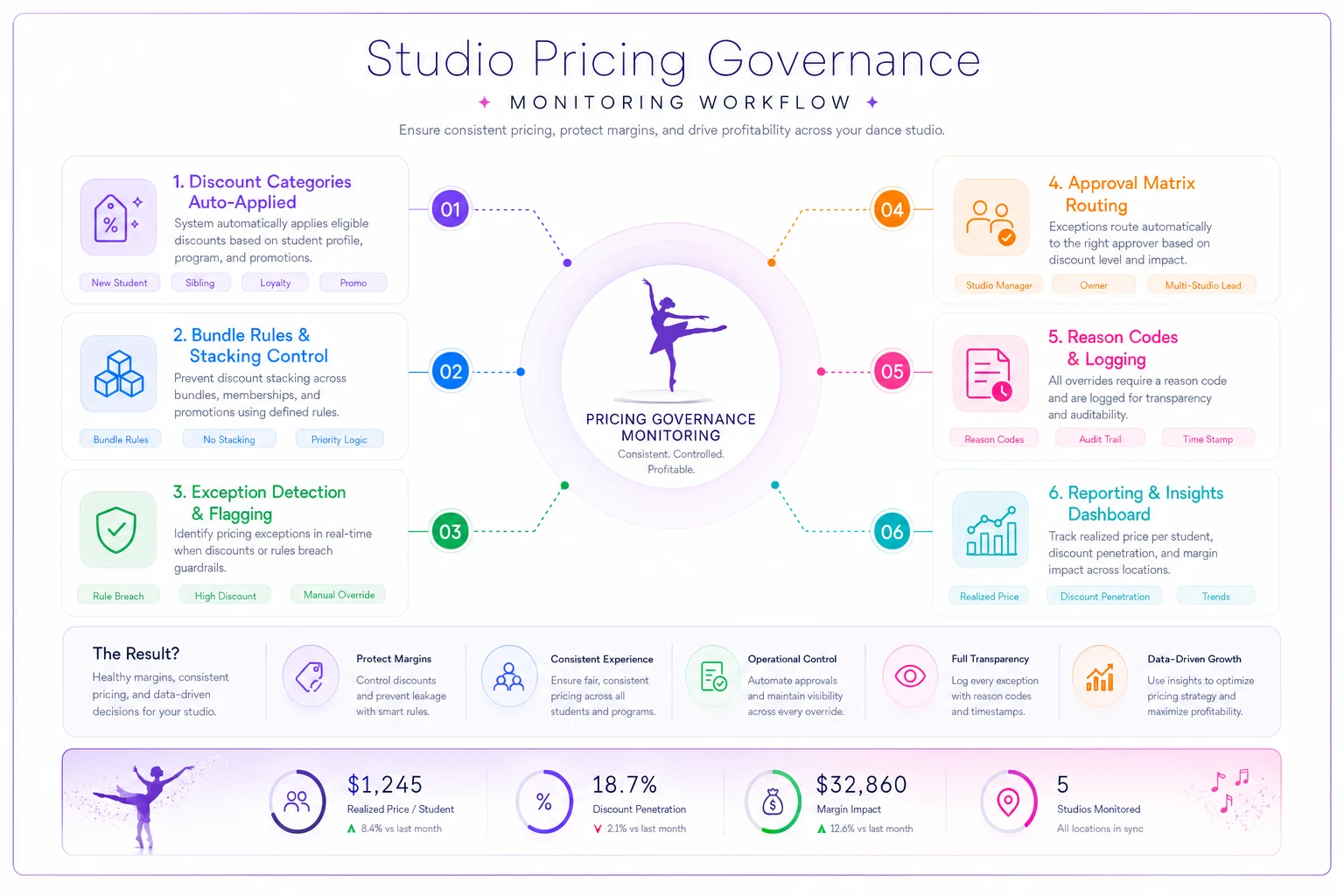
You're not reconstructing what happened from memory at month-end; the report already exists because the rules ran automatically.
A real scenario
A two-location studio with around 300 active students had healthy-looking tuition numbers and a nagging feeling that margins were softer than they should be. When they pulled realized price per student against rack rate, the gap was about 17% — noticeably wider than the roughly 9% they'd assumed based on their intended sibling and multi-class discounts.
The extra 8 points came from three places: retention saves that had quietly become automatic, sibling and multi-class discounts stacking on top of season bundles, and a rotating set of flash promos that were mostly reaching already-enrolled families.
They didn't raise a single published price. They wrote a discount policy with named categories, capped total stacking at 25% below rack, moved all discretionary saves to manager approval with reason codes, and pulled promos back to two time-boxed campaigns aimed only at the slow winter window. Within about two sessions, realized price per student recovered by roughly 6 points — most of the leak — with no measurable increase in churn. On their base, that worked out to somewhere in the range of $30k–$40k of annual margin that had simply been walking out the door.
The interesting part: families didn't revolt. Consistency actually reduced complaints, because the framework was the same for everyone and staff could explain it plainly instead of negotiating on the fly.
When tighter governance is a bad idea
This isn't universal. A brand-new studio still finding its price point shouldn't over-engineer this — you need flexibility while you're learning your market, and rigid guardrails can slow you down unnecessarily. A single-owner studio where one person makes every call already has de facto governance; formalizing it too early is just overhead you don't need yet.
And if your problem is genuinely too few students rather than too much discounting, tightening first can make things worse. Governance protects value — it doesn't create demand. Fix the demand side before you clamp down on pricing.
Who should build this now
If you have more than one person authorized to talk price, more than one location, or a discount penetration rate you can't state off the top of your head — you're already leaking, you just can't see it.
The governance system above isn't about squeezing families. It's about making sure every dollar you choose to give away actually buys loyalty, fills a slow period, or brings in a referral, instead of quietly training your entire market to wait for the next deal.
Start with one thing this week: pull your realized price per student and compare it to your rack rate. That single number will tell you whether you have a pricing problem or a governance problem — and almost every studio that runs the number is surprised by what they find.
Ready to elevate your studio operations?
Join 500+ studios using Movioly to save time, reduce admin workload, and enhance student experiences.