



Every dance studio pricing strategy eventually hits the same wall. You start with simple monthly tuition, add some drop-in rates, maybe a trial package. Works great for your first 80 students. Then you grow to 200 and suddenly your pricing structure creates operational chaos. Teachers don't know who paid for what. Parents complain about confusing invoices. Your front desk spends half their time explaining different package options.
The studios that scale successfully don't just raise prices or add more packages. They build revenue architecture that actually works at different sizes — and that means understanding package mix percentages, trial conversion economics, and how seasonal promotions affect your baseline revenue.
Why standard pricing advice breaks at scale
Most dance studio pricing advice assumes you're either tiny (under 50 students) or massive (multi-location franchises). The reality is that most studios operate somewhere between 100 and 400 students, and that middle zone requires completely different pricing logic.
A 120-student studio can run profitably with simple monthly unlimited packages. At 250 students, that same model creates scheduling nightmares. You need class caps, which means unlimited doesn't really mean unlimited. Parents get frustrated when their kid can't get into Tuesday's 4pm ballet class because it's already full of unlimited members.
The math changes too. With 120 students paying $140/month for unlimited classes, you're looking at roughly $16,800 monthly revenue. Clean, simple, predictable. Scale that to 250 students and theoretically you'd have $35,000 monthly — except you can't actually deliver unlimited classes to 250 students without either massive facility expansion or quality degradation. So you add package tiers, which fragments your revenue and complicates operations.
This fragmentation is where studios get stuck. They end up with eight different package types, each with different rules, different pricing, different allowed classes. The administrative burden explodes. A studio owner once showed me their pricing sheet — 11 different options across recreational, competitive, and drop-in categories. Their front desk staff needed a full training manual just to explain packages to prospective parents.
The three proven revenue architectures
After analyzing hundreds of studio operations, three pricing architectures consistently hold up across different growth stages. Each has specific package mix ratios, trial structures, and promotional cadences that maintain margins while scaling.
Eliminate scheduling headaches and missed payments.
Movioly streamlines booking, confirming, and managing every class with ease.
- Unified class and instructor scheduling
- Automated student notifications
- Integrated payment tracking
No credit card required
Architecture 1: The Progressive Tier Model (80-200 students)
Package Structure:
-
Starter
1 class/week at $95/month (target 45% of students)
-
Standard
2 classes/week at $165/month (target 35% of students)
-
Unlimited
All recreational classes at $245/month (target 20% of students)
| Package | Details |
|---|---|
| Starter | 1 class/week at $95/month (target 45% of students) |
| Standard | 2 classes/week at $165/month (target 35% of students) |
| Unlimited | All recreational classes at $245/month (target 20% of students) |
The pricing gaps matter here. The jump from Starter to Standard ($70) is intentionally larger than Standard to Unlimited ($80). This pushes families toward the middle tier, which has the best margin profile when you factor in facility utilization.
Trial Structure:
Skip free trials. Use a $39 three-class trial that converts to a $39 credit toward first month's tuition. This filters out non-serious inquiries while giving committed families a low-risk entry point. Conversion rates typically run 65-70% versus 35-40% for free trials.
Promotional Cadence:
-
September
Back-to-school special — waive registration for Standard and Unlimited packages
-
January
New Year resolution push — upgrade incentive ($20 off first month when moving up a tier)
-
March
Spring into dance — buddy referral program (existing student gets $25 credit, new student gets trial for $19)
-
June
Summer intensive prep — 20% off summer camps for currently enrolled students
Revenue math for 150-student studio:
-
68 Starter students × $95 = $6,460
-
52 Standard students × $165 = $8,580
-
30 Unlimited students × $245 = $7,350
-
Monthly baseline = $22,390
-
Annual with 92% retention = $247,000
Architecture 2: The Class-Credit System (200-400 students)
Package Structure:
-
4 credits/month at $88 (target 25% of students)
-
8 credits/month at $156 (target 40% of students)
-
12 credits/month at $216 (target 25% of students)
-
16 credits/month at $264 (target 10% of students)
Credits roll over for one month, which removes the "use it or lose it" frustration that drives cancellations. Different classes require different credit amounts — recreational classes cost 1 credit, technique classes cost 1.5 credits, competitive team practices cost 2 credits.
Trial Structure:
Offer a $49 four-credit starter pack valid for 30 days. No automatic enrollment, but include a one-time upgrade bonus — if they sign up for a monthly package within 7 days of trial purchase, they get 2 bonus credits added to their first month.
Promotional Cadence:
-
August
Early bird special — buy credits in bulk, get 15% bonus credits (48 credits for the price of 42)
-
November
Holiday prep — gift card promotion with 10% bonus value
-
February
Bring-a-friend month — students get 1 free credit for each friend who enrolls
-
May
Recital package — bundle recital tickets with credit packages for 10% discount
Revenue math for 300-student studio:
-
75 students × $88 = $6,600
-
120 students × $156 = $18,720
-
75 students × $216 = $16,200
-
30 students × $264 = $7,920
-
Monthly baseline = $49,440
-
Annual with 88% retention = $521,000
The credit system typically reduces retention by around 4% compared to unlimited models, but the operational efficiency and improved capacity management more than compensates through lower staffing costs and better class utilization.
Architecture 3: The Membership + Add-on Model (400+ students)
Package Structure:
Base Membership (required for all students):
-
Facility fee
$65/month
-
Includes
1 technique class/week, recital participation, member pricing on everything else
Add-on Packages:
-
Additional recreational classes
$35/month per class
-
Competition team
$180/month (includes 3 practices/week)
-
Private lessons
$65/hour (member rate) vs $85/hour (non-member)
-
Master classes
$25/class (member rate) vs $40/class (non-member)
Target mix:
-
100% pay base membership
-
70% add at least one recreational class
-
20% join competition team
-
30% take occasional private lessons
-
40% attend master classes
Trial Structure:
No traditional trial. Instead, offer a $99 "Discovery Month" that includes base membership plus 2 recreational classes. After the month, they choose their ongoing package. Getting them integrated into the studio community immediately pushes conversion above 80%.
Promotional Cadence:
-
September
Sibling discount — 2nd child gets 25% off add-ons
-
December
Competition team early commitment — lock in current year's rate for next year
-
April
Summer planning — pre-pay 3 months of summer, get 4th month free
-
July
Fall preview — reserve fall schedule spots with $50 deposit, get $50 credit
Revenue math for 450-student studio:
-
450 base memberships × $65 = $29,250
-
315 students × $35 (one add-on class) = $11,025
-
90 students × $180 (competition) = $16,200
-
Private lessons (135 students × 2 lessons/month × $65) = $17,550
-
Master classes (180 students × 1.5 classes/month × $25) = $6,750
-
Monthly baseline = $80,775
-
Annual with 85% retention = $825,000
The studios that scale successfully don't just raise prices or add more packages. They build revenue architecture that actually works at different sizes — and that means understanding package mix percentages, trial conversion economics, and how seasonal promotions affect your baseline revenue.
Here's a simple workflow visualization for choosing a pricing architecture.
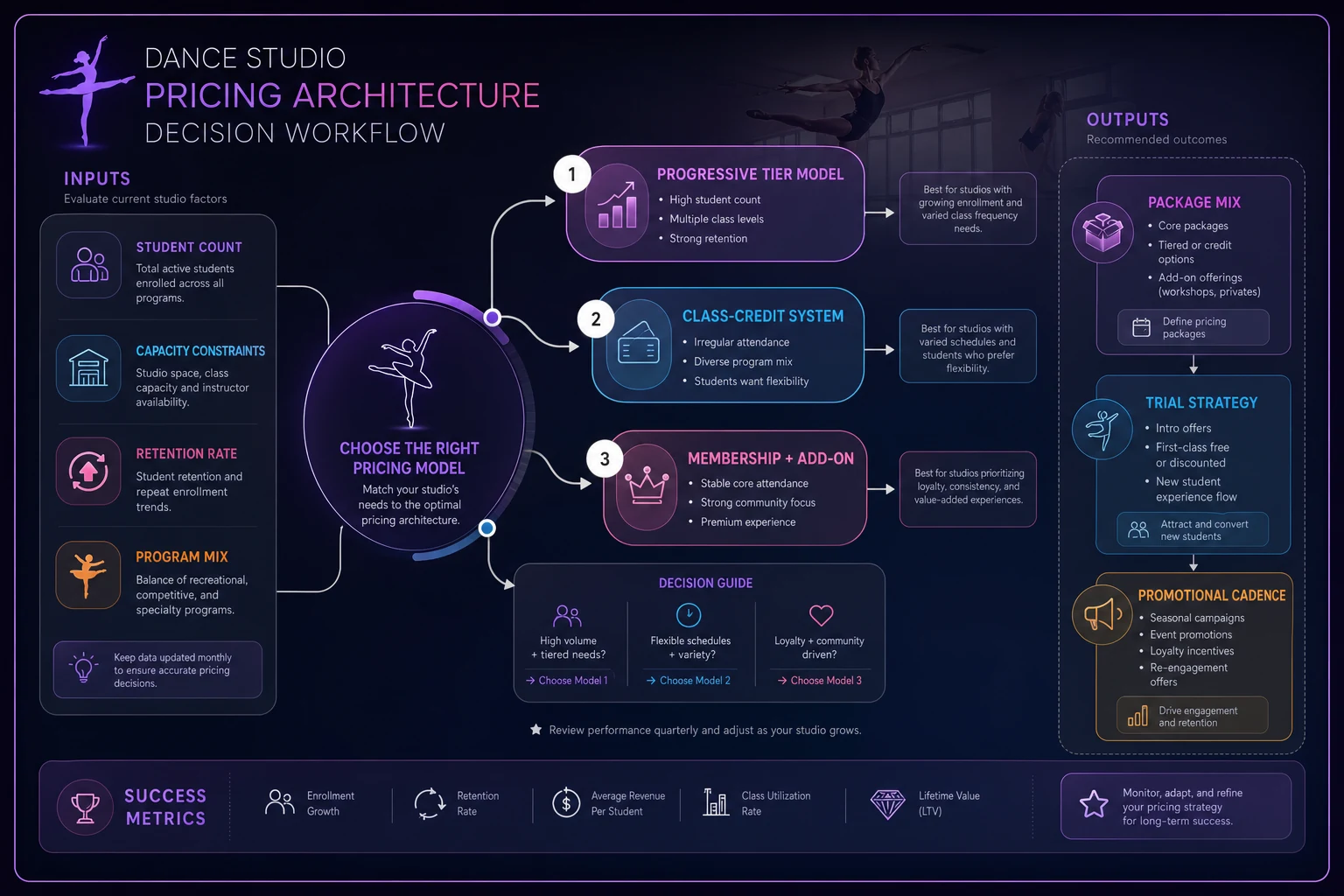
This diagram shows how studios evaluate and shift between the three architectures.
Three studio examples: from startup to scale
Studio A: The Conservative Growth Path (Madison, 2019-2024)
Started with 82 students in a 2,000 sq ft space. Owner Sarah initially offered just two options: $120/month unlimited or $15 drop-in classes. Simple to manage, but revenue capped around $9,000/month.
Year 2: Switched to the Progressive Tier Model. Revenue immediately jumped to $13,000/month with the same student count — families choosing the middle tier spent more than the previous unlimited price. Structured packages also made staffing needs easier to forecast.
Year 3: Grew to 145 students. Monthly revenue hit $21,000. The tier model scaled smoothly — just added more class times in popular slots.
Year 4-5: Reached 180 students and started hitting capacity limits. Began planning a transition to the credit system. Current revenue around $28,000/month.
Key lesson: Graduated pricing tiers created natural upgrade paths. Parents started kids in Starter, moved to Standard after a few months, some eventually upgraded to Unlimited. Average student lifetime value increased roughly 40% just from this progression dynamic.
Studio B: The Aggressive Expansion Path (Phoenix, 2020-2024)
Opened during the pandemic with just 31 students. Started directly with a class-credit system despite being small, betting on rapid growth.
Year 1: Struggled at first. The credit system was overkill for 31 students. Simplified down to just 4 and 8 credit packages. Ended the year at 67 students and $8,400/month revenue.
Year 2: Growth exploded. Good infrastructure already in place allowed them to scale to 220 students without any operational breakdown. Revenue hit $35,000/month. The credit system proved its value — they could add students without worrying about unlimited members overwhelming popular classes.
Year 3: Reached 340 students and expanded to a second location. The credit system made multi-location straightforward — students could use credits at either studio. Combined revenue hit $58,000/month.
Year 4: 410 total students across both locations. Considering a move to the Membership + Add-on model as they approach 500 students. Current combined revenue around $71,000/month.
Key lesson: Starting with scalable architecture, even when small, positioned them for rapid growth without having to pause marketing mid-expansion to restructure pricing.
Studio C: The Premium Position Path (San Francisco, 2018-2024)
Launched as a premium studio with the Membership + Add-on model from day one. Just 45 students initially, but a high price point.
Year 1: Base membership at $95/month plus add-ons. Even with 45 students, the studio generated $12,000/month. High prices filtered for committed families from the start.
Year 2-3: Grew slowly but profitably to 120 students. Revenue reached $34,000/month. The membership model made it easy to add specialized programs — contemporary, hip-hop, acro — without restructuring pricing every time.
Year 4-5: Accelerated to 275 students. Capped membership at 300 due to facility constraints. Revenue hit $68,000/month. A waiting list of 40+ families allowed them to be selective about who joined.
Year 6: Opened a second location to handle demand. 380 students total. Combined revenue around $95,000/month. Premium positioning plus the membership model created roughly 50% higher revenue per student than market average.
Key lesson: Starting premium attracted families genuinely invested in dance education. Higher revenue per student meant they could pay instructors better, which attracted top talent, which justified the premium pricing. That flywheel compounds over time.
When to adjust your revenue architecture
The timing of pricing architecture changes matters as much as the changes themselves. Switch too early and you add unnecessary complexity. Switch too late and you're managing a crisis while trying to restructure at the same time.
Watch for these transition signals:
Time to leave simple monthly unlimited (usually around 150-200 students):
-
Waitlists forming for popular class times
-
Parents complaining about full classes despite "unlimited" membership
-
You're considering adding more package options to manage capacity
-
Schedule coordination taking more than 2 hours per week
Time to move from tiers to credits (usually around 200-250 students):
-
More than 15% of students asking to switch packages mid-month
-
Unlimited members attending 6+ classes per week and disrupting capacity
-
You need different pricing for different class types
-
Competition team members need a separate pricing structure
Time to implement membership + add-ons (usually 350+ students):
-
Managing more than 8 different package types
-
Billing complexity causing 5+ hours of admin work weekly
-
Need to differentiate between program types (recreational vs competitive vs specialty)
-
Planning a second location or major expansion
Time to implement membership + add-ons (usually 350+ students):
Revenue leakage points that kill profitability
Even a well-designed pricing architecture fails if you're not plugging common revenue leaks. These operational gaps can quietly cost 10-20% of potential revenue.
Failed autopay recovery: Studios typically lose 3-4% of monthly revenue to failed credit card charges. The fix isn't just retry attempts — you need a systematic recovery process. Send a text 2 days before the charge, email immediately after failure, text again at day 3, phone call at day 5. Most studios stop after one email. Studios that track proper financial metrics understand that payment recovery rate directly impacts cash flow predictability.
Trial no-shows: A studio running 20 trials per month with a 30% no-show rate loses roughly $3,000 in monthly revenue (assuming 65% conversion of attended trials at a $150 average monthly rate). Fix: take a credit card at trial booking, charge a $20 no-show fee, send three reminders — 3 days before, 1 day before, and 2 hours before.
Take a credit card at trial booking and charge a $20 no-show fee, and send reminders 3 days before, 1 day before, and 2 hours before.
Untracked makeups: Makeup classes feel like good customer service but can wreck revenue if unmanaged. One studio discovered they were issuing 300+ makeup credits monthly, equivalent to $4,500 in lost revenue. Clear policy: makeups expire after 30 days, maximum 2 per month, must be scheduled within 48 hours of the missed class, no makeups for no-shows without 24-hour notice.
Sibling discount creep: Starts as "10% off second child" and somehow becomes 25% off the third child, plus honoring expired promotions, plus stacking discounts. One studio audit found $8,000/month in unplanned discounts going out the door. Written discount policy, maximum one discount per family, no stacking, quarterly review.
Promotional timing and revenue impact
Promotions should amplify your baseline revenue, not replace it. Most studios run promotions reactively — enrollment drops, so let's offer a discount. That just trains customers to wait for deals.
Strategic promotion calendar based on dance studio enrollment patterns:
August (roughly 25% of annual new enrollments): Focus on early commitment incentives, not discounts. "Register by August 15, lock in last year's rates." Or "First 50 families to register get priority class selection."
September (roughly 30% of annual new enrollments): This is your highest-demand month. Don't discount heavily — demand is already there. Add value instead. "Register for fall, get a free dance bag" or "September enrollment includes a free recital costume."
January (roughly 20% of annual new enrollments): New Year resolution timing. Lean into transformation messaging. "6-week challenge program" or "New student bootcamp." These packaged programs can often charge premium prices.
March (roughly 10% of annual new enrollments): Spring enrollment is naturally soft. This is when discounts actually make sense. "Spring into Dance — 20% off first month" or "March Madness — register 2 kids, 3rd is free for March."
June (roughly 15% of annual new enrollments): Summer program gateway. Don't discount summer camps — use them as a pipeline for fall. "Register for summer camp, get $50 credit toward fall enrollment."
Studios seeing consistent growth run 4-5 planned promotions annually, not constant discounting. Each promotion has a specific goal — acquisition, upgrade, retention, or reactivation.
Technology and revenue operations
Manual billing and package management becomes unsustainable somewhere around 150 students. But the solution isn't just any software — it's software that actually understands how dance studios operate.
The revenue architectures outlined above require specific technical capabilities. Progressive tiers need automatic upgrade prompts when students hit certain milestones. Credit systems need rollover tracking and expiration management. Membership models need complex add-on logic and family account management.
Most generic scheduling software forces you to bend your pricing to fit their limitations. You end up with workarounds, spreadsheet supplements, and manual processes that defeat the whole purpose — and the overhead of managing these band-aids can eat 10+ hours weekly at a 300-student studio.
Modern AI-powered operational platforms handle complex pricing logic while automating the repetitive parts. Package recommendations based on attendance patterns, automated trial follow-ups timed to engagement levels, makeup class policies that balance flexibility with revenue protection. These aren't futuristic concepts — they're exactly what smart studios are already using to convert more trials into committed students.
Technology is still just an enabler though. The strategic decisions about pricing architecture, package mix, and promotional timing are what determine whether you build a scalable revenue model or stay stuck in the messy middle.
Making the architecture decision
Choosing the right revenue architecture isn't about following best practices — it's about matching your studio's specific situation. A studio in an affluent suburb can run membership + add-ons from day one. A studio in a price-sensitive market might need to stay with simpler tiers longer.
Think about your market position, competitive landscape, and operational capacity. Can your staff explain complex packages clearly? Do your customers value flexibility or simplicity? Are you optimizing for growth right now or profitability?
The most common mistake is waiting too long to evolve the pricing model. Studios get comfortable with what's working, even when it's starting to constrain growth. They know they should change but don't want to risk losing students. Meanwhile, they're leaving money on the table and creating operational headaches that only get worse.
Start planning your next architecture evolution when you're at about 70% of the transition threshold. If the credit system makes sense at 200 students, start designing it at 140. That gives you time to test, adjust, and prepare both staff and customers before you actually need it.
Pricing architecture shapes your studio culture, determines which students you attract, and influences every operational decision downstream. The three models outlined here have held up across hundreds of studios, but your implementation will always have its own nuances.
The studios that thrive long-term are the ones that treat pricing as a strategic tool, not a set-it-and-forget-it decision. They understand the math, track the metrics, and adjust proactively before things break.
Your current pricing might be working fine today. The question is whether it still works when you have twice as many students. The time to build scalable revenue architecture is before you desperately need it — because restructuring pricing while keeping operations running and families happy at the same time is a genuinely unpleasant experience.
The math is clear. The models are proven. The only real question is whether you evolve your pricing on your own terms or get forced into it when your current model stops working.
Ready to elevate your studio operations?
Join 500+ studios using Movioly to save time, reduce admin workload, and enhance student experiences.