

Most studios have a no-show policy written somewhere. It's in the parent handbook, maybe on the registration form, maybe pinned in the private Facebook group. And most of those policies are essentially decorative. They exist so the studio can say it has one, but nobody at the front desk actually enforces it — because the first time you try, a mom whose kid has been in your program for four years gives you a look, and you fold.
That's the real problem. Not the policy. The enforcement.
The gap between "we have a policy" and "we consistently apply it without losing families" is where studios quietly leak thousands of dollars a year. A no-show in a private lesson is instructor time you paid for and can't resell. A late-cancel in a small class doesn't just cost you that seat — it messes up choreography, splits attention, and slowly trains the whole roster that showing up is optional.
So this is about building a dance studio no-show policy SOP your front desk can actually run — tiered rules, an escalation matrix, contract language that holds up, a reminder cadence, and word-for-word scripts. The goal isn't to punish families. It's to make enforcement so predictable and calm that it stops feeling personal.
Why enforcement fails even when the policy is good
The policy usually isn't the weak link. The weak link is that enforcement depends on a human making a judgment call, in the moment, in front of the person they're enforcing against.
Here's how it plays out. Your policy says late cancels inside 24 hours forfeit the class. A parent texts at 3pm for a 5pm class: "So sorry, Maya has a fever, we can't make it." Now your 17-year-old front desk employee has to decide — in real time, over text — whether to charge a sick kid's mom. She won't. Nobody would. So she waives it. And she waives the next one. Within a month the policy is dead, not because it was wrong, but because every single enforcement decision got left to discretion at the exact worst moment to make one.
The other failure pattern is inconsistency between staff. One instructor enforces, another doesn't. Parents talk. Once a family figures out that catching Jen at the desk means it slides, your whole system falls apart. Inconsistency does more relationship damage than strict enforcement ever does — because inconsistency feels like favoritism, while strict-but-fair just feels like a rule.
The fix isn't "enforce harder." It's removing discretion from the front desk and replacing it with a decision the system already made.
The tiered structure that keeps it fair
A flat policy — "all late cancels are charged, no exceptions" — sounds strong but breaks the first time someone's grandmother goes into the hospital. A policy that waives everything is worthless. You want tiers that distinguish between patterns and incidents.
Eliminate scheduling headaches and missed payments.
Movioly streamlines booking, confirming, and managing every class with ease.
- Unified class and instructor scheduling
- Automated student notifications
- Integrated payment tracking
No credit card required
The core insight: you're not trying to punish a single missed class. A one-off no-show costs you a little. A family that no-shows five times a term is the actual problem, and they're usually the ones eroding class quality for everyone else. So the SOP should escalate based on frequency, not the severity of the excuse.
Here's a tiered structure that holds up in practice:
| Tier | Trigger | Consequence | Who handles it |
|---|---|---|---|
| Tier 0 | First late-cancel or no-show in a term | Logged, gentle reminder of policy, no charge | Front desk (auto) |
| Tier 1 | Second occurrence | Class forfeited (charged/credit used), courtesy note | Front desk (script) |
| Tier 2 | Third occurrence | Forfeit + a short check-in call about fit/schedule | Studio manager |
| Tier 3 | Fourth+ / chronic pattern | Forfeit + required schedule conversation before re-enrollment | Owner or manager |
The magic of Tier 0 is that it gives everyone one clean pass. Almost no reasonable parent argues with "first one's on us, here's how it works going forward." You look generous and you've put them on notice. Most families never hit Tier 1 once they know the counter is running.
[Miss occurs] ↓ Is this the first miss this term? ↓ Yes ↓ No [Tier 0] Is this the second miss? Log + reminder ↓ Yes ↓ No No charge [Tier 1] Is this the third? Forfeit + ↓ Yes ↓ No courtesy note [Tier 2] [Tier 3] Forfeit + Forfeit + check-in call schedule talk before re-enrollment
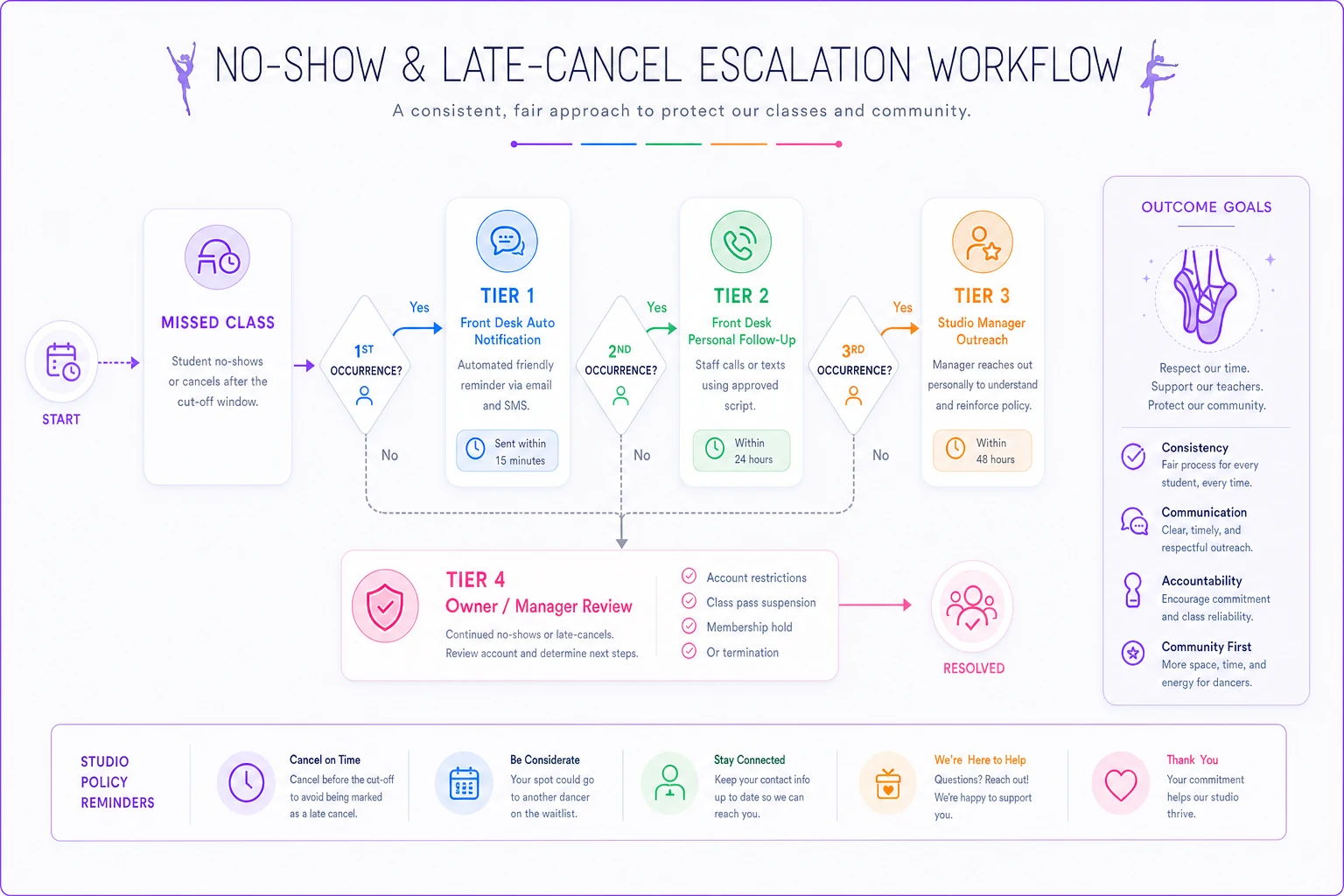
Each tier is a defined outcome, not a judgment call. That's what makes it enforceable. The moment you hand the front desk a decision tree instead of a blank check, enforcement gets a lot less personal for everyone involved.
Contract language that actually gives you standing
Vague policy language is why enforcement collapses under pushback. "Late cancellations may be subject to a fee" gives a parent room to argue. "May be" means "sometimes not," and now you're negotiating.
> Attendance, Cancellations & No-Shows > A "late cancellation" is any cancellation made less than 24 hours before a scheduled class or private lesson. A "no-show" is any missed class without cancellation. > > Each enrolled student receives one (1) courtesy waiver per term. After the courtesy waiver, each late cancellation or no-show results in forfeiture of that class — the session is deducted from your package or billed at the standard rate — and cannot be made up. > > Repeated late cancellations or no-shows (three or more in a term) may require a schedule review with studio staff before continued enrollment. Cancellations for illness or emergencies follow the same forfeiture policy; where possible, a make-up credit may be offered at the studio's discretion, but is not guaranteed. > > Cancellations must be made through [your booking system / front desk] to be logged. Verbal cancellations to an instructor are not recorded and do not count as notice.
That last line matters more than most people expect. A huge chunk of "but I told Miss Rachel!" disputes come from parents cancelling to whoever they see instead of through the actual channel. Putting the channel in the contract means you're enforcing your own written rule, not making something up at the desk.
One more thing on the illness clause: don't promise you'll always waive sick days. If your policy says illness is automatically free, every cancellation becomes an illness. Keep the forfeiture standard, but leave yourself explicit discretion to offer a make-up credit. That way generosity is a gift, not an entitlement.
The reminder cadence that prevents most of this
The cheapest no-show reduction isn't enforcement at all — it's reminders. A big chunk of no-shows are simply forgotten classes, not deliberate skips. Reduce the forgetting and you reduce the enforcement you ever have to do.
A cadence that works well for most studios:
-
72 hours out — soft reminder of upcoming classes for the week, with a clear "need to change something? here's how" link. This is your early-warning window; changes made here cost you nothing.
-
24 hours out — this is the boundary. The reminder should explicitly note that cancellations after this point are late cancels. Naming the deadline in the message removes the "I didn't know" defense entirely.
-
2–3 hours out — final same-day nudge. Catches the "we forgot" families before they become no-shows.
-
After a miss — an automatic, non-accusatory note logging what happened and where they stand ("this was your courtesy waiver" / "this counts toward the policy").
Include the 24-hour deadline and the cancellation link in the same message so the timestamped notice is indisputable.
The 24-hour message doing double duty — reminder and documented notice — is the operational trick here. When a parent later disputes a charge, you have a timestamped message that named the deadline before it passed. That single record settles most disputes before they even start.
If you're still running reminders manually or through a patchwork of texts, this is exactly the kind of repetitive, timing-sensitive work worth systematizing. Studios that have moved off paper and manual tracking — the phased approach in our guide to migrating off paper without chaos covers this — tend to see no-shows drop just from reminders becoming consistent, before any enforcement even kicks in.
Front-desk scripts so nobody has to improvise
This is where good policies die: a parent pushes back and the staff member, put on the spot, caves or gets defensive. Scripts fix that. Not because you want robots at the desk, but because a nervous employee with no script will default to whatever ends the tension fastest — which is usually a waiver.
The tone across all of these is the same: warm, matter-of-fact, and the system did it, not me.
Tier 0 (first miss, in person or text): > "No worries at all — since this is your first one this term, we've got it covered. Just so you know for next time, cancellations need to come through the booking app by 24 hours out, otherwise the class gets forfeited. Want me to show you where that is?"
Tier 1 (second miss, charge applies): > "Thanks for letting me know. Because this is the second one this term, this class is going to be forfeited per our attendance policy — you used your courtesy waiver last time. I know that's not fun. Do you want me to help you find a time that fits your schedule better going forward?"
When a parent says "but she was sick": > "I'm really sorry she's not feeling well — I hope she's better soon. The policy is the same for illness, so this one is forfeited, but I can flag it for [manager] to see if a make-up credit works. No promises, but I'll pass it along."
When a parent gets heated: > "I completely understand the frustration, and I want to make sure this gets looked at properly. This isn't something I can change at the desk, but I'll have [manager] follow up with you today. Can I confirm the best number to reach you?"
That last script is probably the most important one your front desk will ever use. It gives them an honest, non-confrontational exit: I'm not the decision-maker, and I'll route you to who is. No junior staffer should be defending a charge against an angry parent alone. Escalation isn't weakness — it's the system working correctly.
A real scenario
A mid-size studio running mostly small-group classes and a handful of privates was losing money in a way they couldn't quite see. Their handbook had a late-cancel clause, but the front desk waived essentially all of it. When they actually logged a term's worth of misses, they found somewhere around 40–50 late cancels and no-shows across the season, almost none charged. On private lessons alone, at their rate, that worked out to roughly $2,500–$3,500 in instructor time paid out for empty slots.
They didn't crack down harder. They did three things: added the tiered structure with the one-free-waiver, put the 24-hour reminder in writing so it doubled as documented notice, and handed the front desk the scripts above so nobody was negotiating on the fly.
Two terms later, the raw number of misses had dropped noticeably — reminders alone pulled a good chunk of the "forgot" category out. Of the misses that did happen past the courtesy waiver, most were actually being forfeited or credited correctly instead of quietly written off. No mass exodus of families. A couple of chronic offenders had the Tier 3 schedule conversation and either committed to a better-fitting time slot or left — which honestly cleaned up class quality for everyone who stayed.
When to be flexible (and when not to)
Not every situation fits neatly into a tier, and pretending otherwise is how you create new problems.
When flexibility makes sense: genuine one-offs from otherwise reliable families, a first-term family still learning your system, or a scheduling conflict you can actually solve by moving them rather than charging them. If a strong long-term family hits a bad week, offering a make-up credit costs you almost nothing and buys loyalty. That's what the discretion clause is for.
When to hold the line: chronic patterns, "I told the instructor" when they didn't use the actual channel, and anyone who's already had their courtesy waiver and a Tier 1 charge. Bending here doesn't feel generous to the rest of your roster — it signals that the policy is fake, and word travels fast.
Who should NOT roll this out as-is: if your class times genuinely don't fit your families' lives, enforcement will just accelerate churn. A wave of no-shows is sometimes a scheduling signal, not a discipline problem. If that's the situation, fix the calendar first — the decision matrix for year-round vs term-based models is a better starting point than any enforcement SOP. Enforce a schedule that works; don't try to enforce your way out of one that doesn't.
Bringing it together
The studios that collect on missed classes without becoming the villain all do the same underlying thing: they take the decision out of the moment. The tiers decide who gets charged. The contract language decides what "late" means. The reminder cadence handles the honest forgetters. The scripts handle the conversation. By the time a parent is standing at your desk, nothing is actually being decided — it's just being explained.
That's what makes enforcement survivable. Not toughness, not exceptions for everyone, but a system predictable enough that families stop reading it as personal and start reading it as how the studio runs. Write the tiers down, put the 24-hour notice in writing, give your front desk their scripts, and then — this is the hard part — let the system do its job even when you're tempted to fold.
The studios that collect on missed classes without becoming the villain all do the same underlying thing: they take the decision out of the moment. The tiers decide who gets charged. The contract language decides what "late" means. The reminder cadence handles the honest forgetters. The scripts handle the conversation. By the time a parent is standing at your desk, nothing is actually being decided — it's just being explained.
That's what makes enforcement survivable. Not toughness, not exceptions for everyone, but a system predictable enough that families stop reading it as personal and start reading it as how the studio runs. Write the tiers down, put the 24-hour notice in writing, give your front desk their scripts, and then — this is the hard part — let the system do its job even when you're tempted to fold.
Ready to elevate your studio operations?
Join 500+ studios using Movioly to save time, reduce admin workload, and enhance student experiences.