



Most studio owners forecast the same way: last year's revenue, plus a hopeful percentage, minus whatever expenses they can remember. That's not forecasting. That's guessing with a spreadsheet open.
It falls apart because a single-number projection can't answer the questions you actually face during the year. Should you take on a second contemporary instructor before the fall term? Can you afford to raise tuition when enrollment feels shaky? Is that empty Tuesday slot worth opening a new class, or will it just pull students out of your Thursday one? A flat forecast has no opinion on any of that. It just sits there being optimistic.
What works instead is a layered model — three versions of the future (base, optimistic, pessimistic) tied to specific triggers that tell you when to act. This is less about predicting the future perfectly and more about pre-deciding what you'll do when reality picks a lane. When you're doing dance studio financial forecasting over a 3-year horizon, the goal isn't accuracy to the dollar. It's knowing your thresholds before the pressure hits.
Why single-line forecasts break down in real studios
Studio revenue is lumpy in ways most generic financial templates ignore. You get enrollment surges in September, a dead zone in December, a recital-season cash bump in spring, and a summer that either carries you or drains you depending on how your intensives run. A straight-line annual forecast averages all of that into a smooth curve that never actually happens.
The deeper problem is that your costs and your revenue don't move together. Instructor pay, rent, and insurance are largely fixed month to month. Revenue swings. So the month a forecast says you're "profitable on average" can still be the month you can't make payroll. This is why cash-flow timing matters more than annual profit — something worth mapping out separately if you haven't already. The 90-day cash-flow template approach handles the short-horizon side of this well.
A layered model fixes the "averaging away reality" problem by forcing you to describe three specific worlds instead of one blurry one. And once you have three worlds, you can build decision rules that say: if we're tracking toward the pessimistic line by October, we freeze hiring; if we're beating base by 8%, we open the waitlisted class.
The three layers, and what actually goes into each
People overcomplicate this. You don't need a Monte Carlo simulation. You need three coherent stories about enrollment and retention, each with its own numbers.
Eliminate scheduling headaches and missed payments.
Movioly streamlines booking, confirming, and managing every class with ease.
- Unified class and instructor scheduling
- Automated student notifications
- Integrated payment tracking
No credit card required
| Layer | Enrollment assumption | Retention (year-over-year) | Pricing | What it's for |
|---|---|---|---|---|
| Pessimistic | Flat to -5% new students | ~68% retained | No increase | Survival planning, cost floors |
| Base | +6–9% new students | ~78% retained | +3% annual | Default operating plan |
| Optimistic | +12–15% new students | ~85% retained | +5%, new premium tier | Expansion triggers |
The mistake most owners make is building the optimistic layer first because it feels good, then treating it as the plan. The base case should come from your actual trailing retention and acquisition numbers — not aspirations. The optimistic and pessimistic layers are bounded adjustments around that, not fantasies.
One pattern worth flagging: retention swings hit multi-year models harder than new enrollment does. A 10-point retention drop compounds. If you lose 78% retention and drop to 68%, by year three your student base is meaningfully smaller even if new signups stay flat, because the base you're growing from keeps shrinking. New-student numbers are visible and get all the attention. Retention is the quiet variable that decides whether your 3-year model bends up or down.
Building the model layer by layer
This is a workable process you can do in a spreadsheet in an afternoon, once you have your history pulled together.
-
Pull your real baseline. Trailing 12-month enrollment by month, average revenue per student, and month-by-month retention. Not annual — monthly, so the seasonality shows.
-
Set your three enrollment paths. Apply the growth and retention assumptions from each layer to individual months, not to the annual total. This keeps the September surge and December dip intact.
-
Layer fixed costs on flat. Rent, base instructor pay, insurance, software. These don't scale with a good month, so hold them steady across all three scenarios.
-
Make variable costs move with revenue. Substitute pay, per-class instructor hours, recital and costume costs, merchant fees. These flex with enrollment.
-
Extend to 36 months. Roll the assumptions forward, but re-baseline the growth off the ending student count each year. This is where compounding retention starts to show its teeth.
-
Mark your thresholds directly in the model. Every scenario should have visible trigger points — highlighted cells where a decision gets made.
That last step is what separates a forecast from a decision tool. A model that just shows numbers is a report. A model with thresholds is a system.
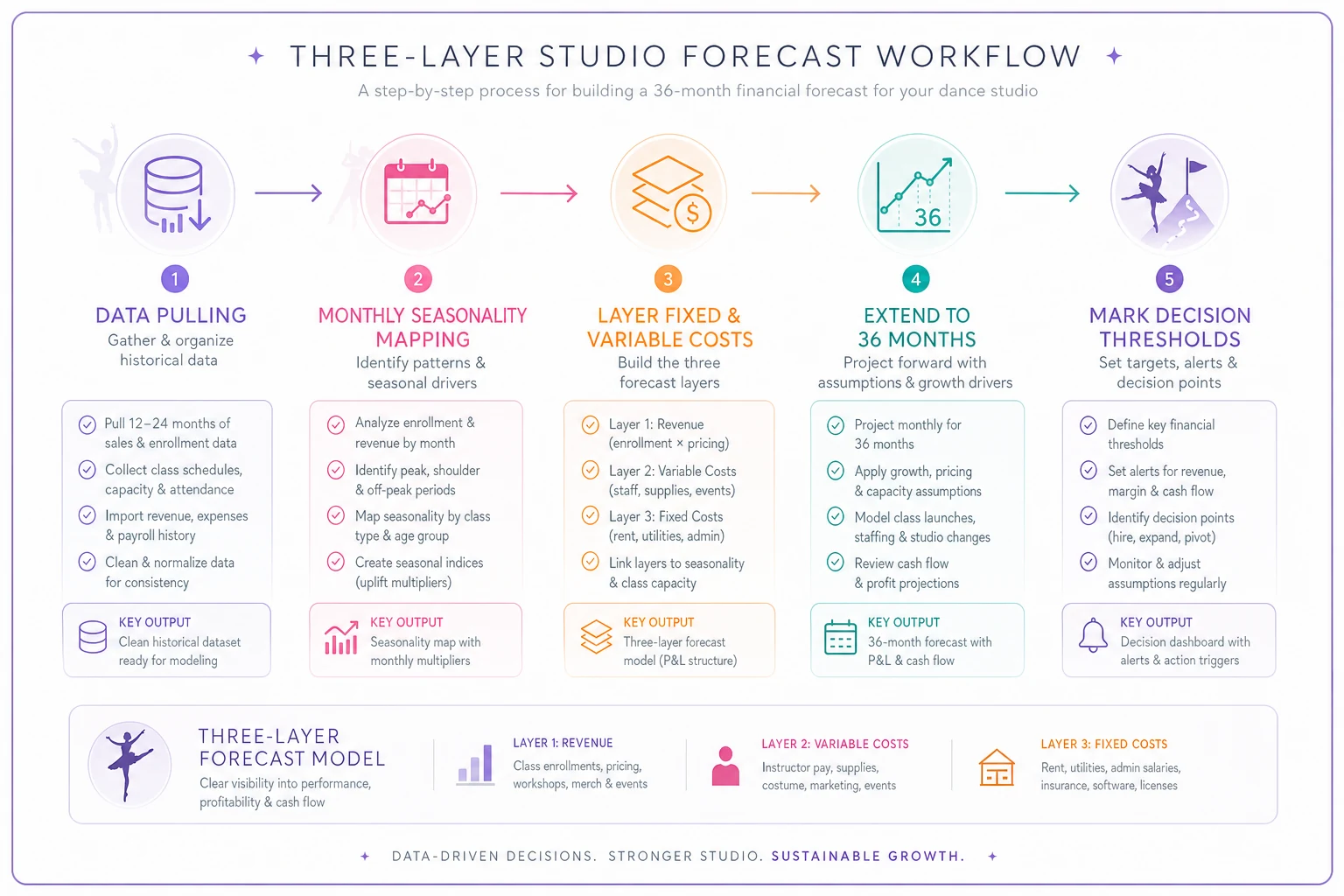
This diagram shows the step-by-step workflow of building the model.
Decision thresholds: hiring, pricing, expansion
This is the part worth spending real time on. A threshold is a pre-committed rule that removes emotion from the moment. You set it when you're calm, so you're not improvising when you're stressed or excited.
Hiring thresholds
The trap is hiring off a good month. One packed September and suddenly you're adding a salaried instructor whose cost is permanent, while the revenue that justified them was seasonal.
-
Trigger to hire classes running above ~85% capacity for 8+ consecutive weeks, and your base-case model shows the new instructor's fully-loaded cost covered within 90 days by already-enrolled students — not projected ones.
-
Hold if utilization is high but concentrated in one or two peak slots you could rebalance, fix the schedule before adding headcount.
-
Freeze if you're tracking toward your pessimistic line at the last checkpoint, no new fixed labor regardless of how one segment looks.
The distinction between enrolled and projected revenue is the whole game. Six metrics that map cleanly onto these hire/hold/freeze decisions are covered in more detail in the guide on when to hire, raise prices, or open a class — worth reading alongside this once your scenarios are built.
Pricing thresholds
Pricing decisions should key off retention strength, not just demand. High demand tempts you to raise prices; strong retention tells you that you can.
-
Green light for a standard increase (3–5%) retention holding above ~76% and fewer than a handful of price-related cancellations in the prior year.
-
Introduce a premium tier instead of a broad hike when a distinct segment — competitive team, advanced levels — is at capacity and clearly less price-sensitive. Raise there, hold the recreational base.
-
Hold prices flat if you're tracking pessimistic and seeing early attrition signals. Raising into a soft base just accelerates the churn you're trying to avoid.
Expansion thresholds (new classes, rooms, or locations)
New classes are the cheapest expansion and the one most often done badly. The failure mode is cannibalization — opening a Wednesday intermediate that just pulls students from your Monday one, leaving both half-full and neither profitable.
A workable rule: open a new class only when your waitlist plus verified new-inquiry demand exceeds ~70% of the new class's break-even headcount before you schedule it. For a class that breaks even at 10 students, you want 7+ genuinely new committed bodies, not hopeful ones drifting from existing sections.
Room or location expansion sits at a different altitude entirely. That decision should be tested against your optimistic layer holding for at least two consecutive checkpoints, because you're taking on fixed cost that a single good season can't justify.
A worked example
Take a mid-size studio — roughly $360k trailing revenue, about 240 active students, 78% retention, running near capacity on weeknight evenings but soft on weekday afternoons and Saturdays.
Base case, year one: +7% new students, 78% retention held, 3% tuition increase. Model lands around $388k–$395k revenue, with a spring cash bump and the usual December dip.
Pessimistic case: new enrollment flat, retention slips to 70% (a competing studio opens nearby), no price increase. Model drops to roughly $330k–$340k — and critically, three months go cash-negative before recovery.
Optimistic case: +13% new students, retention up to 84% on the back of a strong onboarding push, premium team tier added. Model reaches around $430k–$445k.
Now the thresholds do their job. Weeknight evenings are at 90%+ capacity for months — that clears the utilization bar for hiring. But the pessimistic scenario shows three cash-negative months. So the rule fires: hire only if the new instructor's cost is covered by enrolled students within 90 days, and only staff the peak slots that are actually full. That means a part-time evening hire, not a salaried full-timer, and no move to fill the soft Saturday block until real demand shows up on the waitlist.
The pricing call: retention at 78% clears the green light for a 3% recreational increase, plus a premium team tier where those families are already capacity-constrained and price-insensitive. The Saturday expansion: no waitlist demand yet, so it stays closed. That open afternoon slot doesn't get a new class just because the room is sitting empty.
Notice what the layered model did here. It didn't tell the owner to grow or not grow. It told them which growth move was safe given that the downside scenario had a cash-timing problem the upside scenario completely hid.
When this approach makes sense — and when it's overkill
Worth doing when: you're past roughly $200k in revenue, carrying fixed instructor costs, and making decisions that are expensive to reverse. Once you have real payroll and lease commitments, guessing gets costly fast.
Overkill when: you're a solo instructor renting space by the hour with almost no fixed costs. Your risk is low and your decisions are reversible. A three-layer 36-month model is more machinery than the situation needs — a simple monthly cash view is plenty.
Who shouldn't bother: anyone who'll build the model and then override every threshold it fires. A scenario model you ignore when it says "freeze hiring" is worse than no model, because it gives you false confidence without the discipline.
Keeping the model alive
The most common failure isn't a bad model — it's a dead one. Someone builds a solid three-scenario spreadsheet in August and never opens it again. By November reality has diverged and nobody noticed which layer they're actually tracking.
A live model needs a monthly rhythm: pull actual enrollment and cash, drop them next to your three lines, and see which one you're closest to. That check takes twenty minutes if your enrollment and payment data are already in one place, and most of a day if you're stitching together a booking tool, a spreadsheet, and your bank login. Studios that actually keep forecasting alive tend to have their operational data centralized — enrollment, attendance, payments, and instructor hours flowing into one system rather than living in four disconnected places. When that data is already structured, updating scenarios becomes a habit instead of a project.
Quick monthly forecast-review checklist
-
[ ] Update actual enrollment and revenue against all three scenario lines
-
[ ] Identify which layer you're currently tracking closest to
-
[ ] Check every active decision threshold — anything triggered this month?
-
[ ] Flag retention drift (single biggest 3-year variable)
-
[ ] Review upcoming fixed-cost commitments against the pessimistic line, not the base
-
[ ] Note any cash-negative months on the near horizon before they arrive
That check takes twenty minutes if your enrollment and payment data are already in one place, and most of a day if you're stitching together a booking tool, a spreadsheet, and your bank login.
Centralize enrollment and payment exports so monthly scenario updates take under 30 minutes.
When that data is already structured, updating scenarios becomes a habit instead of a project.
The real point
A three-year forecast for a studio isn't a prediction — it's a set of pre-made decisions waiting for a trigger. The base case runs your operations. The pessimistic case protects your cash. The optimistic case tells you when it's genuinely safe to grow instead of just tempting.
The studios that scale without blowing up their cash aren't the ones with the most optimistic forecasts. They're the ones who decided — in advance, while calm — exactly what enrollment number, retention level, and utilization rate would make them act. And then actually acted when the number showed up. Build the three layers, mark the thresholds, and check them monthly. That's the whole discipline.
A three-year forecast for a studio isn't a prediction — it's a set of pre-made decisions waiting for a trigger. The base case runs your operations. The pessimistic case protects your cash. The optimistic case tells you when it's genuinely safe to grow instead of just tempting.
The studios that scale without blowing up their cash aren't the ones with the most optimistic forecasts. They're the ones who decided — in advance, while calm — exactly what enrollment number, retention level, and utilization rate would make them act. And then actually acted when the number showed up. Build the three layers, mark the thresholds, and check them monthly. That's the whole discipline.
Ready to elevate your studio operations?
Join 500+ studios using Movioly to save time, reduce admin workload, and enhance student experiences.