

Most studio owners don't lose instructors because of one bad month. They lose them because pay, career growth, and staffing were never actually connected to each other. Each piece got handled separately — you set rates when someone was hired, you scheduled based on who was available, and you noticed turnover only after someone handed in two weeks' notice.
That disconnection is the real problem. And it compounds as you grow, because the informal system that worked with four instructors quietly breaks when you have fourteen.
This is about the governance layer underneath instructor retention — how pay philosophy, role families, career ladders, staffing forecasts, and retention signals should function as one connected system instead of five separate decisions made at different times in different moods.
The reason turnover feels random (but isn't)
When an instructor quits, owners usually land on a single explanation. "She got a full-time offer." "He wanted more money." "The commute got too long." Those reasons are real, but they're almost never the full picture.
What actually shows up across studios is that turnover clusters around predictable breakpoints. An instructor who's been teaching the same three beginner classes for two years, at the same rate, with no clear path to anything else, isn't just a pay risk. They're a risk because nothing in their role has changed in any way they can see or feel. Pay is just the most quotable reason on the way out.
-
Someone is hired at a rate that felt fair that week
-
A stronger candidate later gets hired higher for a similar role
-
Nobody adjusts the first instructor
-
The gap becomes visible — and it always does
-
Now you have a fairness problem you didn't design, you inherited it
None of that is a people problem. It's a governance gap. There was no shared logic for why people are paid what they're paid, so every individual decision drifted.
Start with pay philosophy, not pay rates
A pay philosophy is just a short, written statement of how your studio makes compensation decisions and why. It sounds bureaucratic for a small business, but it's probably the cheapest thing you can do to stop pay drift.
Eliminate scheduling headaches and missed payments.
Movioly streamlines booking, confirming, and managing every class with ease.
- Unified class and instructor scheduling
- Automated student notifications
- Integrated payment tracking
No credit card required
It answers questions like:
-
Do we pay for credentials, tenure, results, or some mix?
-
Are we aiming to be at market, above market, or below market with better perks?
-
What actually justifies a raise — time served, class load, student retention, level taught?
-
How do we handle two instructors doing the same work at different rates?
Once that exists, individual pay decisions stop being negotiations and start being applications of a rule. When an instructor asks for more money, you're not reacting emotionally — you're checking their situation against a framework everyone is measured by.
A useful test: your pay philosophy should be able to explain any instructor's rate to any other instructor without embarrassment. If it can't, you don't have a philosophy. You have a pile of individual deals.
This connects directly to the mechanics of hiring and rate-setting, which we covered in turning instructor chaos into a predictable system. The philosophy is the "why" that sits above those formulas.
Role families: stop treating every instructor as a snowflake
Studios often describe instructors one at a time — "Maria does ballet and helps with recitals, Devon does hip-hop and runs the teen program, Priya covers adult classes and subs everywhere." Every person is a custom job.
That feels personal. It's also a scheduling and pay nightmare that gets messier with every person you add.
The fix is grouping roles into families — clusters of positions that share the same core responsibilities, skill requirements, and pay band. You might end up with three or four:
| Role Family | Core Function | Typical Pay Band (hourly) | Growth Direction |
|---|---|---|---|
| Assistant / Apprentice | Support lead instructor, cover warm-ups, prep | $16–$22 | Move toward Lead |
| Lead Instructor | Own a class from planning to execution | $28–$40 | Specialize or mentor |
| Specialist / Program Lead | Run a program (competitive, adult, recital) | $38–$55 | Coordinator track |
| Coordinator / Head Instructor | Oversee other instructors, curriculum | Salary or blended | Management |
The pay bands here are illustrative — yours will depend on your market. The important part is the structure. Once instructors fit into families, three things get easier: you can forecast staffing by family instead of by person, you can slot substitutes within a family without renegotiating, and you can show someone exactly where they sit and what's above them.
That last one matters more than most owners expect. A lot of "I need more money" conversations are actually "I can't see a future here." Role families make the future visible.
Career ladders turn families into retention
Role families tell an instructor where they are. A career ladder tells them how to move up. Without the ladder, families just become boxes people feel stuck in.
A ladder doesn't need to be elaborate. For each family, define:
-
What the next role requires — specific skills, certifications, class-load thresholds, or student-retention results
-
How progress is measured — who evaluates it and on what cadence
-
What changes when they move up — pay, title, responsibilities, autonomy
-
A realistic timeline — so nobody assumes a promotion is coming next month
The subtler point: the ladder itself retains people even when nobody is actively climbing it. An instructor who knows a Specialist role exists, knows what it pays, and knows they're two credentials away from qualifying — that person behaves completely differently than one who sees a flat, endless present. They stay through the slower stretches because the stretch has a destination.
Where studios get this wrong is making the ladder aspirational fiction. If you publish a ladder and then never actually promote anyone — or promote based on favoritism instead of the stated criteria — you've made things worse. A visible fake system accelerates turnover faster than having no ladder at all.
Staffing forecasts: connecting pay to the calendar
Pay philosophy and ladders handle the "who" and "why." Staffing forecasts handle the "how many, and when."
Most studios staff reactively — a class fills, then there's a scramble for someone to teach it. That scramble is where payroll churn hides. Rush-hiring means paying above your bands to fill a gap fast, onboarding someone who leaves in a season, and quietly undermining the fairness you worked to build.
A basic staffing forecast projects, by role family, over the next two to three terms:
-
How many classes each family needs to cover
-
Expected attrition — plan for it, instructors don't stay forever
-
Enrollment growth by program
-
Coverage gaps you can see coming months out
The connection people miss: your staffing forecast should feed your career ladder. If your forecast says you'll need two more Specialists in eight months, that's not a hiring problem — that's a promotion opportunity for two current Leads. You develop from within, at your pay bands, with people who already know your studio. That's dramatically cheaper and more stable than external rush-hires.
Use staffing forecasts to identify and time internal promotions before hiring externally.
The financial triggers behind these decisions — when growth actually justifies adding headcount versus raising prices — line up with the metrics in when to hire, raise prices, or open a class. Staffing forecasts are where those financial signals turn into people plans.
The six-month retention dashboard
This is the piece almost nobody builds, and it's the one that turns everything above from a nice HR document into an actual operational system.
A retention dashboard tracks leading indicators of instructor turnover on a rolling basis — ideally reviewed monthly, but structured around six-month trends so you catch drift before it becomes a resignation.
What to track per instructor and per role family:
-
Time in current role — flag anyone past your ladder's expected timeline with no movement
-
Pay position within band — flag anyone stuck at the bottom while peers move up
-
Class-load trend — sudden drops or unsustainable spikes both predict exits
-
Schedule stability — how often their classes get shuffled or reassigned
-
Sub frequency — instructors constantly covering others burn out quietly
-
Last meaningful conversation — when did anyone actually talk to them about their growth?
The dashboard's job is to make invisible drift visible early. An instructor who's been at the bottom of their band for eighteen months, past their ladder timeline, picking up constant subs, with no growth conversation in five months — that's not a mystery resignation. That's a warning sign you could have acted on much earlier.
Operational triggers that actually do something
-
Instructor hits 12 months at bottom of pay band → schedule a rate review
-
Instructor passes ladder timeline with no promotion → growth conversation within 30 days
-
Sub coverage exceeds a set threshold in a month → workload check-in
-
Schedule reassignments exceed a threshold per term → stability review
-
No documented growth conversation in six months → mandatory check-in scheduled
[Dashboard Review] → [Threshold Crossed?] → Yes → [Trigger Assigned] → [Action Scheduled] → No → [Continue Monitoring]
It's not complicated. The value is in making it automatic enough that it actually happens.
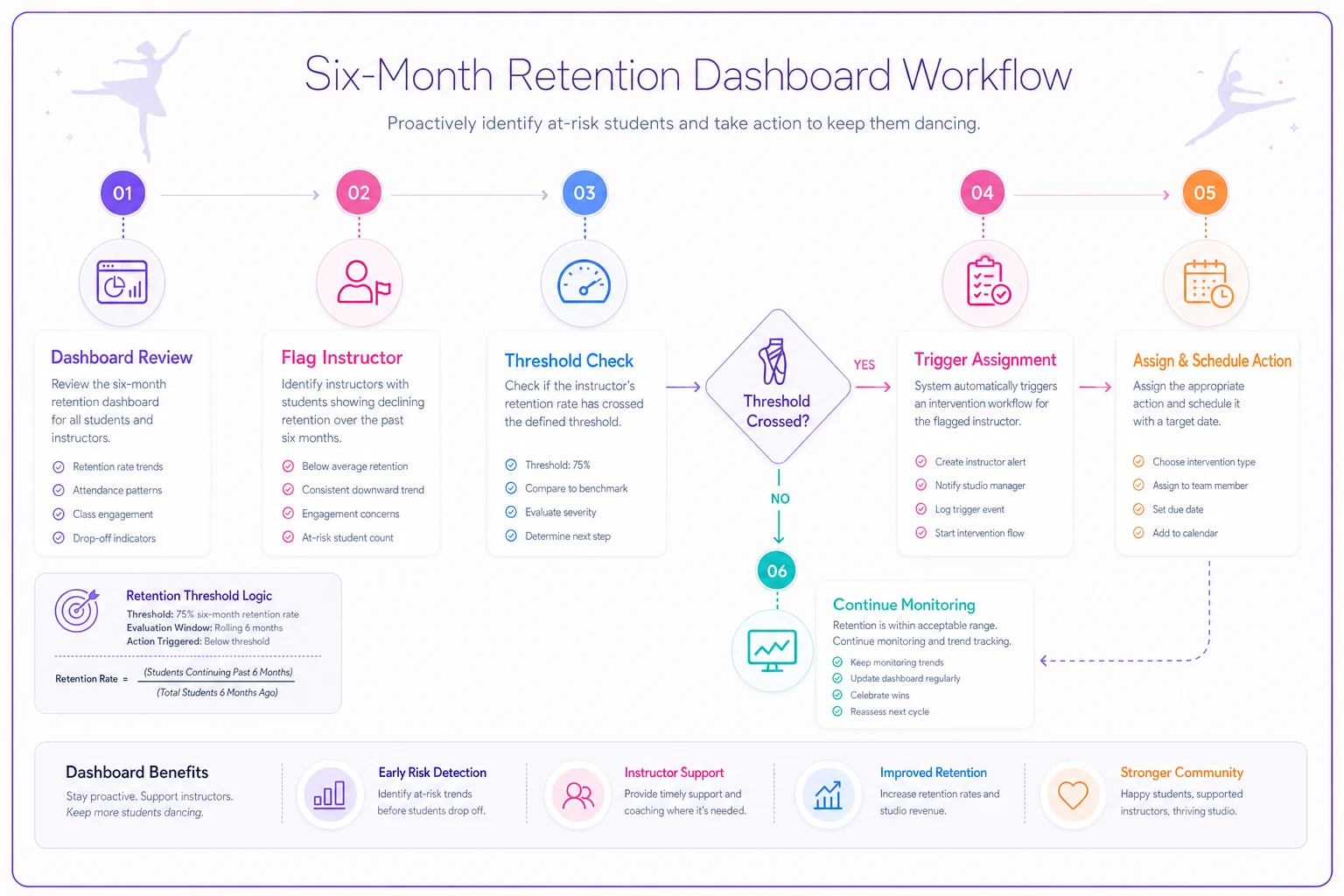
This flow shows how dashboard flags become scheduled actions instead of being missed.
A real scenario
A mid-size studio — around 320 enrolled students, eleven instructors — was losing two or three instructors a year, almost always right before recital season when they were hardest to replace. Each departure meant rush-hiring at inflated rates and reshuffling classes, which unsettled the instructors who stayed.
When they mapped it out, the pattern was obvious in hindsight. Their two longest-tenured Leads were both stuck at rates they'd had for years, while two newer hires had come in higher. There was no ladder, so neither veteran could see any path forward. Both were quietly picking up extra subs to make up the difference.
They didn't do anything dramatic. A one-page pay philosophy, four role families, a simple published ladder, and a basic monthly dashboard flagging pay position and time-in-role. The two veterans moved onto a Specialist track with a real timeline and a modest rate bump within band.
Over the following year, turnover dropped to a single departure — a relocation, not a fixable situation. Rush-hiring at above-band rates basically stopped, which quietly saved several thousand dollars in premium pay and onboarding costs they'd been absorbing every year without really tracking it. The harder-to-measure win: the studio stopped feeling fragile every spring.
Where the software layer fits
None of this requires software to start. You can build the philosophy, families, and ladder in a document this week. But the dashboard and triggers are where manual tracking tends to fall apart — tracking eleven people's pay position, time-in-role, and sub frequency across rolling six-month windows is exactly the kind of thing that gets abandoned by March.
This is where an operational platform earns its keep. When scheduling, payroll, and instructor records live in one system, the retention dashboard mostly builds itself — time-in-role, class-load trends, and sub frequency are already in the data. AI-assisted monitoring can watch those thresholds continuously and surface the triggers to you instead of waiting for you to go looking. The point isn't automation for its own sake; it's that the warning reaches you while there's still time to act on it.
That's the difference between a governance system that exists on paper and one that actually runs.
When this level of structure makes sense — and when it doesn't
When it's worth building: Once you're past roughly six or seven instructors, informal pay decisions start colliding and drift gets expensive. If turnover clusters around your busy seasons, or if you've noticed pay gaps you can't cleanly explain, you're already paying the cost of not having this structure.
When it's premature: With three or four instructors and a stable roster, the full role-family-and-dashboard setup is overkill. Write the one-page pay philosophy anyway — it's cheap insurance — but skip the machinery until you have enough people for drift to actually happen.
Who should be careful: If you publish a ladder you don't intend to honor, or build a dashboard you'll ignore, don't bother. A visible-but-fake system erodes trust faster than no system. The structure only works if the triggers fire and the promotions actually happen.
The connection people miss
Instructor retention isn't a benefits question or a pay question or a culture question in isolation. It's what happens when pay philosophy, role families, career ladders, staffing forecasts, and retention signals reinforce each other — or slowly drift apart. Sound instructor compensation governance is really just keeping those five things pointed in the same direction over time.
Studios that treat each piece separately end up managing turnover as a series of emergencies. The ones that connect them stop being surprised. They see the departure coming, they see the promotion that prevents it, and they've already scheduled the conversation. That's not luck, and it's not a better hiring instinct. It's a system doing the noticing that owners are too busy to do on their own.
Instructor retention isn't a benefits question or a pay question or a culture question in isolation. It's what happens when pay philosophy, role families, career ladders, staffing forecasts, and retention signals reinforce each other — or slowly drift apart. Sound instructor compensation governance is really just keeping those five things pointed in the same direction over time.
Studios that treat each piece separately end up managing turnover as a series of emergencies. The ones that connect them stop being surprised. They see the departure coming, they see the promotion that prevents it, and they've already scheduled the conversation. That's not luck, and it's not a better hiring instinct. It's a system doing the noticing that owners are too busy to do on their own.
Ready to elevate your studio operations?
Join 500+ studios using Movioly to save time, reduce admin workload, and enhance student experiences.