

Most studios don't lose students because the kid hated dance. They lose them because the kid quietly stopped keeping up, started dreading class, and the parent eventually heard "I don't want to go anymore" — without ever knowing a small, fixable skill gap was the root cause.
The frustrating part is how predictable it is. A 9-year-old who can't nail a pirouette while four classmates can will self-select out within a term. Not because the studio did anything wrong — but because nobody built a structured path to close that specific gap before it became an identity ("I'm the one who can't turn").
This post is about building a productized remediation pathway: a repeatable way to spot a falling-behind student, run a short targeted intervention, keep the parent in the loop, and price it in a way that protects retention instead of draining your schedule. Most owners search this topic as student remediation studio, but almost everything they find is vague advice about "giving extra attention." This is about making it operational.
The real failure: remediation is treated as a favor, not a system
The pattern in most studios goes like this. A teacher notices someone struggling. If that teacher has a spare 10 minutes, they'll pull the kid aside. Maybe. Sometimes. It depends on the day, the schedule, whether they even remember by the time class ends.
That's not a system. That's luck.
When you've got 180 students across 14 classes, the kids who get informal help are the ones with pushy parents or visible talent. The quiet middle-tier student — the one most likely to leave — gets nothing, because nobody formally flagged them.
The core problem is there's no signal definition. Nobody has written down what "falling behind" actually looks like, so every teacher judges it differently, catches it at different points, and responds inconsistently. Some catch it in week 3. Some don't catch it until attendance starts slipping.
A productized pathway fixes this by making remediation a defined product with defined triggers — not something that only happens when your most attentive instructor has a good week.
Step one: define the signals that trigger remediation
You can't run targeted remediation if you can't agree on who needs it. So the first build is a short list of observable, specific signals. Not "seems behind." Observable.
Eliminate scheduling headaches and missed payments.
Movioly streamlines booking, confirming, and managing every class with ease.
- Unified class and instructor scheduling
- Automated student notifications
- Integrated payment tracking
No credit card required
What tends to work across studios is a mix of skill signals and behavioral signals, because skill gaps and emotional withdrawal usually show up around the same time.
Skill signals (teacher-observed):
-
Can't perform a foundational element the rest of the class has moved past (e.g., still can't hold a single pirouette after 3 weeks of it being taught)
-
Consistently a half-count behind in combinations everyone else has internalized
-
Visible compensation habits that will cap future progression (gripping the barre, chronic knee misalignment)
Behavioral signals (anyone-observed):
-
Stops volunteering to go in the first group
-
Positions themselves in the back row when they used to be up front
-
Two or more "I don't feel well" early pickups in a month
-
Attendance slips from consistent to spotty
The rule worth using: one skill signal plus one behavioral signal = flag for remediation. Either alone can be noise. Together, they're a reliable predictor of dropout risk. This overlaps with the logic behind an attendance early-warning system — remediation is basically the skill-based version of that same early-detection approach.
Write these signals on one page and put them somewhere teachers actually see them. The goal is that any instructor, on any night, flags the same kid for the same reasons.
Step two: build short-curriculum templates, not open-ended tutoring
The biggest mistake studios make is treating remediation like a private lesson — expensive, open-ended, loosely planned. That's exactly why it never gets offered at scale.
Instead, build micro-session templates: 20-30 minute focused blocks that target one specific gap and nothing else. Each template should answer three things:
-
What single skill are we fixing?
-
What does "fixed" look like (the exit criteria)?
-
What's the exact drill sequence to get there?
A typical template looks like this:
| Element | Example: "Single Pirouette Recovery" |
|---|---|
| Target skill | Clean single pirouette with controlled landing |
| Session length | 25 minutes |
| Number of sessions | 2-3 |
| Drill sequence | Spotting isolation → relevé balance holds → quarter turns → half turns → full turn with spot |
| Exit criteria | 3 clean singles in a row, landing in position |
| Parent-facing summary | "Worked on balance and spotting — big improvement in control" |
The sessions are capped. Two or three, not "until they get it." This matters for two reasons: it keeps the intervention cheap enough to actually offer, and it forces realistic exit criteria instead of letting remediation quietly become permanent dependency.
Build 8-12 of these templates covering your most common gaps — turns, jumps, flexibility blocks, timing and musicality, specific technique faults by level. Most struggling students fall into a handful of buckets. You'll reuse the same templates over and over.
Step three: scheduling blocks that don't blow up your calendar
This is where good intentions usually die. Owners love the idea of remediation until they realize they have nowhere to put it.
Don't try to custom-schedule each session. That's an admin nightmare. Instead, carve out fixed remediation blocks in the existing schedule. A few options that work in practice:
-
The 15-minute wrap Last 15 minutes of certain classes become optional targeted work for flagged students while others do free practice or stretch.
-
The floating block One 45-minute slot, once a week, in an otherwise slow studio time — early evening before the rush works well. Rotate flagged students through it.
-
The pre-class micro A 20-minute slot before a regular class, where a flagged student gets focused drill time with an assistant.
A repeatable process for the floating-block model:
-
Teachers submit flags by end of each week (one skill + one behavioral signal met).
-
Admin batches flagged students by shared gap.
-
Students with the same gap get grouped into the same block — one template, two or three kids.
-
Parent gets a short notice
what the block is, when, and why.
-
After the sessions, teacher marks exit criteria met or not.
-
Not met → one more session. Still not met → escalate to a conversation, not endless repeats.
Grouping by shared gap is the unlock. Three kids who all struggle with the same turn can run the same 25-minute template together. You're not burning one-on-one time — you're running a tiny, hyper-targeted class.
Visual workflow below shows the weekly loop from flag to group to session to review.
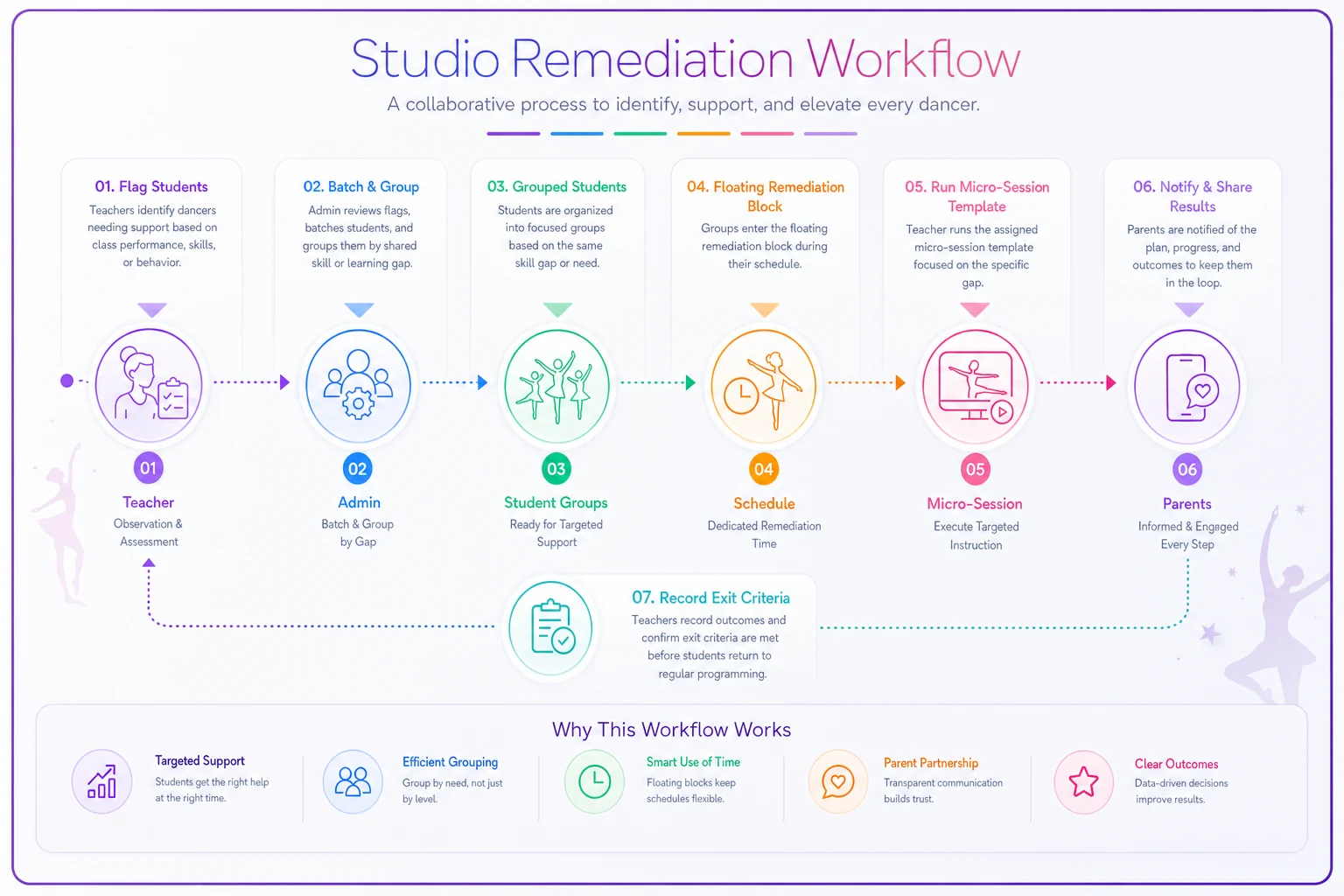
The diagram highlights how batching and fixed blocks minimize scheduling friction while keeping parents in the loop.
Step four: parent communication that frames this as support, not punishment
Say "remediation" to a parent the wrong way, and they hear "my kid is failing." Say it right, and they hear "this studio noticed my kid and is personally investing in them." Same program, completely different reactions.
The framing rule: lead with the plan, not the problem.
Bad version: "Ava is struggling with turns and falling behind the class."
Good version: "We noticed Ava's ready for a focused push on her turns — we've set up two short sessions to lock in her technique so she stays confident with the rest of the group."
A few things that keep parents on board:
-
Name the skill, not the deficiency. "Working on pirouettes" not "can't do pirouettes."
-
Give a defined endpoint. Parents accept 2-3 sessions far more easily than "ongoing extra help."
-
Report the win. When the kid hits exit criteria, tell the parent. That single message does more for retention than almost anything else.
This connects directly to making progress feel visible. Studios that already send monthly progress reports and curriculum maps have a natural slot to fold remediation wins into — the parent sees a gap identified and closed inside the same communication they already trust. That loop (problem spotted → plan → result) is what converts a near-dropout into a renewing family.
The ROI math: why this pays for itself quickly
Owners hesitate because remediation looks like a cost — teacher time you're not billing at full private-lesson rates. But the real comparison isn't "remediation cost vs. zero." It's "remediation cost vs. losing the student entirely."
A realistic example.
Say your average student pays around $140/month and typically stays about 2.5 years once committed. That's roughly $4,200 in lifetime revenue per student, not counting recital fees, costumes, and referrals.
Now say you run remediation for 10 at-risk students a term. A floating block eats maybe 45 minutes of instructor time a week — call it an assistant at $20/hour, so around $15 per session run across grouped kids. Over a full term, your direct cost for the whole program might land somewhere in the $300-$450 range.
If that program keeps even two of those ten students from quietly leaving, you've protected somewhere near $8,000+ in lifetime revenue for a few hundred dollars of instructor time. And grouped micro-sessions tend to save more than two out of ten flagged kids, because you're catching them at the exact moment the gap is still small and fixable.
A rough ROI-pricing calculator for your own numbers:
-
Avg monthly tuition × avg months retained = lifetime value per student
-
Flagged students per term × realistic save rate (start conservative, ~20%) = students retained
-
Students retained × lifetime value = revenue protected
-
Remediation cost = sessions run × cost per session
-
Revenue protected − remediation cost = net
Even with pessimistic assumptions, the math rarely comes out negative. Remediation is one of the few interventions where the downside is capped and the upside is a multi-year tuition relationship.
A real scenario
A mid-size studio — roughly 160 students, ballet and jazz focus — kept losing kids in the 8-10 age bracket right around the point turns got serious. The owner chalked it up to normal attrition. "Some kids just drift off."
When they actually mapped the departures, nearly every one in that bracket shared the same profile: a skill wall (usually turns or balance), followed by back-row behavior, followed by spotty attendance, followed by a "we're taking a break" email about six weeks later. The signal chain was almost identical every time.
They built four micro-session templates for the most common walls, carved out a single Tuesday floating block, and set the one-skill-plus-one-behavioral flag rule. Teachers flagged, admin grouped, parents got the "focused push" message.
Over the next couple of terms, the quiet drift in that age group noticeably slowed. The owner's rough estimate was keeping around 5-7 students who would have otherwise disappeared — kids who, in prior years, just faded out without anyone understanding why. The program cost almost nothing beyond a few assistant hours a week.
The unexpected side effect: teachers said they liked having it. Instead of vaguely worrying about a struggling kid with no clear next step, they had a concrete action to take. The flag itself relieved the pressure.
When this makes sense — and when it doesn't
This makes sense when:
-
You have recurring, predictable skill walls at certain levels (almost every studio does)
-
You're losing students in a specific age or level band and can't explain why
-
You have assistant instructors or dead schedule slots you can repurpose cheaply
This is a bad idea when:
-
You try to make it a premium paid add-on from day one. That reframes it as "pay more or your kid falls behind," which breeds resentment. Run it as included support first; monetize carefully later, if at all.
-
You let sessions go open-ended. Without exit criteria, remediation becomes a permanent crutch and a scheduling black hole.
-
You skip the parent communication. Silent remediation can read as singling a kid out, which tends to backfire.
Who should hold off: a brand-new studio with 30 students and one teacher. At that size you already are the remediation system — you know every kid's weak spot. Build this out when informal attention stops scaling, usually somewhere past 80-100 students.
The quick-start checklist
A short actionable list to get started quickly.
-
- [ ] Write one page of signal definitions (skill + behavioral)
-
- [ ] Set your trigger rule (we suggest one skill signal + one behavioral signal)
-
- [ ] Build 8-12 short-curriculum templates for your most common gaps
-
- [ ] Give each template hard exit criteria and a session cap (2-3)
-
- [ ] Carve out a fixed remediation block in your existing schedule
-
- [ ] Create a weekly flag → group → notify → review loop
-
- [ ] Write parent-message templates that lead with the plan, not the problem
-
- [ ] Set up a win-report so parents hear when the gap closes
-
- [ ] Run your own ROI numbers before second-guessing the cost
Use this as a launch checklist and iterate based on what actually fits your schedule and culture.
The takeaway
The students you lose to "they just lost interest" are usually students who hit a wall nobody caught, got embarrassed, and quietly checked out. A remediation pathway isn't about being a nicer studio — it's about having a defined system that catches the gap early, closes it cheaply, and tells the parent the story along the way.
Most of what makes this work is boring and operational: written signals, capped templates, a fixed scheduling block, a communication script. None of it is glamorous. But it's the difference between a studio that reacts to dropouts after the fact and one that quietly prevents them — one small, fixable skill gap at a time.
Most of what makes this work is boring and operational: written signals, capped templates, a fixed scheduling block, a communication script. None of it is glamorous. But it's the difference between a studio that reacts to dropouts after the fact and one that quietly prevents them — one small, fixable skill gap at a time.
Ready to elevate your studio operations?
Join 500+ studios using Movioly to save time, reduce admin workload, and enhance student experiences.