


The frustrating thing about cohort analysis in a dance studio is that the data almost always exists. Enrollment dates, class rosters, payment history, attendance logs — it's all there. But raw cohort tables don't tell you what to do on a Tuesday morning. They tell you that your September fall enrollees churned faster than your January ones, and then nothing happens. The report gets looked at and closed.
The gap isn't measurement. It's the connection between a cohort signal and an actual operational move. A studio that groups families the right way, watches the right windows, and has a pre-built response ready when a signal fires is running a completely different business than one that pulls a spreadsheet every quarter and sighs at it.
This post is about building that connection — the taxonomy, the timing, and the triggered playbooks that turn dance studio cohort analysis from a reporting exercise into something that changes what your front desk does this week.
Why generic cohort buckets fail dance studios
Most cohort advice comes from SaaS and e-commerce, where a cohort is simply "everyone who signed up in month X." That works when your product and customer are uniform. A dance studio is not uniform. A 4-year-old in a Saturday creative movement class and a 15-year-old on the competition team are not the same customer, don't churn for the same reasons, and shouldn't be measured on the same clock.
When you bucket everyone by signup month, you blur signals that matter. Your competition-team families might retain at 90%+ year over year while your recreational preschool families churn at 40% after recital — but blend them into one "spring 2025 cohort" and the average looks fine while a real problem hides underneath.
What actually works is a taxonomy built around how families behave and why they leave. The cohorts that predict revenue are almost never the ones easiest to pull from a report. They're the ones that reflect commitment level, entry point, and lifecycle stage.
A studio-specific cohort taxonomy
Here's a starting framework. You don't need all of these — pick the four or five that map to how your studio actually makes money.
| Cohort dimension | Example segments | What it predicts |
|---|---|---|
| Entry point | Trial-to-enroll, referral, recital-season walk-in, sibling add-on | Onboarding needs, early churn risk |
| Commitment tier | Recreational (1 class), multi-class, company/competition | Lifetime value, re-enroll likelihood |
| Age/program stage | Preschool movement, youth rec, teen, adult | Churn timing, upsell paths |
| Enrollment season | Fall term, January restart, summer intensive | Retention curve shape |
| Family structure | Single-student, multi-sibling, alumni-connected | Re-enroll and referral behavior |
| Payment behavior | Auto-pay, manual monthly, package prepay | Dunning risk, retention stability |
The point of layering these is that a single family sits at an intersection. "Fall-enrolled, recreational, single-student, preschool, manual-pay" is a high-churn profile you can actually act on. "January-enrolled, competition, multi-sibling, auto-pay" is your most stable revenue and probably your best referral source.
Once you see families as intersections instead of signup dates, the whole analysis gets sharper.
Measurement windows: when to look matters as much as what you look at
The second mistake is measuring on the wrong clock. Studios love annual retention numbers, but annual is too slow to act on and too coarse to explain anything. By the time your year-over-year retention drops, those families are long gone.
Eliminate scheduling headaches and missed payments.
Movioly streamlines booking, confirming, and managing every class with ease.
- Unified class and instructor scheduling
- Automated student notifications
- Integrated payment tracking
No credit card required
-
Days 0–30 (onboarding window) Did the new family attend consistently in the first four weeks? Early attendance in this window is the single strongest predictor of whether they make it to month three.
-
Days 30–90 (habit window) This is where recreational families either lock in or quietly fade. Watch for the second missed class and the first "can we pause?" message.
-
Pre-recital and post-recital (the cliff) Recital is both your best retention tool and your biggest churn trigger. Families who signed up for the recital often leave right after. Measure this cohort separately every single year.
-
Re-enroll window (season transition) The 3–4 week period where families decide whether to sign up for the next term. Miss this window and you're doing win-back instead of retention, which is far more expensive.
-
Summer bridge Families who don't enroll in anything over summer return at a much lower rate. This gap is measurable and predictable.
A pattern worth internalizing: the same family looks totally healthy in an annual view and clearly at-risk in a 30-day view. The window you choose determines whether you catch the problem while you can still do something about it. If you want to see how attendance signals feed into early intervention, the approach in Catch dropouts early: a simple attendance early-warning system and outreach playbook pairs directly with these windows.
Template analyses you should actually run
You don't need a data scientist. You need a handful of repeatable analyses that you run on the same schedule every term. The value is in the repetition, not the sophistication.
The retention curve by commitment tier. Plot the percentage of each cohort still enrolled at 30, 60, 90 days and end-of-term. Do this separately for recreational vs. multi-class vs. competition. What you're looking for is where the curve bends. If recreational families fall off a cliff at day 45, that's a specific, fixable onboarding or scheduling problem — not a vague "retention issue."
The entry-point survival comparison. Compare how trial-converts, referrals, and walk-ins retain over the same window. A common finding: referral families retain dramatically better and cost nothing to acquire, but studios spend all their marketing energy on paid trials. The cohort data quietly argues for redirecting that effort.
The recital cliff analysis. Take everyone who enrolled within 8 weeks of a recital. Track how many re-enroll for the following term. If this number is low — and for a lot of studios it hovers around 30–40% — you have a recital-driven churn pattern that needs its own playbook, not a general retention email.
The sibling and family-lifetime view. Group by household, not by student. Multi-sibling families and alumni-connected families behave completely differently and are worth building a whole system around. The family lifecycle angle is covered in depth in Lock revenue into cohorts: a family lifecycle system for enrollment, re-enrollments and alumni revenue, and it pairs naturally with cohort measurement.
The mistake here is running these once, finding something interesting, and moving on. A cohort analysis you run twice a year, on the same windows, becomes a trendline. A one-off is just trivia.
Triggered playbooks: connecting a signal to an action
This is the part almost everyone skips. A cohort signal is worthless until it's wired to a response. A triggered playbook is simply: when this cohort hits this signal in this window, do this specific thing.
Here are the three core playbooks most studios need.
Here's a simple workflow illustration.
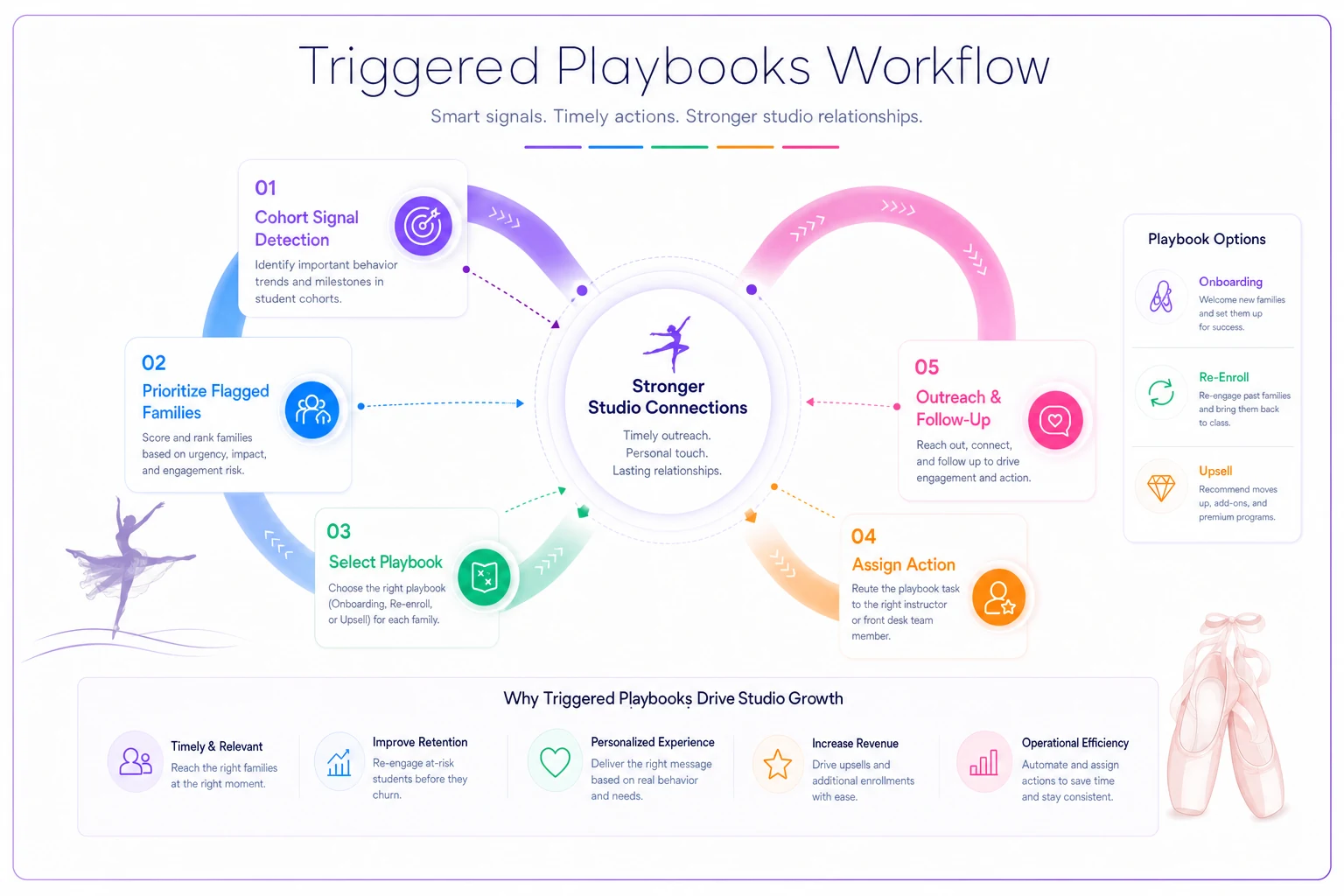
Onboarding playbook (Days 0–30)
Trigger: A newly enrolled family in the 0–30 window misses a second class, or hasn't attended in 10+ days.
-
Personal message from the actual instructor, not the front desk — "we missed [child] this week"
-
Confirm the class placement still feels right (wrong-level placement is a huge early-churn cause)
-
Offer a make-up slot before they mentally file the class as "not working"
The reason instructor-sent matters: onboarding churn is usually about connection, not logistics. A family that feels seen in week two rarely leaves in week eight.
Re-enroll playbook (season transition window)
Trigger: Current family with strong attendance hasn't registered for next term, and the re-enroll window is 2 weeks from closing.
-
Early-bird re-enroll offer sent before the general announcement, framed as "your spot is held"
-
For families with schedule conflicts, proactively offer the alternate class times you already know they can make
-
Flag any family whose preferred class is nearly full — scarcity here is honest and effective
The pattern to notice: re-enroll is won by sequence, not by discount. Families who get a personal, early nudge re-enroll at meaningfully higher rates than families who wait for the mass email.
Upsell playbook (habit window and beyond)
Trigger: A single-class recreational family with high attendance and 90+ days of tenure — clearly committed but under-enrolled.
-
Suggest a complementary second class based on what the student already takes (a ballet kid who might love jazz)
-
For families showing competitive interest, invite to a company audition or pre-team track
-
Time the ask to a moment of visible progress — right after a recital or a level-up, not randomly
Upsell fails when it's generic and mistimed. It works when the cohort signal tells you the family is already ready and you simply name the next step.
Prioritization rules: you can't act on everything
Once you have triggers firing, you'll immediately have more flagged families than time to handle them. This is where studios get overwhelmed and abandon the whole system. The fix is a simple prioritization rule set.
Focus first on families with high revenue-at-stake and high reversibility.
-
Revenue at stake — a multi-sibling competition family outweighs a single recreational student
-
Reversibility — a family in the 0–30 window is far more saveable than one who already ghosted for a month
-
Signal strength — two missed classes plus an unopened email is more urgent than one absence
-
Effort required — a one-message nudge that saves a stable family is a better use of the next 10 minutes than a complex win-back
A workable weekly rhythm: pull the flagged list, sort by revenue-at-stake and reversibility, and handle the top slice your team can realistically touch that week. Everything below the line gets a lighter, templated touch rather than nothing.
The insight most owners miss: three high-priority outreaches done well beats twenty rushed ones badly. Prioritization isn't about triage guilt — it's about protecting the outreach that actually converts.
A short real scenario
A mid-sized studio with around 300 enrolled students was looking at flat top-line revenue and assuming they needed more marketing. When they finally split retention by cohort instead of viewing it in aggregate, the story changed. Their competition and multi-sibling families were retaining beautifully — well above 85% term to term. The leak was almost entirely recreational preschool families enrolled in the fall, dropping off in the 30–90 day window and again right after recital.
They built two triggered playbooks: an instructor-led onboarding nudge in the first month, and a pre-recital "what's next after the show" re-enroll sequence aimed specifically at that shaky cohort. Nothing fancy — just the right message to the right families at the right window. Over the following two terms, that recreational cohort's day-90 retention climbed from the low 60s into the high 70s. On roughly 120 families in that segment, holding onto even 15–20 more per term added up to a noticeable revenue difference without spending a dollar on new leads. The marketing "problem" was actually a cohort-and-timing problem the whole time.
When this makes sense — and when it doesn't
When cohort-triggered playbooks are worth building:
-
You have at least a few hundred enrollments, enough that patterns are real and not noise
-
You have distinct program types (rec, competition, adult) that clearly behave differently
-
You're seeing flat growth despite steady new enrollment — a sign of a retention leak hiding in aggregate numbers
When it's premature:
-
You're a brand-new studio with 30 students; you don't have cohorts yet, you have individuals, and you should just talk to all of them personally
-
Your data is scattered across paper, a booking tool, and three spreadsheets — fix the data foundation first, because triggers built on messy data fire wrong and erode trust fast
Who should not start here:
owners whose churn is driven by something structural — bad scheduling, an unreliable instructor, a facility issue. Cohort playbooks won't rescue families leaving for a real, fixable operational reason. Solve the root cause first, then use cohorts to catch the residual, individual-level churn.
Where the tooling quietly earns its keep
None of this requires a data team, but it does require your signals to live in one place. The reason most cohort analysis dies in a spreadsheet is that enrollment data, attendance, and payment history live in separate systems, and stitching them together by hand every term is exhausting. When those pieces sit in one workflow platform, cohorts can be defined once and refreshed automatically, and triggers can surface the flagged list to your front desk without anyone rebuilding a report from scratch.
That's the practical role of AI-assisted operational software here — not to replace the judgment of who to call and what to say, but to watch the windows, surface the right families at the right moment, and hand your team a prioritized list instead of a raw data dump. The human touch still closes the retention. The system just makes sure the right family shows up on that list before it's too late to act.
Bringing it together
Cohort analysis stops being an academic exercise the moment you connect three things: a taxonomy that reflects how your families actually behave, measurement windows that match your studio's real rhythm, and playbooks that fire a specific action when a specific signal appears. Group families by intersection, not signup date. Watch the 0–30, the 30–90, and the recital cliff. Wire each signal to an onboarding, re-enroll, or upsell response, and prioritize by what's actually at stake.
The studios that grow steadily aren't usually the ones with the most enrollments coming in the front door — they're the ones who noticed which families were slipping out the side door, and had a plan ready before those families were gone.
Ready to elevate your studio operations?
Join 500+ studios using Movioly to save time, reduce admin workload, and enhance student experiences.