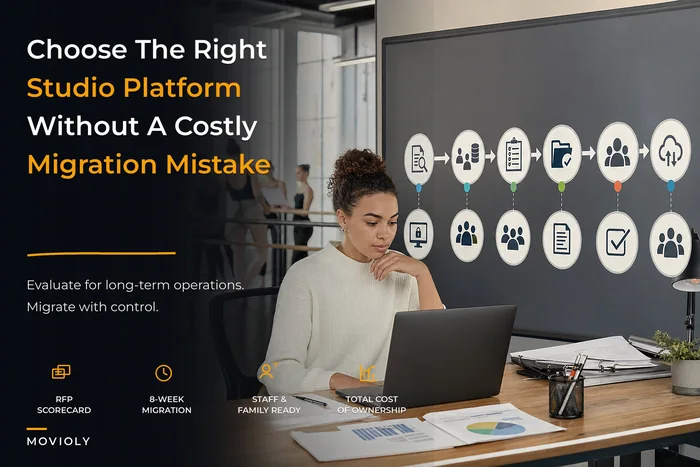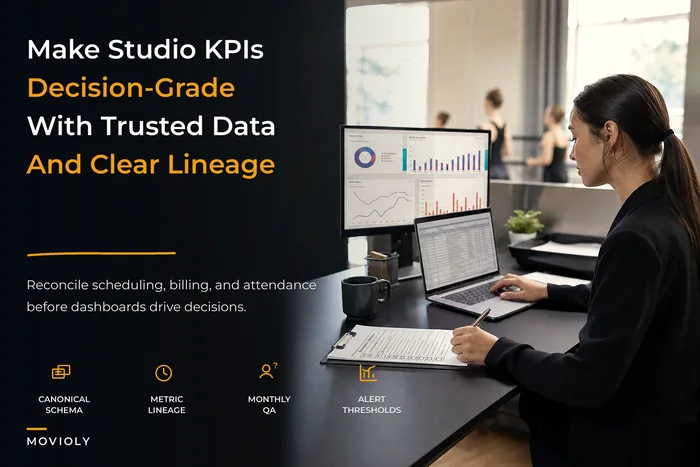

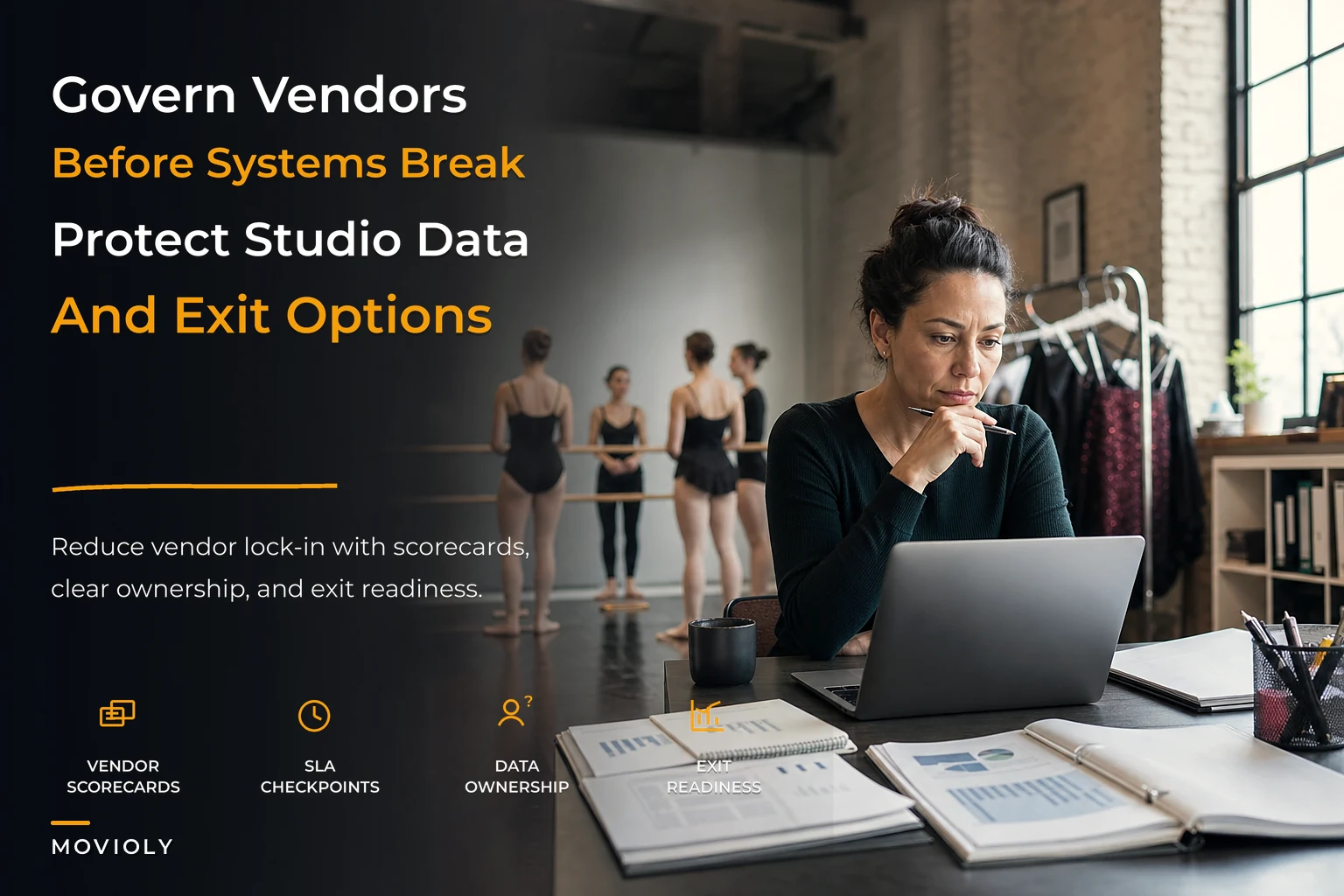

Most studios don't choose their technology. They inherit it. Someone picked a scheduling platform in 2019 because a friend recommended it, bolted on a payment processor, added a texting tool, and now the whole operation runs on five vendors nobody fully understands. Contracts auto-renew. Data lives in systems you can't export cleanly. And when one vendor raises prices 22% or gets acquired, you find out pretty quickly how little leverage you actually have.
That's the problem studio vendor governance solves — not through legalese, but through a handful of repeatable habits that keep your vendors accountable and your studio portable. This isn't about becoming a procurement department. It's about never being in a position where a single vendor can hold your student records, billing, or schedule hostage.
Here's how the whole system works, where it breaks, and the specific documents that keep you in control.
Why fragility creeps in quietly
Vendor fragility almost never arrives as a single bad decision. It accumulates.
A studio signs up for a platform when it has 90 students. The pricing is fine, the features cover the basics, and nobody reads past the monthly rate. Two years later the studio has 280 students, three locations' worth of scheduling complexity, and a payment history completely entangled in that one vendor. The switching cost isn't the subscription fee anymore — it's the terror of migrating two years of billing data, family records, attendance history, and automated workflows.
This is where owners get stuck. They know the vendor is mediocre. They know they're overpaying. But leaving feels harder than staying, so they renew. That gap between "this vendor is fine" and "I literally cannot leave" is where fragility lives.
The uncomfortable part: the vendors that lock you in hardest are rarely the ones you'd describe as predatory. They just made exporting awkward, let the relationship drift, and suddenly leaving became unthinkable. Governance is the discipline of never letting that drift happen.
The three failure points that actually hurt studios
Before any templates, it's worth naming where vendor relationships actually break — because each failure point needs a different safeguard.
Eliminate scheduling headaches and missed payments.
Movioly streamlines booking, confirming, and managing every class with ease.
- Unified class and instructor scheduling
- Automated student notifications
- Integrated payment tracking
No credit card required
Data captivity. Your student records, medical notes, consents, and billing history belong to you — until you try to get them out and discover there's no clean export, or it strips half the fields you need. This is what turns a two-week migration into a three-month nightmare.
Price and term creep. Auto-renewal plus annual increases plus feature-gating slowly inflates your spend. Studios often don't notice until they add up what they're paying across four or five tools and realize it's $900–$1,200 a month for software that used to cost half that.
Operational dependency with no exit plan. When a vendor's automation runs your reminders, dunning, and enrollment flows, and you have no documented understanding of how those flows work, you can't leave even if you want to. The institutional knowledge lives inside their system, not yours.
Good governance addresses all three — captivity, creep, and dependency — with lightweight documents and a yearly rhythm. None of it requires a lawyer on retainer. Most of it is a spreadsheet and a calendar reminder.
A procurement scorecard that filters out future pain
Governance starts before you sign anything. The goal of a procurement scorecard isn't to pick the flashiest product — it's to weight the factors that predict whether a vendor will become a trap.
Most studios score vendors entirely on features and price. That's exactly backwards. Features are easy to evaluate and easy to match; what's hard to recover from is a vendor who makes your data difficult to extract. The scorecard should overweight exit factors.
Here's a weighting structure that reflects what actually matters at scale:
| Evaluation category | Weight | What you're really scoring |
|---|---|---|
| Data ownership & export quality | 25% | Can you get ALL your data out, in usable formats, anytime? |
| Core feature fit | 20% | Does it handle your real workflows, not the demo ones? |
| Pricing transparency & term flexibility | 15% | Month-to-month option? Clear increase caps? |
| Integration & interoperability | 15% | Open API, or walled garden? |
| Support responsiveness | 10% | Real humans, documented SLAs |
| Security & compliance | 10% | Encryption, access controls, breach notification |
| Vendor stability | 5% | Funding, longevity, acquisition risk |
When data ownership carries more weight than features, you naturally avoid vendors that would eventually trap you. Studios that score this way tend to pick slightly less feature-rich tools that are dramatically easier to leave — and that tradeoff pays off every time a switch becomes necessary.
If you want the full RFP mechanics and TCO modeling that sits underneath this scorecard, our procurement playbook for studio owners breaks down the evaluation process in more detail. This article focuses on the governance layer that comes after you've chosen.
RFP questions that reveal lock-in before you sign
The questions you ask a vendor during evaluation tell you more than their marketing ever will. The best ones are questions salespeople don't have a smooth answer for.
Ask these, and watch how they respond:
-
"Can you show me a complete data export right now, including custom fields and attachments?" If they can only export "most" fields, assume you'll lose the rest when you leave.
-
"What's your historical annual price increase over the last three years?" Vagueness here is a forecast.
-
"If I cancel, how long do I have to retrieve my data, and in what format?" You want a documented window, not a verbal promise.
-
"Do you charge for API access or export?" Paying to get your own data out is a red flag that compounds over time.
-
"What happens to our data if you're acquired or shut down?" Acquisitions reshuffle priorities fast.
-
"Can we go month-to-month after the first term?" Perpetual annual lock-in is a negotiation point, not a law.
A vendor who answers these cleanly and in writing is signaling they expect to earn your renewal, not trap you into it.
The SLA checklist most studios skip
Service-level agreements sound like enterprise territory, but a one-page version protects any studio. Without one, the failure mode looks like this: your payment system goes down on the first of the month when tuition runs, support takes three days to respond, and you have no recourse because nothing was ever defined.
Your minimal SLA should pin down:
-
Uptime commitment — a stated percentage, with what happens if they miss it (service credits, usually).
-
Support response times — differentiated by severity. A payment outage isn't the same as a feature question.
-
Maintenance windows — scheduled downtime announced in advance, never during your billing run.
-
Data backup frequency — how often, and how quickly they can restore after a problem.
-
Breach notification timeline — how fast they tell you if your families' data is exposed.
-
Escalation path — an actual name or channel for when normal support fails you.
Vendors rarely offer these terms proactively, but mid-market platforms will often agree to reasonable SLA language if you simply ask during contracting. The studios that ask get protection. The ones that don't find out the hard way during an outage.
Data-ownership clauses in plain language
This is the single most important governance element, and it fits in a few sentences you can request in writing. You don't need a lawyer — you just need to insist the contract says these things:
-
You own your data. The vendor is a custodian, not an owner.
-
You can export all of it, anytime, in a standard format (CSV, JSON) at no extra charge.
-
Upon termination, you get a defined retrieval window — 30 to 90 days is reasonable — before anything is deleted.
-
The vendor won't sell, share, or use your student data beyond providing the service.
-
Deletion on request — when you leave, they confirm in writing that your data is purged.
The reason data ownership matters this much: everything downstream — your KPIs, your reporting, your ability to make decisions — depends on being able to get clean data in and out of your systems. A studio that can't trust or extract its own records is flying blind.
If you want to see how data quality connects to actual decision-making, our studio data governance blueprint covers how clean records become reliable numbers you can actually run the business on.
The annual vendor risk review
Governance isn't a one-time event at signing. It's a yearly rhythm. Block two hours once a year — most studios tie it to fiscal-year planning — and run every vendor through the same quick review.
Four questions per vendor:
-
Are we still using what we're paying for? Studios routinely pay for tools or tiers they've outgrown or stopped touching.
-
Has the price crept, and is it still justified? Add up the real annual spend, not the monthly number that feels small.
-
Has anything changed with the vendor? Acquisition, major outages, degraded support, a feature you depend on getting sunset.
-
How painful would it be to leave right now? This is your captivity score, and it should be getting easier over time, not harder.
A realistic finding from this kind of review: a studio discovers it's paying for a premium communications tier at around $140 a month that overlaps almost entirely with features already in its main platform. Nobody chose to double-pay — it accumulated. The annual review is the only thing that catches drift like that before it runs for another year.
When tighter vendor governance makes sense — and when it's overkill
Not every studio needs the full apparatus.
This matters most when you have more than a couple hundred students, multiple integrated tools, meaningful recurring revenue flowing through a vendor, or any plans to add locations. At that scale, a single vendor failure or forced migration can genuinely threaten operations.
This is lighter-touch when you're a small studio running one simple tool with under a hundred students. You still want the data-ownership clause and a clean export — those are non-negotiable at any size — but quarterly scorecards are overkill. A yearly glance is plenty.
Who should not over-engineer this: brand-new studios still figuring out their model. Spending weeks building vendor-risk frameworks before you have 40 students is procrastination dressed up as diligence. Get the data-ownership basics right, then grow into the rest.
An exit-readiness runbook
The best protection against lock-in is being able to prove — to yourself — that you could leave in a weekend if you had to. Not because you plan to, but because that capability is your entire source of leverage. A vendor who knows you can walk treats you differently than one who knows you can't.
Build a simple exit-readiness runbook for your critical vendors and keep it current:
-
Export test. Once a quarter, actually download a full data export and open it. Confirm the fields you need are there. Store it somewhere safe.
-
Workflow documentation. Write down how your automations work — reminders, dunning, enrollment flows — in plain language, independent of the vendor's system. This is the institutional knowledge that otherwise stays locked inside their platform.
-
Integration map. List every tool connected to this vendor and what breaks if the connection does.
-
Replacement shortlist. Keep a rough note of two viable alternatives, so "who would we even switch to?" is never the thing that stops you.
-
Migration time estimate. A realistic guess at how long switching would take, updated yearly.
Studios that run quarterly export tests almost never get burned by migrations, because they've already proven the data comes out clean. The ones that assume it works and never check are the ones who discover the gaps at the worst possible moment.
Store quarterly export files in a versioned cloud folder to ensure you can access historical snapshots.
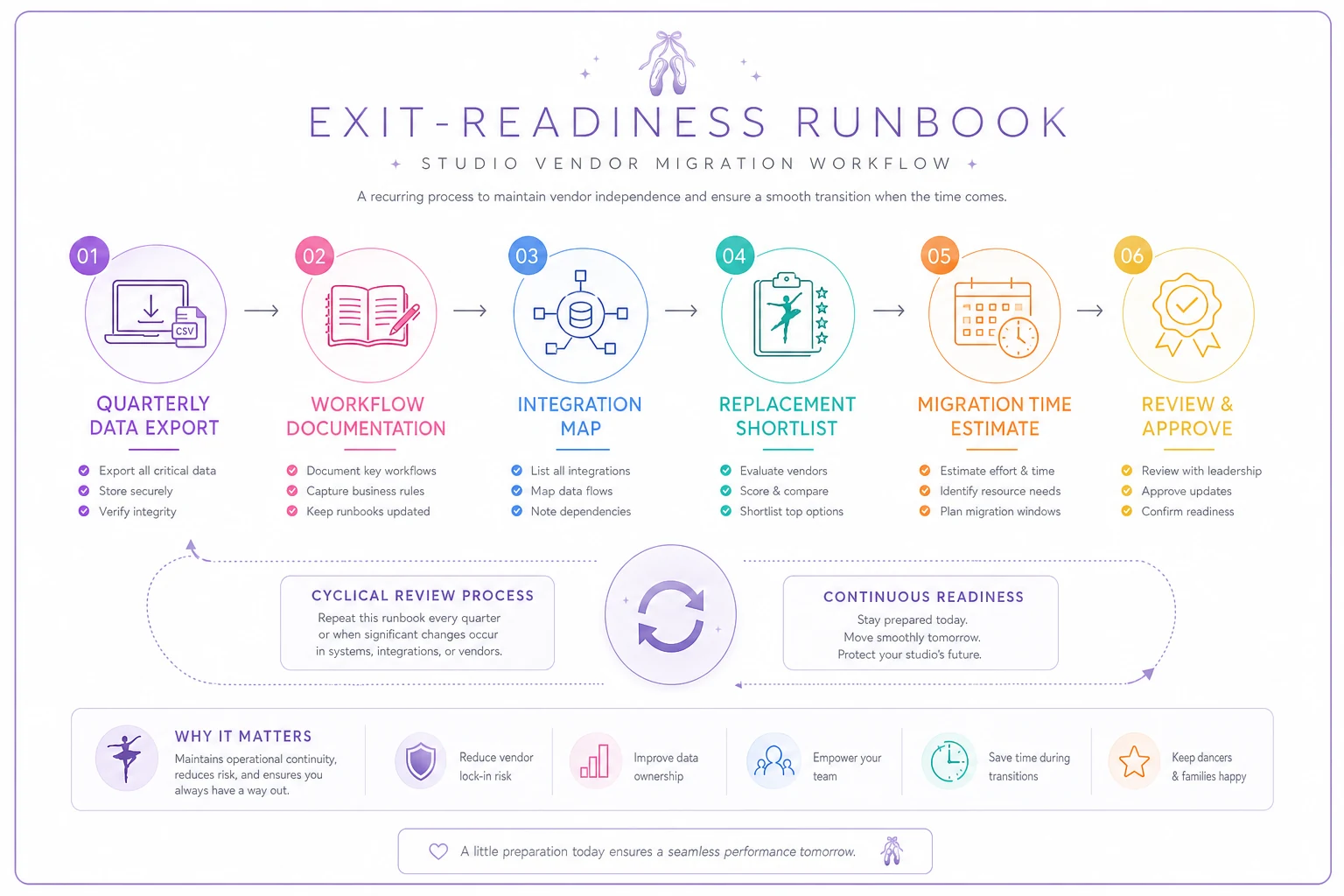
Here's a quick visual of the runbook workflow.
A real scenario
A two-location studio with about 310 students was running on an all-in-one platform plus two bolt-on tools for texting and email. Total software spend had crept to roughly $1,100 a month, up from around $700 when they started — mostly through tier upgrades and add-ons nobody formally approved.
When they ran a vendor risk review, three things surfaced. The texting tool duplicated features already in their main platform. Their contract auto-renewed annually with no price cap and a 4–6% yearly increase baked in. And when they tested a data export, roughly a third of their custom family fields came out blank — meaning a migration would've required re-entering hundreds of records by hand.
They didn't blow everything up. They dropped the redundant texting tool (saving around $140/month), negotiated a price-increase cap into the next renewal by simply asking for it, and pushed the vendor to fix the export gap — which the vendor did, because the studio made clear it was evaluating alternatives. Nothing dramatic. Within a year their spend was back under $900, their data was genuinely portable, and the relationship had shifted from "we're stuck" to "we're choosing to stay." That shift is the entire point of governance.
Minimal contract clauses that reduce lock-in
You don't need a custom legal agreement for every vendor. You need a short list of clauses you try to get into any contract, pushing hardest on the data and term language. In plain English, request:
-
Data ownership and export "Customer owns all data. Customer may export all data in standard formats at any time at no additional cost."
-
Termination and retrieval "Upon termination, Customer has [60] days to retrieve all data before deletion."
-
Price protection "Annual price increases shall not exceed [X]% without [60] days' notice and the right to terminate."
-
Term flexibility "After the initial term, this agreement converts to month-to-month."
-
Data handling "Vendor shall not sell or share Customer data and will delete it upon request following termination."
Not every vendor accepts every clause. But asking costs nothing, and the ones who agree are telling you they're confident enough in their product to earn your renewal rather than trap you into it.
Asking also signals that you're paying attention — which changes how they treat the account. Vendors who know their clients are watching tend to respond faster and negotiate more reasonably at renewal time. That alone is worth the five minutes it takes to put these clauses in an email.
Pulling it together
Studio vendor governance isn't a legal exercise or an enterprise luxury. It's the set of habits that keep a growing studio from waking up one day dependent on a vendor it can't afford to leave. The scorecard filters out future traps. The SLA and data-ownership clauses protect you while the relationship is healthy. The annual review catches drift. And the exit runbook keeps leverage on your side.
The studios that stay portable aren't the ones with the best lawyers — they're the ones who test their exports, read their renewals, and refuse to let a vendor relationship drift into captivity. Build the rhythm once, keep it light, and you'll never again be surprised by what your software can do to you.
The studios that stay portable aren't the ones with the best lawyers — they're the ones who test their exports, read their renewals, and refuse to let a vendor relationship drift into captivity. Build the rhythm once, keep it light, and you'll never again be surprised by what your software can do to you.
Ready to elevate your studio operations?
Join 500+ studios using Movioly to save time, reduce admin workload, and enhance student experiences.