

Most studios don't fail because they lack a plan. They fail because the plan lives in four different places — enrollment numbers in one spreadsheet, the hiring timeline in the owner's head, promo dates in a marketing doc nobody opens, and the actual class schedule buried in the software. Each of these runs on its own clock. And because they run on separate clocks, they drift out of sync in ways you only notice when it's already too late to fix cheaply.
The symptom shows up as the same recurring problems every year. You open a new class and realize three weeks in there's no instructor who can actually teach it. You launch a fall promo but the schedule is already full, so you've paid for ads driving signups you can't absorb. You hit recital season and suddenly realize your part-time staff can't cover the extra hours. None of these are isolated mistakes — they're what happens when programming, staffing, and marketing aren't tied to the same timeline.
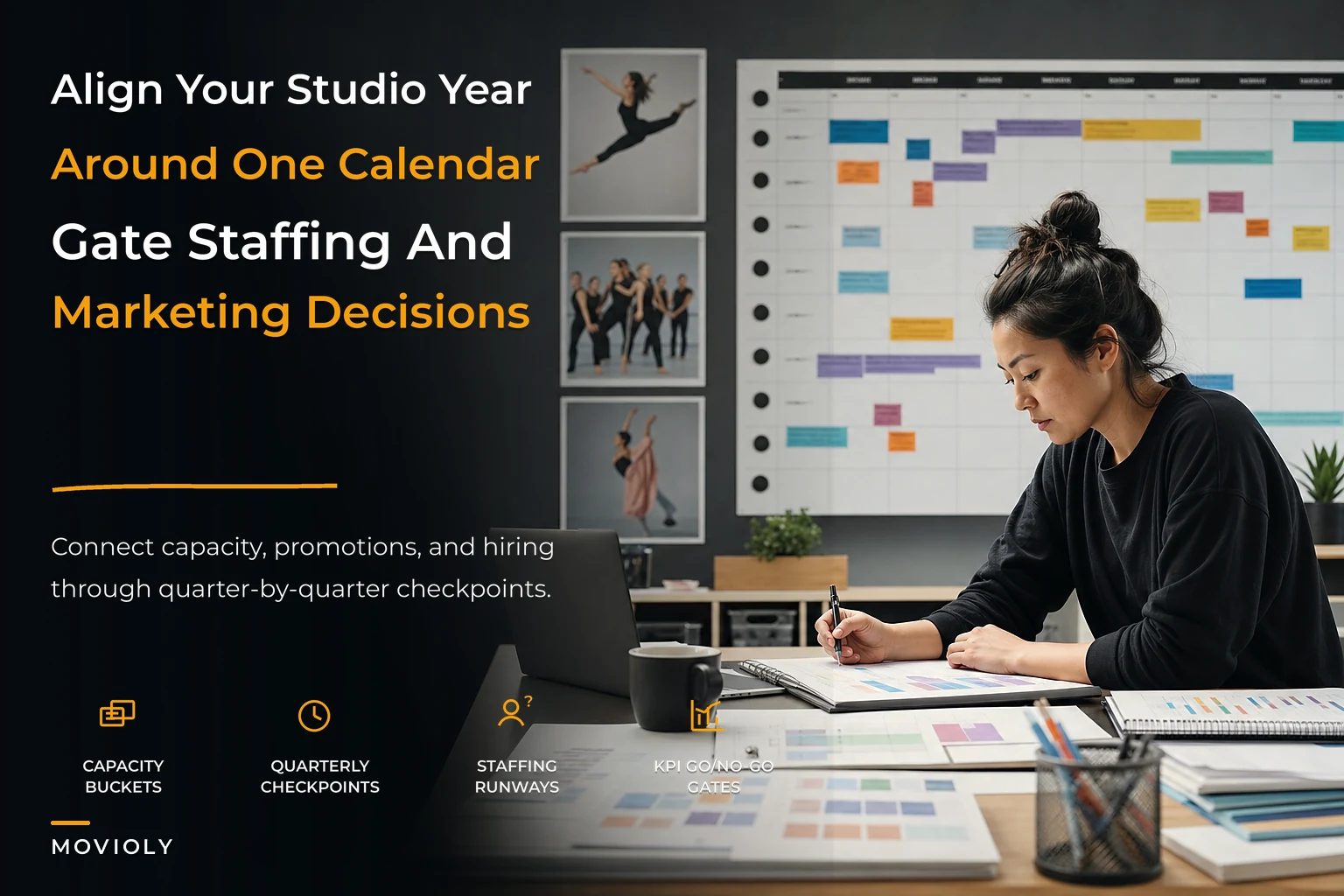
An annual studio operations plan fixes this not by adding more planning overhead, but by forcing everything onto one calendar with decision points built in. The calendar becomes the single source of truth, and the whole year gets organized around a handful of go/no-go gates where you commit or pull back based on real numbers.
Why the four clocks drift apart
The pattern across most small studios: each function plans in isolation and on a different lead time.
Programming decisions — what classes to offer, when to open new ones — get made fairly late, often a month or two before a term starts once you see what's enrolling. Staffing needs a much longer runway. A good instructor takes 6–10 weeks to find, interview, and onboard, and they almost always have another job or prior commitments you're working around. Marketing sits somewhere in between: ad creative and email sequences need a couple weeks of lead time, but the decision to promote needs to happen before you've committed spend.
When these run on separate clocks, the lead times just don't line up. You decide to add an intermediate hip-hop class in late August. Fine. But finding the instructor should have started in July, and the promo to fill it should have gone out in early August. By the time all three catch up to each other, it's October and you've got a half-full class with a substitute teacher nobody asked for.
What breaks at scale is coordination, not effort. A one-room studio with 80 students can hold all of this in the owner's head. At 250 students across two rooms and nine instructors, that mental model stops working. The number of dependencies between class slots, teacher availability, and promo windows grows faster than any one person can realistically track.
The capacity bucket: the number everything else hangs on
Before you can align anything, you need one honest number — your real usable capacity, broken into buckets.
Eliminate scheduling headaches and missed payments.
Movioly streamlines booking, confirming, and managing every class with ease.
- Unified class and instructor scheduling
- Automated student notifications
- Integrated payment tracking
No credit card required
A "capacity bucket" is just a block of teachable hours in a specific room at a specific time, matched to the type of class that can go there. Not your theoretical maximum. What you can actually staff and fill without degrading the experience.
A typical breakdown for a mid-size studio looks something like this:
| Bucket | Hours/week | Current fill | Open capacity | Constraint |
|---|---|---|---|---|
| Weekday afternoon (youth) | 18 | 85% | Low | Instructor availability |
| Weekday evening (teen/adult) | 22 | 70% | Medium | Demand |
| Weekend morning (mixed) | 12 | 95% | None | Room space |
| Weekend afternoon (open) | 10 | 40% | High | Both demand and staffing |
The thing most owners miss: the constraint is different in every bucket. Weekend mornings are maxed on room. Weekday afternoons are maxed on instructor availability. The open weekend afternoon slot has plenty of room but no demand and no teacher. You can't solve all of these with the same move. Running a promo into a room-constrained bucket just creates a waitlist you can't serve. Hiring more staff for a demand-constrained bucket just raises your cost per student with no return.
Once you map buckets this way, the whole year gets simpler. Marketing points at buckets with real open capacity and actual demand. Hiring points at the ones constrained by staffing. Programming decisions get evaluated against which bucket they'd fill — and whether that bucket can absorb them.
The staffing runway: working backward from the calendar
Staffing is where the calendar either saves you or sinks you, because it has the longest lead time and the least flexibility once you're in it.
-
Program start date — the week the new class or expanded session begins.
-
Onboarding window — 2–3 weeks before start for shadowing, choreography prep, and getting the new hire into your systems.
-
Decision/offer point — 1 week before onboarding; this is when you commit.
-
Interview and trial-teach window — 2–3 weeks before the offer.
-
Sourcing start — 2–4 weeks before interviews, depending on how thin the local instructor pool is.
Add it up and you need to start hiring roughly 8–10 weeks before a class goes live. For a September start, that means posting the role in early July — right when most owners are heads-down on summer intensives and not thinking about fall staffing at all.
Build conditional staffing triggers into the calendar so potential hires are pre-sourced and ready to confirm when a gate is hit.
This is the single most common timing failure. The programming decision feels like it can wait until you see enrollment, but the staffing runway can't. So you either commit to hiring before you know demand (risky) or you wait and scramble (worse). The way out is building a conditional staffing plan into the calendar: if a bucket hits a demand threshold by a certain date, the hire is already pre-sourced and ready to confirm.
Promo windows: timing spend to capacity, not the calendar
Most studios run promos on habit — back-to-school, New Year, spring. The dates aren't wrong, but the targeting usually is. A promo should point at a specific capacity bucket with open room and available staff, not just go out broadly because it's September.
A real example. A studio with around 190 students ran its standard fall campaign across all programs. It drove roughly 35 trial signups. But most of the interest landed in weekday afternoon youth classes — already at 85% capacity and staffing-constrained. They could realistically absorb maybe a third of that new interest without overcrowding or rushing a hire. The rest either waitlisted and drifted away, or got placed into weak-fit classes that hurt retention a few months later.
The fix wasn't more marketing spend. It was pointing the same budget at the weekend afternoon bucket — the one with actual open capacity — and building messaging around that specific slot. Same money, better match between what they promoted and what they could deliver.
The pattern worth internalizing: an unmatched promo isn't free, it's negative. You pay for the ad, you generate demand you can't serve, and you create a bad first experience for families you turn away or misplace. Every promo window on your annual plan should name the bucket it's feeding.
KPI go/no-go gates: the checkpoints that keep the plan honest
A calendar without decision gates is just a wish list. The gates are where you look at real numbers and decide whether to proceed, adjust, or pull back.
You don't need many. Four quarterly checkpoints, each with two or three metrics and a clear threshold, covers most studios.
Q1 gate (January – set the year):
-
Re-enrollment rate from the prior term. Below around 80%? Pause expansion plans and fix retention first.
-
Confirmed instructor availability for spring. If you're short, spring programming shrinks to match — don't schedule classes you can't staff.
Q2 gate (April – commit to fall):
-
Spring fill rate by bucket. This tells you which buckets actually justify fall expansion.
-
Summer intensive projected margin. A weak summer is often a signal of demand softness heading into fall.
Q3 gate (July – execute fall):
-
Fall pre-registration against target. Below threshold by mid-July? Trigger the backup promo and hold on the marginal hire.
-
Staffing runway status. Every planned fall class has a confirmed teacher, or it comes off the schedule.
Q4 gate (October – protect and plan):
-
Fall actual fill vs. capacity by bucket.
-
Early attrition signals. This is your read on whether Q1 next year starts strong or you're already playing defense.
The discipline here is treating a missed threshold as information, not failure. A "no-go" at the July gate that keeps you from opening a class you can't staff saves you the much larger cost of running it badly for a full term. The gates exist so you make the small, cheap correction instead of the big, expensive one.
For the layered demand assumptions that feed these thresholds, it helps to run them through scenario-based forecasting with decision thresholds so the go/no-go numbers aren't just gut calls.
Example calendars by studio size
The structure is the same at every size. What changes is how much runway you need and how many dependencies you're managing.
Small studio (under ~100 students, 1 room, 2–3 instructors): The whole plan can live on a shared calendar and one capacity sheet. Staffing runway is short because you're often teaching yourself or drawing from a small known pool. The main risk is you being the bottleneck — your own teaching hours cap everything. Gates can stay light: a mid-year check and a pre-fall check are usually enough.
Mid studio (~100–300 students, 2–3 rooms, 6–10 instructors): This is where the four clocks first fall out of sync badly enough to actually hurt the business. You need real bucket mapping, a documented staffing runway, and all four quarterly gates. Promo targeting matters more because you have multiple buckets with different constraints. Recital and summer now compete directly with regular programming for staff and room time — managing that overlap is its own problem worth planning around with a 12-week recital-season timeline.
Large studio (300+ students, 4+ rooms, 12+ instructors): Dependencies multiply to the point where nobody can hold it mentally anymore. You need the calendar, buckets, runways, and gates formalized with clear owners by function. Staffing runways lengthen because you're often hiring for specialized roles. Summer programming becomes a profit center you plan months out rather than an afterthought — the staffing and pay structure for profitable summer intensives needs to slot into the annual plan early, not get bolted on in spring.
Building the workflow: how the pieces connect in practice
Here's how a single fall expansion flows through the system when the calendar is actually working.
In April, your Q2 gate shows the weekday evening bucket filling at 88% with steady waitlist demand — a clear expansion candidate. That triggers two parallel tracks. The programming track pencils in a new intermediate class for September. The staffing track, working backward from that September start date, posts the instructor role in early July.
By the July gate, you check fall pre-registration for that specific class. If it's tracking at or above target, you confirm the hire you've already interviewed and the promo for that bucket goes live. If pre-registration is soft, you hold the offer, scale the promo down, and the class either starts smaller or waits a term. Either way, you're not committed to an unfillable, understaffed class burning money for a full term.
The key is that each function triggers the next on a shared timeline. Programming doesn't decide in a vacuum — it fires the staffing runway. Staffing doesn't commit blindly — it waits for the gate. Marketing doesn't fire on a calendar date — it fires when there's matched capacity to feed.
This is where studio management software earns its place — not as a magic button, but as the shared surface where capacity, schedule, enrollment, and staffing actually live together. When fill rates, waitlists, and instructor availability sit in one system instead of scattered across spreadsheets, the gates become quick to run and the dependencies become visible instead of hidden. Some owners also set up simple automated alerts — a flag when a bucket crosses a fill threshold, or a reminder when a staffing runway deadline is approaching — so the calendar nudges you instead of relying on memory. But the system comes first; the tooling just makes it faster to run.
Below is a simple visual of that fall expansion workflow.
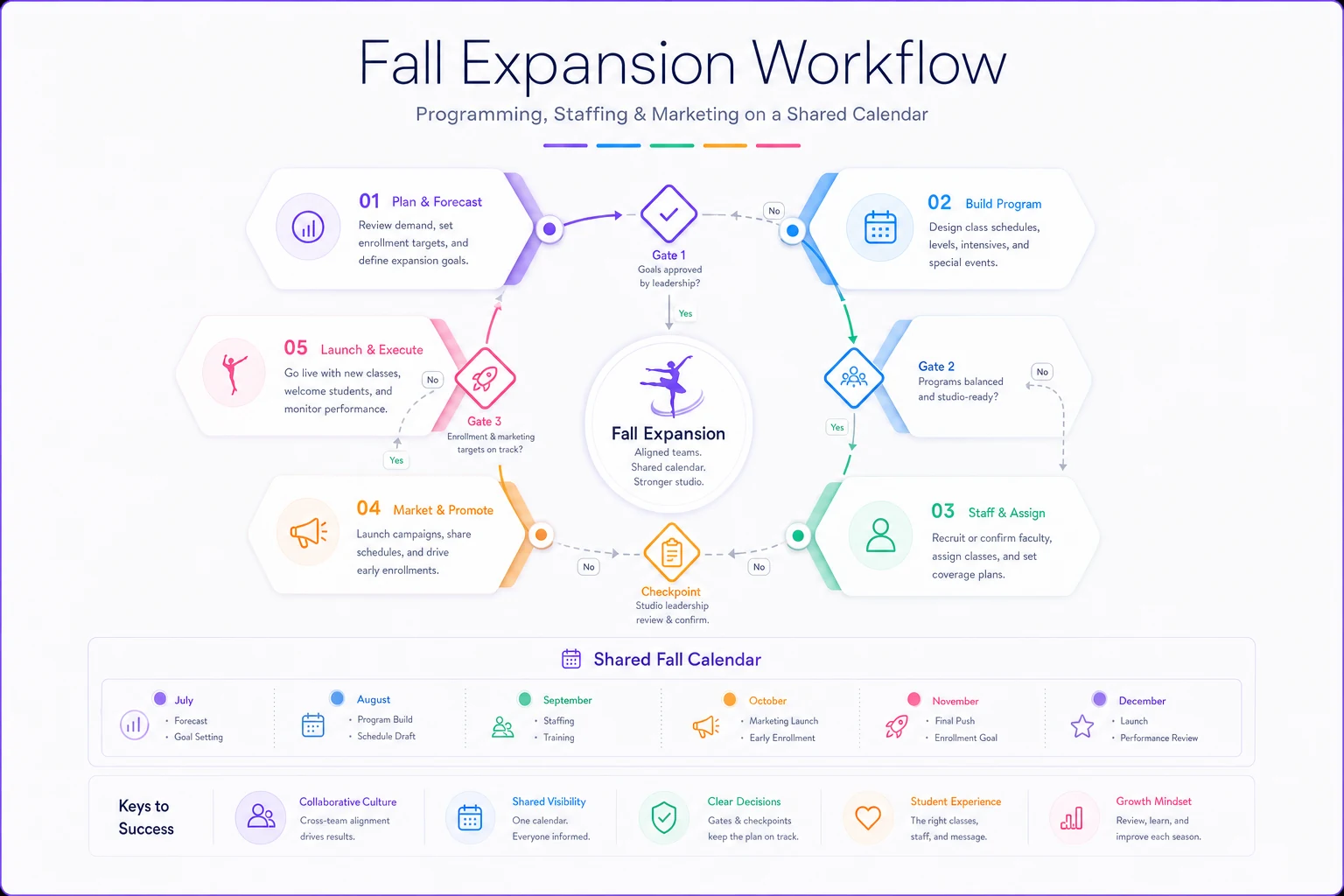
When fill rates, waitlists, and instructor availability live together, the gates are quick to run and the dependencies become visible instead of hidden.
A short real scenario
A two-room studio running around 210 students kept hitting the same fall crunch every year. Every September they'd open two or three new classes, scramble to staff them, and end up with one or two taught by rushed substitutes. Attrition in those classes ran noticeably higher than their established ones, and the owner was burning most of August on hiring panic.
The change wasn't dramatic. They mapped their buckets, set the staffing runway to kick off in early July, and added two mid-year gates. The first fall under the new calendar, they opened two new classes — both pre-sourced, both with confirmed instructors before registration opened, both pointed at a real promo. One class hit target and launched. The other came in soft at the July gate, so they held it to winter term instead of forcing it.
The win wasn't a big enrollment jump. It was that nothing broke. No scramble, no rushed subs, no half-full class limping through fall. The owner got August back, and the classes that launched retained like their established ones because they started with the right teacher in the right slot.
When this level of structure makes sense — and when it's overkill
This full system is worth building when you've got multiple rooms, a handful of instructors, and more than one or two program types competing for the same time and staff. That's the point where the four clocks genuinely can't be held in one person's head anymore.
It's overkill for a very small operation where the owner teaches most classes and knows every family by name. If you're under 60–70 students in a single room, a shared calendar and a simple capacity sheet will do fine. Forcing quarterly gates and formal runways on a studio that small adds process without reducing any real risk.
The warning sign that you've outgrown the informal approach: you've had two or more "we opened a class we couldn't staff" or "we promoted something we couldn't fill" moments in the last year. Those aren't bad luck. They're the clocks drifting, and they only get worse as you add rooms and students.
The core idea behind an annual studio operations plan is that programming, staffing, and marketing aren't separate projects — they're three views of the same year, and they only work when they share one calendar with decision gates built in. Map your capacity into honest buckets. Work the staffing runway backward from each program start. Point promos at the buckets that can actually absorb them. And put four quarterly go/no-go gates in place so you're making small corrections early instead of expensive ones late.
Do that, and the annual crunch stops being a crisis you survive and becomes a sequence of decisions you've already prepared for. The year still has surprises — enrollment dips, a key instructor leaves, a promo underperforms — but you catch them at a gate instead of in the middle of a half-staffed term. That's the whole point of running the calendar as a system instead of a loose collection of separate plans that happen to share a building.
Ready to elevate your studio operations?
Join 500+ studios using Movioly to save time, reduce admin workload, and enhance student experiences.