

Most studios don't have a curriculum problem. They have a distribution problem. The knowledge exists — usually locked inside your two or three best instructors — and everything works fine until one of them leaves, or you add a second location, or you hire three new teachers in August and suddenly the Level 3 ballet class on Tuesdays looks nothing like the one on Saturdays.
That gap is what curriculum governance actually solves. Not "what should we teach," but "how do we make sure teaching quality, level definitions, and student progression stay consistent no matter who's in the room or how big we get." It's the connective tissue between your pedagogy and your operations, and when it's missing, the cracks show up everywhere: parent complaints about placement, instructors quietly teaching whatever they feel like, students plateauing without anyone noticing.
This is a systems article. We're going to walk through how the pieces connect — level definitions, assessment rubrics, coaching cycles, and rollout — and where each one breaks as you scale.
Why teaching quality quietly drifts as you grow
At one studio with one lead teacher, governance is invisible because it's biological. The owner is the standard. She watches every class, corrects every routine, and knows exactly what "ready for pointe" means. There's no rubric because she's the rubric.
The trouble starts around the third or fourth instructor. Now the owner can't watch everything. Each teacher fills the gap with their own judgment — which is fine when they're all experienced, and a slow disaster when they're not. What tends to happen across growing studios is that the drift is never dramatic. It's a Level 2 tap class where one teacher spends 20 minutes on time steps and another barely touches them. It's a jazz instructor who thinks "intermediate" means one thing while the person who placed the student thought it meant something else.
Six months later a parent asks why her daughter, who's been in "Level 3" for two years, can't do what the other Level 3 kids can. Nobody has a good answer, because "Level 3" was never actually defined — it was just a label on a schedule.
This happens across nearly every studio for structural reasons, not personal ones. Level names get created for scheduling and marketing long before anyone writes down what each level means as a set of competencies. The definition work feels academic when you're already busy. So it never happens, and the labels float free of any real standard.
The four layers of a working governance system
Governance sounds heavy, but it's really just four layers that connect to each other. Each one is useless without the others.
Eliminate scheduling headaches and missed payments.
Movioly streamlines booking, confirming, and managing every class with ease.
- Unified class and instructor scheduling
- Automated student notifications
- Integrated payment tracking
No credit card required
| Layer | What it defines | What breaks without it |
|---|---|---|
| Level / competency definitions | The specific skills a student must demonstrate to be in and to exit a level | Placement disputes, inconsistent classes, students stuck for years |
| Assessment rubrics | How a teacher objectively scores whether a student meets those competencies | Subjective "gut feel" evaluations that vary by teacher and mood |
| Coaching cycles | How teachers themselves are observed, given feedback, and developed | Instructors plateau, best practices never spread, quality drifts |
| Deployment / rollout | How all of the above actually gets adopted in daily operations | Beautiful binder no one opens, teachers ignore the new system |
The mistake most owners make is building one layer and assuming it's enough. They write gorgeous level definitions, print them, and then never build the rubric that turns those definitions into a repeatable assessment. So the definitions sit there as aspiration, and teachers keep eyeballing it.
Let's go layer by layer.
Layer 1: Level and competency definitions that actually mean something
A usable level definition isn't a paragraph of vibes. It's a list of observable, demonstrable competencies broken into two categories: entry criteria (what a student needs to belong here) and exit criteria (what they need to move up).
Ballet Level 3 — Competency Definition Entry criteria (student should already show):
-
Correct five positions of the feet with proper turnout for their range
-
Pliés and tendus in all directions with stable alignment
-
Basic port de bras coordinated with legs
-
Can hold a passé balance at the barre for ~4 counts
Exit criteria (must demonstrate to advance to Level 4):
-
Clean single pirouette from fourth, both directions
-
Grand battement with control, no hip hiking
-
Sustained relevé balance in center (~4 seconds)
-
Can pick up and retain a 32-count combination within one class
-
Demonstrates correct spotting on chaîné turns across the floor
Notice what this does. It gives the placing teacher, the teaching instructor, and the parent the same reference. When a parent asks why their child hasn't moved up, you're no longer defending a feeling — you're pointing at "sustained relevé balance in center" and saying, "this is the one we're working toward."
The pattern to avoid: writing exit criteria that are impossible to observe in a normal class. "Musicality" and "artistry" belong in your teaching, but if you can't score them consistently, keep them out of the gate criteria or define them behaviorally ("stays on the beat through tempo changes"). Vague criteria reintroduce exactly the subjectivity you built the system to remove. This connects directly to how you handle placement fairness — if you haven't nailed that side yet, the approach in a fair placement policy with rubrics and appeal scripts pairs almost one-to-one with these definitions.
Layer 2: Assessment rubrics that any teacher can apply the same way
Definitions tell you what to look for. Rubrics tell you how to score it so two different teachers land in roughly the same place.
The trick is a simple scale with described anchors, not just numbers. A "3 out of 5" means nothing unless every teacher agrees what a 3 looks like.
Sample rubric row — Pirouette (Level 3 exit skill)
| Score | What it looks like |
|---|---|
| 1 | Cannot initiate a turn; loses balance immediately |
| 2 | Completes a partial turn, spots inconsistently, needs the barre |
| 3 | Completes a single turn one direction, unreliable other side |
| 4 | Clean single both directions most attempts, occasional wobble |
| 5 | Consistent clean single both directions, controlled finish |
Run four or five rows like this per level and you have an assessment sheet a substitute could use. That last part matters more than people expect — when your rubric is objective enough that a fill-in teacher can assess with it, you've built something that survives staff changes instead of collapsing with them.
One thing worth noting from watching studios roll these out: don't assess every skill every time. Pick two assessment windows a year (say, December and May), and keep the rubric to the exit skills only. Teachers who try to score fifteen competencies per student per month abandon the whole system within a term because it eats their prep time. Governance that's too heavy dies of its own weight.
These assessments also feed straight into what parents actually see. If you're already sending progress reports, the rubric scores become the backbone of them — which is the natural bridge to curriculum maps and monthly progress-report templates that increase perceived value. The same data that governs progression also proves value to families.
Layer 3: Coaching cycles — governing the teachers, not just the students
This is the layer almost everyone skips, and it's the one that actually raises quality over time. Level definitions and rubrics keep things consistent. Coaching cycles make things better.
A coaching cycle is a repeating loop: observe a class, give structured feedback, set one or two development goals, follow up. The reason most studios don't do this isn't philosophy — it's that "give feedback to teachers" without a structure turns into either awkward criticism or vague praise, and both feel bad, so it gets avoided.
-
Pre-observation (5 min) teacher names one thing they want feedback on. This flips the power dynamic — they're inviting input, not being audited.
-
Observation (full class) the coach watches against a shared teaching rubric (pacing, correction quality, class management, progression alignment).
-
Feedback session (20–30 min, within 48 hours) structured conversation, not a lecture.
-
Goal-setting one or two specific, revisitable goals. Not ten.
-
Follow-up observation (next cycle) did the goal move?
Run this per teacher two to three times a year. New hires more often in their first term.
A coach-feedback template that keeps the conversation productive:
-
What worked (specific, observed) "Your tendu breakdown for the newer students was clear and they self-corrected by the third rep."
-
One growth area (observed, not personal) "The last 15 minutes drifted — three students were off-task while you worked with one group."
-
A question, not a directive "What's a way you could keep the rest of the room engaged during small-group corrections?"
-
The agreed goal "Try a 'hold your last combination' task for the group while you circulate. We'll look at that next visit."
-
Support offered "Want me to send you two transition activities that other Level 3 teachers use?"
Frame feedback as a question to encourage reflection and voluntary change.
What tends to happen: feedback framed as questions gets acted on far more than feedback framed as fixes. Teachers who feel evaluated defend. Teachers who feel developed experiment. And experimentation is what actually spreads good practice from your strongest instructor into the rest of the team.
This is really the missing half of most instructor systems. Pay, scheduling, and hiring get formalized long before development does — if that side of your operation is still ad hoc, the framework in turning instructor chaos into a predictable system sits right underneath this coaching layer. Retention and development are the same project: teachers who are growing don't leave.
Layer 4: Deployment — how this actually gets adopted (and where rollouts die)
Most governance systems fail not because they're badly designed but because they're badly deployed. The owner builds the whole thing over a summer, presents it in a 90-minute staff meeting in August, hands out binders, and assumes adoption.
Adoption doesn't happen from a meeting. It happens from embedding the standard into the tools teachers already touch every week.
-
Definitions and rubrics finalized for at least your two highest-enrollment tracks before touching the rest. Don't boil the ocean.
-
One pilot level, one term. Roll out Level 3 ballet fully before expanding. Learn where the rubric is confusing.
-
Teachers co-author at least one rubric row. Ownership kills resistance. People defend systems they helped build.
-
Assessment windows on the calendar before the term starts, not decided mid-year.
-
Rubrics stored where teachers work — inside the class roster or attendance view, not in a separate binder or a shared drive nobody opens.
-
One coaching cycle completed for each teacher in the pilot track.
-
Parent-facing language drafted so placement and progression conversations use the same words internally and externally.
-
Review point at term's end — what confused people, what got ignored, what to fix before scaling.
That fifth bullet is where operational software quietly earns its keep. When level definitions and rubric scores live inside the same platform that runs your rosters, attendance, and progress reports, teachers assess in the flow of their normal work instead of remembering to open a separate document. A system with student records tied to competency tracking means an assessment score entered in May automatically informs next year's placement and the parent's progress report — no re-keying, no lost sticky notes. The governance stops being a parallel chore and becomes part of how the studio already runs. That's the difference between a system that survives and a binder that gathers dust.
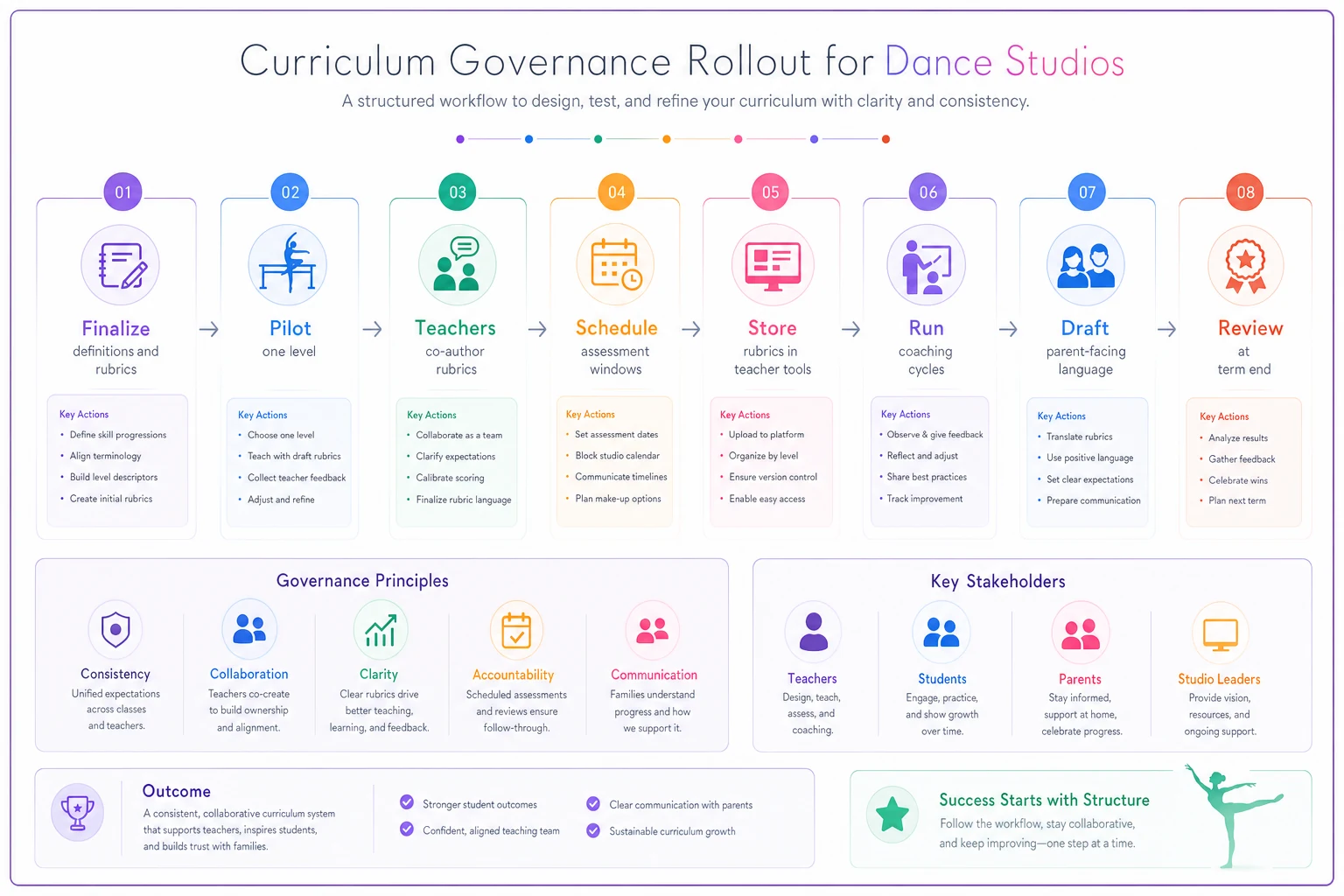
Here's a quick visual of a typical rollout flow.
A real scenario: what changes when the system exists
A studio with around 280 students and six instructors kept running into the same August problem: placement disputes. Every year, roughly 15–20 families pushed back on their child's level, and each conversation ate 20–30 minutes plus follow-up emails. Two of the six teachers were placing students noticeably "looser" than the others, so kids arrived in classes they weren't ready for — which frustrated both the students and the receiving teachers.
They spent one summer building competency definitions and exit rubrics for their four core levels, then piloted assessment windows in December and May. They didn't touch coaching until the following year.
The first visible change wasn't dramatic — it was quieter. Placement pushback dropped to a handful of families the next fall, because parents were getting rubric-based reasons instead of "she's not quite ready." The bigger shift showed up in the receiving teachers: fewer misplaced students meant classes moved at a more consistent pace, and the two "loose" placers naturally tightened up once they were scoring against the same anchors as everyone else. By the second year, when they added coaching cycles, two mid-level instructors visibly leveled up — the kind of improvement that used to only happen by accident.
Nothing about this was a revenue rocket. It was friction reduction: fewer disputes, fewer misplaced kids, a team that taught more alike, and a couple of teachers who got measurably better on purpose instead of by luck.
When this makes sense — and when it doesn't
When to build this now: You have four or more instructors, more than one class per level, or you're planning a second location. The moment teaching quality depends on people who could leave, governance is no longer optional — it's risk management.
When to keep it light: A solo owner-operator with one or two hand-picked, experienced teachers doesn't need a full rubric apparatus yet. Write down your level definitions (that part's always worth it), but don't build a coaching-cycle bureaucracy for a two-person team. It'll feel like paperwork with no payoff.
Who should NOT do this yet: A brand-new studio still figuring out what it even teaches. You can't govern a curriculum you haven't stabilized. Get the teaching working first, notice what your levels actually require in practice, then write it down. Governance formalizes what's working — it can't invent it.
The core idea to hold onto
Curriculum governance isn't about control. It's about making sure the quality that already exists in your best teachers doesn't stay trapped there. Level definitions make progression fair and defensible. Rubrics make assessment consistent across people and time. Coaching cycles raise the whole team instead of just the standouts. And deployment — embedding all of it into the tools teachers actually use — is what keeps the system alive after the launch enthusiasm fades.
Studios that scale without this end up rebuilding their standards from scratch every time someone leaves. Studios that build it once find that hiring gets easier, placement gets calmer, and teaching quality stops being a matter of luck. The curriculum stops living in a few heads and starts living in the studio itself.
Ready to elevate your studio operations?
Join 500+ studios using Movioly to save time, reduce admin workload, and enhance student experiences.