



Most studios don't have a revenue problem. They have a stitching problem.
Acquisition lives in one tool and one person's head. Trials get tracked on a clipboard or a spreadsheet nobody updates after Tuesday. Cohort re-enrollment is a frantic spring scramble. Upsells happen when an instructor remembers to mention the competitive team. And alumni? Alumni just... disappear, usually taking three potential referrals with them.
Each of these works okay in isolation. That's the trap. A funnel that converts fine on its own can still leak revenue at every handoff, because the handoffs are where studios lose the thread. A family converts from trial, but nobody flags them for the right cohort. They finish a session year, but the re-enroll nudge goes out two weeks too late. They'd happily buy a second class, but no one's watching for the signal.
This article maps the full architecture — acquisition → trial → cohort → upsell → alumni — as one connected system with defined telemetry, governance gates between stages, and stage-specific playbooks. The goal isn't more tactics. It's turning five tactical funnels into a single measurable machine where every stage feeds the next and nothing falls through the cracks.
Why the lifecycle breaks at the seams, not the stages
When a studio tells me enrollment feels "unpredictable," the problem almost never sits inside a single stage. The marketing works. The onboarding works. Classes are good. What fails is the connective tissue between stages — the moment a student moves from one phase of the dance studio customer lifecycle to the next.
A common pattern: a studio runs a strong trial-to-enroll conversion, maybe 55–65%. Owner feels great. But nobody's measuring what happens to that family in months 4 through 9, which is exactly when silent attrition starts. By re-enrollment season, a chunk of those "converted" families have already mentally checked out — they just haven't told you yet.
-
Each stage has a different owner. Front desk owns trials, instructors own retention, the owner owns re-enrollment. No single person sees the whole journey, so no one catches the drop between phases.
-
The data doesn't travel. A trial family's goals, their kid's starting level, why they chose you — all captured at intake, all lost by month two because it never moved into the cohort record.
-
There are no gates. Nothing stops a student from advancing (or quietly churning) without the right checks. A family can reach the upsell moment without anyone confirming they're even happy.
What breaks at scale is coordination. With 80 students, one attentive owner can hold the whole lifecycle in their head. At 250, that same owner is now the bottleneck — and the mental model that worked at 80 is exactly why students slip away unnoticed.
The five stages, defined as a system
Before you can measure or govern the lifecycle, you need to agree on what each stage actually is — specifically, what event marks entry and exit. Vague stage definitions are why two people in the same studio give you different enrollment numbers.
Eliminate scheduling headaches and missed payments.
Movioly streamlines booking, confirming, and managing every class with ease.
- Unified class and instructor scheduling
- Automated student notifications
- Integrated payment tracking
No credit card required
| Stage | Entry trigger | Exit trigger | Core question |
|---|---|---|---|
| Acquisition | First tracked contact (inquiry, event signup, referral) | Trial booked | Are we attracting the right families? |
| Trial | Trial class booked | Enroll or decline decision | Do they experience value fast? |
| Cohort | Enrolled into a class/session | Session completion | Are they progressing and staying? |
| Upsell | Eligible for a second product (team, private, second style) | Second product purchased or declined | Are we expanding the committed? |
| Alumni | Formal exit (graduation, move, non-renewal) | Re-engagement or referral event | Are we harvesting goodwill? |
The discipline here is forcing binary entry and exit events. "Kind of interested" is not a stage. "Booked a trial on March 3" is. Once every stage has a clean trigger, your pipeline becomes countable — and countable is the whole game.
One thing worth sitting with: most studios have never defined the alumni stage at all. A family that finishes their last recital just evaporates from the system. But alumni are the cheapest revenue you'll ever access — referrals, nostalgia enrollments for younger siblings, adult classes, merchandise. Treating "exit" as a defined stage with its own playbook is often the highest-ROI change a mature studio can make.
Telemetry: what to actually measure at each stage
You don't need forty metrics. You need a handful that tell you whether each stage is healthy and whether the handoff to the next stage is working. Here's the minimal set worth building around:
Acquisition
-
Inquiry → trial-booked rate
-
Source attribution (which channels produce families who actually stay, not just book)
-
Cost per trial booked
Trial
-
Trial attendance rate (booked vs. showed — this gap is bigger than most owners think, often 15–25%)
-
Trial → enroll conversion
-
Time-to-enroll (days between trial and decision)
Cohort
-
Mid-session attendance trend (the early-warning signal)
-
Session completion rate
-
Re-enroll rate by cohort
Upsell
-
% of committed families with a second product
-
Upsell offer-to-accept rate
Alumni
-
Referral rate from exited families
-
Reactivation rate
Pro-tip: prioritize leading indicators like trial attendance and mid-session slope — they give time to act before final conversion shows up.
The non-obvious insight: the metrics that predict revenue aren't the conversion rates everyone watches. They're the leading indicators inside each stage — trial attendance, mid-session attendance slope, time-to-enroll. A family that takes 18 days to decide after a trial converts at a fraction of the rate of one who decides in 3. If you're only measuring final conversion, you miss the chance to intervene while the decision is still live.
Governance gates: the checks between stages
A gate is a required check before a student advances. It's what stops the lifecycle from leaking at the handoffs — the operational contract between stages.
A practical gate structure:
-
Acquisition → Trial gate Trial is confirmed only when goals and starting level are captured. No blank intake records move forward. This data becomes fuel for the entire downstream journey.
-
Trial → Cohort gate Enrollment isn't "done" until the family is placed in the right cohort with a confirmed schedule and the first payment method on file. Placing a student in a mismatched level is one of the most common early-churn causes.
-
Cohort → Upsell gate A family becomes upsell-eligible only after hitting a satisfaction and progress threshold — consistent attendance plus a positive progress check. Upselling an unhappy family burns trust.
-
Cohort → Re-enroll gate Before a session ends, every family gets a progress touchpoint and a re-enroll decision logged. No family exits a session without an explicit renew/decline.
-
Cohort → Alumni gate A formal exit triggers an offboarding flow — referral ask, alumni list add, feedback capture.
The mistake studios make is treating these as things an organized front desk handles informally. At scale, informal gates fail silently. The whole point of making them explicit is that a skipped gate becomes visible. If 12 families moved into cohorts last month and only 9 had complete placement records, you can see the leak before it costs you in June.
Stage-specific playbooks
Governance tells you what must be true to advance. Playbooks tell you how to make it true. Three deserve special attention because they drive the most revenue.
Onboarding (Trial → Cohort)
-
Confirm the trial twice (booking + 24-hour reminder) to close the booked-vs-showed gap
-
Capture the "why they came" and the child's goal at intake, then reference it in the first class
-
Make the enroll decision easy and time-boxed — a clear window with a small incentive to decide now
-
Place deliberately, not by whatever has an open slot
For the full day-by-day version, the day-by-day onboarding funnel for converting trials into committed students breaks the sequence down class by class.
Re-enroll (Cohort → Cohort)
Re-enrollment is where most annual revenue is won or lost, and it's almost always run too late and too flat. The healthy version starts 6–8 weeks before session end, is sequenced by cohort, and leads with progress — not a payment link.
-
Progress touchpoint first — show the family what their kid accomplished
-
Re-enroll offer with priority placement for current families
-
Decision logged for every family (renew/decline), not just the ones who respond
-
Targeted outreach to the "no response" group, who are the real risk
Because re-enrollment lives inside the cohort structure, the family lifecycle system for enrollment, re-enrollments and alumni revenue is the deeper companion piece on structuring cohorts to make renewal predictable.
Upsell (Cohort → Second product)
Upsell fails when it's random and instructor-dependent. It works when it's gated and triggered. A family becomes upsell-eligible through the governance gate — satisfied, progressing, attending consistently — and only then does the offer fire. The offer should match where they are: a strong beginner gets nudged toward a second style, a committed intermediate toward team or privates.
Ancillary revenue stacks on top of this. Once a family is committed and happy, the second class, the merchandise, the workshop — all become natural extensions rather than sales pitches. The playbook for making ancillary revenue a predictable studio pillar covers how to systematize that layer.
A sample dashboard that ties it together
You don't need a BI team. You need one view that shows stage health and handoff leaks at a glance. A workable monthly dashboard has three bands:
Here's a simple visual to keep the lifecycle and dashboard relationships clear.
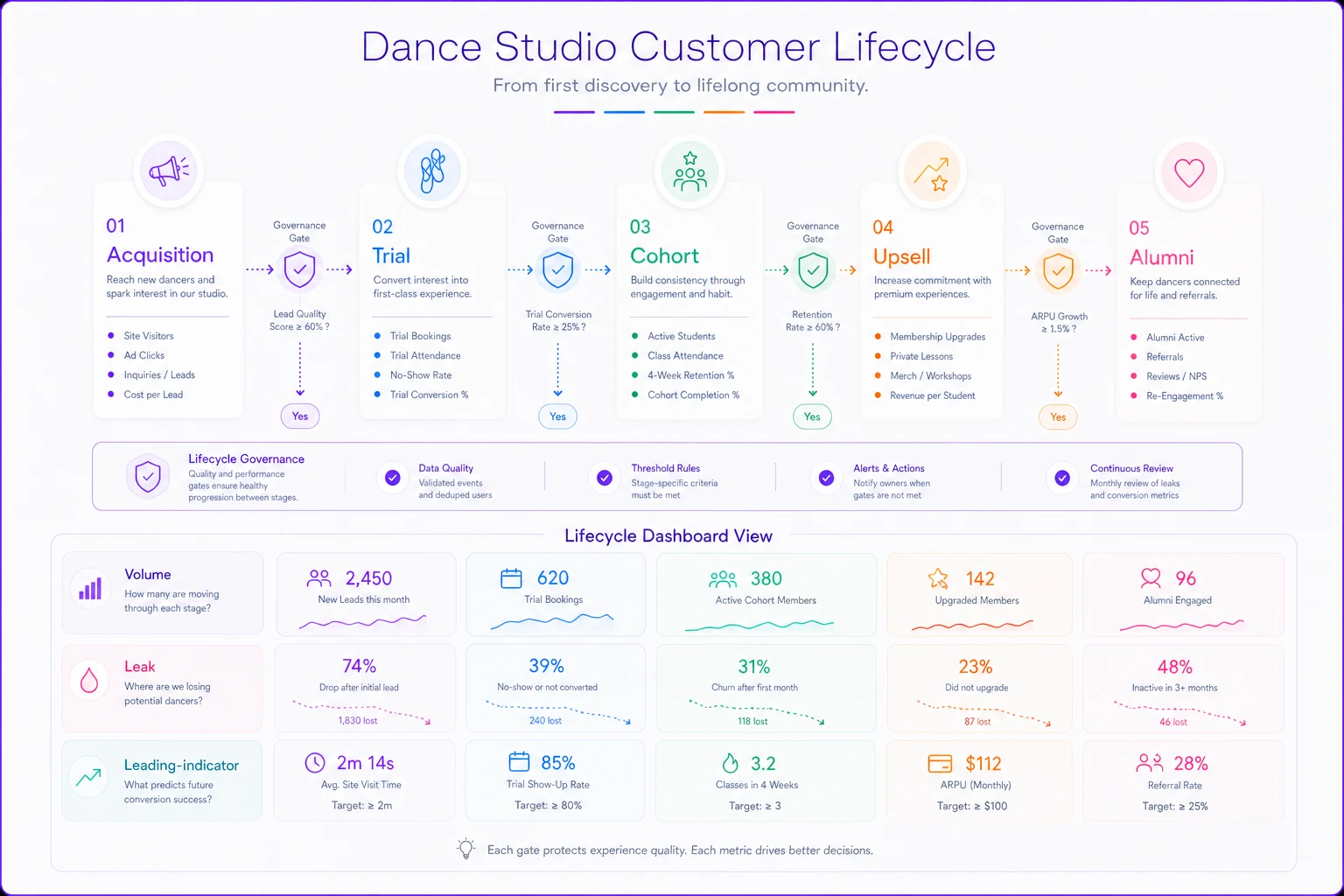
Volume band — how many students sit in each stage right now, and how many moved between stages this month. This is your pipeline shape. If acquisition is up but trial-booked is flat, you have a top-of-funnel handoff problem.
Leak band — the gap at each handoff. Booked-vs-showed trials, placed-vs-complete-records, session-end families with no logged re-enroll decision. Every number here is a dollar figure in disguise.
Leading-indicator band — time-to-enroll, mid-session attendance slope, upsell eligibility counts. These tell you what next month looks like before it arrives.
Review this on a fixed cadence — monthly for the full picture, weekly for the leak band during re-enroll season. A dashboard nobody looks at on schedule is just a spreadsheet with ambitions.
A real scenario
A studio with roughly 190 students ran what looked like a healthy operation. Trial-to-enroll sat around 60%. Classes were full-ish. But year-over-year growth had stalled, and the owner couldn't say why.
-
Trial attendance was around 78% — nearly a quarter of booked trials never showed, and nobody was tracking it.
-
Re-enroll had no logged decision for about 40 families each spring; they were simply assumed to return, and a chunk didn't.
-
Upsell was entirely instructor-mood-dependent — fewer than 1 in 6 committed families had a second product.
-
Alumni was a void. Dozens of families exited each year with zero referral ask.
Nothing here required better marketing or better teaching. It required closing the handoffs. They added a two-touch trial confirmation, a logged re-enroll decision for every family, and a gated upsell trigger. Over the following year, re-enrollment tightened up noticeably, the trial no-show gap shrank by more than half, and second-product attachment roughly doubled off a low base. The revenue lift came almost entirely from plugging leaks that already existed — not from adding new volume at the top.
Most studios are sitting on recoverable revenue inside their own pipeline. They just can't see it because the stages aren't connected.
When this architecture makes sense (and when it doesn't)
When it makes sense: You're past roughly 120–150 students, you have more than one or two instructors, and the owner can no longer personally track every family's journey. This is the point where informal coordination fails and you need defined stages, telemetry, and gates to replace the mental model that's hit its ceiling.
When it's premature: If you're a 40-student studio where the owner teaches most classes and knows every family by name, a full lifecycle architecture is overhead you don't need yet. Capture the basics — clean intake data and a simple trial tracker — but don't build governance gates for a pipeline you can see with your own eyes.
Who should not do this: Anyone looking for a quick enrollment bump. This is a structural investment that pays off over quarters, not weeks. If you need cash this month, run a targeted campaign; build the architecture in parallel, not instead.
A 12-month roadmap to one revenue system
You don't install this all at once. Sequence it so each quarter builds on the last.
Quarter 1 — Define and instrument. Lock down stage definitions with binary entry/exit triggers. Clean up intake so acquisition and trial data actually gets captured. Stand up the minimal telemetry set. Goal: you can count your pipeline accurately for the first time.
Quarter 2 — Install the gates. Add the five governance gates, starting with the trial→cohort placement gate and the cohort→re-enroll decision gate, since those protect the most revenue. Make skipped gates visible in your dashboard.
Quarter 3 — Deploy the playbooks. Roll out structured onboarding, sequenced re-enroll, and gated upsell. Run them for a full cycle and measure the handoff leaks closing. Expect the re-enroll playbook to show results first.
Quarter 4 — Close the loop with alumni. Build the offboarding flow and alumni stage. Turn exits into referral asks and reactivation candidates. Review the full-year dashboard, find the remaining leaks, and tighten.
By the end of the year, you're not running five funnels and hoping they connect. You're running one lifecycle where every stage has a definition, a measurement, a gate, and a playbook — and where a leak at any handoff shows up on a dashboard instead of hiding until June.
The real shift
The studios that scale cleanly aren't the ones with the flashiest marketing or the best single funnel. They're the ones who stopped thinking in funnels entirely and started thinking in lifecycle — one connected path from first contact to alumni, measured end to end, with checks at every seam.
The tactics you already run probably work fine on their own. The opportunity isn't replacing them. It's connecting them — so a family that enters at acquisition actually makes it all the way through to upsell and alumni without quietly slipping out a gap you never knew was there. That's what turns unpredictable enrollment into a revenue system you can actually plan around.
Ready to elevate your studio operations?
Join 500+ studios using Movioly to save time, reduce admin workload, and enhance student experiences.