


Most studio owners don't have a bookkeeping problem. They have a classification problem. The money comes in — tuition, recital fees, costume orders, drop-in passes, that surprise summer camp deposit in April — but nobody has decided, in writing, what each dollar actually is and when it counts as earned revenue.
That gap is where the real mess lives. It's why your bookkeeper categorizes the same recital fee three different ways in three different months. It's why your "profit" on the P&L swings wildly even when enrollment is flat. And it's why, when an accountant finally looks at your books before filing, you get that dreaded email: "Can we hop on a call? I have some questions."
Studio financial governance isn't about fancy software or a CFO. It's about building a small set of rules — a playbook — that says: here's every product we sell, here's how we recognize the revenue, here's how it gets taxed, and here's the checklist we run every month so nothing drifts. Once that exists, your numbers finally tell the truth.
Why studio books drift (and it's rarely the bookkeeper's fault)
The core issue is that a dance studio sells more product types than a business its size should have to manage. A single parent payment might contain:
-
Monthly tuition (earned as classes are delivered)
-
A registration fee (earned when? Over the year? At signup?)
-
A costume deposit (a liability until the costume ships)
-
A recital ticket (earned on recital night)
-
A retail hoodie (earned at point of sale)
Five revenue types inside one $340 Venmo-style payment. And most studios dump the whole thing into one line called "Income."
The drift happens quietly. In month one, someone makes a reasonable judgment call. In month four, a different person makes a different reasonable call. Nobody wrote the first one down, so there's nothing to be consistent with. By year-end you've got a dataset that can't be trusted for any decision — not pricing, not hiring, not forecasting.
The deeper problem is deferred revenue. A huge chunk of studio money is collected before it's earned. Annual tuition paid upfront. Camp deposits in winter for a July program. Costume money collected in October for a May recital. If you book that as revenue the day it hits the bank, your early-year P&L looks amazing and your spring looks terrible — even though the business performed identically. You've turned a cash-timing quirk into a fake performance story.
Good governance fixes this at the source, by deciding the treatment before the money ever arrives.
The governance playbook: four documents, nothing more
You don't need a 40-page policy binder. You need four living documents, all spreadsheet-first so anyone can open and maintain them.
Eliminate scheduling headaches and missed payments.
Movioly streamlines booking, confirming, and managing every class with ease.
- Unified class and instructor scheduling
- Automated student notifications
- Integrated payment tracking
No credit card required
-
The Product Line Register — every single thing you sell, with a treatment attached.
-
The Revenue-Recognition Packages — the rules for when each product becomes earned revenue.
-
The Tax-Treatment Decision Trees — how each product line gets handled for sales tax and income categorization.
-
The Monthly Close Checklist — the repeatable process that keeps 1–3 honest.
The whole point of keeping it spreadsheet-first is that governance survives staff turnover. When your front-desk manager leaves, the rules don't leave with them. A new hire opens the register and sees exactly how a costume deposit is handled. No tribal knowledge, no guessing.
Document 1: The Product Line Register
This is the backbone. One row per product. Here's the structure that holds up as a studio grows:
| Product Line | Category | Recognition Trigger | Deferred? | Sales Tax | GL Account |
|---|---|---|---|---|---|
| Monthly tuition | Service | As classes delivered (monthly) | No | No | 4000 – Tuition |
| Annual tuition (prepaid) | Service | Straight-line over program year | Yes | No | 4000 / 2100 deferred |
| Registration fee | Service | Over enrollment period | Partial | No | 4010 – Reg Fees |
| Costume deposit | Goods | On costume delivery | Yes | Usually yes | 2110 deferred → 4200 |
| Recital tickets | Event | Recital date | Yes | Varies by state | 4300 – Events |
| Drop-in class | Service | On the class date | No | No | 4000 |
| Retail (apparel/shoes) | Goods | Point of sale | No | Yes | 4200 – Retail |
| Summer camp deposit | Service | Over camp weeks | Yes | No | 2120 deferred → 4100 |
| Private lessons | Service | As delivered | No | No | 4050 |
| Gift cards | Liability | On redemption | Yes | On redemption | 2200 – Gift card liability |
A few things worth flagging that owners consistently get wrong:
Costume money is almost never revenue when you collect it. You're holding the family's money against a product you haven't bought yet — it's a liability. If you book it as income in October and spend it, then the costume order lands in March and craters your margin, you've just lived a lie for five months.
Gift cards are liabilities until redeemed. Selling a $200 gift card isn't $200 of revenue — it's $200 you owe in services. This trips up studios that run holiday gift-card promos and then can't figure out why January "revenue" looks soft. The December sale was never real revenue to begin with.
Sales tax on costumes and retail varies wildly by state. Tangible goods are frequently taxable even when your services aren't. A studio that's never charged tax on a single transaction may be quietly accruing a liability on every hoodie and costume it's sold. That compounds into a real number over a few years.
Document 2: Revenue-recognition packages
A "package" is a pre-built rule you attach to a product so recognition is automatic, not improvised. Think of them as templates. You'll only need a handful.
Package A — Delivered-as-performed (straight service). Used for: drop-ins, private lessons, monthly tuition paid in the month it's used. Rule: revenue is earned in the period the class happens. No deferral.
Package B — Straight-line deferral. Used for: annual prepaid tuition, camp deposits, semester packages. Rule: take the total, divide by the number of program periods, recognize one slice per period. A $1,800 annual tuition paid in September becomes roughly $200/month across a nine-month year. The unrecognized balance sits in deferred revenue — a liability — until it's earned.
Package C — Point-in-time (goods/events). Used for: retail, recital tickets, costumes on delivery. Rule: nothing is earned until the specific event or delivery. Money collected before that is a liability.
Package D — Redemption-based (stored value). Used for: gift cards, class credit banks, punch cards. Rule: liability on sale, revenue on redemption. Track the outstanding balance as a running liability.
The discipline here pays off directly when you forecast. If your deferred revenue is clean, you can see exactly how much earned revenue is already locked in for the next six months versus how much you still have to go sell. That's the real input for the kind of layered planning we've written about in the revenue math behind scalable studio pricing — package mix only tells you the truth if the recognition underneath it is honest.
Document 3: Tax-treatment decision trees
Taxes are where owners freeze, so the goal is to turn judgment calls into a tree anyone can follow. Run each new product line through two short trees.
Tree 1 — Sales tax (goods vs. services):
``
Is the product a physical good the family keeps?
├─ YES → Is it exempt in your state? (some states exempt dancewear/children's apparel)
│        ├─ YES → No sales tax, but DOCUMENT the exemption basis
│        └─ NO  → Collect sales tax at point of sale
└─ NO (it's a service)
         └─ Are instructional services taxable in your state?
            ├─ YES (rare, some states) → Collect sales tax
            └─ NO → No sales tax
``
Tree 2 — Income categorization (for your P&L and eventually your return):
``
Does the payment represent something NOT yet delivered?
├─ YES → Book to deferred revenue (liability). Recognize per its package.
└─ NO  → Is it a service you performed, or a good you sold?
         ├─ Service → Service revenue account
         └─ Good   → Retail/goods revenue (track COGS separately!)
``
The non-obvious trap here: merged income hides your cost structure. If costume sales and tuition live in the same bucket, you can't see that costumes run at near-zero margin after vendor cost while tuition runs high. You end up thinking your retail side is profitable when it's basically a pass-through with a shipping headache attached. Separating goods revenue — and pairing it with its COGS line — is what lets you actually answer "should we even keep selling apparel?"
A note on scope: these trees get you organized and consistent. They don't replace a conversation with an actual tax professional, especially on state-specific exemption questions. The value of governance is that when you do talk to your accountant, you arrive with a clean, categorized register instead of a shoebox — which cuts their time and your bill considerably.
Document 4: The monthly close checklist owners can actually run
This is the piece that keeps everything from rotting. A close is a monthly ritual where you reconcile, recognize, and lock the period. A disciplined studio should be able to do this in a couple of hours, not a week.
Run it on the same day each month — say, the 5th, covering the prior month:
-
Reconcile the bank — every deposit matches a recorded payment; no orphan transactions.
-
Reconcile the merchant processor — gross charges, fees, refunds, and chargebacks all accounted for. Processor fees are an expense, not a reduction you quietly ignore.
-
Recognize deferred revenue — move this month's earned slice out of deferred into revenue for every Package B and C item.
-
Update the gift-card / credit liability — add new sales, subtract redemptions, confirm the outstanding balance.
-
Confirm costume deposits — any costumes delivered this month? Move those from liability to revenue and book the matching COGS.
-
Categorize every transaction against the Product Line Register — no "uncategorized," no "ask me later."
-
Separate sales tax collected — park it in its own liability account so you never spend money you owe the state.
-
Review the P&L for obvious weirdness — a line that doubled or vanished usually means a miscategorization, not a miracle.
-
Snapshot key figures — earned revenue, deferred balance, cash position. Save the month so you have a clean trail.
-
Lock the period — no edits to a closed month without a note explaining why.
That last rule — locking — is underrated. Studios that let anyone edit any past month end up with books that silently change, which makes year-over-year comparison meaningless. A locked close is what makes your history trustworthy.
If you're building this muscle for the first time, it pairs naturally with the broader rhythm in our small-studio bookkeeping checklist and 90-day cash-flow template. The close keeps the books honest; the cash-flow template keeps you solvent. You need both.
Here's a simple workflow visualization to follow each month.
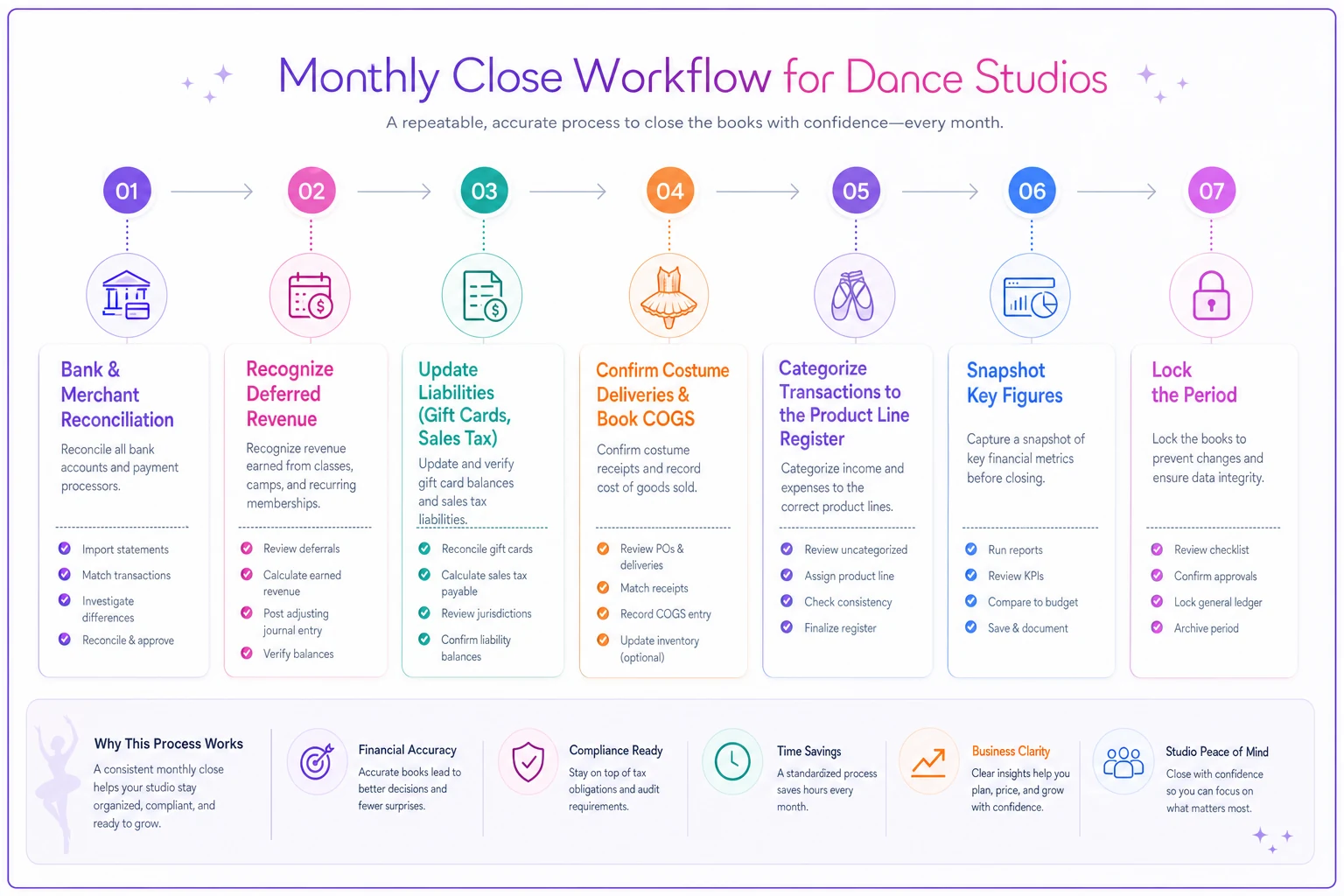
Lock the period immediately after saving the snapshot so no one silently changes prior months.
That last rule — locking — is underrated. Studios that let anyone edit any past month end up with books that silently change, which makes year-over-year comparison meaningless. A locked close is what makes your history trustworthy.
A real scenario: what clean governance actually changed
A mid-sized studio — roughly 280 students, one location, a growing retail corner and a May recital — had been running everything through a single income line for years. On paper, fall looked phenomenal and spring looked like the business was dying. The owner was seriously considering cutting spring staff.
The problem was pure recognition. Annual tuition and costume money both landed in September–October and got booked as revenue immediately. By spring, the cash was long gone but the services were finally being delivered, so the P&L showed revenue cratering while costs stayed flat.
-
Fall "revenue" dropped to a realistic level, because prepaid tuition got spread across the year.
-
Spring stopped looking like a collapse — it was earning the revenue that had been collected months earlier.
-
The costume liability finally surfaced, which revealed the retail side was running at a slimmer margin than anyone assumed — low single-digit thousands of profit annually, not the chunky number they'd imagined.
Nothing about the business changed. Enrollment was flat the whole time. But the picture went from misleading to accurate, and the panicked staffing cut never happened. That's the whole value of governance: the numbers finally describe reality.
Where this makes sense — and where it doesn't
This makes sense when:
-
You collect meaningful money upfront — annual tuition, camps, costumes.
-
You sell more than one product type, which basically every studio does.
-
You're approaching a point where you'll hire, take on debt, or add a location, all of which require trustworthy numbers.
This is overkill when:
-
You're a brand-new solo instructor with a handful of students paying monthly for the month they attend. In that case you're almost entirely Package A — delivered-as-performed — and a simple ledger is genuinely fine. Don't build deferral machinery you don't need yet.
Anyone tempted to jump straight to complex accounting software before writing the four documents should hold off. The software isn't the governance — the rules are. A studio that implements powerful tools on top of undefined rules just automates its own confusion faster.
How this connects to the rest of your operation
Financial governance isn't a standalone chore. The product register becomes the shared vocabulary for everything downstream. Pricing decisions rely on knowing which lines actually carry margin. Forecasting relies on a clean deferred-revenue balance. Platform migrations rely on products being classified consistently — if you ever move systems, you want to carry clean categories across, which is exactly the kind of mapping work the studio migration toolkit is built around. Messy categories in your old system become messy categories in your new one unless the register tells you how each line should map.
When every product has a defined treatment, every other financial decision gets easier. You're building on numbers you can actually trust, and that changes more than you'd expect.
Start with the register, not the software
If you do one thing this week, open a blank spreadsheet and list every single thing your studio sells. Just the list. Then add three columns: what is this, when is it earned, how is it taxed. You'll immediately spot two or three items you've been handling inconsistently — probably costumes and gift cards, if the pattern holds.
That one spreadsheet is the seed of the whole framework. The packages, the decision trees, and the monthly close all hang off it. Studio financial governance sounds heavy, but at its core it's just this: decide the rules once, write them down, and run the same close every month so they stick. Do that, and your books stop arguing with reality — which is the only point of keeping them in the first place.
That one spreadsheet is the seed of the whole framework. The packages, the decision trees, and the monthly close all hang off it. Studio financial governance sounds heavy, but at its core it's just this: decide the rules once, write them down, and run the same close every month so they stick. Do that, and your books stop arguing with reality — which is the only point of keeping them in the first place.
Ready to elevate your studio operations?
Join 500+ studios using Movioly to save time, reduce admin workload, and enhance student experiences.