


Most studios run their programs like a recipe box nobody reorganized in ten years. There's the recital class that started in 2014, the adult hip-hop block that half-fills every term, the summer camp that somehow generates a third of the annual profit, the "advanced competitive track" that drains three of your best teachers, and a pile of one-off workshops that exist only in the owner's head. Each of these is a product. Each one has a cost structure, a margin, a demand curve, and a lifecycle. Almost nobody treats them that way.
That gap — between running classes and managing a portfolio of products — is where money quietly leaks. You don't notice it because the aggregate revenue looks fine. The studio's full. Tuition comes in. But underneath, you've got three programs subsidizing two that should've been killed or repriced a year ago, and no systematic way of knowing which is which.
Program product management is just the discipline of applying real product thinking to your offerings: a taxonomy so you can see them clearly, an experiment-to-scale process so you stop launching on gut feel, pricing tests that don't require a committee, and governance gates that keep the catalog from turning into clutter again. This is the framework. Let's build it.
Why studio programs drift into chaos (and why size makes it worse)
The core problem isn't that owners are disorganized. Programs get added constantly and removed almost never. Every program has an origin story — a parent requested it, a new instructor could teach it, a competitor launched something similar. Adding feels low-risk. Removing feels like admitting failure, or worse, upsetting the eight families still enrolled.
So the catalog accretes. And here's where it breaks at scale: when you have 12 programs, you can hold the whole thing in your head. You know the hip-hop block is thin, you know the ballet track is your margin engine. At 30+ programs across multiple age bands and levels, that intuition collapses. You start making scheduling, staffing, and marketing decisions blind.
-
Scheduling gridlock — you can't add a high-demand program because the room is blocked by a legacy class with six students.
-
Instructor burnout — your strongest teachers get assigned to the prestige programs that don't actually pay well, because those feel important.
-
Marketing confusion — your ads promote whatever the owner remembered that week, not what's actually profitable or scalable.
-
Pricing drift — new programs get priced by copying an old one, with no connection to actual cost or value.
None of these are isolated problems. They're all downstream of one missing system: a structured view of your programs as a product line. Fix the taxonomy and the governance, and scheduling, staffing, and pricing decisions get dramatically easier because you finally know what you're actually deciding about.
Step one: Build a program taxonomy
You can't manage what you can't categorize. A program taxonomy is a structured inventory of everything you offer, tagged along dimensions that actually affect business decisions. Most owners have a class list. That's not a taxonomy — a list tells you names, a taxonomy tells you roles.
Eliminate scheduling headaches and missed payments.
Movioly streamlines booking, confirming, and managing every class with ease.
- Unified class and instructor scheduling
- Automated student notifications
- Integrated payment tracking
No credit card required
Here's a copy-into-a-spreadsheet structure that works for studios of almost any size:
| Field | What it captures | Example |
|---|---|---|
| Program name | The label families see | "Petite Ballet (Ages 3–5)" |
| Category | Discipline family | Ballet / Hip-Hop / Contemporary / Adult |
| Lifecycle stage | Where it is in its life | Pilot / Growth / Mature / Decline |
| Strategic role | Why it exists | Margin engine / Feeder / Prestige / Filler |
| Capacity | Max viable headcount | 14 |
| Current enrollment | Actual bodies | 9 |
| Fill rate | Enrollment ÷ capacity | 64% |
| Instructor cost tier | Pay band of required teacher | Senior / Mid / Entry |
| Gross margin estimate | Revenue minus direct cost | ~$180/student/month |
| Feeds into | Next program in the pathway | "Junior Company" |
The two columns people skip — and the two that matter most — are strategic role and feeds into. A program's role tells you whether you should be optimizing for profit, enrollment volume, or reputation. A feeder program with thin margins might be entirely worth keeping because it funnels students into your high-margin competitive track two years later. If you cut it on margin alone, you've quietly damaged your pipeline.
A common scenario: an owner reviews her taxonomy and finds a Tuesday toddler class running at 40% fill, clearly losing money on its own. Her instinct is to cut it. But the "feeds into" column shows that roughly 70% of her Petite Ballet students came up through that exact toddler class. It's not a losing program — it's a customer acquisition channel that happens to show a loss on its own line. The taxonomy made that visible. A class list never would have.
Tagging lifecycle honestly
Lifecycle stage is where owners lie to themselves. Everything gets labeled "Growth" because admitting something is in "Decline" feels like a verdict on your own judgment. Be ruthless here. A program is in Decline if enrollment has slipped two terms running, if you're the only one who still champions it, or if it stays alive mostly out of loyalty to one long-tenured instructor. Naming it honestly doesn't mean you cut it tomorrow — it means it goes into a different decision track, with scrutiny instead of autopilot.
Step two: The experiment-to-scale checklist
Once you can see the catalog, the next discipline is controlling how new programs enter it. The default approach is: someone has an idea, you put it on the schedule, you hope it fills. That's not a launch — it's a wish. Every new program should start as an experiment with a defined success bar before it earns a permanent slot.
The sequence:
-
Define the hypothesis. Not "let's try an adult tap class," but "we believe 10+ adults within 4 miles will pay $95/month for a weekday-evening tap class." Specific enough to be wrong.
-
Set the minimum viable offering. One class, one time slot, a short 6–8 week run. Don't build the full program before you've proven demand.
-
Pre-define the success bar. Write down the number before you launch. "This graduates to a permanent program if it reaches 8 paying students by week 4 and retains 6 into a second term." Writing it in advance stops you from moving the goalpost once you've grown attached.
-
Launch the pilot with a real deadline. Pilots without end dates become permanent zombies. The deadline forces a decision.
-
Review against the bar. Hit it → scale. Miss it narrowly → one more cycle with a specific change. Miss it badly → kill it cleanly and reclaim the slot.
-
Document what you learned. Even killed pilots teach you something about demand, pricing, and scheduling. Capture it so you don't re-test the same bad idea 18 months later.
The mistake owners make is skipping step 3. They launch a pilot, it gets five students, and instead of a clean decision they get a slow negotiation with themselves. "Five's not bad, maybe if we market more…" Six months later it's a permanent four-student class clogging a prime-time slot. The pre-defined bar converts an emotional decision into a mechanical one. That's the whole point.
A quick visual can help teams follow the same pilot-to-scale steps.
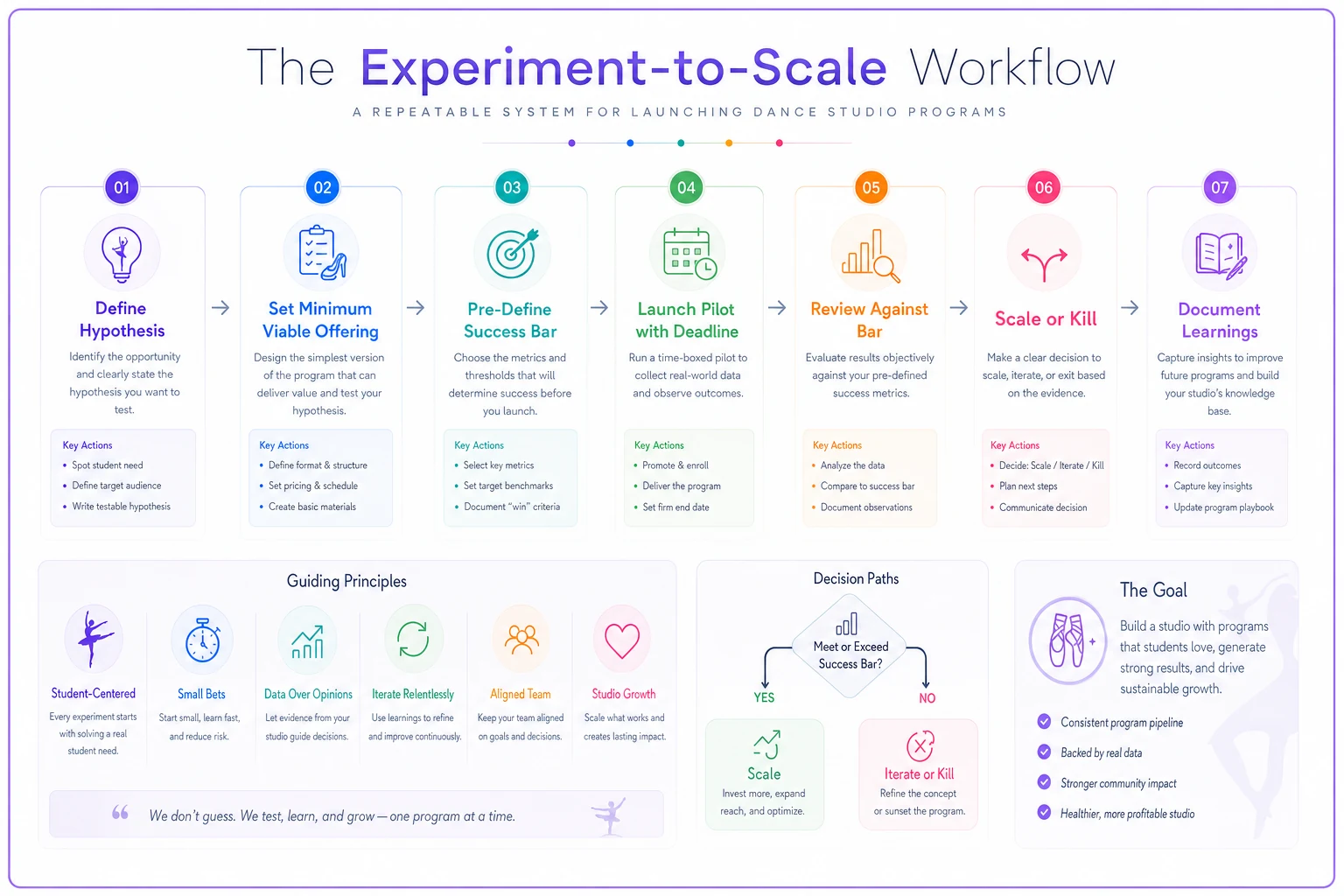
Use the workflow image as a checklist during pilot reviews so decisions stay mechanical.
Step three: Pricing-test templates that don't require a committee
Pricing is where the most upside hides and where studios are the most timid. Most owners set a price at launch by looking at what the program next to it costs, then never touch it again. That compounds every year.
A pricing test doesn't mean upending your whole fee structure. It means running controlled experiments on new enrollments or specific segments. Existing families stay on their current rate; the test only touches new cohorts, which sidesteps the "you raised my price" backlash entirely.
Run price tests only on new cohorts to avoid upsetting existing families.
A simple pricing-test spreadsheet tracks:
-
Program tested
-
Control price (current rate)
-
Test price (the new rate you're trying)
-
Segment (new enrollments only / specific location / specific time slot)
-
Window (e.g., one enrollment period)
-
Conversion at control vs conversion at test
-
Revenue per inquiry at each price
-
Decision (adopt / revert / test again)
The metric people get wrong is raw conversion rate. If raising the price from $110 to $125 drops conversion from 60% to 52%, owners panic and revert. But run the math on revenue per inquiry: at $110 and 60%, that's $66 per inquiry; at $125 and 52%, that's $65. Essentially flat on conversion economics — but every student who does enroll pays 14% more, every month, for years. On a program with decent retention, the higher price wins decisively once you account for lifetime value.
This connects directly to the broader pricing architecture work in the revenue math behind scalable studio pricing — pricing tests are how you discover the right numbers to plug into that model rather than guessing at them.
When pricing tests are a bad idea
Don't run a price test during a period of instability — right after a competitor opens, in the middle of recital crunch, or when you've just had a round of complaints. You want clean signal, and chaos contaminates the data. Also don't test on a program with fewer than around 15 inquiries per window; the sample's too small to tell you anything useful, and you'll make a confident decision off statistical noise.
Step four: Launch cadence and governance gates
This is the part that separates a studio with a managed portfolio from one with a cluttered mess: you launch on a cadence, and programs pass through gates to move forward. No mid-term additions because an instructor got excited. No permanent program slots awarded without clearing a bar.
A workable launch cadence for most studios ties to natural enrollment rhythm: two major launch windows a year (fall and a secondary winter/spring), plus one summer window for intensives and camps. Everything funnels into those windows. A fixed cadence means marketing, scheduling, and staffing can all plan around the same calendar instead of scrambling for every one-off idea.
The governance gates:
-
Gate 1 — Concept Does this fit a real gap in the taxonomy, or is it duplicating something we already offer? Does it have a defined strategic role?
-
Gate 2 — Pilot approval Is there a written hypothesis, a success bar, and an available slot that doesn't displace a profitable program?
-
Gate 3 — Scale approval Did the pilot hit its bar? Do we have the instructor depth to run it reliably without burning out a key person?
-
Gate 4 — Portfolio review (recurring) Every program gets reviewed on cadence against its lifecycle stage. Decliners get a decision — reprice, reposition, or retire.
That fourth gate is the one studios never build, and it's probably the most important. Without a recurring portfolio review, your taxonomy becomes a one-time cleanup that decays right back into clutter. A studio running 25+ programs should be formally sunsetting one or two per year just to stay healthy. If you're never killing anything, you're not managing a portfolio — you're hoarding.
A real scenario: from 28 programs to a managed line
A mid-sized studio — two locations, around 340 active students — was running 28 distinct programs. Revenue was healthy but margins were soft and the owner felt perpetually stretched. Building the taxonomy surfaced the real picture: 6 programs generated the bulk of the profit, about 14 were roughly break-even, and 8 were quietly losing money while occupying prime-time slots.
The portfolio review killed 4 clear decliners and merged 3 thin programs into 2 stronger ones. That freed up roughly four hours of prime-time studio space per week, which went to expanding the two highest-margin programs that had been capped by room availability. A pricing test on new competitive-track enrollments moved the monthly rate up about 12% with almost no hit to conversion.
None of these were dramatic individually. But over the following year the combined effect — fewer money-losing slots, reclaimed prime time redirected to margin engines, a modest price correction on the strongest program — improved annual profit somewhere in the range of $30k–$40k on roughly the same headcount. The owner didn't work harder or add students. She just stopped letting the catalog run itself.
Where tooling actually helps
You can run all of this in spreadsheets, and plenty of studios do. The friction shows up in the recurring parts — pulling current enrollment and fill rates for every program by hand, tracking pilot cohorts against their success bars, isolating a pricing test to new enrollments only. When that data lives inside your management platform, the taxonomy and portfolio review mostly populate themselves: fill rates, retention by program, and margin inputs are already there, so the quarterly review becomes a reading exercise instead of a data-collection marathon.
The governance cadence only survives if the data is cheap to pull. When it's a two-day spreadsheet project every quarter, it gets skipped, and the clutter creeps back.
Connecting this to the rest of your operation
Program product management isn't a standalone exercise — it's the layer that makes everything downstream coherent. Your summer offerings become far easier to plan when they're managed as deliberate products rather than annual guesses, which is exactly the discipline behind running profitable summer intensives.
Your non-tuition offerings gain the same structure when you treat them as a managed line, the way you would when building ancillary revenue into a predictable pillar rather than a grab-bag of add-ons.
A studio's programs are its product catalog, and a catalog nobody curates will always bloat toward chaos. Taxonomy gives you sight. The experiment-to-scale checklist controls what comes in. Pricing tests keep your numbers honest. Governance gates and a launch cadence keep the whole thing from drifting back into the recipe-box mess. Build those four pieces, revisit them on a cadence, and your revenue stops being a function of how many classes you can cram onto the schedule — and starts being a function of how well you manage the handful that actually drive the business.
Ready to elevate your studio operations?
Join 500+ studios using Movioly to save time, reduce admin workload, and enhance student experiences.